Ethical Implications of Unquestioned Mackian Research at CIHS (DRAFT)
Risks of harmful false memories caused by alien mythologizing in UAP and Experiencer Studies based on an appeal to authority argument to John E. Mack’s psychiatric credentials and an appeal to emotion based on the trauma of the UFO Abduction Syndrome testimonies; or, the Risks of Anomalous Retrocognition
Daniel Rekshan, MA, CHt
School of Integral Noetic Science, California Institute for Human Science
Ethical/financial leave of absence justification
September 3, 2024
Note: This document is in DRAFT status and may never find completion because its argument has been taken up by the documents Risk of Harmful False Memories in UAP Studies, which I submitted as a justification for my leave of absence from CIHS to my program director, and Grievance Definition Regarding Risk of False Memory to Human Subjects in UAP Studies and Experiencer Research at CIHS, which initiates a grievance process for the resolution of my concerns. I share this document to provide context, especially in the documentation within the appendices.
Abstract
This document is justification my leave of absence application from the Integral Noetic Sciences (INS) program at the California Institute for Human Science (CIHS) for the following ethical concerns, which may be directly addressed by authoritative statements and guidelines regarding false memory in UAP and Experiencers Studies at CIHS:
- Risk to human subjects for harmful false memories related to the Super Experiencer Global Research Initiative (SEGRI) research project and new Unidentified Anomalous Phenomenon (UAP) and Consciousness Studies concentration
- CIHS-endorsement of named celebrity-experiencers as case studies or support groups risks harmful false memory in human subjects recruited through endorsed media (see New Thinking Allowed with Mishlove and Esbjörn-Hargens)
- UAP and Experiencer Studies are historically based upon appeal to authority claims to John E. Mack, a Harvard psychiatrist and alien abduction researcher who popularized the term experiencer as an alternative to alien abductee, therefore the new concentration risks harmful false memories in human subjects due to Mack’s bias that traumatic content indicated veridicality
- CIHS does not specifically mention the risk of harmful false memories in human subjects, in either the Student or Research Policy Handbooks, despite known controversy regarding the subject, therefore risks harmful false memories in human subjects
- UAP and Experiencer Studies may derive from dream-reality confusion within the researcher or subject, therefore ethical guidelines must be set by institutional ethical authority that integrates credulous and skeptical perspectives.
Summary
Fear not that I shall be the instrument of future mischief. My work is nearly complete…My spirit will sleep in peace. — Mary Shelley, Frankenstein; or, the Modern Prometheus
This document outlines ethical considerations in support of my leave of absence (LOA) application. I am a PhD student at the California Institute for Human Sciences (CIHS) in the Integral Noetic Sciences (INS) program with an Anomalous Studies concentration and an explicit research focus on extraterrestrial or nonhuman intelligence (ET/NHI) contact in dreams. Pursuant to the Student Honor Code and the Research Handbook of CIHS, I am honor-bound to report risk of human subject associated with unintended induction of harmful false memories. I hold a MA in East-West Psychology from the California Institute of Integral Studies, am a certified hypnotherapist in the spiritual counseling modality of Depth Hypnosis, and am certified in Beyond Quantum Healing. I have maintained a professional hypnosis and dreamwork practice supporting missing time experiencers since 2020, which I have written about in my book Missing Time Found (Rekshan, 2023).
I am applying for a LOA due to related financial and ethical issues, which arose from the literature review of a) UFO Abduction Syndrome claims (Mack et al., 1992) regarding body marks as physical evidence, which I conducted in the Foundations of Integral Studies class, and b) the risks of harmful false memories in the Super Experiencer Global Research Initiative (SEGRI), which I conducted in the Anomalous Research Practicum in the spring quarter of 2024. This document supports the concern that unquestioned Mackian Research at CIHS or as a basis for abductee/experiencer hypnosis and support groups may be unethical. Mackian Research is any research-related activity that makes an appeal to authority claim to John E. Mack’s Harvard psychiatry credentials. Mack was the most prominent alien abduction researcher in the 1990s. The ethical considerations involve two fundamental questions. First, is it harmful to conduct abductee/experiencer research or hypnosis after learning about false memory risks? Second, if the entire field of abductee/experiencer study is based on unquestioned Mackian Research and if John E. Mack was proven to lack the capacity to discern dreams and fantasy from reality, then is it unethical to base academic research or professional hypnosis practice on Mackian Research methods. In practice, this document invites the Institutional Review Board of CIHS to ask a similar question: If Esbjörn-Hargens’ primary case study is Chris Bledsoe and both were at a well-documented UAP encounter, both publicized it as a UAP encounter, both were informed it was a geosynchronous satellite (likely Intelsat 29E), and both did not disclose the fact when given the opportunity months ago, then would it be unethical to not question the discernment of both the researcher and primary case?
While I raise grave ethical concerns, I do not raise accusations of academic misconduct at this time. Rather, I testify to the good-faith of all named parties and would recommend the continuance of Mackian Research at CIHS provided that they conduct an inquiry regarding the risk of harmful false memory according to the highly strange constraints of Mackian Research. I say that the ethical evaluation of Mackian Research at CIHS may involve special considerations due to a) the historic significance of Mack’s work on the UAP Disclosure movement, b) the ontological reality of ET/NHI/UFO/UAP, and c) a complex network of appeal to authority/emotion claims justifying many aspects of Mackian Research. The Introduction section provides historical context to the topics, my own history with Mackian Research, personal and professional reflections on my ethical inquiry, and justifications for presenting my concerns to CIHS as justification for my LOA application. The Definitions section clarifies Mackian Research language, which I say may induce harmful false memories of the UFO Abduction Syndrome in human subjects because of its ambiguity and historic connection with that research. The Premise section lists the premises, along with supporting research literature references, that I ask CIHS to grant for the purposes of inquiry or else justify their rejection. The Ethical Concerns section outlines my ethical concerns in syllogistic fashion beginning with the established premises, proceeding through statements of facts documented in the appendices, and ending with conclusions of ethical concerns. The Questions of Mackian Research section outlines my ethical questions that I feel incapable of answering in dialog with myself or other Mackian Researchers such as my program director, Esbjörn-Hargens. Finally, the Conclusion of Ethical Concerns outlines my belief that questioning Mackian Research assumptions at this historic moment will reduce risk of harmful false memories in human subjects and the audience of CIHS research regarding ET/UFO/NHI/UAP encounters. I have good faith that the Mackian Research community at CIHS may address my ethical concerns and questions such that I resolve my next steps to conclude my leave of absence.
I became fully conscious of the magnitude of my ethical concerns on August 18th, 2024, when I awoke from a dream about leaving behind my family of origin to pursue the Sidhe portals within the mountains, then immediately composed a draft email to my program director with the subject Check-in about ethical concerns regarding false memory and doubleness in CE-5?. Upon reading the draft, I realized that my concerns could not be addressed through an isolated conversation with my program director because they involve questions of ethical discernment that are best addressed by the Institution. I wrote 100 original pages and compiled this document in less than 10 days, therefore I apologize for any unintended error or typo.
Introduction
The ethical considerations that inspired this document arose during my academic journey at CIHS, during which I committed myself to academic excellence through exhaustive literature reviews after Dargis introduced me to the academic writing standards of our institute. I began my journey with a credulous perspective as an experiencer of the phenomenon, which is the contemporary term for alien abductee (Hernadez et al., 2018). In 2020, I left full time software engineering work to offer dreamwork/hypnosis for experiencers. In 2022, I entered CIHS with explicit research focus on ET/NHI contact in dreams, as documented in my entrance application (see Appendix A). In the spring of 2024, I encountered research literature that caused a crisis of faith in the contemporary UAP Disclosure narrative and the 1990s UFO Abduction Syndrome mythologies, both of which derive from the work of John E. Mack and Robert Bigelow, as will be elaborated through literature review and documentation presented in Appendices B and H. In the spring of 2024, I engaged an integral practice of lucid dream inquiry to understand NHI phenomena, which yielded a powerful question: is it criminal to study the UFO Abduction Syndrome and its contemporary manifestation as experience of the phenomenon after being informed of the scientific studies that prove the risks of false memory?
Ethical Concerns, Integral Studies of Alien Abduction, and False Memories
In the Anomalous Research Practicum, I tasked myself with a literature review of false memory related to surveys. I read Shaw’s Memory Illusion (2016), reread Loftus and Ketcham’s Myth of Repressed Memory (1994), and deeply examined Unusual Personal Experiences, which presented the original definition of the UFO Abduction Syndrome (Mack et al., 1992). I learned that false memories may be induced through hypnosis, suggestion, dream interpretation, interview, and as contagion in online groups (Loftus and Ketcham, 1994; Mazzoni et al., 1999; Oeberst et al., 2012; Masswood et al., 2022). I learned that false memories of traumatic events, like alien abduction, produce physiological effects like genuine PTSD (McNally et al., 2004; Latorre and Vellisca, 2022). I learned that veteran false memory researchers warned that there is no upper limit to the risk of false memory (Nash et al., 2017). While false memory research has produced a number of studies that prove the risks of alien abduction false memories, UFO Abduction and UAP Disclosure researchers have yet to produce evidence that is not controversial. In the Phenomenology of UAPs course, I examined UFO Abduction Syndrome researcher intentionalities, including a review that documented dream-reality confusion (see Rassin et al., 2001 for definition of dream-reality confusion) in all UFO Abduction Syndrome researchers and proponents of UAP Disclosure such as Mack, Jacobs, Hopkins, Bigelow, Blumenthal, and Nolan (Rekshan, 2024, April 27). Therefore, the ethics of continuing to do credulous research into alien abduction, ET/NHI contact, or experience of the phenomenon is questionable given the evidence for risk of traumatic and harmful false memories and the phenomenological observation of dream-reality confusion in researchers.
This document arises from the values and spirit of the Integral Noetic Science (INS) program at CIHS. This is an integral and participatory approach to ethical inquiry. I realized that I may be the only PhD student in INS with an explicit research focus on ET/NHI contact within a department that was just accredited, therefore I conduct all my research from my credulous perspective and an imagined perspective of skeptics who question the ethics of my hypnosis and research practice. If there is an ethical boundary with hypnotic false memory and alien research, then I have crossed it in my work with Dan Berg, my first missing time client and public experiencer of human initiated contact (Rekshan, 2023). In 2023, I intentionally published an email in Missing Time Found that I first wrote to Dan, which I feel I crossed an ethical boundary because I told him I believed his hypnosis session indicated he had a physical face-to-face interaction with extraterrestrials. His refusal to accept, watch, or remember our regression hypnosis session of his missing time event inspired me to write The Book of Galactic Light (Rekshan, 2022), which explored John Dee as an early precedent for ET/NHI (Mackian) hypnosis, and Missing Time Found (Rekshan, 2023), which presented the shamanic dreaming hypothesis of missing time.
Note to the Uninitiated
This document is intended to be first read by those who are initiated into study of NHIs and UAPs based upon an appeal to authority claim to John E. Mack’s psychiatric credentials and a personal journey with ontological shock, which is discussed in the Definitions section. Mack was the most prominent alien abduction researcher in the 1990s because of his highly praised credentials and accomplishments. However, if you are uninitiated into UAP studies or alien abduction research, you may by only vaguely aware of his name or face, perhaps because you may have seen a clip of him speaking on any number of ET/UFO documentaries or referenced in any number of contemporary academic documents about experiencers of the phenomenon and UAPs. Mack was reported to be charming, he believed in alien abductee tales, and he is to have given up his career to rejection from his peers because he chose to believe in alien abductees and his capacity to extract veridical testimony through modified hypnosis over and above the mainstream consensus of science.
The story I am about to tell through literature review, dreams, and ethical syllogisms may inspire several different reactions. First, it might seem obvious to you that alien abduction is sleep paralysis and you might be confused why I would submit so many pages to explore the ethical risks of false memory. In this case, I hope by the end of our journey together that you will believe in the reality of dreams and understand that Mack was truly studying something extraordinary when he studied abduction tales. I say that the constructive interference between several biases created the phenomenon known as alien abduction, which directly informs the epistemology of UAP studies and the UAP Disclosure movement. Consequently, most people assume that either alien abduction is literally true or else it is a hoax, confusion, or in other ways false and not worth studying. While I argue that alien abduction tales essentially involve dream-reality confusion and false memory, they also may involve interactions with ontologically distinct entities, which may provide data regarding extended human capacities. This document hopes to clarify biases regarding abduction and UAP studies so that human science may be performed on the human aspects of this powerful phenomenon.
The second reaction this document may produce involves those who are initiated into the cult of personality around John E. Mack, which I call Mackian Research. In the 1990s, John Mack put his credentials on the line to disclose the reality of alien abduction to the mental health community, science, and culture in general. Some percent of his audience believed him in the same way that he believed his abductees. At this point, it is necessary to observe that abductees and abduction researchers do not appear abnormally psychopathic. In fact, Mack testified that he could not find issues with them, which would be a claim tested and repeated until at least the 2010s (Appelle et al., 2014). However, abductees have been hypothesized to be fantasy-prone or schizotypal (Clancy, 2005), although there is no major consensus because abductees reject clinical language in favor of innocuous language like experiencer, which Mack used from them since at least 1992 (Mack et al., 1992). People who believe in Mack may react to this document as if it were blasphemy, which I hope would be therapeutic in some way.
Mackian Researchers and experiencers are people who believe in the underlying reality of the encounter phenomenon and are deeply influenced by Mack. I say that the underlying phenomenon of the UFO Abduction Syndrome is a spiritual encounter or powerful dream that Mack understood through his Freudian style of dream interpretation informed by his modified (amateur) form of hypnosis. While there is truly a phenomenon that would appear like aliens to the uninitiated, it is actually a very human phenomenon. The only reason why I am writing this document is that I believe humans are powerful dreamers who need not be disempowered or victimized by the sleep paralysis hallucinations or false memories known as alien abduction. As will be demonstrated, Mackian Research may be a cult of personality built upon a fallacious appeal to authority claim (to Mack’s Harvard MD), which is confounded by the very real, yet tricky, data of paranormal interactions.
According to the UAP Disclosure movement, we are at a historic moment that may disclose the ontological reality of non-human others, whose technology powerful people have studied and hidden for the last century. In 2017, the New York Times published a story about the US government’s study of UAPs with Bigelow Aerospace (Cooper et al., 2017). In around 2022, the California Institute for Human Science (CIHS) offered an accredited program with the possible research focus on ET/NHI contact through the Integral Noetic Science (INS) concentration in Anomalous Studies and the upcoming UAP and Consciousness Studies concentration. In 2023, the same reporters introduced the UAP whistleblower, David Grusch, who testified to Congress about a crash retrieval program, which later turned out to likely be the Bigelow-proposed Kona Blue special access program. In response to the UAP whistleblower claims, Scheumer proposed the UAP Disclosure Act of 2023, which included references to flying saucers and alien bodies.
UAP Disclosure is like the Magic Eye optical illusions, which looked like television static until the right focus was achieved and a 3D image emerged. You first need to have a book, then know how to look at it, then practice crossing your eyes, and finally you might be able to observe the illusion. Once you get the trick, you see the illusion easily, but it takes dedicated effort to see them. I say that the trick of UAP Disclosure is initiation into the cult of personality around John E. Mack through the ritual trauma of ontological shock, which is a journey described in the Definitions section. The paradox of UAP Disclosure is that it has not yet acknowledged it is an optical illusion that requires specific knowledge through ritual initiation.
My favorite interview of the entire UAP Disclosure narrative was Sean Kirkpatrick’s last interview on the subject of UAPs with New York Post reporter Steven Greenstreet (New York Post, 2024). Kirkpatrick is the former director of the All-domain Anomaly Resolution Office (AARO), which the department of defense and Congress set up to evaluate UAP claims. Kirkpatrick and Greenstreet commiserated about their discovery that a small group of influential UAP activists or UFO religious groups, appeared to push forward UAP notions because of their deep belief in aliens and not the objective evidence at all. They observed that most claims regarding UAPs involved circular appeal to authority arguments that could not be evaluated due to government secrecy. It is my favorite video because I watch it to learn about mainstream perspectives who are not touched by the dream-reality confusion and tendency to psychic experiences characteristic of the UAP Disclosure movement. I had discovered the complex of Mackians in 1990s abduction research literature around the same time that Greenstreet and Kirkpatrick made earlier statements about them. While I see the same historic and social factors as they see, I also see the reality of ET/NHI/UFO/UAP encounters. While Greenstreet and Kirkpatrick are confused by paranormality, I am no longer and therefore can testify to its reality along with the Mackians, at the same time as agreeing with skeptics about methods and facts.
Kirkpatrick could not understand why some people saw a UFO and jumped to the conclusion that it was aliens. He sought for an explanation and could not find one, therefore he recommended that some psychology PhD student write a thesis on the reason why some people see UFOs and jump to the conclusion that it is aliens. This document will explain the reason, but it involves both history and psychology. Just as some people are fantasy-prone, have open boundaries, or tend toward schizotypy, so too are some people natural Mackian Believers. While it seems unreasonable to Kirkpatrick that space aliens may be real, it might seem reasonable to someone else who had a few more dreams, may be a little more fantasy-prone, or simply have read Mack’s work and believes in his credentials.
John E. Mack advised many US Elite about psychiatry and his credentials were highly praised. It is said he evaluated the sanity of pilots who reported UFOs for the US government, which means that they valued his authority. I say that when Mack published on alien abduction, some nontrivial percent of the government, science, and academia believed him for one reason or other, then started taking reasonable actions in light of their new worldview. While it is easy to trace appeal to authority claims in academic literature because of our commitment to referenced sources, it is more difficult for the public to trace such claims in the government, military, or intelligence community. Someone in 2024 may believe that aliens or future humans visit Earth through alien UAP spacecraft like Tic-tacs or Gimbals because several high ranking officials claim UAPs are real. However, their first-person knowledge is limited to only inconclusive data regarding unidentified objects and not definitive alien spacecraft. Rather, they offer impressive appeal to authority claims, perhaps to many other high ranking government officials. If only a fraction of a percent of the US Elite decision-makers believed in Mack’s credentials, then entire programs and narratives may have been created.
Dear Reader, if you are uninitiated into the reality of dreams or the strange topics of Mackian Research, it may seem unbelievable to you that congress people, military officers, and scientists would believe in aliens because of the credentials of John E. Mack alone. However, they had their lived experience of ET/NHI/UFO/UAP encounters. Some percent of the US Elite, perhaps slightly more than 2% (see Roper’s market evaluation of alien abductees in Mack et al., 1992), had their own experiences. Just like the Magic Eye illusions, belief in Mack might require the proper sense organs. Some percent of a percent of the US Elite happened to be a) a vivid dreamer or sleep paralysis experiencer and b) relied upon Mack’s credentialed statements to make decisions. As I will discuss throughout this document, some dreams and dream characters appear to be ultra-real and involve ontologically distinct entities nonlocal to the human organism. Therefore, a percent of the US Elite who had psi-capacities like vivid dreaming or remote viewing adopted Mack’s research and have been active ever since. I say that the UAP Disclosure movement may be resolved into:
- an awareness that subtle realms and psi capacities are real
- disclosure of chained appeal to authority arguments that ultimately end in Mack’s MD within government and special access program documentation
- an awareness of Mackian dream-reality confusion or Mackian belief, which attributes the reality of transpersonal experiences to waking phase consciousness or physical reality
This document is primarily written for Mackian Researchers to become sensitive to false memory risks because it is my justification for a leave of absence from my PhD studies at CIHS, who are familiar with UAP Disclosure narratives and Mack’s research. If you happen to not be initiated into either Mack or psi-experience, then I would recommended that you compliment your reading of this document with a psychospiritual practice such as dreamwork, shamanic drumming, spiritualism, or psychic development and so on, along with a survey of Mack’s literature beginning with his 1992 introduction to the Bigelow-publish Unusual Personal Experiences booklet or Mack’s 1994 book Abduction: Human Encounters with Aliens.
Monroe UAP as Primary Case Study
To return to the story, Dan Berg’s CE-5 activities, my first significant missing time case, caught the attention of David Broadwell, the organizer of the UAP Consciousness Connection Event hosted at the Monroe Institute in 2022, by way of Berg’s videos with Rob Freeman (Freeman, R., 2022; Bledsoe, C., 2023). The event was centered around Chris Bledsoe, a public figure and experiencer. Blesdoe’s book UFO of God climaxed with a retelling of a UAP sighting at the event that involved a disagreement between Berg (a “skeptic” who they invited because of his notable missing time and CE-5 experiences) and Bledsoe. Berg skeptically complained that Bledsoe could not discern between a satellite and a UFO/UAP. The language around the UAP is intentionally vague, but implies a paranormal object, supernatural entity, or otherwise magical object and not something as prosaic as a plane or satellite. The event was attended by experiencers and academics, including Esbjörn-Hargens. After Berg apologized for his skeptical attitude, Bledsoe observed a UAP that consistently flashed and stayed in place.
The UAP sighting, I argue, is one of the most influential in academia and CE-5/HICE (human initiated contact) circles. Rob Freeman, a UFO filmmaker, recorded the UAP on multiple cameras (Freeman, R., 2022). The UAP was named The Monroe Flasher UAP by David Palanick, the director of MUFON Canada, who pronounced the sighting to be a genuine UAP in MUFON Canada Case #122866 (Palanick, D., 2022). Bledsoe’s book ended with the sighting, implying that it is one of the most documented and central UAP encounters of his experiencing journey. Bledsoe offered the sighting as proof that God will listen to your prayers to see UFOs. His book was endorsed by Jim Semivan, a former CIA official, and Col. John Alexander, a paranormal researcher for the US military, who both have publicly advocated for the UAP Disclosure narrative. Here is a direct quote from the UFO of God:
Each night after dinner everyone would return to their rooms for sound exercises, and then we’d reconvene for nightly sky watching. Everyone had been hopeful during these sky watches, but very little was appearing. I wanted the phenomenon to show up, but felt that everything was being hampered by all the science and an endless sort of skepticism. Two individuals in particular seemed eager to discredit any glimmer of the phenomenon.
I prayed about it off and on all day trying to figure out the best way of handling the situation. The final evening, Emily and I walked down to the crystal again and stayed there a few minutes before returning to the large group. As we did, a calm came over me and I said to the two skeptics, “Look, just please open your mind and don’t automatically try to debunk everything you see.” I told them let the energy flow without judgment and they may be surprised at what happens.
It was getting late and finally one of the skeptics came up to me and apologized.
“I’m sorry, Chris,” he said. “You have opened my eyes to something I couldn’t see.”
I stood up feeling the greatest joy because my prayer was being answered. I reached out and hugged him and said I was sorry too. And just then, at that very moment, someone shouted, “LOOK[A”
We all looked up to see a flashing orb. It was timed perfectly to the two of us apologizing to each other. Rob, a world explorer on the hunt to film the phenomenon, had a $200k camera array set up twenty-five feet away. He filmed that orb for an hour sporadically pulsing, and while the star field moved out of the frame, the orb never budged. It was our last night together, and a beautiful way to end a transformative week.
The last sixteen years have been a tremendous test of my faith. But this story does not end here. It continues with you. Do you want to experience the phenomena? Are you interested in seeing a UFO?
All you need to do is humble yourself before the heavens. This simply means go outside and look up. Connect your heart and mind as one, humble yourself, and say out loud, “I am here.” It is not more complicated than that. God, the universe—whatever you want to call it—did not make it difficult to connect. You don’t have to follow some set of formal instructions, learning fancy words and acronyms to experience the phenomena. It is between you and God. Just pick one spot in the night sky, surrender yourself, and say, “I AM HERE.” (Bledsoe, 2022).
Geometric SETI Communication
Believing that the UFO of God, aka the Monroe Flasher UAP, was the most documented and endorsed UAP sighting in recent history, I analyzed its light pulsation pattern as a potential communication signal. During my academic writing class with Dargis, I developed a hypothesis based on SETI literature that ET/NHI may communicate through Euclidean Constructive Geometry through anomalous phenomena like abduction or devil’s body marks, alien crop circles, electronic chatter of radios, or the formation and pulsation of UAPs. Rather than seek for encoded messages like in binary, I sought to reduce the anomalous geometry to a geometric design based upon a single circle, which would serve as a mandala for meditation or Active Imagination.
My hypotheses were derived from both academic literature review and personal experience of anomalous geometric body marks associated with a hypnotic regression involving my own missing time episode from my teenage years. My integral practice method is based in creative dreamwork, in which I incubate dreams and then take creative actions. I will often fall asleep meditating on an intention, have a potent dream at around 3am, and then write for several hours. The text requires minimal editing and feels like a dream character has delivered it to me. Robert Louis Stevenson’s depiction of his dream “brownies”, who delivered his fantastic stories to him wholly made, is the closest depiction from literature of my dream experiences. I was convinced of my dreams’ reality when I incubated a dream about out of body experience, to which the dream characters Set and Osiris took me to the Pyramids in Perfection to give me the teachings of Asclepius. The gods then took me to a death altar where I practiced finding joy in the transition out of the body with another soul. Upon waking, I wrote down my dream, then my mother called to inform me that my grandfather had just passed. I wrote about this story in my first creative dreamwork book, An Illustrated Guide to Practical Dreaming (Rekshan, 2011).
I produced the first draft of my Missing Time Found content through video lectures produced as creative dreamwork. Just as I thought I finished the draft, I had a series of three dreams of luminous darkness, in which entities came to me or me to them and they taught me lucid dreaming from their perspective. After my third dream, of which I only remembered the hypnopompic mindset that was filled with rich instructions and information, I discovered an anomalous geometric bodymark that felt paranormal. Upon discovery, I recalled the hypnopompic memory and an entire dreamscape filled with information from which I applied the mark to myself in dreams, therefore I testify to a psychosomatic dream bodymark phenomena. The geometric formation eluded me until the same dream characters instructed me in the connection between dreams and ruler and compass geometry, exactly six months later on the winter solstice.
This is what I wrote about the Tall Grey ET dream character who claimed responsibility for my mark in Missing Time Found:
The tall gray ET asserts that my geometric inquiry into my own body mark authenticates my dreams as ET/NHI telepathy. Its argument is simple and direct. It marked my body with geometry I did not understand and it provided novel geometric insight beyond my conscious capacity. The only peer-reviewed paper about dream telepathy with ETs uses geometry as a tool to authenticate the ET/NHI source of telepathy, which the gray ET claims is not by accident. Further, it claims that the timing of my marks substantiates its claims that it was responsible and not just any other ET/NHI.
There are a few meaningful coincidences that support its claim. The book content was initially outlined through a series of video presentations. The day after I completed the final one, or so I thought, I discovered my first DIAL mark (Figure 8), from which I felt compelled to present on the topic of anomalous body marks. I underwent a regression hypnosis session on August 15th, 2022 about the missing time event I shared with my brother, in which I encountered the tall gray ET. Within a week of the session, my hypnotist discovered their own geometric mark, the analysis of which helped establish my technique using golden ratio constructions. One year later, on August 15th, I wrote about the experience for the draft of this book, then discovered my second DIAL mark the next day (Figure 9). (Rekshan, D., 2023)
The topic became an obsession for me because it seemed to be the key to alien abduction research paradoxes. I developed my ideas first through my final paper, Geometry as Communication with Nonhuman Intelligences, for Dargis’s Academic Writing class. I developed an initial research methodology to perform an integral survey of anomalous body marks as physical evidence for alien abduction or NHI contact as my final paper, The Boundaries Between Quadrants: An Integral Study of Anomalous Geometric NHI-associated Body Marks, for Dr. Hedlund’s Foundations of Integral Studies class. I followed the initial research methodology to produce the book Galethog the Grey’s Field Guide to Anomalous Geometry: An initiation into the mantic art of divination using anomalous body marks such as alien abduction wounds or fairy marks (for mature Terrans) (Rekshan, 2024). The field guide presented a literature review, methods chapter, channeled chapter from the Zeta Reticlean perspective, and an integral survey of anomalous geometric body marks as evidence for NHI encounters.
Lucid Dreaming and UAP Studies
Galethog the Grey appears to be a Tall Grey Space Alien from Zeta Reticuli, among many other appearances. I recognize it as a frequency within the luminous darkness of my prophetic dreams. Galethog has taught me the mysteries of daemonic communication in line with Platonic tradition, as it says. Although I was not taught this type of Platonism in school, its geometry, or its type of lucid dreaming, it has built sufficient rapport with me that I honor its claims by repeating them here. It claims responsibility for:
- a light being encounter when I was three interpreted as the Easter Bunny,
- screen memories of a kind elementary school janitor who let me hid in his closet when the mean teachers were after me
- a missing time episode with my brother on a road trip, which I remembered because a Mackian client had a highly similar story and choose to go by the mirror reflection of the name of the city in which my brother was living
- Anomalous geometric body marks upon my Mackian hypnotist within a week of the regression of that missing time episode
- Anomalous geometric body mark upon me on the anniversary of my Mackian hypnosis session
- Visitation in dream, then waking life as strangely behaving animals and lights in the sky UAP corroborated by family witnesses
- Proof of dream telepathy with NHI in line with expectations defined in the only peer-reviewed paper about dream telepathy as a means of SETI (see Ibison and Hathaway, 2011)
My geometry inquiry was directed by my dreams. I worked with many types of anomalous geometry including radio signals, UAP footage, art, body marks, and crop circles. I used the Monroe UAP as a case study because it was highly credentialed and personally relevant. I eventually discovered that the graph of its light intensity could be described using ruler and compass geometry. I developed a computational technique to extract the brightness from Freeman’s footage, then visually and auditorily demonstrate its geometric qualities. I analyzed dozens of other UAP recordings as comparisons, discovering simple methods for identifying planes, satellites, and other known objects. I discovered that two CE-5 experimenters recorded similar orb pulsation patterns that expressed similar geometric themes. I published my analysis files as the open-source code repository ETolemy (Rekshan, D., 2023b).
Announcing ET Signal in the Monroe UAP
Believing that this could be an ET signal, I contacted all the stakeholders of the event: Broadwell, Freeman, Bledsoe, Berg, Palanchik, Esbjörn-Hargens, King (Darren not Jay), Semivan, and Alexander (see Appendices D-E for supporting documentation of claims regarding non-private communications that are central to my argument). Broadwell immediately responded on behalf of Bledsoe to discuss the findings over the phone. Freeman forwarded my request to Palachick and provided footage of a similar UAP filmed during Berg’s missing time event. When I got a hold of Bledsoe, he provided footage of what I believe was an identifiable aircraft in response to my request for evidence of his claims to film similar orbs. Berg and I chatted about his experiences, but did not dive into the geometry. Palachik explained his reasoning behind the UAP classification, which he later clarified with essential details. Esbjörn-Hargens acknowledged the geometry, but did not inquire. King, Semivan, and Alexander have not yet replied.
While many of the Monroe UAP stakeholders generously replied to my inquiries, I eventually got the feeling there was something off about the UAP. I had expected the stakeholders to inquire more about a clearly discerned geometric pattern within the UAP because it seemed to truly be a UAP responding to Bledsoe’s prayers that was full of old gods like Hathor or perhaps a UAP responding to Berg and Freeman’s CE-5 invitation that was full of Alpha Centarians like Ivika and Antarel. Not only had I discovered there was a pattern, I had produced open-source analysis code that computationally extracts the message from footage and produces multisensory data visualizations of that message, along with comparisons of dozens of other known UAPs.
Why did the Monroe UAP stakeholders ignore my findings or engage in minimal ways? At first, I was humble and assumed my work was not as meaningful as I thought. Next, I figured that they were busy. Finally, I realized that it could be a satellite just like Berg had said. I found a similar light pattern in an old soviet satellite, the Raguda-14 (Papushev et al., 2009), and realized it was a meaningful coincidence. Raguda is the name of a Russian dream researcher who has recently published on lucid dreaming and ET contact (Raduga et al., 2021). I figured it was a funny synchronicity and got distracted from the matter until I saw Bledsoe make extraordinary claims on the Danny Jones podcast (Jones, 2023). I realized that my confusion regarding the Monroe UAP had been harmful to me both personally and professionally, yet I could not be certain if it were a UAP or a satellite. The entire situation deeply disturbed me and I wanted final resolution. I reached out to Michael Earl, a satellite expert, who identified it as likely Intelsat 29E and berated the researchers who declared it UAP for their incompetence (Earl, 2024).
Identification of the Monroe UAP
Armed with a conclusive expert opinion, I informed most of the stakeholders who replied back to me. Only Berg had a meaningful conversation with me about the evening. Broadwell, Freeman, Palanchik, and Bledsoe have not acknowledged that the Monroe UAP is a geosynchronous satellite. Esbjörn-Hargens (personal communication) offered the opinion that it is an instance of doubleness, which is a term that suggests an ET/NHI/UFO/UAP may occupy multiple ontological stations (Esbjörn-Hargens, 2020). I have communicated these findings in several ways to various stakeholders, yet the major stakeholders of the event have not, to my knowledge, acknowledged the objective reality that the UAP is identified as a satellite. The fact that so-called UAP experts could not or would not discern that the footage was of a known satellite demonstrates that they are not experts. To my eyes, it demonstrated a fatal flaw in discernment particularly where healthy discernment may be needed. If Bledsoe and Esbjörn-Hargens have not yet publicly corrected the record about this important sighting, despite notice it is identified as a satellite, then I question wonder why I should believe Esbjörn-Hargens that Bledsoe is UFO/UAP experiencer?
The Term UAP Leads to Nonfalsifiable Statements
The ambiguity of the language of UAP makes evaluating ethical claims extremely difficult. I am personally interested in light orbs that manifest deities and OBEers, as well as space craft filled with medicalizing telepathic humanoids, but not Intelsat 29E or a plane. If the term UAP includes distant planes, optical illusions, spirit orbs, and flying saucers, then everyone everywhere is a super experiencer of UAP contact. If I am led to think that UFOs contain space aliens and angels, then if Bledsoe were to claim that the Monroe UAP was truly a UAP, then I think it is proof for aliens. However, the only reason why anyone regards the Monroe UAP as anything other than a geosynchronous satellite is through the media and academic publicization of a discernment by Palanick that was subsequently characterized by an expert as incompetent.
At this point in the introduction, I need to interject my personal voice to assure you that I believe in Bledsoe, Esbjörn-Hargens, Mack, and all those I am raising ethical concerns about. Ultimately, I believe in the phenomenon and I believe in their good work and good intentions. Most of my concerns derive from overlapping biases and quirks of the history of psychology. While this document may appear to cast a first stone in a debate, I am not without sin as evidenced in my book Missing Time Found in Berg’s case. Ultimately, while I believe Mack performed harmful pseudoscience, I believe he unconsciously did shamanic dreamwork when he performed his light relaxation technique. While I am raising ethical questions about large experiencer surveys, I believe they can be ethically performed when adequately informed by the science of false memories. Further, a recent study suggests that simple false memory sensitization techniques may reverse rich autobiographical false memories (Oeberst, 2021).
I have faith in named individuals and the Mackian Research community to hear and respond to the ethical questions I raise in good faith. I am raising my concerns at this moment for two reasons. First, Esbjörn-Hargens is launching a new UAP and Consciousness Studies concentration, which may perpetuate Mackian Research myths about dreams, hypnosis, and NHI/UAP encounters that may cause harmful false memories. Personally, I do not yet know if it is ethical to conduct large abductee/experiencer surveys using Bledsoe’s UAP encounters as an example because they objectively seem like dream-reality confusion, hallucination, or fantastic magical thinking to me. However, I believe these three statements:
- False memories of alien abduction may be caused by hypnosis, interviews, and surveys
- False memories of alien abduction may be harmful by causing physiological responses similar to genuine trauma
- I was personally harmed by alien mythologies derived from Mackian Research
Therefore, I must ask myself the ethical questions listed in this document. Even though my crisis of faith in alien mythologies and Mackian Research began in the spring, it took me until the summer to realize its seriousness. All the while, my dreamwork and hypnosis practice dwindled. I had several podcast interviews, produced online content, and conducted consultations, but I was unable to bring myself to sell sessions. Rather, I invited my potential clients to join a dream sharing group or asked if they would join my research in the future. One reason for my LOA is financial because I had counted on both my dreamwork/hypnosis sessions and a delayed web contract to pay for my last year of school. Upon reflection, I realized that I was unconsciously obstructing sessions because I had unresolved ethical questions. My last session was on March 30, 2024.
My Ethical Impasse
I realized the gravity of the situation when I contemplated the potential criminality of causing harmful false memories. If I know that hypnosis causes false memories, then I should not perform regression hypnosis unless I am confident in my ability to discern what is a true or false memory. Luckily, I have treated my hypnosis sessions as if it were shamanic dreamwork, which was the subject of my final paper, Shamanic Dreamwork as a Precedent for Alien Abduction Experience (AAE) Hypnosis, for Esbjörn-Hargen’s class, the Varieties of Anomalous Experiences. I unconsciously stopped working until I could gain clarity on the ethics of false memory. If the history of alien abduction hypnosis and Mackian Research taught me one thing, it is not to trust my own discernment. Therefore, if I am to continue regression hypnosis or Mackian-inspired research, I must raise these ethical questions to a higher authority than my own judgment. While I trust Esbjörn-Hargen’s discernment in many academic and scholarly matters, I must be cautious and engage perspectives outside of the Mackian Research community.
Whether or not Mackian researchers appreciate it, Mackian Research into NHI/UAP encounters started with the UFO Abduction Syndrome and its traumatizing appropriation of sleep and dream phenomena into alien abduction mythology and pseudoscience, which a position I elaborate in Appendix I. If we conduct Mackian Research at CIHS, then we run the risk of causing the traumatic false memories associated with the UFO Abduction Syndrome. The fault, responsibility, and cause of the ethical dilemma is our cultures and no single experiencer or researcher. We may have not known better about hypnosis and false memories in the 1990s, but once a researcher is informed of the science, it is their ethical responsibility to minimize the risk of harmful false memories in their research. However, false memory discussions are particularly triggering because they involve self-identity and require integral sensitivities to worldviews.
I am justifying why I am making an ethical claim that contemplates criminality while also writing about space alien abduction. It might seem that I am being semantic or petty in my argument. It might seem overly dramatic to involve criminality. However, if a false memory of trauma is harmful like genuine trauma, then I run the risk of knowingly causing harm for my professional benefit. All Mackian language is associated with alien abduction myths through his important introduction of the UFO Abduction Syndrome in the 1992 Bigelow-published Unusual Personal Experiences booklet (Mack et al., 1992). Therefore, using Mackian Research language runs the risk of causing harmful false memories of fantastic sexual trauma by space aliens (see Laycock, 2012). My academic process papers in Esbjörn-Hargen’s classes demonstrate that I dealt with conditioned fear responses to natural dream phenomena like hypnagogia because of alien abduction mythologies. As part of my integral practice, I used a modified form of holotropic breathwork and light relaxation to recover repressed memories of my traumatizing fear of space aliens, which revealed the complex started when I watched Mack on Oprah as a child (OWN, 2019). My recovered memory is evidence that Mackian Research caused harm to a minor involving sexual themes due to the credentialed actions of John E. Mack as a medical scientist and psychiatrist.
Imagine that a researcher were to discover that my children have exotic dreams like me and would like to study them. If he were to disclose the risk that they may implant a false memory that aliens kidnapped and raped my children then write a best-selling book about their PTSD nightmares, then I would say no. If anyone were to do this to my children without my consent, which I would never give, I would raise criminal charges. While this seems dramatic and improbable, it may be possible the entire field of alien abduction is based on false memories and misinterpretations of dream or spiritual events. Raising these ethical concerns does not imply the phenomenon of ET/NHI contact is unreal, only that some interview or survey methods are shown to cause harmful false memories. It should be obvious that the criminality is abstract in essence and not physical.
I am at an impasse and need help from higher authorities. I have based my professional hypnosis career and academic path on Mackian Research, yet I am concerned it may be harmful and pseudoscientific if it is not questioned by an accredited authority like CIHS. I know that neither myself, Esbjörn-Hargens, or Bledsoe have demonstrated proof we can reliably discern aircraft from projected fantasy. I am now aware of false memory research that implies my hypnosis and research activities may cause harm to minors with impacts similar to sexual abuse, which I personal can testify to based on my experience of the UFO Abduction Syndrome. I am unable to continue my work as I have until I resolve my ethical considerations. I am applying for a leave of absence for related ethical and financial reasons. I have shifted back to freelance web work and exclusively dreamwork until I can resolve these questions. By now, it should be clear that I do not have ill-will towards anyone named in this document. I have good-faith in all named parties to resolve any ethical considerations according to the values and policies of CIHS.
I understand that my ethical concerns will be treated with seriousness by CIHS and may have unforeseen implications. While some may say that these ethical concerns appear semantic, I testify that the UFO Abduction Syndrome and Mackian Research has caused me personal harm. As a trained hypnotherapist and integral researcher, I say that the risk of false memory is mortally serious. I know that semantics among authoritative researchers becomes narratives within documentaries that become lived experiences for audiences who then respond to researcher’s questions about their strange dreams interpreted as evidence for alien abduction or NHI/UAP experiences. If my semantic inquiry prevents someone’s child from interpreting their sleep paralysis symptoms as evidence that they are repeatedly raped by telepathic space aliens and the government knows but is hiding it, then the semantics are worth it.
Documentation of Relevant Dream Omens
Galethog the Grey reminded me to remind you that myths and daemons come alive when scholars and elites of the empire find themselves at logical impasses. I must testify that I have a) credulously studied ET/NHI contact using the methods taught to me at CIHS, b) personally sought abductee/contactee support and hypnosis from those professionals named by Esbjörn-Hargens to Misholve on a CIHS endorsed podcast (Esbjörn-Hargens, 2024), and c) facilitated dozens of missing time regression hypnosis sessions with a naive Mackian perspective. My communications with Galethog through dreams, visions, hypnosis, channeling, and other means are documented in my process papers for Esbjörn-Hargens’ classes and have instructed me to raise the ethical concern that unquestioned Mackian Research at CIHS may cause harm.
The potential harm caused by Mackian Research seems abstract, semantic, or even petty. However, Galethog demonstrated its mortal significance to me in multiple ways. First, I had a prophetic dream in which Galethog revealed his true form, thus the true reality of imagination. I woke up weeping with more tears than after my father died. Second, Galethog spoke again through potent omens while my family evaded wildfires in British Columbia. Traveling elevates the power of my dreams to speak through chance events. I ended up completing an illustrated dream book that was designed to demonstrate my capacities as a lucid dreamer focused on ET/NHI contact, in order to test my recent hypotheses about telepathic NHI dreams. The final page of the book included a reference to a shocking car accident, which I inked and painted on a family friend’s driveway. Later that week, I learned that I painted the page about the car accident on the 6 month anniversary of their 2 year old death, near the spot he died because he was run over by a car. I honor their tragedy by acknowledging it as an omen in this work.
Additionally, the boy’s father had tattoos of bear imagery on one arm, while he had a row of kombo scars on the other, which he received as he mourned his son’s death. Kombo is a shamanistic ceremony that involves the application of frog venom upon intentionally burned areas of the skin, generally as dots the radius of a small branch set in a creative pattern. The bear and scar imagery connected to previous dreams I had related to anomalous body marks sometimes used as evidence for alien abduction. I have received four geometric body marks associated with potent dreams, which all involve dots marks placed in a line with geometric intervals and sizes. The marks seem psychosomatic and I suspect they rely upon my earlier practice of making flutes from tree branches because I have spent hundreds of hours crafting flutes with similarly geometric hole patterns. One of the marks involved a bear who entered my village and touched my heart with his claw, which happened on the birthday of my brother who looks similar to the boy’s father. His kombo scars looked very similar to the Red Grid Mark Phenomenon (RGMP), which I believe was first documented as proof for alien abduction by Hopkins. I study RGMP because it is associated with vivid dreaming and some marks are highly geometric and feel communicative. The dead boy’s father had a line of scars and a circular tattoo in nearly the same pattern and proportions as Figure 50 from Galethog the Grey’s Field Guide to Anomalous Geometry that is titled Key to the RGMP (Rekshan, 2024). It is the only figure for which I did not produce geometric observations because Galethog instructed me that I would find the key in the future. Coincidentally, my final paper for the Anomalous Research Practicum, titled Learnings from the Dialectical Tradition of Large ET/NHI-Experiencer Surveys, discussed my early ethical concerns regarding large experiencers surveys and my own dream surveys of the RGMP community.
The seriousness of precognitive dreams weaving with the untimely accidental death of a child made me question the seriousness of my work. The omens clearly said that I was in a mortal crisis in my work with dreams, aliens, body marks, and surveys. My dreams also introduced me to a dream character who I call Grandfather, who instructed me on the true nature of alien crop-circles, which is another story. This Grandfather helped me see myself in a tradition of Platonist who use logical impasse or aporia as a religious sacrament in order to substantiate the reality of our daemons and gods. This Grandfather would remind you, Dear Reader, that Plato found meaning in the distinction of daimon and daimonion (daemon entity versus daemonic things). This Grandfather would remind you that when Daniel’s flesh-and-blood grandfather passed away, his soul went to Egypt beyond the time of Solon. This Grandfather kindly commands that his grandchildren would respect the distinction of daimon and daimonion. My encounters with the Grandfather are documented in my recent illustrated dream journal, Liber Visionum Xenomanticarum: Magiae Secretum Magnum. Grandfather now questions, is a UAP a daemon or is it merely daemonic?
The answer to my ethical impasse is to give up trying to do it myself. If we truly run the risks of false memory harm, then we actually are risking lives because alien abduction mythologies, particularly when associated with sleep paralysis hallucinations, may produce ultra-real experiences of victimization that produce real traumatic effects
(see Worsely comments quoted in Gackenbach, 1989). I personally lost two decades of dreaming to my fear of alien abductions. During this time, I was processing the death of a fellow crop-circle and ET dream enthusiast who died on Easter while having a seizure while swimming alone. She was a former therapist who helped define ethics for my HICE dream group. Several weeks after her death, she posted dozens of geometry videos about alien crop-circles, which made me consider if her death was intentional. While her death was accidental and her friend posted the videos, it made me consider the mortal risk of working with vulnerable and fantasy-prone people to generate authoritative testimony about alien encounters. Rather than produce trauma and fear because we have not clarified Mackian Research language, I would have CIHS offer such clear and empowering language that the next generation of alien abductees would have as powerful dreams as I have shown you. Ultimately, the answer to the mortal omens is this: if you have learned the risks of false memories of alien abduction and you continue to run those risks, then you put other people’s lives in mortal danger.
The risk of false memories is abstract, which suggests that a researcher may never consider it or measure it unless they are educated about it. The myth of repressed memory offered through the charming words of John E. Mack as light relaxation needed to be tested by science before we could make claims about it. It has been tested by science and found to be lacking. Therefore, if CIHS makes claims that “ET/UFO/NHI/UAP are real” based upon unquestioned Mackian Research, then CIHS runs the risk of causing harmful false memories. Even though my dreams say it is a mortal risk, it feels calm because no one is in physical danger at all. Harm of false memory is subtle and will take time to reveal itself. If Mack truly hypnotized his subjects to believe in alien abduction false memories, then why would they see their trauma as anything other than proof Mack was correct?
My Journey to Question Mackian Research
I started my journey from an unconscious and naive Mackian perspective. My hypnotherapy training was from a transpersonal perspective that blended Eriksonian hypnosis with Core Shamanism and Buddhist psychology, which turned to past-life and life-between-life hypnosis for regression hypnosis methods. Consequently, my training involved specific education about false memories and the necessity to identify the service as a psycho-spiritual, but not forensic, practice, which is why included the word “dream” in my first hypnosis brand Cosmic Dream Hypnosis and included my understanding of regression hypnosis as spiritual dreamwork in my terms of service. I felt relieved to find Mack’s work because his Harvard credentials bolstered my approach and legitimized my inquiry into alien experiences.
After I found Mack, I stopped investigating the efficacy of my methods because I could simply rely upon his credentials to justify my claims. I worked for a couple of years as a naive Mackian. I joined The Experiencer Group, which is a Mackian support group identified as an example of a safe-space for experiencers by Esbjörn-Hargens. I underwent missing time regression with a prominent Mackian hypnotist, which brought me into connection with Galethog the Grey who has had so much to say about the Mackian perspective.
I started to question my naive Mackian perspective as I was writing Galethog the Grey’s Field Guide to Anomalous Geometry. Several assigned readings in Esbjörn-Hargen’s Subtle Energies II class helped me see that alien abduction claims could be reviewed like research literature. Therefore, I sought for the definitive literary connection between alien abduction and body marks. I scanned through decades of Fund for UFO Research reports on the Internet Archives and began a correspondence with Will Bueche, the archivist/consultant for the John E. Mack Institute, with the email subject “Mack’s research or documentation of experiencer bodymarks? Does it exist or does it just rely on empty citations of Hopkins and Jacobs? If it does exist, would you like to collaborate on publishing it?”. I learned that Mack did not research body marks and later gave up the claim that body marks could prove alien abduction. However, the authoritative definition of the UFO Abduction Syndrome suggests that body marks are evidence for abduction, which relies upon Mack’s credentials.
Bigelow’s Unusual Personal Experience Defines Mackian Research
I say that the authoritative definition of alien abduction, NHI contact, and body marks as physical evidence was published in the Unusual Personal Experiences booklet by the Bigelow Holding Corporation in 1992. Mack introduced the booklet by invoking his Harvard psychiatry credentials. Hopkins, Jacobs, and Westrum defined the UFO Abduction Syndrome, which they supported by a survey of around 6k people to determine the prevalence of the syndrome indicators. Skeptics noted that most of the indicators of the UFO Abduction Syndrome were known to be sleep paralysis or hypnagogic hallucination (Blackmore, 1998). Skeptics also noted that Mack, Hopkins, and Jacobs used a form of amateur repeated hypnosis based upon the authority of the myth of repressed memory. I have yet to see a missing time regression hypnotist prove they can recover memories for eye witness or forensic testimony, yet they claimed to recover memories tampered with by advanced space aliens. Those familiar with abduction literature like Appelle et al. (2014) reference this booklet as the authoritative definition of alien abduction. Mack, Hopkins, and Jacobs would later quote from this booklet to promote their best-selling books, like Mack on Oprah in 1994 (OWN, 2019). My claim that the Unusual Personal Experiences published the authoritative definition of alien abduction is supported by a literature review presented in Appendix I.
In the booklet, Robert Bigelow took responsibility for mailing it to 100k mental health professionals. He ended the booklet with an invitation to join a free conference or lecture in a near-by major city about abduction. While I found the magnitude of the claims to be extraordinary, I believe they may be credible because a) Bueche agreed Bigelow may have actually mailed 100k mental health professionals, b) at the time of investigation, I could buy several copies on eBay for around $50-100, and c) Bigelow described running conferences for several years on a recent podcast with George Gnapp.
If Unusual Personal Experiences is the authoritative definition of alien abduction, then Mack’s introduction may be seen as the first moment alien abduction entered medical science and scholarly research as an objective syndrome. Further, the use of his credentials in a mass mailing and engagement with the mental health community would have forcefully propagated the suggestion that hypnosis may recover repressed memories of traumatic alien abduction, especially if the client reports the same symptoms as sleep paralysis and hypnagogic hallucination. Some percent of the clinical and scholarly world, along with those in government who trust them for knowledge, likely accepted Mack’s credentials just like I did. A recent survey of clinical, legal, and scientific professionals revealed that around 60% believed in the myth of repressed memory or related notions (Otgaar et al., 2019).
My 1990s Fears as Cautionary Tale
When I was a teen in the 1990s, I had strange and vivid dreams. I sought to understand them and thought that they may be created by demons. The strange books in my library said that I might be an alien abductee and that I might find puzzling marks on my body. Just like the lists on the internet today, that book relied upon the definition of abduction publicized in Unusual Personal Experiences. I seriously thought that my vivid dreams and some strange moles might be evidence space aliens kidnapped and raped me. I thought it was a possibility until Galethog showed me his true form and I awoke in tears. Even though Mack went on to write Passport to the Cosmos and Bigelow went on to do his impactful paranormal research, people still suffer from the confusion between dreams and reality that Mack and Bigelow introduced to the research community in 1992. I have spoken with many people who suffer from missing time and the UFO Abduction Syndrome. They believe that they may be kidnapped by space aliens, raped and violated, then put back in bed with their memories wiped. I believe that they may manifest extended human abilities like psychosomatic body marks, parateleportation (see McCaul, 2013), or other psychokinetic (PK) phenomena that could explain their anomalous evidence.
If the UFO Abduction Syndrome is ultimately a dream or dream-like phenomena, then it would be mediated by the human organism even if it involves PK events like the apportation of alien space craft (see Krippner, 1994 for a list of anomalous dream phenomena that may be relevant). Therefore, an abductee is only a victim of alien abduction so long as they believe they are a victim of alien abduction. I have transformed my terrifying vivid dreams and false memories of alien abduction into a source of healing, insight, and transformation through my integral dreamwork practice and integral study of the phenomenon. The ethics and semantics of Mackian Research at CIHS may have an impact on some people. Some percent of those people may be schizotypal, fantasy-prone, or otherwise vulnerable people (Clancy, 2005). Some will be minors. Some may have extended human capacities like parateleportation. Science, literature, and common sense say that unquestioned Mackian Research at CIHS runs the risk of inducing traumatic false memories of alien abduction in these vulnerable people.
Response to Possible Objections
At this point, Dear Reader, you may have some objections you would like addressed. What about the white crow? How could I dismiss the possibility that some percent of experiences are truly what they purport to be: space aliens from Zeta Reticuli who extract genetics? Or perhaps whatever happens in missing time is truly a government psy-op? Something is going on that surely is real[A? How could I ignore the dawning of the New Paradigm Worldview? How could I be so insensitive to the trauma abductees report about their abductions?
In response, I would first ask you to set aside your discernment about ultimate truth and consider the pragmatic ethics of your actions. Of course, one in a 100 abduction reports might be true, but is it worth inducing false memories in 99 other people? I have deeply considered dozens of NHI/UAP cases using a variety of inquiry methods and I have not yet found a conclusive case to support the UFO Abduction Syndrome. Mackian Research involves ambiguous language like “experiencer” or “light relaxation” that lacks proper definition and therefore must be interpreted within the context of the authoritative definition in the Bigelow-published Unusual Personal Experiences booklet. I say that we must assume unquestioned Mackian Research runs the same risks of inducing harmful false memories as the UFO Abduction Syndrome unless it clearly defines its research focus, methods, ethics, and epistemologies.
If you are like me or the Mackians who I have spoken with about my concerns, then you may feel a sense of being triggered. You may be a Mackian because you believe in human experience, you believe in the power of research to reveal truth and change the world. You believe in being brave and creative in your research. Mack was the only man of his stature to believe the unbelievable and he changed our world[A He is the reason that experiencers can talk openly about their abductions and use their testimony to fight for UAP Disclosure politics, which may make you proud or triggered depending on what you feel about UAP Disclosure politics. How could I, Daniel Rekshan, know more about dreams and hypnosis than the heroic John E. Mack? How could you, Dear Reader, know more about UAP/NHIs than that Harvard visionary?
If Donna Bassett’s testimony (PBS, 1997), Philp Klass’ skepticism, Carol Rainey’s accusations of Mack’s colleagues (Rainey, 2011), and a Harvard inquisition has not brought Mack from his pedestal (Blumenthal, 2021), what can Daniel with his dreams do in this lion’s den? If you are feeling triggered or skeptical of me for raising concerns against Mackian Research, please take a moment to consider my position. I believed in Mack, I had a regression from a Mackian hypnotist, I participated in a Mackian support group, and I studied in a Mackian PhD program. As one of the first PhD students who would defend a dissertation explicitly on ET/NHI contact, I knew that I would need to address skeptical and ethical concerns of my research. I followed Mackian and Integral Research practices to come to the conclusion that unquestioned Mackian Research poses an immediate and grave, albeit abstract and subtle, ethical risk of harmful false memories.
Induction/Recovery of False/Real Memory
My dreams guided me to an integral practice and a paradox. Galethog or some other dream daemon whispered in my ear: use Mack’s own method to recover the memory that his research caused your traumatizing fear of alien abduction and see what happens. I used a modified form of holotropic breathwork and light relaxation to recover my repressed memories. I recovered the repressed memory of watching Mack on Oprah about alien abduction, which caused a traumatic complex involving being a victim of fantastic sexual trauma by space aliens. If Mackian light relaxation can recover traumatic memories of alien abduction, then I have discovered that Mack and his supporters in 1992 are directly responsible for what I say is my abstract yet traumatic sexual abuse when I was a child due to the generation of alien abduction false memories. I induced/recovered this false/real memory on March 24, 2024. This memory now lives like Schrodinger’s cat, which will either live or die when the box is opened. If Mackian hypnosis methods can recover veridical eyewitness testimony, then I will discover that Mack and his supporters caused my harmful false memories for their gain. If Mackian methods are determined to be transpersonal methods, in line with current definitions of Holotropic Breathwork, then I discover that my memory of Mack on Oprah as cause of my complexes may simply be a fabrication that helped sensitize a generation of Mackian Researchers to the risks of harmful false memories. I have named this thought experiment Memory Assured Disclosure (MAD) after the Mutual Assured Destruction policy.
I documented the process and archived it in paranoid ways. It is an ethical thought experiment, but it feels like handling something extremely hot. Grandfather told me to introduce this thought experiment as a medicine or pharmakon, in just the right dose. I am not a lawyer and would pursue legal action only as a final and desperate recourse to address the risks of unquestioned Mackian Research. The Myth of Repressed Memory (Loftus and Ketcham, 1994) documented legal cases where sexual abuse of a minor may be prosecuted several years after the discovery of the crime, mostly through the recovery of forgotten or repressed memory. I have noticed that several prominent Mackians suggest there is testimony of NHI encounters that could convince a jury beyond reasonable doubt, such as Bigelow regarding NDE or Sheehan and Esbjörn-Hargens regarding UAP contact. This is a thought experiment involving the implication of abstract criminality Mackian hypnosis. If testimony derived from Mackian Research were to be accepted by a jury beyond reasonable doubt, what might they say about my recovered memory?
For better or worse, I have induced/recovered a false/real memory in myself on purpose in a documented way for a deeply integral inquiry into alien abduction, hypnosis, and false memory. Should I have realized how easy it was to induce a false memory in myself, I may not have taken this action. While I may have the capacity to reverse this false memory, I now deeply believe it is authentic. When I finally realized how powerful and subtle false memories risks were, I contemplated how I might take legal action should testimony derived from unquestioned Mackian Research be accepted as grounds for legal or political actions such as related with the UAP Disclosure political movement. However, I have no actual desire to pursue any legal action whatsoever, but I do feel that negligence regarding the risks of false memory related to the UFO Abduction Syndrome could be criminal when it leads to significant harm. Personally, I testify that my own experience with the UFO Abduction Syndrome involved significant harm that could now be avoided. Therefore, I am reporting my ethical considerations to CIHS in good faith that their inquiry and resolutions will disclose and minimize the risks of false memory in Mackian Research.
After implanting/recovering my false/real memory of Mack on Oprah, which caused my experience of the UFO Abduction Syndrome, I no longer believe in the ethics of unquestioned Mackian Research. I have structured my business and academic life around Mackian Research. I can not continue working in the way I have, which means I can not raise the funds for school in the way I have, nor would I want to pay to conduct unethical research, which forces me to apply for a leave of absence until my ethical questions are resolved and my professional life stabilizes. I believe that Mackian Research will eventually address the risks of false memory, but I can not afford to wait at this critical moment in the life of my young and growing family, therefore I must raise my questions to CIHS as a higher authority.
Questioning Mackian Research May Make It Ethical
You may have noted that my entire introduction has focused on the risks of unquestioned Mackian Research and not Mackian Research in general. It is very easy to avoid questioning Mack’s credentials or the sincerity of his patients/subjects because of their charm. Further, the risk of false memory is extremely abstract, which requires a literacy in the subject to make meaningful conclusions. I did not question Mack’s sleep, dream, and hypnosis science until several years into my Mackian Research, which radically transformed my interpretation of his work. It took me over four years of direct inquiry to finally understand that my dreams did not indicate I was kidnapped and raped by space aliens. How could it take me so long to figure out this obvious truth? Mackian Researchers used ambiguous language like NHI, which media production adopted. They said UAPs and NHIs were real, so I believed them and my unconscious mind pictured the alien abduction stories that I was terrified of in the 1990s. If all the Mackians in media and academia were clear in their language, then I would have known that NHI means a subjectively perceived character like in a dream or imagination rather than a space alien from Zeta Reticuli who kidnaps and violates me.
There are two historic moments in the history of Mack’s research that cause potentially harmful confusion. First, Mack’s credentials were used by Robert Bigelow to promote the UFO Abduction Syndrome without Mack’s consent (see Appendix B). This action created the illusion that the UFO Abduction Syndrome was psychiatric medical science and therefore is appropriate to inform clinical and research activities. Second, when Mack’s methods were called into question, his lawyer, Danny Sheehan, leaked confidential information that caused his legal strategy to change. If Mack had been left to his own devices, he may have waited to publish on the abduction phenomenon and may have worked with his questioners. As it now stands, his career started and ended in controversy that has not yet found a conclusion. While Harvard dropped their tribunal of Mack, the questions of his methods and ethics are still unanswered. Is the UFO Abduction Syndrome a legitimate concern? Are there really flying saucers and space aliens like Abduction said or is it more dreamy like Passport to the Cosmos indicated? How can we trust Mack’s hypnosis if he was trained only by Hopkins and Grof? How can we trust Mack’s discernment if he can not tell the difference between sleep paralysis and abduction or between Bassett’s fantasy and reality?
John E. Mack claimed authority to discern between dream and reality, yet he never offered proof that he could. I have yet to see an article he wrote that references appropriate sleep, dream, or hypnosis science from the 1990s. His dream authority is derived from his psychoanalysis career before the discovery of lucid dreaming in 1975, lucid dreamer explorations of the UFO Abduction Syndrome in the 1980s (Gackenback, 1989), or wide spread awareness of hypnosis and sleep paralysis issues that were controversial in the late 1980s or early 1990s (Baker, 1990). I have yet to see proof that holotropic breathwork can recover repressed memories. I have yet to see an ethical justification of Mackian Research for the risks of harmful false memories. If I have proof that the person who claims space aliens are real can not discern between dreams and reality or satellites and alien spaceships, and if those people do not offer proof of aliens and spaceships beyond a fantastic story, then how can I ethically trust Mackian Research to discern the truth?
I expect that most of my ethical concerns will drop when a higher academic authority answers my ethical questions in simple language. For example, if I am afraid that my children will be abducted and raped by space aliens because John E. Mack said so in 1992, I want to hear from the Mackian Research community that my children will not be raped by mind-wiping space aliens, not that NHIs can hold multiple ontological stations and sometimes express the trickster archetype. Once a number of reasonable questions have been asked and defined, I imagine that the ethical risk will become manageable. Researchers have shown that false memories may be reversed through education and sensitization to false memories (Oeberst, 2021). At the moment, I imagine that a document produced by a committee of Mackians and CIHS officials regarding ET/NHI research informed by Mack would be sufficient to address my concerns.
Documentation of a Meaningful Omen
Before I defend my position that Mackian Research has never been adequately questioned regarding its ethics and methods, I must document an omen that has just occurred. In the course of writing each book, there is a powerful omen that happens in my life that I document within the draft, then leave in my manuscripts as a way for my dream characters to speak in real time. I woke up this morning at 3:03am, then wrote the last ten pages of the draft. I then made breakfast and took the kids for a long bike ride, which I explained to my two year old was a “bear journey”, which means it is long as opposed to a raven or rabbit journey. There is a field where I have been planning to place a crop-circle that I discovered was surrounded by a thimbleberry thicket. We ate up the last of the season’s berries and then peanut butter cracker snacks. As we prepared to go home, I heard what sounded like a strange dog sound and branch noises from the forest strip between the field and the berries. I grabbed my 2 year old and an adult bear surrounded by its three children charged out of the woods at us. In a split second, I realized that we were alone, my children were sticky with peanut butter and berry juice, and I would likely have to engage the bears with a baby on my back while my 13 year old would defend the toddler. I grew up in the woods and have had many wildlife encounters, but this was the closest I have ever had. I have often wondered what sort of a man I would be when my children were threatened by wildlife, would I have the courage to fight the wild monsters from the dark part of the woods? I now deeply know with every fiber of my being that I will stand my ground and use my voice to protect my children when they are in danger of harm. I turned the growling and charging bear family by standing my ground and using my voice, then I ran with my children until a passing truck gave us a ride.
Dear Reader, if you have been startled by my voice in this text, please know that it is because you are both the charging bears and the vulnerable children. I hope that once you process your initial reaction to the fact I am raising ethical concerns about unquestioned Mackian Research, you will realize that simply questioning Mackian Research may resolve any ethical issues. Mackian Researchers are empirical people who value personal experience and honor the traditions of science and open inquiry. If Mack had been given an opportunity to defend the ethics and science of his methods, he may have listened to and addressed ethical concerns regarding the myth of repressed memory and improved his discernment between dreams, fantasy, and reality.
Dear Reader, please take a moment to contemplate what would have happened if I listened to bear advice from the wrong authority about the wrong type of bear. Imagine what you would do. If a bear family charged you in the woods, would you know what you do? Would you recognize the difference between grizzly and the less aggressive types of bears? Would you register that different strategies should be employed? I knew the difference because I spoke with experienced locals, I grew up with bears in the woods, and read materials by accredited experts. However, if an author who had no bear experiences themselves made a best-selling book career writing about “unidentified forest monster” (UFM) attacks and that was my sole knowledge of bears and forest cats, then my response may have been different and my family may have been killed. Imagine what you would do if you knew the truth about bears, but you saw that the UFM author was so respected by academia that they were about to accredit a wild life study program based on the ideas of UFM and that the program was endorsing UFM-encounter support groups of people? I say that my soul has come from the other side of the woods, that I have walked the hidden paths unseen by Terrestrial dreamers to get here, and that I am friends with many of the creatures you call monsters. Why else would they mark my body with geometric glyphs? Why else would they visit me in their balls of light and dreamships? Who else would have the authority to turn the Zeta Reticulean Abduction Corps and their flying saucer surgery rooms? The other side has not failed you, rather, the other side has sent me to correct your guide books so that no one else suffers harm because of misinformation about a dangerous topic.
I ask you, Dear Reader, have you truly walked the dark paths of dreaming so that you can guide others through its dangers? Do you know the difference between a grizzly and a black bear? What about an alien abduction, incubus, or false awakening? How about those phenomena that no one has studied, yet make themselves known to intrepid souls like Alan Worsely, the first scientific lucid dreamer who testified to ultra-real realms of hallucination (Gackenback, 1989)? Based upon your personal experience, would you risk advising the human subjects of CIHS to travel the dark paths of dreaming? How confident are you that Mack and the researchers who do not question him know the subtle differences that could mean life or death in these dark woods? I now inform you that unquestioned Mackian Research at CIHS poses at least similar danger as advising bear attack strategies without identifying the type of bear.
Institutional Statements Could Resolve My Ethical Concerns
While it is the job of a higher academic and ethical authority than me, I will offer my opinion about how my ethical questions may be resolved. First and foremost, I would like a list of questions answered in simple language by CIHS about the research and education regarding UAPs and NHIs. The list of questions seeks clarity about statements and claims made by Mack or prominent Mackians like Bigelow, Sheehan, Blumenthal, Esbjörn-Hargens, and so on. For example, Mack claimed that space aliens would kidnap me and my children because we might have out of body experiences or vivid dreams and see strange lights in the sky. Is alien abduction truly a risk I should be concerned about? Is there actual evidence for aliens and alien space-craft recovered by the government? Why should I trust Mack’s judgment if he could not tell Donna Bassett was lying? Sheehan has recently recommended that the government set up genetic donation centers for humans to give materials to aliens so that abductions stop happening. Sheehan is promoting alien abduction mythology under the name of the New Paradigm Institute, claiming Mack’s visionary legacy. Do the Mackian Researchers associated with CIHS believe that Sheehan’s strategy would be effective and that he is accurately representing Mack’s legacy?
I am submitting my ethical concerns to CIHS in an official way for several reasons. First, I am required to explain why I am applying for a LOA. Second, I am honor-bound by the policies and values of CIHS to report any concern of risk for human research subjects. Third, I have lost faith in my own personal discernment regarding fantasy and reality of UAP/NHIs, as well as question Esbjörn-Hargens’ discernment regarding Bledsoe as a primary example of super experiencer. Therefore, I have submitted this document to CIHS with the intention to cause an official inquiry into the ethical concerns regarding the risks of false memory in unquestioned Mackian Research.
Once again, I must stress that I have the utmost respect and confidence in Esbjörn-Hargens, CIHS, and the other named stakeholders of Mackian Research. There is no accusation of misconduct, only documentation of what I say is an unavoidable good-faith error for which I am grateful because it gives the opportunity to address logical fallacies in research. I say that Mackian Research may always involve dream-reality confusion and major lapses of discernment regarding the ontological status of NHI/UAPs, which appears to me to be correlated with deeply empathic qualities that are excellent for qualitative research. Personally, I believe the risks of false memory are so abstract that any accusation of researcher misconduct regarding false memories should occur only after a) ethical guidelines regarding the risk of false memory are institutionalized in research policies, b) education regarding the risk of false memory are provided to researchers, c) demonstration by researchers they have grasped the risk of false memories through multiple means of knowing beyond mental, and d) demonstration that the research consciously and willingly transgressed ethical guidelines regarding false memory. However, I believe that the risks of false memory are so grave that I am willing to devote my research career to providing the education and training necessary to establish such an ethical research scenario that coercive and harmful false memory generation regarding ET/NHI/UFO/UAP in research would be protected by law, beginning with this document. Therefore, I testify to my utmost respect and confidence in Esbjörn-Hargens, CIHS, and the other named stakeholders of Mackian Research.
Definitions
ET/NHI/UFO/UAP research has a long history of euphemistic and confusing words about what is reported, such as flying saucer. The phrase UAP exemplifies the confusing history. In 1947, people began talking about flying saucers and UFOs (Bullard, 2016). UFO stands for unidentified flying object, even though many people who reported them imagined that they were alien spacecraft. The term UFO recently shifted into UAP, which stands for unidentified aerial phenomenon. Even more recently, UAP became UAP, which stands for unidentified anomalous phenomenon. I advocate for precise and descriptive language. For example, “spacecraft of time traveling telepathic future humans” or “spirit orb containing transfiguration body of self as mystic” are much clearer than “UFO” or “UAP”.
Mackian Research
Mackian Research is a term I coined to define the scope of my ethical concerns. It is defined as research into ET/NHI or UFO/UAP phenomena inspired by Mack’s work that relies on his credentials as a medical scientist and psychiatrist. Most of Mack’s abduction work was brilliant transpersonal psychology, which can be ethically pursued, for example through Grof’s Transpersonal Training Institute because their research includes ethical disclosure about its risks and scope of claims. However, Mack’s credentials were respected by objective scientists and skeptical politicians to define cultural knowledge about the human mind and experience. Abductions must be true because Mack, former head of Harvard psychiatry and Pulitzer Prize winner, believed in them.
If you need to reference scholarly material in your research and you reference Mack in a credulous way, then you are a Mackian researcher. If you run a support group and you rely upon testimony derived from hypnosis, light relaxation, or stories Mack had told, then you rely upon Mackian Research. If you are a politician or activist and you advocate for political change because of something Mack had said or investigated, then you rely upon Mackian Research. If you are an administrator or funder of scientific research that references Mack, then you work with Mackian Research.
Mackian Research has several major characteristics:
- Based upon an appeal to authority argument to the credentials of John E. Mack
- Freudian or psychoanalytic and not quantitative research bias, which constitutes an appeal to emotion argument
- Perpetuates myth of repressed memory through transpersonal psychology and not psychiatric methods, therefore is similarly authoritative as past-life hypnotic regressions, although purports veridicality
- Produces documentation of obvious cases of dream-reality confusion among subjects and researchers, e.g., Donna Bassett’s case with Mack or the Monroe UAP with Esbjörn-Hargens and Bledsoe
- Linguistically marked by the use of the phrase ontological shock
- Invokes logical fallacy involving the assumption that the resolution of Harvard’s inquiry into Mack was an endorsement that his research and methods bolster credibility to ET/NHI research.
The primary source text that defines Mackian Research is Mack’s letter to a psychiatric colleague in Cambridge, in which he explained that Robert Bigelow got ahold of his Harvard stationary to invite mental health professionals to a series of conferences about alien abduction (see Appendix B). The conferences promoted findings published in the booklet Unusual Personal Experiences.
Unquestioned Mackian Research
All my ethical considerations about Mackian Research derive from the fact that Mack ran out of time in at least two critical moments and was never able to defend his methods. The first time was in the early 1990s when he first became associated with alien abduction research. While he had not made up his mind, Hopkins pushed him towards the ET hypothesis and Bigelow used his credentials to promote the UFO Abduction Syndrome. He was forced to choose a side and he chose to side with experiencers, but that also meant siding with the extremely popular but not yet scientific UFO Abduction Syndrome hypothesis. If Mack was allowed to quietly research for a few more years, he maybe would have spoken with his office neighbor Deidre Barrett about her dissertation on hypnotic dreams or would have read the book Myth of Repressed Memory. However, the experiencer community needed his credentials and he bravely gave them, for which all Mackian Researchers, including myself, are grateful.
The second time that Mack ran out of time was when he was defending his methods in Harvard. Blumenthal’s biography (2021) conveys the sense that Mack would have happily exposed every secret of his method to researcher scrutiny because he believed in Harvard’s open-mindedness and the path of open inquiry. However, Blumenthal reported that Mack’s lawyer, Danny Sheehan, leaked details of his case, which forced more drastic action. Sheehan and Mack aligned funding for a grand round of inquiry. Harvard then canceled their inquiry into Mack’s methods. If Harvard had inquired into Mack’s methods, he may have accepted the fact of dream-reality confusion in the case of Bassett and the risk of false memory in his methods.
The logical fallacy at the center of my ethical concerns involves an appeal to Mack’s authority, supported by the notion that his ethical inquiry was canceled, which is a fallacy to suggest the inquiry’s resolution endorsed his methods. Many credulous presentations of Mack’s work may skip over the inquiry or suggest that it was unfair. Some may say Harvard could not find fault in his methods, but only wanted to silence ontologically shocking and controversial facts. Unquestioned Mackian Research is based on the following logic:
- John E. Mack was a highly credentialed psychiatrist
- Mack used hypnosis to retrieve memories of repressed trauma purportedly caused by space alien abduction
- Mack’s method and sanity were questioned by Harvard
- Harvard canceled their inquiry into Mack’s abduction work
- Therefore, Mack’s abduction research is deemed ethical and scientific by Harvard
However, by reading both Blumenthal’s chapter on the subject and comparing it with Sheehan’s public testimony about abduction and Mack on several podcasts, it has become clear to me that Mack’s methods were never adequately questioned. Additionally, there have been years more dreams, sleep, and hypnosis science literature that must now inform Mackian Research. Therefore, it may be unethical to rely upon Mack’s research regarding the risks of false memory or discernment of phase of consciousness (dream-reality confusion). I hope that raising these ethical questions through the appropriate channels in CIHS will provide an opportunity for prominent Mackians to clarify his legacy as a means to mitigate the risk of harmful false memories.
The primary source text that defines the unquestioned status may be chapters 35 and 38 from Blumethal’s biography of Mack, The Believer. While the most authoritative text would be the Harvard inquiry transcriptions, I say that Blumenthal’s biography is the primary text because of his status in the field as a respected reporter.
Dream-Reality Confusion
Dream-reality confusion is a term from recent dream science that describes the inability to discern if a memory is from a dream or waking life. Researchers have found that around 10% of people (Rassin et al., 2001) report at least one experience of dream-reality confusion. Dream-reality confusion may derive from dreams like false awakenings, in which the dreamer believes they have awoken and may go about their daily life only to wake up in bed. Additionally, lucid dream researchers suggest that confusion about the lesser known aspects of dreams, hypnagogic hallucinations, and sleep paralysis may explain dream-reality confusion (LaBerge and Rheingold, 1990) and UFO Abduction Syndrome (Gackenback,1989). While the phrase “dream-reality” implies the monophasic bias because it attributes reality to only waking, a more appropriate phrase may be “phase confusion”. However, for the sake of congruence with research literature, I use the phrase “dream-reality confusion”.
Whether we know it and like it or not, Mackian Research may typically involves dream-reality confusion between the subject and researcher. Many of Mack’s primary case studies involve textbook symptoms of sleep paralysis and dreams, such as the witnesses he brought forward on Oprah. However, his argument that their experiences, initially reported as dreams, were real and not dreams may not be solid. He argued that the dreams were real because they were strangely traumatic when he explored them with amateur hypnosis informed by modified Holotropic Breathwork (Mack, 1994). However, Mack’s interaction with Donna Bassett proved to the world that Mack could not tell the difference between wild fantasy and reality because he believed a story that Bassett made up to test him during a session with Mack (PBS, 1997).
My previous inquiries into Mack received the criticism that they invoked an ad hominem fallacy. My questioning of Mack’s credentials and dream-reality confusion may appear to be an ad hominem attack only if you assume that my goal is to throw away abduction testimony or to deny the phenomenon, which is not my goal. Rather, I question Mack’s credentials and dream-reality confusion primarily because I believe it will clarify the reality of the phenomenon.
While I initially assumed that Mack was an expert on dreams, nightmares, and hypnosis because Mack made strong claims about the unreality of dreams and the reality of alien abduction, I no longer believe that Mack was an expert on dreams, sleep, or hypnosis in the 1990s. Rather, I believe he was once a well respected Freudian psychiatrist who wrote a well referenced book on nightmares from a psychoanalytic perspective, which came to the conclusion that the trauma of nightmares proved that the human organism was traumatized in waking life among many other observations. Lucid dream science, neuroscience of dreaming, awareness of shamanic dreaming, and research about hypnosis and false memory dawned since the1970s. Unfortunately, Mack did not reference relevant research literature in his 1990s abduction work, consequently I can no longer accept his perspective as an expert on sleep paralysis and dreams in the 1990s. Therefore, I must question all Mackian doctrines about the reality of ET/NHI/UFO/UAPs.
While Mack would later back up from explicit statements about physical alien abduction in favor of more transpersonal terms, I have yet to see a retraction from Mack about the UFO Abduction Syndrome definition. His initial case studies involved dream-reality confusion that he enforced through hypnosis, which he or his credulous community has not yet acknowledged. Why should CIHS trust Mack’s discernment about Peter Faust or the other witness he presented on Oprah? Why should anyone trust Mack’s discernment if he could not tell an intentional fake from a genuine fantasy? I have similarly asked why we should trust Esbjörn-Hargens’ discernment regarding Bledsoe. I informed Esbjörn-Hargens that the Monroe Flasher UAP was a geosynchronous satellite and objectively not a UFO or UAP in the month that I solicited an expert second opinion on the UAP, January 2024 (see Appendix D). Both Esbjörn-Hargens and I acknowledged the fact as an instance of the doubleness of the phenomenon, which he defined in his Exostudies resource paper Our Wild Kosmos[A (2020). The sighting is obviously significant as it was endorsed by nearly half a dozen UAP experts and was filmed. However, none of the stakeholders of the sighting has publicly acknowledged the objective truth. If no one will go out of their way to acknowledge the objective truth of such a significant sighting, is it possible that all UAP sightings likewise double? The solution to this ethical problem is that we should never trust just one researcher’s discernment about a UAP/NHI encounter as a historic fact and should never trust a subject’s testimony at face value. We must proceed as if we are both right and wrong all the time. Our actions should be ethical if space aliens truly kidnapped our subject, just as if they were victims of false memory suggestion.
Dream-reality confusion is essentially Mackian as characterized by Blumenthal’s book title The Believer. One should not be ashamed of their poor discernment. After all, I am only casting stones because I believed that the Monroe UAP held telepathic space aliens from Alpha Centauri who wanted to contact Blesdoe and Berg using a geometric pulsation pattern in their light. No one should take a Mackian seriously about their beliefs because of their tendency to believe. Any ethics inquiry should assume that Mackian Researchers will deeply believe and empathize with their subjects and take actions to safeguard both researchers and subjects. I recommend several actions:
- Publish ethical guidelines for research that assume the subject is fantasy-prone and vulnerable to suggestion, while also assuming that the researcher may confuse the subject’s fantasies for reality. Dreamwork, psychedelic therapy, holotropic breathwork, and many contemporary hypnosis systems provide ethical frameworks for this type of transpersonal research.
- Include false memory and dream-reality confusion disclaimers in subject agreements that follow research literature recommendations for education and sensitization of false memories.
- Formally require linguistically precise statements at all levels from Mackian Researchers regarding potentially ambiguous or confused terms. For example, “Chris Bledsoe is an experiencer of UFO contact and angel visits” or “UAPs are real” could be transformed to “Bledsoe reported several UAP encounters with mostly identifiable aircraft, which he and his followers attribute to space aliens, deities, or angels, while also reporting miraculous healing and other powerful subjective or intersubjective experiences” or “ball of light spirit orbs that appear to transform into humanoid figures of light are reported by multiple witnesses with objective documentation of radiation but no further identification”.
- Publish active corrections to objective statements and claims about NHI/UAPs, such as regarding Mack’s confusion regarding sleep paralysis, regression hypnosis, and Bassett’s testimony or else Esbjörn-Hargens’, Bledsoe’s, and my own confusion regarding the Monroe UAP.
The primary source text for Mackian dream-reality confusion is the NOVA transcript about Donna Bassett’s fake session with Mack (PBS, 1997). Additionally, an essential passage from Abduction deeply expressed dream-reality confusion as ontological shock, which I discuss in the relevant section.
Gary Nolan, a SEGRI advisor, possibly presents a contemporary and public example of Mackian dream-reality confusion. Nolan recently discussed two childhood experiences that he credits for his belief in the phenomenon: a UFO sighting and a bedroom visitation by paralyzing visitors (Nolan, 2024). In his bedroom visitation, he experienced classic sleep paralysis symptoms like intruder and body hallucinations like vibrations (Cheyne et al. 1999), which out of body and astral projection experiencer immediately identify as a phase between waking and dreaming, OBE, or the astral plane. Nolan consulted with the head of Stanford psychiatry and Jaques Vallee, both of whom apparently never heard of sleep paralysis, OBE, or the vibratory state. While these things are obvious to dreamer and dream researchers, they are not obvious unless you are made aware of them. It seems that between 10-25% of people have some type of experience like this at least once or twice in their life (Blanke et al., 2004; Sharpless and Barber, 2011). Academia holds many biases about dreaming, which are confused by the cultural prevalence of psychoanalytic ideas unsupported by science like the myth of repressed memory (Otgaar et al., 2019).
It is entirely justifiable that Mackian Researchers are unaware that Mack transgressed the ethics and epistemology of dreamwork when he declared his subjects were alien abductees and hypnotized anyone who said they were just dreams. The ethical guidelines of dreamwork say that the dreamer is the final authority regarding the significance of the dream, which would include ontological significance (IASD, n.d.). I have participated in dream sharing groups with clinical psychology students who already hold master’s degrees in psychology who do not know about dream science or how dreams relate to psychology. The cultural bias against dreams is called the monophasic bias, which attributes reality only to the waking phases. Mack said that Faust’s dreams were not dreams because they were traumatic and therefore real. However, unlike Mack in 1994, 90% of Earth’s cultures are polyphasic and attribute reality to all phases of reality (Laughlin and Rock, 2012). Mack’s journey may be a Hero’s journey from a monophasic to polyphasic perspective. Mack’s credentials as a medical scientist represent the monophasic perspective, while his writing in Passport to the Cosmos represents the polyphasic perspective.
Robert Bigelow may be another primary example of Mackian Research dream-reality confusion. Like Nolan, myself, and my clients, Bigelow has family stories of UFOs and personal experiences of paralyzing visitors, which he described as “silly dreams” to Joe Rogan (Bigelow, 2021). His silly dreams made him believe in Mack, but also pushed away the idea that those dreams could be evidence for abduction for himself. In the 1990s, Bigelow was so impressed by the UFO Abduction Syndrome that he mailed the report to 100k mental health workers and borrowed Mack’s letterhead to promote its findings. Yet, in the 2020s, Bigelow claimed to be unqualified to speak to the validity of the UFO Abduction Syndrome findings that he publicized decades ago, even though he conducted significant research in the field.
Mackian dream-reality confusion appears to be often exacerbated by manifestations of paranormal activity like synchronicities or other anomalous signs. I have personally been haunted by a strange geometric body mark phenomenon that seems objectively mysterious. I personally believe that many abduction testimonies derive from an unknown human teleportation phenomenon and a ball-of-light orb phenomenon. I personally believe that I have spoken with NHIs who manifest through anomalies in tricky, yet completely clear and undeniable ways, who promise to teach me the secrets of the teleportation phenomenon if only I practiced lucid dreaming all night, every night, for maybe a few weeks. However, I have been too afraid of Zeta Reticulean space aliens who might violate me to actually practice lucid dreaming for long. I am no longer afraid of alien abduction, but I am afraid that alien abduction myths will prevent dreamers like me from even trying to activate their potential.
Some might say I have criticized Bigelow and Mack in my arguments and I have. But I have done so because I believe that they are truly visionaries and pioneers. I say that they stand as Prometheus for generations of enlivened dreamers[A They discovered a new truth that will revolutionize the world. Bigelow’s action to use Mack’s credentials to promote the UFO Abduction Syndrome changed the world by making ET/UFO/NHI/UAPs possibly real to psychiatric science. Mackian Research likely holds objective evidence for extended human capacities like teleportation and invocation of orb entities. I offer my observations and criticisms of Mackian dream-reality confusion with the hope that actual science may be done rather than alien mythologizing.
Hypnosis, Light Relaxation, and Holotropic Breathwork
The question of John E. Mack’s research method is often the subject of controversy and has evaded skeptical inquiry due to shifting language and cultural biases. As it stands now in contemporary UAP Disclosure narratives, it would appear that John E. Mack used the standards of his discipline to study direct testimonies of NHI encounters. UAP Disclosure propaganda suggests that anyone who opposes Mack’s methods may be reactive due to the ontological shock caused by disclosure. Mack originally used Hopkin’s hypnosis method, which may be reconstructed from the writings of Aphrodite Clamar (Hopkins, 1981), the credentialed psychologist who administered Hopkins’ sessions until he felt confident enough to hypnotize people and run support groups himself. Clamar’s method appears to me to be an expression of her time, based in guided imagery, relaxation, and suggestion. Her description of her sessions reminded of Dolores Cannon’s QHHT because of their use of a cloud and a suggestion of subject control. Mack clearly was informed by Hopkins’ hypnosis as evidenced by his dedication in Abduction, conversations in national media, and the fact they performed hypnosis together.
Mack’s groundbreaking book Abduction was published in 1994, which is the same year that Loftus published The Myth of Repressed Memory. False memory controversy climaxed in the 1990s with global attention on sexual abuse claims derived from extraordinary therapy designed to recover repressed memory. While there is still controversy about the matter, it should be clear to CIHS administrators and research faculty that they may run the risk of false memories controversy.
Several facts may be relevant to this ethical inquiry. First, Mackian Research methods and epistemology primarily derived from hypnosis, not light relaxation or Holotropic Breathwork, because it purports to produce veridical eye-witness testimony. Second, Holotropic Breathwork is now trademarked by Grof Transpersonal Training and has a clearly specified scope of research (transpersonal), which appears to me to directly contradict Mackian understandings of its capacity to recover veridical memories of alien abduction or NHI encounters. Third, hypnosis has been shown to induce false memory, to not reliably retrieve veridical memories, and to produce highly suggestive and vulnerable states in the subject. Finally, false memories have been proven to cause harm, while are still awaiting definitive proof of objective claims about ET/NHI derived from hypnosis.
Therefore, I say it may be negligent, if there truly is a risk for harmful false memories, for any member of the Mackian Research community at CIHS to make veridical or historical claims based upon Mackian Research, including ontological claims about NHI/UAP, unless there is a clear demonstration of objective proof to support these claims. If the Mackian Research community at CIHS were to elevate and support veridical claims based upon hypnosis modified by Holotropic Breathwork, then they would establish a sufficient expert opinion on the nature of my real/false memory (my discovery of a complex of false memory sexual trauma caused by Mack on Oprah) to take specific legal actions. As the matter stands now, I do not know if Mackian Research truly holds hypnosis as a veridical or a transpersonal research method and therefore I will give everyone the benefit of the doubt and assume all members of the Mackian Research community at CIHS would integrate the findings of science and law regarding false memories.
Mackian Research is primarily based in transpersonal methods, not forensic hypnosis or psychiatry. The ethical risks of Mackian Research derive from the confusion regarding his methods. On the one hand, he represented an objective worldview, which is why the military and government trusted his psychiatric opinion. On the other hand, he was a brilliant transpersonal psychologist, but he did not realize it until after writing in the language of psychiatry, which in turn caused the dream-reality confusion characteristic of Mackian Research. Mack’s journey started with mass-market understandings of clinical hypnosis derived from Hopkins and similar authors, but he ended with a powerful system of transpersonal inquiry. Mack’s system could stand today in transpersonal literature, if only the Mackian Research community would clearly reject its pseudo scientific understanding that hypnosis yields memory that discloses facts and adopt the transpersonal understanding that hypnosis yields imaginal experience that requires interpretation.
Fully realizing Mack’s turn to transpersonal psychology away from clinical psychiatry research will require the Mackian Research community to question the ontological status of many of its claims. For example, a central premise of Mackian Research is that the trauma reexperienced in a light relaxation session regarding an NHI encounter implies that the testimony was ontologically real in the way of waking-phase events. While Mack clearly discusses nonphysical and imaginal causes in his later career, confusions derived from his early writing are frequently used by UAP Disclosure propentents to support ontological claims about UAPs and NHIs, which may involve appeal to authority and emotion fallacies.
Most UAP Disclosure claims derive from Mackian Research, which is a literary argument presented in Appendix I. Most key figures in the UAP Disclosure movement rely upon unquestioned Mackian claims regarding the ontological status of NHI/UAPs. The famous 2017 New York Times article on government UAP research with Bigelow was credited for generating sufficient credibility to discuss UAPs in academia and Congress. However, its authors Blumenthal and Kean, in addition to Bigelow, clearly hold Mackian Research biases about the ontological status of NHI/UAP. After four full years of seeking as a credulous researcher and experiencer of NHI/UAP contact, I have not yet found clear objective evidence for NHI/UAP as imagined by most Mackians. Rather, I have seen evidence for dream-reality confusion among experiencers and research, along with evidence for extended human capacities like teleportation or telepathy.
Consequently, if CIHS supports claims that UAPs or NHIs are real because of Mackian Research, then it may create harmful false memories and traumatic complexes similar to the UFO Abduction Syndrome. An adequate resolution to the ethical risks may be the production of ethical guidelines for Mackian Researchers, support groups, and media production companies regarding ontological claims. The ethical guidelines could be informed by established transpersonal research and ethics guidelines such as those associated with Holotropic Breathwork, psychedelic therapy, hypnotherapy, dreamwork, core shamanism, and so on. Additionally, the guidelines could include sensitization techniques to false memories, which have been shown to reverse false memories (Oberst, 2021)
The primary source text for Mackian Research methods must span the breadth of Mack’s career. First, he clearly defined the scope of research in his introduction to Unusual Personal Experiences in 1992. Second, he described his process as hypnosis modified by Holotropic Breathwork in Abduction in 1994. Finally, Mack described his process mostly as light relaxation in Passport to the Cosmos in 1999.
Ontological Shock
Mackian Research may be identified by its use of the phrase ontological shock, which Mack described as the anxiety or trauma involved with the collapse of a worldview to explain NHI/UAP experiences. The phrase is popular in the Mackian Research community because it describes a journey of worldview transformation and provides a framework to interpret symptoms of cognitive dissonance caused by the suggestion that ET/NHI/UFO/UAPs are real. While the phrase “ET/NHI/UFO/UAPs are real” is too vague to make objective claims about, the subjective mind may project its unconscious understanding of those entities onto the phrase and then assumes that the Mackian Research authority has just told them their nightmare monsters are real. The unconscious projection may cause cognitive dissonance because it is the equivalent of claiming that individual subjective experience is equivalent to collective objective experience. I say that ontological shock is a reaction from a subject to a suggestion from a Mackian Research interlocutor and not caused by the ontological status of ET/NHI/UFO/UAP at all.
When I realized that Mackian Research may be a cult of personality around Mack, I familiarized myself with cult research from the perspective of supporting survivors. While I have deeply considered the possibility that Mackian Research may be a coercive cult, I have come to the provisional conclusion that it is not. Rather, although I am not a cult dynamic authority, I say that Mackian Research is a loosely knit community bound together by their shared appeal to authority claims to Mack’s credentials, as well as their shared interests and methods, but not a cult per se. However, like all social groups, Mackian Research appears to have some cultish dynamics. Montell’s book about Cultish Language described its subtle and powerful effects:
Creating special language to influence people’s behavior and beliefs is so effective in part simply because speech is the first thing we’re willing to change about ourselves … and also the last thing we let go. Unlike shaving your head, relocating to a commune, or even changing your clothes, adopting new terminology is instant and (seemingly) commitment-free. Let’s say you show up to a spiritual meeting out of curiosity, and the host starts off by asking the group to repeat a chant. Odds are, you do it. Maybe it feels odd and peer pressure–y at first, but they didn’t ask you to fork over your life savings or kill anyone. How much damage can it do? Cultish language works so efficiently (and invisibly) to mold our worldview in the shape of the guru’s that once it’s embedded, it sticks (Montell, 2021).
I say that the use of the phrase ontological shock indicates that the user has been unconsciously initiated into the Mackian Research community by an existing member, similar to cultic initiation in oral traditions. I say that the phrase’s literary history justifies the claim its special usage with ET/NHI/UFO/UAP indicates unconscious Mackian Research bias and therefore its characteristic dream-reality confusion.
The journey to my paranoid interpretation of ontological shock is several steps. First, ontological shock was originally defined by Paul Tillich in Systematic Theology, with no reference to ET/NHI/UFO/UAP or even Mackian worldview transformation ideas. Tillich has defined it as “the threat of non-being”, which he elaborated over several highly philosophical and technical paragraphs. Mack likely was familiar with Tillich, but did not reference him. Therefore, Mack’s idiosyncratic use of the phrase and its repetition in Mackian Research is unique and identifiable. Symptoms of ontological shock are highly similar to cognitive dissonance, which may actually be derived from the suggestion that sleep paralysis dream and hypnagogic hallucinations are ontologically real and objective. Mack prescribed repeated hypnosis, support groups, and other known forms of false memory generation to relieve the ontological shock that the UFO Abduction Syndrome was real.
The unquestioned use of the phrase within the Mackian Research community presents an ethical risk because it reinforces the core ethical problem of Mackian Research, which is the ontological attribution of objective reality to subjective or intersubjective reality. The ethical principle that Mack explicitly violates is the respect of the dream defined in the International Association of the Study of Dreams (IASD) ethics guidelines, which states that the dreamer is the final authority regarding the significance of the dream (IASD, n.d.). I say that when Mack diagnosed his patients with ontological shock then administered repeated amateur hypnosis to affirm Mack’s belief that sleep paralysis dreams were ontologically significant as historic and objective events, Mack violated current dreamwork ethics. Mack’s clinical and transpersonal research was initially blended, which suggests that he may have violated the standards of his clinical credentials through his aggressive form of amateur hypnosis, of which he was warned by experts in his field. It is unfortunate that Mack earned a 200k, while Bueche confirmed $250k in personal communication). If the Mackian Research community does not question the phrase as a manipulative tool to perform unethical false memory suggestions for the personal profit of its user, then I say the community runs the risk of violating clear ethical guidelines.
Given my current understanding of the risks of false memory as a means of genuine trauma, I would say that unquestioned use of the phrase after reading my credentialed complaints should be understood as negligence. While I do not make the explicit claim at the moment that it is criminal to use the phrase to coerce testimony for personal profit, it is a real possibility in my mind, which I must ethically disclose even though I can not completely defend my argument.
The primary source text for ontological shock in Mackian Research is Abduction. Chapter One presented a passage that clearly outlined the process of Mackian initiation through hypnotic suggestion into his alien mythology using the phrase. Mack’s description of his process with Peter Faust on Oprah (OWN, 2019) added clarifying details to the processes, including 1) a vivid description of how Faust believed they were dreams, 2) how Mack went out of his way to convince people to publicly testify to alien mythology, and 3) emotional and vivid documentation of the trauma experienced through Mack’s modified hypnosis method. Here is the passage in full:
When experiencers ask me about the status of their experience under hypnosis, I can only say that the elements of their story have appeared again and again in the stories of other individuals who are not crazy. I note that the feelings and emotions they have shown me seem quite real to me, and I ask them if they can find any explanation for feelings that intense. Finally, I tell them that I have no answers, and I ask them to rate the reality of their “memories.”
At the end of the session I instruct the experiencers to call either me or my assistant, Pam Kasey, who is present during almost all the meetings, for a follow-up discussion. They usually do call, but if they do not we call them. We are interested in how the experience has dealt with the powerful feelings that came up during the session, additional memories that surfaced, and how they are managing what I call the “ontological shock” of the abduction events; for until the powerful reliving that has occurred during the hypnosis session, the abductees may have still clung to the possibility that these experiences are dreams or some sort of curable mental disorder. The denial never disappears altogether, and a shock may recur, even after several hypnosis sessions, especially if a second abductee reports independently witnessing or experiencing during a shared abduction precisely what the first one has reported.
Regular support group meetings, held in a friendly, private atmosphere where easy socializing is possible, are an important aspect of my work with abductees; for members of this population feel extremely isolated and unable to communicate, except with other experiencers, a central aspect of their lives without fear of rejection or outright ridicule. In the support group they find a community of individuals with similar experiences. In the group abductees can share what they have been through, or are still experiencing, can keep up with what is going on in the UFO/abduction field generally, and can explore the various possible meanings and implications of the experiences in their individual and collective lives. (Mack, 1994).
Therefore, when I hear the Mackian Research community use the phrase ontological shock, I remember Peter Faust’s hyperventilation and screaming on Oprah. John E. Mack did not identify text-book sleep paralysis symptoms and obvious dream-reality confusions because he was a Freudian expert sure of his amateur hypnosis method. Rather, Mack applied his aggressive form of hypnosis to coerce his subjects/patients to testify on Oprah that their sexual sleep paralysis nightmares were proof that Mack’s book contained objective truth and not documentation of Mack’s dream-reality confusion.
Nearly every worldview outside of our modern Western culture would not be surprised by the fact that dreams are real. If we educated people about sleep paralysis, dreams, shamanism, and other polyphasic attitudes like integral studies, then they would not be shocked by the suggestion that their dreams are real. The suggestion of ontological shock implies trauma and anxiety, which may be unnecessary and harmful suggestions.
Trauma As A Validity Test
Unquestioned Mackian Research may include psychoanalytic biases toward trauma, which may be the source of harm in Mackian false memory suggestions. False memory suggestions may or may not contain traumatic suggestions. However, Mackian Research may contain the suggestion that trauma is an adequate validity test for reality. Both Mack and Faust testify to the reality of dreams and hypnosis testimony because of the perceived trauma. Mack introduced the UFO Abduction Syndrome in terms of four essential traumata of abduction (Mack et al., 1992). Mack also wrote that nightmares prove that the human organism was traumatized. Mack suggested hypnotherapy and support groups to help process the reality of alien abduction trauma. However, it is entirely possible that support groups and hypnotherapy create trauma by suggesting 1) traumatic false memories and 2) that trauma is an effective validity test for reality of testimony. In his introduction to Unusual Personal Experiences, Mack wrote:
Their traumata have four dimensions: 1 ) The physically and emotionally intrusive abduction phenomena themselves, which may have recurred repeatedly during the lifetime of a particular abductee; 2) The personal isolation the experiencer has undergone, reinforced whenever their communications are misunderstood or treated as a form of strangeness or evidence of mental illness; 3) The shattering of socially agreed upon or consensus definitions of reality, which abductions bring about and that abductees, like ourselves, must undergo in their confrontation with this phenomenon; 4) The fact that the trauma, whatever its source is not over i.e. abductees cannot prevent its recurrence or protect their children and other loved ones from its effects. (Mack et al., 1992)
Trauma as a validity test for real testimony is obviously a logical fallacy when considered from an abstract perspective. However, abduction tales are rarely presented in clinical coldness, rather they involved rich media productions like CBS’s Intruders mini-series that presaged Mack’s ascent as leading abduction researcher. Tales are shared person-to-person and through gripping mass-market books, which glorify the reality of fantastic sexual trauma (see Laycock, 2012). Abduction researchers created entire ecosystems of testimony production through their support groups, hypnosis sessions, and mass-market books, which in turn produced more testimonies. Carol Rainey described the corrupt aspect of alien abduction research in 2011. Why is Mack not included in the list of unethical abduction researchers given that he received a $250k advance for his best-selling book based upon his Harvard psychiatry credentials, which he appeared to abuse by implanting traumatic false memory suggestions for personal profit?
Mackian Research at CIHS runs ethical risks if they do not ask similar questions of Esbjörn-Hargens and his connections to The Experiencer Group (TEG), which is a Mackian support group founded by media production professionals and grew to popularity because it as featured in Blumenthal’s article on modern day abductees (2023). Esbjörn-Hargens publicly recommended The Experiencer Group as a good example of an online support group during a CIHS-sponsored podcast episode of Mishlove’s New Thinking Allowed. I have been a member of The Experiencer Group and underwent a missing time regression by the hypnotist recommended by Esbjörn-Hargens. I personally testify that all named individuals act in good faith, with no intentional violation of ethics, and I would wholeheartedly give my recommendation after CIHS clarifies the Mackian Research assumption that trauma is an adequate validity test for reality.
Experiencer, NHI, UAP, and Other Ambiguous Terms
The phrases “experiencer of the phenomenon”, “non-human intelligence”, or “unidentified anomalous phenomenon” are so vague that they are nearly meaningless. However, the unconscious mind may project whatever it likes upon them and the conscious mind seems to experience it. Disinformation agents, alien mythology profiteers, and Mackian Researchers may say “UAPs are real and NHIs are here” and communicate no objective information, expose themselves to no risk of falsification, and affirm their listeners’ unconscious projections with the authority by which they speak. When government or military officials affirm that UAPs are real, they are simply affirming the fact that it is impossible to identify some objects, not that there are space aliens and angels. However, when documentarians place emotional music behind the statements and cut in imagery of Mack with his Harvard credentials, they create a situation where the listener feels as if the authority is affirming their personal mythologies about flying saucers, time travelers, space aliens, interdimensional beings, or whatever you imagine. Mack’s introduction to Unusual Personal Experiences contains a definitive early use of “experiencer”, therefore authoritatively associated the term with alien abduction, not paranormality in general.
The ambiguous phrases central to UAP Disclosure arose from Mackian Research and involve the transformation of a clear mainstream term into an ambiguous term laden with hidden, or cultish, meaning that is available only after the initiate experiences ontological shock. Aliens became non-human intelligences (NHI), which is a category that literally means any intelligence besides humanity. For those initiated in Mackian Research, NHIs typically means telepathic space aliens who might kidnap and rape you or else guide you on a prophetic journey that makes you more spiritual. NHIs could also mean time traveling future humans, parallel dimension humans, cryptids like Bigfoot, interdimensional beings, ultradimensional beings, and many others. Similarly, flyings saucers, UFOs, and alien spacecraft became unidentified aerial phenomenon (UAP), which in turn became unidentified anomalous phenomenon (UAP). While the term literally means anything one cannot identify, Mackian Research understands the UAP to be either a space-craft to which aliens kidnap you to violate your body in fantastic sexual ways or else an archetype of consciousness or perhaps a new worldview.
Esbjörn-Hargens claimed that Bledsoe is a “super experiencer” because he has UAP and NHI contact. While the claim literally means nothing, the implication is that a Dean of CIHS believes that Bledsoe has encountered something that is as ontologically shocking as space aliens or the physical manifestation of angels in line with the authoritative association of experiencer with alien abduction in Unusual Personal Experiences (Mack et al., 1992). While it is impossible for me to prove that Bledsoe is not an experiencer of UAP contact, I will point to the fact that the Monroe UAP is definitively a satellite, yet has been declared to be a UAP by several highly credentialed people. The Monroe Flasher UAP, perhaps the UFO of God, is objectively identified as a geosynchronous satellite, likely Intelsat 29E. Further, I have requested and received other examples of orb UAPs from Bledsoe that I could easily identify, therefore are not actually UAPs or UFOs. If someone claims angel visitations and offers UAPs as proof for their encounter, yet I can identify most of them, I must question the discernment of that person regarding objective and subjective reality. I have not seen Bledsoe, the government scientists that he claims surrounds him, Esbjörn-Hargens, the endorsers of Bledsoe’s book, or MUFON issue an acknowledgement that the declared UAP was identified and therefore no longer a UAP. The use of meaningless, yet evocative, ambiguous language created the ability for everyone to claim Bledsoe is an experiencer and is worth studying, while never able to be falsified and scientifically examined.
The ethical risk regarding false memory arises because of unconscious projection. When Esbjörn-Hargens affirms that UAPs are real, his listeners who respect the accreditation of CIHS may project their unconscious understanding of space aliens, angels, or whatever else comes up. It is quite possible that the listeners may remember terms like UFO and alien abduction, then assume that Esbjörn-Hargens is affirming the reality of abduction, while he simply is affirming that anomalous encounters with unidentified things happen and that people often imagine what might happen in interesting ways that are worth studying. However, Esbjörn-Hargens is a Mackian Researcher and the term is derived from Mackian Research, therefore it is loaded with cultural meaning from the Mackian Research community. In our ethical considerations, we should imagine the most harmful probable unconscious projection for UAPs. We must weigh the risks of not using language like “Bledsoe is a super experiencer because he encountered UAPs”and “UAPs are real” against the risk of implanting harmful and traumatic false memories of the UFO Abduction Syndrome.
Mack introduced Unusual Personal Experiences. The booklet presented the definition of the UFO Abduction Syndrome and the results of a large experiencer survey that supported the conclusion that a) 2% of Americans were alien abductees, b) that abduction was traumatizing, and c) that hypnosis could help ventilate feelings but not stop abductions. While the language of Passport to the Cosmos and later Mackian Research is ambiguous like NHI or UAP, his earlier 1990s writing was literal, physical, and directly implied the physical ET hypothesis. His influence in the 1990s gave me such fear that it took me decades to approach abduction literature, often forced to use mindful breathing practices to manage overwhelming fear. When I first started my missing time research in 2020, I was unable to read more than a few pages at a time. Working with missing time felt like death and rebirth for me, which I am now just experiencing after my crisis of faith in the spring of 2024. I still meet people that are haunted with a similar fear as I had about alien abduction. They tell me that they are potent dreamers and psychics, but are afraid of what might lurk in the missing time or the UAP encounter. They know that they are psionically gifted like other members of their families, but they refuse to open those gifts because their fear of alien abduction prevents them. I believe my journey to be able to read abduction literature, confront my abductors in lucid dreams, conduct missing time dreamwork sessions, and produce academic research is relatively rare.
I say that Mackian Research at CIHS should quantitatively estimate the benefits of using ambiguous language in ontological statements within research or marketing against the risks of suggesting traumatic false memories of the UFO Abduction Syndrome. I say that Mack is too much associated with the terms UAP/NHI and the definition of the UFO Abduction Syndrome that we must ethically assume that UAP/NHI implies the UFO Abduction Syndrome, which may induce false memories especially if the audience or reader is a member of a vulnerable population or has exotic dream and sleep paralysis experiences. I have calculated the impact of the UFO Abduction Syndrome in various ways in the chapter UAP Crash Narratives as Iteration of 1990s Alien Abduction Research Conspiracy (see excerpt in Appendix F).
The primary source text for ambiguous language may be Mack’s introduction to Unusual Personal Experiences because he uses terms like UFO (Mack et al., 1992), which is ambiguous because it simply implies unidentified, and syndrome, which is also ambiguous because it is an assemblage of symptoms that may or may not have a single known cause. While his language was properly bracketed and ambiguous, as appropriate to his scholarly tone, his argument included references to a fictional docudrama about himself and Hopkins’ discovery of the alien abduction phenomenon called Intruders. On the one hand, Mack used vague clinical language to introduce the idea of alien abduction, which appears impossible to falsify although it may be argued against in other ways. On the other hand, Mack offered a fictional dramatization as a concrete example of abduction and a reason why therapists might expect their clients to explore abduction regression through hypnosis. Mack’s introduction quote definitively ties the term experiencer with possible suggestions of alien abduction trauma perpetuated through research-informed science fiction :
It is possible that after the showing of the intensely promoted CBS miniseries docudrama in May, which will treat the abduction phenomenon with dramatic seriousness, great numbers of abductees and others who may fear that they are “experiencers” will turn to mental health professionals in their anxiety or self diagnosed concern. It is especially important that these clinicians have sufficient knowledge of the phenomenon to be able to respond appropriately. They need to be open to the possibility that something exists or is happening to their clients which, in our traditional Western framework, cannot or should not be. We also need to know to whom mental health professionals can turn for further information or help. (Mack et al., 1992)
In honor of the Mackian tradition of ambiguous language, I will coin another acronym ET/NHI/UFO/UAP, which could be pronounced “E-N-F-U” (ET/NHI/UFO/UAP or “enough”). The acronym signifies every unidentified and anomalous entity that you could possibly identify. The acronym points to the history of ambiguous language and therefore points at both the reality of the phenomenon and the fantasy that caused it. Like all ambiguous Mackian language, I say that it should be evaluated as the UFO Abduction Syndrome for ethical purposes.
Mackian Research Community
The Mackian Research community includes anyone who relies upon the credentials of John E. Mack to make authoritative statements in their professional activities. The community may include academics, independent researchers, documentarians, media production professionals, hypnotherapists, journalists, support group leaders, and so on. Mackian Research seems to behave like an oral tradition, with cultish use of words like ontological shock and NHI. Mackian Researchers may be characterized by dream-reality confusion or belief in subjective testimony whether it is true, false, hoaxed, fantastic, or confusing over acknowledgement of objective reality. However, Mackian Researchers may also be characterized by their capacity to find compelling, enigmatic, and otherwise worthy-of-study phenomena. You could trust a Mackian to give you a good story that will lead to some new objective truth, but you might not trust their interpretation of it (like sleep paralysis dreams as alien abduction).
The Mackian Research community is highly strange because it involves scientists, academics, paranormal researchers, intelligence community members, artists, therapists, support group leaders, media producers, and so on. If Mackian dream-reality confusion is as prevalent as schizotypy or alien abduction, then around 2% of the population may be vulnerable. Mack’s credentials were the very best in psychiatry and psychoanalytic dream interpretation. All American institutions would have trusted his voice in almost anything besides alien abduction and many of them did trust him. Therefore, the Mackian Research community involves quite a diverse cast of characters from a variety of stations that normally would not mingle.
Even though I suffer from Mackian dream-reality confusion at the same time as documenting it, I must testify that there is a reality behind the phenomenon that is worth studying. I say the primary reality of the phenomenon is shamanic and spiritual, not scientific or objective. Although I am raising ethical concerns, I would personally advocate that Mackian dream-reality confusion is worth the risk of false memories, given the several conditions already listed. Even though I testify to suffering for decades because of Mackian dream-reality confusion, I would say that my personal journey has been worth it. As I have noted, I now more deeply believe in my personal alien mythologies and will deepen my lucid dream practice in hopes of documenting the ball of light entities and teleportation associated with the UFO Abduction Syndrome. UAPs, aka spirit orbs or My Friends the Sylphs as I call them, made such promises to me in trance and dream, which I have confirmed through omens from other dreamers and have documented in The Book of Galactic Light. I honored their promises by giving my son a second middle name after Paracelsus’s original third name and will honor them by following their instructions. My son’s first name, gender, and birthday were correctly predicted months ahead of birth in a channeling session conducted by myself and my wife with a galactic entity self-named as Prometheus.
Like me, some percent of the government, intelligence community, science, and so on accepted Mack’s credentials and trusted that abductee tales at face value. Most people would hear Mack’s claims and not think about them. Some people would have evaluated them as false. Others may have felt challenged by the idea and bought into the notion of ontological shock. A nontrivial number of American elites bought into Mack’s stories of abduction and became initiated into Mackian dream-reality confusion. Perhaps there are 500 Mackians in the upper echelons of government, media, science, and so on. They are convinced that UFOs and space aliens, or something like that, are here on the planet. The Elite Mackians would respond to a whole new reality in the same way they may respond to the discovery of a mysterious continent. The intelligence community would monitor it, the department of defense would prepare for war, academia would study it, science would take it apart, and so on.
Even though Mackian Research essentially involves dream-reality confusion, it would be a logical fallacy to assume its focus is not real. The phenomenon that they study involves real and powerful aspects of reality that are expressed through paranormality, dreams, fantasy, and other anomalous means. If you paired a skeptic with a Mackian like Mulder and Scully in the X-Files, the skeptic would be able to find a phenomena worth studying perhaps like extended human capacities or the reality of psionic or shamanic skills. In other words, even though Mackians are confused, you actually have to be confused to do Mackian Research.
Now that I have finally cured myself of the fear of the UFO Abduction Syndrome, I can finally focus on whatever skill made me vulnerable to the UFO Abduction Syndrome. I say that whatever the Mackian Research Community is doing, including the Elite Mackians, is likely worthwhile because if you are suffering from dream-reality confusion, then your dreams are in some control of your life and your dreams will lead you to wholeness, healing, and insight. This document is a testament that I believe that Mackian Research is worth the risk of false memory given adequate precautions and deep ethical consideration of Mackian Research.
Take a moment to imagine what sort of transpersonal realities, paranormal manifestations, and other extraordinary real events may have occurred in the lives of the Elite Mackians whose professional lives involve decision making for many people. ET/NHI/UFO/UAP often speak to me through and because of the people I work with. Objectively strange events and paranormal activity really happened to me and my family on this journey, which somehow feels related to the people my words touch. If the intensity of paranormal phenomena is a function of consciousness, then I can not imagine the intensity of paranormal experience associated with the responsibilities of the Elite Mackians. However, I would ask that the Elite Mackians, who define knowledge and policy for many people, would consider the risk of harmful false memories, then find consensus on ethical guidelines, then produce supporting literature.
A moment of truth and reconciliation may need to happen before the Mackian Research Community can move forward, which is why I have submitted this document to trigger ethical inquiry involving Mackian Research so that its initial foundation and premises may be made ethical and solid ground for all future research activities. I believe in the reality so much and in the good faith of Mackian Researchers that I submit my concerns to CIHS for ethical inquiry primarily because it will help, not hinder or diminish, the community.
While I have speculated in the past that UAP Disclosure and the prevalence of the UFO Abduction Syndrome was caused by organized cultish behavior of fanatic UFO believers, I now believe that the UAP Disclosure narrative arises from the decentralized collaboration of a smaller percent of the Mackian Research community. There is most certainly a cult of personality surrounding Mack, however it appears that most activity arises from individuals or small groups of Mackians who seek collaboration within a wider community, which has wide and disorganized activities. For example, an abductee may start an online support group inspired by vaguely remembered news stories involving Mack in the 1990s. A journalist might publish their story, which in turn may encourage a dreamer to consider the fact that they could be an alien abductee and that the government is hiding alien spacecraft. That dreamer might write a letter to a politician, who in turn demands UAP transparency. Finally, a new member of Congress may open their mind and consider the reality of UAP/NHI , then they search for an authoritative voice and find Mack. Mack’s work is the only thing that connects the chain of events, but no one in the chain critically questions Mack on his credentials and dream/hypnosis expertise, because a) his credentials were the best and b) he discussed real experiences with real evidence with an interpretation that aligned to Western monophasic bias.
I say that may be time to define the Mackian Research community, establish firm ethics to protect dreamers and vulnerable people against the risks of harmful false memories, clarify the Mackian dream-reality confusion that has run wild in American society for three decades, and then establish the new paradigm in law, policy, media, and research. I say that CIHS, in its moments just after accrediting a Mackian Research program and turning to consciousness studies of UAPs, may have sufficient institutional weight and obligation that it may effectively question Mackian Research to finally resolve its ethical and epistemological puzzles.
Premises
All my ethical concerns and questions about Mackian Research at CIHS follow from the premise that academic activities such as surveys, interviews, and publication may cause harmful false memories related to the UFO Abduction Syndrome that may cause similar symptoms as genuine trauma like PTSD. I deeply testify that false memories of alien abduction are harmful and avoidable, but may be challenging to discuss because of their abstract and subtle qualities.
Myth of Repressed Memory and Dream-Reality Confusion
I define Mackian Research as research activities, support group or hypnosis facilitation, media production, and any other professional activity that appeals to Mack’s authority as a Harvard psychiatrist. If a professional uses language that refers to Mack like, experiencer, the phenomenon, NHI, UAP, light relaxation, or ontological shock, then they rely upon Mackian Research whether or not they know it because of the history and definition of those words. I say that Mackian Research was born when Bigelow borrowed Mack’s credentials to introduce the UFO Abduction Syndrome to the mental health community in the Unusual Personal Experiences booklet and related conferences (see Appendix B). Therefore, I say that the UFO Abduction Syndrome, not Mack’s later work, defines Mackian Research.
I argue that all Mackian Research suffers from dream-reality confusion due to its bias toward the myth of repressed memory, which is derived from the psychoanalytic myth that therapy may recover long-forgotten memories of repressed trauma. As a Freudian, Mack believed the primary validity test for the reality of any testimony was the degree of trauma it expressed. Mack’s 1974 book Nightmares and the Human Condition was introduced by Robert Coles, who offered a brief history of Freudian dream interpretation, then wrote that the book was “in the best tradition of psychoanalysis”. In Mack’s 1992 introduction to Unusual Personal Experiences, Mack outlined four aspects of abduction trauma, including trauma because belief in alien abduction is isolating. In his 1994 appearance on Oprah, he claimed that the trauma of his subject, Peter Faust, must be real because dreams do not behave like that. However, sleep paralysis dreams behave exactly like that, including the prevalence of unexplainable fear. It is a logical fallacy that veridicality of testimony is a function of the trauma reported in that testimony or emotions expressed by the subject. Science demonstrates that eyewitness testimony is unreliable and that therapy techniques involving trauma inquiry may lead to criminal accusations of fantastic sexual abuse by ritual satanists, demons, or space aliens (Laycock, 2012).
Mack published his book Abduction in 1994, the same year that Loftus and Ketcham published The Myth of Repressed Memory. Their book documented controversial legal cases involving criminal accusations of sex abuse based solely upon long-forgotten memories recovered through extraordinary therapy techniques. Most law courts in North America no longer accept hypnotic testimony as the sole source of evidence for criminal proceedings (Skeem et al., 2009). In response to national controversy about hypnosis, Mack adopted the language of hypnosis modified by holotropic breathwork or simply light relaxation. However, I say that shifting language due to legal controversy regarding false memory may be potentially criminal because it intentionally misled his subjects/patients/victims to believe his method was likely effective in recovery memories, unlike hypnosis which was shown to produce false memories. Mack did not validate his capacity to recover veridical memories of everyday events and Grof Transpersonal Training has written about ethical concerns of using Holotropic Breathwork, therefore I say that Mack’s methods must be simply interpreted as amateur hypnosis just like Hopkins and Jacobs.
Mack’s bias toward the myth of repressed memory may have directly caused the dream-reality confusion that characterizes all Mackian Research. He believed that trauma proved the reality of testimony. Consequently, the fear and trauma of sleep paralysis hallucinations convinced him that they must be real like physical reality. Arguments for and against Mackian Research typically assume that dreams are unreal and that waking life is real. However, sleep paralysis hallucinations may include real interactions with ontologically distinct entities who may perform actions that have physical effects or share knowledge beyond what is known in the human organism. Even though Mack correctly attributed reality to all phases of consciousness, he initially held the assumption that reality implied physical waking life. Therefore, Mack introduced the confusion that dreams are real in the way of waking like to the entire Mackian Research community.
Eventually, Mack would release the monophasic bias that only the waking phase of consciousness is real (see Laughlin and Rock, 2012). He bravely followed the reality of trauma to a greater reality all together, which included both traumatic and transcendent experiences. However, his initial work with the UFO Abduction Syndrome defined Mackian Research because it was the most heavily promoted and is the basis for existing confusions. Some might object that the world has learned about the risks of the myth of repressed memory and the 1990s controversies. However, recent surveys of relevant professionals revealed that around 60% still hold beliefs in line with the myth of repressed memory bias (Otgaar, 2019). Therefore, I say that Mack’s initial biases and confusions may still be present with perhaps 60% of the Mackian Research community.
Mackian Research biases constructively interfere to produce wild and fantastic statements about objective reality that are unquestioned by the Mackian community. For example, Donna Bassett fabricated her story during a session with Mack, then publicly testified to the hoax (PBS, 1997). In response, Mack and the community asserted that she was simply a confused experiencer, but actually the story was real. Similarly, when confronted with the objective fact that the Monroe UAP was a geosynchronous satellite, Esbjörn-Hargens labeled it doubleness and doubled-down on Bledsoe being a super-experiencer and not simply confused about fantasy and reality. This dream-reality confusion is the very reason why I love the Mackian Research community and I would never see it diminished, however, I would see that it be checked by those who are not so confused in order to prevent harm to human subjects.
Ethical inquiries must be held to a higher standard than academic speculation about the nature of reality. The worst-case scenario must be imagined in order to calculate the risks of research. Therefore, when I ask you to grant these premises, I ask you to consider the worst-case scenario: Mack and the entire Mackian Research community is confused about the reality of sleep paralysis hallucinations and other intrapsychic phenomena. For the purpose of this ethical inquiry, I ask that CIHS either grant these premises or issue counterarguments against these premises, which are presented in the following sections and summarized in this list:
- When unquestioned, Mackian Research implies Mack’s perspective defined in his introduction to the 1992 Unusual Personal Experiences booklet and his 1994 Abduction book.
- Mackian Research is characterized by:
- Myth of repressed memory due to Mack’s use of hypnosis
- Monophasic bias due to Mack’s attribution of physical reality to sleep paralysis dreams
- Appeal to emotion due Mack’s attribution of verdicality to emotional content
- Appeal to authority due to Mack’s appeal to his own psychoanalytic authority on nightmares
- All Mackian Researchers may suffer from dream-reality confusion about significant and important objective events like Bassett’s testimony or the Monroe UAP.
Harmful False Memories of Alien Abduction
Mackian Research was originally defined by the UFO Abduction Syndrome and alien abduction testimonies. A series of research articles by Harvard researchers, likely in response to Mack’s work, examined the phenomenon in terms of false memories, suggestion, and sleep paralysis (McNally et al., 2004; McNally et al., 2005; Clancy, 2005). The researchers investigated alien abduction testimony as if there were possibly false memories caused by hypnosis or other similar psychological mechanisms. The series of research demonstrates that false memories of alien abduction may produce PTSD and other physical symptoms like genuine trauma. The series of research studies involved multiple authors who only invoked criticism from the abductee/experiencer community and not from mainstream science experts. The false memory articles documented a) rich literature reviews, b) repeatable and falsifiable experiment design, c) objective measurement of harm through PTSD response, and d) peer-reviewed statements about false memory and harm.
While the research literature, in my opinion, is clear that Mackian Research risks harmful false memory in human subjects and anyone exposed to such literature, I must address some objections before I ask you to grant the premise. The possibility that everyone’s sleep paralysis hallucination dreams are evidence for physical alien interactions forces Mackian Researchers to assume that there is a complex government cover-up of the phenomenon (Bullard, 1987). Therefore, it is quite plausible to the Mackian Research community that the series of false memory papers by Harvard, including Clancy’s book Abducted: How people come to believe they were kidnapped by aliens (2005), exaggerate or fabricate the risks of false memory because they may appear to be attempts to silence the truth of Mackian Research by Harvard, the government, or the mainstream who would be ontologically shocked. Given the lack of scientific support for hypnosis as a means of memory recovery and the science that indicates it may cause harmful false memories, I ask that CIHS grant the premises:
- False memory of alien abduction may lead to harm
- Mackian Research risks false memory in human subjects
Hypnosis, Interviews, and Surveys Induce False Memories
False memories may be caused through a variety of means and may be communicated through online groups like a contagion (Loftus and Ketcham, 1994; Mazzoni et al., 1999; Oeberst et al., 2012; Masswood et al., 2022). Veteran false memory researchers warn that there may be no upper limit to the prevalence, thus risk, of false memories (Nash et al., 2017). It is very important to note that autobiographical false memories may be reversed through sensitization to false memories in the interlocution process (Oeberst, 2021).
While some Mackian Researchers may object that these false memory studies involve the DRM wordlist and therefore may be questioned, I would need to see those Mackians put forward experimental data to validate their claims because we are dealing with the risk of harmful false memories to human subjects. Similarly, some Mackian Researchers may object because Mack used “light relaxation” and not hypnosis, therefore Mackian Research does not risk false memories. However, I say that false memory generation may be a complex phenomenon involving dynamics with authoritative interlocutors in any form, not just hypnotist/hypnotee.
Given the experiment research literature that false memories may be caused by social contagion online, interviews, surveys, and hypnosis, I ask that CIHS grant the premises:
- False memories may be caused by interaction with an authoritative interlocutor
- Any statement made by a CIHS researcher may then induce false memories, even if it is a casual statement on a public podcast
Mackian Research and Harmful False Alien Memories
Mackian Research may cause harmful false memories through its ambiguous language. False memories arise through a complex interaction between an experiencer and an authoritative interlocutor (perhaps even a narrator on a documentary) through a variety of mechanisms such as suggestion from the interlocutor or the desire to please from the subject. In any case, ambiguous language like NHI/UAP causes unconscious projections, perhaps most definitively noted by Carl Jung about UFOs. For the purpose of ethical inquiry, it is necessary to establish a model for what might be suggested or projected in the use of ambiguous language. A suggestion that UAPs are benevolent reflections of your higher self may have a different impact than the suggestions they contain malevolent creatures who repeatedly violate you and your children.
While Mackian Research may suggest very lofty notions like what Mack put forward in Passport to the Cosmos, I say that Mackian Research was defined the moment Bigelow borrowed Mack’s Harvard stationary to introduce the UFO Abduction Syndrome to the mental health community. Therefore, I ask that CIHS grant the premises that:
- The UFO Abduction Syndrome introduced by Mack in the Bigelow-published Unusual Personal Experiences booklet defined the unconscious suggestions associated with all ambiguous Mackian language like NHI, UAP, and experiencer.
- All unquestioned Mackian Research and language runs the risk of causing harmful false memories to human subjects based upon suggestions defined as the UFO Abduction Syndrome
Ethical Concerns
I am ethically bound to report any concern of risk I may have for human subjects in research at CIHS. As discussed in the Introduction, I have become aware of the risk of harmful false memories caused by research through hypnosis, surveys, and interviews during literature reviews for Anomalous Research Practicum and Phenomenology of UAP classes in the spring of 2024. I may have induced/recovered a false/real memory regarding false memory trauma, which may be reversing as I write to educate and sensitize my reader to the risk of harmful false memory (see Oeberst et al., 2021). I am officially and formally raising ethical concerns to CIHS about the risk of harmful false memory of UFO Abduction Syndrome themes because I need to see these ethical questions resolved before I continue my academic journey and my Mackian Research activity regarding ET/NHI/UFO/UAP.
Please note that I only claim that unquestioned Mackian Research poses an ethical risk. It is necessary to recall some Mackian history before proceeding with the ethical inquiry because it contextualizes the need for questioning Mack’s methods. In the early 1990s, Mack published research on alien abduction and was pushed in the public eye sooner than he might wish, such as his 1994 Oprah appearance. Harvard quietly inquired about his methods, which I say would have revealed a) his dream-reality confusion, b) his bias toward the myth of repressed memory, and c) objective evidence for extended human capabilities and/or physically real and ontologically distinct sentient organisms perceived as balls of light or orb UAP.
The Harvard inquiry into Mack’s abduction research was leaked to the public, which inspired Harvard to cancel the inquiry and confirm Mack’s good standing. However, they documented serious concerns and questions about his methods that were never addressed. Herein lies the central fallacy of Mackian Research. The central fallacy begins with an appeal to authority to Mack’s credentials as a psychiatric medical scientist capable of speaking on forensic matters like eyewitness testimony, rather than as a transpersonal psychologist who may study the inner realms of psyche and spirit using psychedelic methods. The fallacy becomes complete with a non sequitur that assumes that Harvard endorsed Mack’s research methods when they affirmed his good-standing and canceled their inquiry.
Mack’s credentials and Mackian Research are frequently used as justifications for adopting new worldviews and taking political action associated with UAP Disclosure. While I personally would see safe transparency in government, I do not grant the premise that the government is hiding alien space-craft or bodies (see Bullard, 2016 for a definition of the cover-up myths). The government cover-up of ET/NHI/UFO/UAP seems to me like a hypothesis to fit a theory and not the facts. If Mack’s subjects/patients/victims were telling the historical truth about physical events, then the government cover-up is necessary to explain the physical evidence. If Mack was fundamentally confused about the phase of consciousness in which the experience occurs, then we will never find conclusive physical evidence for bodies and craft. However, there is a complication because humans have been said to teleport, discover body marks, see balls of light, and present objectively measurable evidence for the encounter. I say the evidence may derive from extended human capacities and/or are simply accidents like seeing satellites. Therefore, I say that all ethical calculations include the possibility that there is no white crow, which Mackian Researcher might reference to justify running the risk of harmful false memory of alien abduction.
I am raising the ethical concern that there may be no such thing as alien abduction, UFOs, alien spacecraft, and so on. Proponents of Mackian Research, including Esbjörn-Hargens and Sheehan, suggest that human testimony of alien encounters may prove beyond a reasonable doubt that aliens exist according to the standards of legal evidence. Even though there is no physical evidence for their extraordinary claims, Mackian Researchers confidently say that the testimony they have collected would convince a jury. However, the jury would turn to an expert opinion on the method by which the testimony was collected. Most original Mackian Research testimony derives from hypnosis, dreams, and leading interviews (Mack’s presence alone was leading because of his abduction fame, even to African children), therefore it needs to be justified to the jury why and how it is not false memory ultimately caused by the myth of repressed memory or else dream-reality confusion involving sleep paralysis.
I say the presentation of Mackian testimony as evidence for space aliens or the reality of NHI may not convince a jury beyond a reasonable doubt because it has not yet convinced me, a credentialed hypnotherapist experiencer who has maintained a 4.0 GPA in my PhD program at CIHS over the two years I inquired into these topics during my final papers. To my knowledge, I am the only student with an explicit research focus on ET/NHI contact and the only Mackian Researcher to bridge experiencer, hypnotist, and researcher roles. Quite the contrary, I have documented the recovery/induction of my real/false memory associated with my personal history of UFO Abduction Syndrome trauma, which I believe may document the discovery of sufficient harm that I could summon an actual jury to examine Mackian Research claims should my ethical questions remain unresolved and unanswered by the Mackian Research community at CIHS. I would see that claims about the legal status of dreams and hypnotic testimony from authoritative Mackian Researchers be grounded in actual legal precedents or else be retracted and corrected.
I say that CIHS is ethically bound to proceed as if nearly all cases of ET/UFO/NHI/UAP contact may resolve into dream-reality confusion, unconscious projections caused by accidents, and the very real effect of subtle realms. The subtle realms are objectively real in some senses because they are ontologically distinct from the human organism and may act as if they are free agents in our experience. However, the manifestation of subtle realms into consensus reality may be a process mediated by psychospiritual mechanisms like shamanism, mythology, dreams, religion, and so on. While I feel there may be enough expert opinion to justify testimony regarding the ontological status of subtle beings, it is quite another matter to assume there are physical space craft and bodies, which is what is implied when one uses the language of NHIs and UAPs (see Scheumer’s UAP Disclosure Act of 2023).
I grant that the discovery of space aliens on our planet is so revolutionary that it may be worth the risk of implanting false memories. Mack argued that anomalous phenomena like abduction and crop circles indicated that an alien civilization may be interacting with humanity, yet I say both alien abduction and alien crop circles resolve into primarily intrapsychic and human causes. Although I have examined dozens of abduction cases from multiple researchers, I sought an argument against the verticality of Mackian Research in the abstract so that I do not need to investigate every NHI/UAP encounter looking for the white crow. Here is my argument:
- All NHI/UAP testimony derive from Mackian Research because all major NHI/UAP researchers rely upon the authority of Mack’s credentials to affirm that the NHI/UAP are not psychiatric or intrapsychic events
- Mackian Research, by default, is defined by the UFO Abduction Syndrome
- The UFO Abduction Syndrome, by definition, involve researcher discernment between dreams, sleep paralysis hallucinations, hypnotic testimony, and veridical remembrance
- Mack provided no sufficient justification for his discernment beyond self-confidence and the validity test that traumatic remembrance proved the reality of physical traumas.
- All prominent Mackian Research community members that I have explored exhibit dream-reality confusion about testimony that inspires their research journey, for example Mack, Bigelow, Nolan, King, Blumenthal, and so on.
- I have yet to see critical reflection from the community regarding dream-reality confusion, sleep paralysis, shamanic dreaming, and so on that is grounded in relevant research literature
- THEREFORE, unless a Mackian Researcher provides me with a clear example of veridical ET/NHI/UFO/UAP testimony supported by objective evidence, I must ethically conclude that the probability of UFO Abduction Syndrome and derivative mythologizes like UAP Disclosure are infinitesimally small.
- If the probability for harmful false memories is nontrivial, then I must consider the prevention of false memory harm to be infinitely more ethical than the pursuit of veridical ET/NHI/UFO/UAP testimony
Personal Note of Respect
I do not wish that any of my ethical concerns have a negative impact for any of the named individuals in this document. Rather, I have the utmost respect for them and will advocate that they continue their important research and work provided ethical guidelines can establish safety of human subjects and research integrity given the extraordinarily strange constraints of Mackian Research. It is not my place to say, but I would expect that CIHS can quickly address any ethical question and concern I present by forming a committee, updating ethics guidelines, and issuing clarifying statements regarding Mackian Research topics like NHI and UAP or methods like hypnosis. I deeply appreciate my CIHS education and connection to the named individuals, which creates a sense of cognitive dissonance, perhaps even ontological shock, as I write these concerns. I would love nothing more than to resume my NHI/UAP session work and my PhD studies with Esbjörn-Hargens at CIHS based upon the ethical guidelines of questioned Mackian Research.
I say that all individuals named in this document may not be personally liable for harm of false memories because they now appear to me to have acted in good faith without misconduct. I have tried and failed to communicate my specific concerns with the named individuals and have lost faith in myself to improve my communication from me to them. My research triggers me as much as it may with other Mackians, which is why I may trigger them when I talk about it. Once my questions about Mackian Research are addressed by an ethical committee not fully composed of Mackian Researchers, I plan to deliver apologies for any of my communications that may have offended or triggered people.
SEGRI and Harmful Risk to Humans Subjects
Human subjects of CIHS research may be harmed by traumatic false memories caused by unquestioned assumptions regarding Mackian Research within the SEGRI project definition and the Integral Noetic Science program. If surveys, interviews, and media from authoritative sources may create harmful false memories, then performing or marketing research activities may unduly cause harmful false memories in human subjects and anyone who relies upon the accreditation status of CIHS to justify decision making in their professional lives. Here is the argument:
- (Premise) Mackian Research methods such as hypnosis, holotropic breathwork, light relaxation, surveys, and interview techniques have been shown to produce false memories
- (Premise) False memories of alien abduction have been shown to produce psychophysiological responses similar to real memories of genuine trauma
- (Fact) CIHS and Esbjörn-Hargens accredits ontological statements regarding ambiguous terms like NHI/UAP as authoritative and meaningful through the current Anomalous Studies concentration definition and the planned UAP Studies concentration, e.g., “Bledsoe is an experiencer of the phenomenon” or “UAPs are real”.
- (Fact) CIHS and Esbjörn-Hargens are actively marketing a large-scale survey under the working name Super Experiencer Global Research Initiatives, which publicizes many Mackian advisors, for which I have not yet seen or discussed ethical guidelines regarding marketing activities and the risk of false memory.
- (Conclusion) Therefore, CIHS runs the risk of inducing harmful false memories in human subjects and professionals who rely upon the authority of WASC-accredited research institutes to make decisions
Risk of Harmful False Memories in UAP Studies
While I am not a lawyer, nor have I consulted legal counsel, common sense would say that CIHS may be responsible for harmful false memories related to authoritative statements based upon unquestioned Mackian Research assumptions. CIHS holds WASC-accreditation and appears to endorse authoritative statements made by Esbjörn-Hargens regarding the efficacy of Mackian Research methods like interviews and surveys involving ambiguous language, while minimizing the risks of harmful false memories. If a support group leader offered support groups based upon these statements, then induced false memories in a victim, who in turn went on to share their story in a public way that hurt their career or destroyed their mental health, who would be responsible for the harm? Similarly, if a politician made a decision based upon an authoritative statement by an accredited researcher at CIHS, which had devastating consequences, who would be responsible for the harm?
I say that CIHS may be responsible for harmful false memories caused by authoritative statements by accredited researchers regarding ambiguous Mackian terms like experiencer, NHI, or UAP. Here is my argument:
- (Premise) Mackian techniques like hypnosis, interview, and support groups are known to cause false memories
- (Premise) False memories of alien abduction are known to produce effects similar to genuine trauma
- (Premise) Mackian Research may cause harmful false memories of the UFO Abduction Syndrome because ambiguous language like experiencer, NHI, or UAP imply it.
- (Common sense) Decision-makers who impact many lives rely upon authoritative statements from accredited researchers to make decisions
- (Conclusion) Therefore, CIHS may be responsible for authoritative statements made by its accredited faculty regarding unquestioned Mackian Research
Named Celebrity-Experiencers May Exacerbate Risk of False Memory
Esbjörn-Hargens’ Super Experiencer Global Research Initiative (SEGRI) presents Chris Blesdoe as a primary case study. In telling the SEGRI story, Esbjörn-Hargens described sending Bledsoe a list of anomalous experiences to which Bledsoe responded affirmatively to most of them. Esbjörn-Hargens offered Bledsoe’s affirmations as sufficient justification for the SEGRI study. While I do not doubt that people experience multiple types of anomalous phenomena and that it is worth studying, I question the ethics of elevating Bledsoe’s testimony as marketing and justification for the study.
My concerns involve named celebrity-experiencer testimony as justification and marketing for accredited research at CIHS. Bledsoe is now famous for his experiences, is the author of a best-selling ghost-written book on his experiences that has a major movie deal, which is endorsed by prominent members of the intelligence community. Using Bledsoe may unconsciously incentivize the generation of false memories with similar themes as Bledsoe. While many Mackians claim that NHI/UAP testimony is impossible to make up, dream researchers have demonstrated that lucid dreaming may emulate alien abduction experiences (Raguda et al., 2021). It seems incredible that someone could make up such a story for no apparent good reason, so the Mackian Research believes it without question. I have induced/discovered my own false/real memory that is a driving force behind these ethical concerns, which I hope will show you how powerful and transformative the suggestion of false memory can be.
Should I be given ethical approval for such a study, I would be happy to induce any number of false memories of alien abduction with corroborating witnesses and physical evidence in myself or other human subjects that may be as compelling as Bledsoe’s case. I do not have specific control over the anomalous transpersonal manifestations, but I certainly can induce a trance state that responds to suggestions in most experiencers who reach out to me. I say that the human subjects of SEGRI will induce false memories in themselves, regarding anomalous experiences, and make reports in line with expectations derived from Bledsoe’s public persona. Should one find it ethical, one could test it now by placing a sequence symbol, entity, or action within Bledsoe’s public speaking lines about halfway through the survey period, then observe its manifestation in content reported in SEGRI over the last half of the survey period. I would look to dream telepathy target recommendations by Krippner or Graff to establish experiment design and expectations.
My study of the Monroe UAP, experienced by both Bledsoe and Esbjörn-Hargens, is the primary reason why I am submitting my ethical concerns directly to an ethical authority higher than Esbjörn-Hargens at CIHS. While some may say that the Monroe UAP is simply one of many claims, that perhaps it is an honest mistake, or that it may also express other paranormality, I say that this one event is a totemic representation of the UAP Disclosure movement. If none of the many stakeholders of the Monroe UAP have spoken up for the objective truth that it was only a satellite in nine months of communications with me about it, why should I believe anything they say?
My study of the Monroe UAP may have been a costly mistake. I presented my credulous findings to the International Association of the Study of Dreams. I based my professional and academic research activities for nearly a year on the premise that the Monroe UAP was a UAP. I did so because Bledsoe, Palachick, Freeman, and others claimed it was a UAP, which was endorsed by intelligence community members, and implicitly endorsed by academics like King and Esbjörn-Hargens. The book authors and media producers implied it proved the physical reality of Bledsoe’s alien/angel mythologies. I am in financial hardship because I went all-in on NHI and UAP studies, but I discovered that may all be based on empty claims to authority like the Monroe UAP and have been in a crisis of faith since I performed my last hypnosis session on March 30th. While I have engaged in marketing activities, held consultations, and ran dream groups, I have not sold an ET/NHI-related hypnosis/dreamwork session since.
I say that the narrative around Bledsoe has confused and misled me, which made me question its efficacy as the justification of a study conducted by accredited researchers without a serious discussion around the ethics of establishing a research relationship with a professional experiencer-celebrity. The Monroe UAP was identified as a satellite by Michael Earl in January 2024. I notified Bledsoe, Esbjörn-Hargens, and Palachick that month, yet I have not yet seen a retraction or correction to the objective statement that the Monroe UAP is a UAP. I have literally asked Bledsoe and his manager David Broadwell for similar clips as the Monroe UAP or any others as an example of UAP encounters, but I was able to identify every clip they selected. At this point, I can no longer give the benefit of the doubt and must raise this concern. I say that Esbjörn-Hargens and Bledsoe may be lying by omission because a) this sighting is central to their narrative that Bledsoe is a UAP experiencer and b) it is literally identified as a satellite.
While Bledsoe and Esbjörn-Hargens presents a specific and documented case of dream-reality confusions, which I say is an essential characteristic of unquestioned Mackian Research, I am concerned that there is ethical risk in general regarding dream-reality confusion and the discernment of Mackian Researchers regarding objective reality. Personally, I understand that there is another reality expressed through the synchronicities and personal connections to the satellite encounter. I believe I had several telepathic dreams with NHIs about this sighting. I know that Bledsoe and Esbjörn-Hargens are truly studying something meaningful, but it is certainly not a UAP in the encounter with the geosynchronous satellite that is likely Intelsat 29E. I raise the same concerns about myself as Bledsoe and Esbjörn-Hargens because it took me many months before I sought clarity regarding its identification from Earl and clarity regarding its ethics through this document. The ambiguity of claims exposes human subjects of SEGRI and those who honor CIHS accreditation to the risk of possibly harmful false memories.
- (Premise) All Mackian Researchers may exhibit dream-reality confusion in response to emotional and traumatic stories
- (Fact) Bledsoe presents a story endorsed by intelligence community members and featured on reality TV programs that presents a highly traumatic story
- (Fact) The Monroe UAP demonstrated that a) Bledsoe can not discern the objective reality of his UAPs as known aircraft, b) Esbjörn-Hargens could not discern the ethical or research significance of omitting the fact that Bledsoe’s primary UAP documentation is objectively of known and identified aircraft, and c) it took me months of contemplation to realize the UAP was identified and that I had an ethical obligation to speak up
- (Conclusion) Therefore, use of Bledsoe as a primary case study for SEGRI may produce ethical controversies derived from the resolution of ambiguous claims regarding UAP into identified aircraft
Incentivization of False Memories in Academy, Support, and Media
Alien abduction research emerged out of mass-market fictionalizations of testimony collected by amateur researchers like Hopkins and amateur hypnotists like Jacobs. In Mack’s introduction to Unusual Personal Experiences, he warned the mental health community that many clients may soon present the possibility that they were alien abductees because of the intensely promoted CBS miniseries Intruders, which was based on Mack’s work with Hopkins and abduction research. At the time of writing the introduction, Mack had already received a $250k advance for his book. In his 1994 book Abduction, Mack described his process, which may be summarized by these steps:
- Sleep paralysis experiencer would be referred to Mack with an unwanted or mysterious dream experience
- Mack presented the suggestion it was alien abduction and not a dream at all through repeated amateur hypnosis
- Mack followed up and if the experiencer thought of the experience like a dream, Mack would diagnose ontological shock and prescribe light relaxation and support groups
- Mack harvested stories and testimony from his subjects/patients/victims through interview, hypnosis, and support groups for book and publicity material
There now appears to be a growing ecosystem of organizations that loosely work together to form an industry around the generation and sale of alien abduction false memory testimony. For example, Esbjörn-Hargens is an accredited Mackian Researchers who endorsed the same Mackian support group that Blumenthal, a Mackian journalist, lauded in his news article about modern day abductees. The support group, The Experiencer Group, is named after the Mackian term experiencer and offers support by media production professionals such as Jay Christopher King and Stuart Davis. While Davis holds credentials in transpersonal hypnotherapy, his primary business involves media production. I raised the ethical questions regarding false memory to King, which he forwarded for Esbjörn-Hargens’ review. Yet, Esbjörn-Hargens named The Experiencer Group as an example for a safe-space for experiencers to explore their experiences of the phenomenon on a CIHS-endorsed podcast (Esbjörn-Hargens, 2024).
While I would recommend Davis’ sessions without qualification (his terms of service address ethical issues related to transpersonal hypnosis), I question the ethics and liability of providing named endorsement of support groups run by media production professionals, who are not primarily trained to support people and who promote alien abduction mythologies. Carol Rainey’s article (2011) that exposed many dark secrets of Hopkins’ research suggested that he ran negatively biased support groups and used social dynamics to reinforce false memories he would later include in his best-selling books. Rainey wrote that Hopkins established a business relationship with a client to share the profits of a potential movie deal. While I name TEG and its founders in my ethical inquiry, I do so as part of a literary precedent beginning with Blumenthal and then Esbjörn-Hargens. I do not raise any specific concerns or ethical accusations against TEG, rather I simply name them as a familiar public example. Once Mackian Research assumptions have been questioned and clarified by an ethics committee who publishes statements about Mackian Research in general, I would likewise advocate that TEG in particular is a recommendation-worthy support group.
It seems to me that much of the religious and spiritual worlds are based upon similar dynamics as experiencer support groups and media production. The Quantum Healing tradition may provide a positive and possibly ethical example of abduction hypnosis and content production working hand-in-hand. Similarly, past life regression hypnosis appears to adequately navigate these ethical issues. I am raising the concern only about Mackian Research and related support groups because of the specific literary connection between the UFO Abduction Syndrome, Mack’s psychiatric credentials, and contemporary usage of the terms experiencer, NHI, and UAP.
- (Premise) Mackian Research is biased toward the psychoanalytic assumption that trauma is a validity test for veridicality in experiencer testimony
- (Premise) Hypnosis, interview, and support groups, which may be described as involving authoritative interlocution, may produce false memories
- (Premise) False memories of alien abduction may be harmful
- (Fact) Mack wrote that he recommended support groups to those reporting sleep paralysis dreams who would not accept that their dream testimony was evidence for space alien abduction
- (Fact) Esbjörn-Hargens recommended The Experiencer Group, which Blumenthal noted was an example of a modern day support group for modern day abductees, which is run by media production professionals
- (Conclusion) Recommendations by accredited researchers at CIHS may put human subjects and audience members at risk of harmful false memory incentivized by people who profit from stories that are validated by their traumatic content
Mackian and Non-Mackian Evaluation of Ethical Concerns
Mackian dream-reality confusion is a two-edged sword. The tendency to confuse phases of reality seems correlated with the ability to deeply empathize with an experiencers. I am personally grateful that Mack confused sleep paralysis dreams with reality because that was the first time anyone with his stature affirmed the reality of dreams. Nearly every culture except for the Modern West believes in the reality of dreams and the spirit world. All that I can blame any Mackian Researcher for in this ethical inquiry is believing too much and too far.
Mackian Belief is a beautiful thing and it would break my heart if anyone experienced any negative consequences for my concerns. I have written strong words about named individuals and organizations, who are people that I believe in and deeply respect. If I could have managed to have a dialogue with them about Mackian dream-reality confusion or the risks of false memory in the last two years, then I may never have written this document. As it stands, I was personally so triggered by the impact of unquestioned Mackian Research in my own life as false memories of alien abduction, that I likely behaved in a strange, unpredictable, and unpleasant way at times. While I keep meditating, writing, and reaching out to Mackians, I have yet to communicate what I need to communicate.
When I realized that there may be a cult of personality around John E. Mack, I needed to understand how deep I was in and how far the cult extended. While my anecdotes tell my personal story about cultish speculations, I have actual experience living and working in the cult of Shambhala Buddhism, which I say was a cult because a) it was based upon coercive and abusive belief patterns defined by an elevated leader and b) it was written about a prime example of cultish language (Montell, 2023). Cultish language creates new meaning for language that one needs to be initiated to fully understand the lingo of the group, which is a subtle form of brainwashing. I decided to offer both a positive and a negative perspective of John E. Mack on my small Youtube channel to track the triggered reactions, therefore the depth of the cult, which I have since unlisted because I learned what I needed. The Experiencer Group expelled me from their group, then quietly informed Esbjörn-Hargens of their ire, who then contacted me (see Appendix D). While no other Mackians have been so explicit, my observations of other people’s reactions to my statements suggest to me that there is a cult of personality around John E. Mack and that speaking my truth, derived for literature review conducted at CIHS, has diminished my professional opportunities in the field, which is what King implied in his emails if I continued my attack on Mack. I understand that I am risking my social standing, if not academic and professional career, in questioning Mackian Research, which I am willing to do in order to mitigate the risk of harmful false memory of alien abduction in all Mackian Research activities.
While I say that there is a cult of personality around Mack and that I have personally and professionally suffered because of its negative reaction to my public inquiry into Mackian fallacies, I say that it appears to me to be decentralized and unorganized. While it would be tempting to assume that John E. Mack Institute, Bigelow’s Foundation, the Sol Foundation, and the New Paradigm Institute all work together in a coordinated cultish plan, I say that the wider cult of Mackian Research does not appear to be organized in an intentional way. It appears that some clusters of Mackian Research have been operating longer than others, for example Bigelow’s activities have been applied to the US Government since his enthusiastic support of abduction around 1992. I suspect that there is a collective of Mackians that span the intelligence community, politics, science, academia, and so on who are actively coordinating in the UAP Disclosure Movement efforts. However, it appears that most Mackians either enter the community through person-to-person interactions or else they seek an answer to their UFO Abduction Syndrome symptoms in Mack’s literature.
The cult of personality around John E. Mack is characterized by several intentionalities, which I say comprise both a strength and a weakness of the Mackian Research community that need to be addressed for me to ethically continue my Mackian Research at CIHS:
- Dream-reality confusion regarding a personal experience of ET/NHI/UFO/UAP contact
- An appeal to authority to Mack’s psychiatric credentials
- An appeal to emotion to the trauma of experiences
- An expectation that first person accounts of dreams and trance prove the ontological status of ET/NHI/UFO/UAP, thus alien abduction and UAP Disclosure mythology (see Bullard, 2016)
I now believe that most Mackians believe in ET/NHI/UFO/UAP encounters because they personally encountered something or else knows someone who did and the encounter changed their reality. I was maybe three years old when I had the first encounter I remember. I had dozens of dreams, whose characters forcefully and uncomfortably proved their reality to me. I know something real happens in ET/NHI/UFO/UAP, so why should I question the authority of Mack or the emotionality of his subjects? The only reason why I questioned Mack was because I needed to defend his position through literature review in my future dissertation at CIHS. I may be the only credulous Mackian Researcher who deeply believes in encounters but also has conducted a critical literature review about Mack’s method and epistemology.
The Mackian Research community seems to be a rich and diverse primordial soup of possibilities. My deepest prayer is that my ethical concerns may be a spark that creates complex life. Small groups of researchers and experiencers form into little clusters, which come together in the various institutes and foundations. However, any ethical inquiry into Mackian Research needs to be aware of its nature as possibly a decentralized cult of personality. For example, SEGRI has amassed a large board of directors including people personally and intellectually influenced by Mack such as Kean, Nolan, Engels, Kelleher, and so on. While Esbjörn-Hargens and SEGRI acknowledge the possibility of harmful false memories and claim the remedy was multidisciplinary conversation, I see a strong Mackian tendency to the SEGRI advisory board and I do not see false memory experts or literature reviews on the risks of false memory beyond my own in the Anomalous Research Practicum.
One of the primary reasons why I am submitting this document through institutional channels in CIHS is to avoid the Mackian Research tendency of working only with Mackian Researchers. If I can not trust my own dream-reality discernment, my program director, or his advisors, then I must raise my ethical concerns in an institutional manner. If only Mackians are involved with Mackian Research, then we run the risk of chaining appeals to authority and emotions claims to perpetuate dream-reality confusion and, therefore we risk suggesting harmful false memories to human subjects or producing factually inaccurate and dangerous claims.
- (Premise) Mackian Research holds bias towards dream-reality confusion
- (Fact) Mackian Research at CIHS is advised by many Mackian Researchers
- (Conclusion) CIHS risks conducting research that perpetuates dream-reality confusion, which in turn may cause harmful false memories or have other negative impacts that could be mitigate by ethical inquiry that integrates non-Mackian perspectives
Questions of Mackian Research
The paradox of Mackian Research is that it has actually been questioned by Harvard and found lacking. Blumenthal’s chapters on the Harvard inquiry documented clear and direct statements that the scientific consensus was against Mack’s claims and methods. However, the statements, for Mackian Researchers, were evidence that the old worldview wanted to cover up the ontologically shocking revelation of ET/NHI/UFO/UAP encounters. There is clear and direct science against Mack’s methods, yet Mackian Research has not yet acknowledged it and continues to promote Mackian dream-reality confusion.
UAP studies concentration at CIHS may be an example. Why do we consider it to be a credible topic for study? Esbjörn-Hargens, among myself and many others, claimed that UAPs are a credible topic of academic inquiry due to the cultural shifts associated with the 2017 New York Times article and the UAP Disclosure Act of 2023. However, nearly all literary sources involved are directly tied to Mackian Research such as Blumenthal, Kean, Bigelow, and The Experiencer Group founders, who offered their testimony to Blumenthal about Mackian abductions, perhaps to align political action regarding the UFO whistleblower and the UAP Disclosure Act, which in turn is associated with Bigelow’s Mackian Research involving psychic connections to UFOs in the Kona Blue program, which I believe considered dream telepathy authenticated by geometry to identify crashed UFOs (see Ibison and Hathaway, 2011).
Perhaps I am missing an essential document, but the only literary justification I have found for CIHS’s ethical justification for the risk of false memories derives from Esbjörn-Hargens’ writing and public speaking, which in turn invoke Mack’s credentials. The most relevant article I have found is hosted on the What’s Up with UFOs? website, which is titled John Mack’s work at Harvard provided early credibility to the abduction phenomenon. The post lists other posts that present Mack’s public statements about abduction, including a discussion of Mack on Oprah in 1994 and on NOVA in 1995. The website does not mention Mack’s 1997 NOVA appearance, which presented video recordings of Mack believing a total fabrication by expereincer Donna Bassett. Everything that Esbjörn-Hargens writes seems to be factually accurate, but misses an essential detail like the fact Harvard deeply questioned Mack’s credibility or the objective fact that the Monroe UAP was a satellite. I question the ethics of omitting crucial justification of research methods and relevant objective data in establishing the credibility of ET/NHI/UFO/UAP studies.
When I realized just how unquestioned UAP Disclosure and Mackian Research foundations were, I went through a crisis of faith described in the introduction. I hypothesized that there was a cult of personality around John E. Mack. The cult involved a small, yet non-trivial, section of culture to believe that ET/NHI/UFO/UAPs were real in the physical sense and that we needed to take physical actions to respond. I wanted to test how deep into the cult I was, so I created a series of videos designed to acknowledge both the positive and negative aspects of Mack, which I assumed would trigger a cultish response from those around me from which I could discern their level of initiation into the Mackian Research cult. During this time, Will Bueche of the John E. Mack Institute publicly insulted my arguments by calling me a chatbot and gave permission for me to quote our interactions around the exchange. I responded by producing a video that asked questions of the John E. Mack Institute:
- What is the official JEMI position on the following questions? If you can’t speak for them, what is your personal opinion?
- Is the 1992 Unusual Personal Experiences booklet pseudo-science? Why or why not?
- Would you agree that pseudoscience presenting clinical definitions and therapy recommendations extraordinarily propagated to 100k mental health professionals should have more rigorous validity tests than non-fiction book authors who stay within their lane of expertise and propagate their work through normal channels of the marketplace?
- What would be your argument that UPE was not pseudoscience propagated to the mental health community with an agenda to establish the legitimacy of the phenomenon, which Mack had already received at least a $200k advance to write a book about?
- Who consulted, if anyone, with the recent documentaries like The Phenomenon or Encounters? What are their financial motivations?
- What due-diligence did Mack perform on his hypothesis that the encounters were not dreams and that regression hypnosis was valid? Did he consult with known Harvard experts on hypnosis and dreams such as Deirdre Barrett?
- Clancy later identified abductees as schizotypal, has JEMI considered the harm caused by Mack’s encouragement of abductees to go public or Mack’s endorsement of the UFO Abduction Syndrome?
- Is the UFO Abduction Syndrome a legitimate concern? If so, why? If not, why?
- I testify that the UFO Abduction Syndrome narrative has caused me personal harm and that there is still suffering because of confusion related to abduction claims. What sort of protections and oversight did Harvard provide Mack’s subjects/patients (victims?)?
- It seems that Mack’s defense of his methods was achieved through sophistic legal posturing by Danny Sheehan, not a good-faith investigation of his methods. Sheehan is currently using Mack’s legacy, through the New Paradigm Institute, to make wild claims that abductions are real and that we may reduce abductions by willfully offering sperm and eggs. What positions does JEMI take on Sheehan’s claims regarding a) physical abduction and b) his use of the New Paradigm Institute vision?
Bueche, like many other Mackian Researchers, have professionally engaged with my research inquiry despite my sometimes triggered and perhaps strange way of communicating about alien abduction. My triggered and triggering engagement with Mackian Researchers may be an unfortunate consequence of my own traumatizing false memories of alien abduction, which I am coming to understand through these interactions. Bueche did provide meaningful responses to some of my questions and has offered delightful tidbits of archival communications regarding missing time hypnosis. His generous responses, despite my objectively weird behavior, demonstrate the good faith and nature of the Mackian Research community. Therefore, I am grateful both personally and professionally for my engagements with Mackian Researchers even if my inquiries trigger all of us.
It was around this time that I induce/recovered my false/real memory of Mack on Oprah, which represented my discovery that my traumatizing and harmful false memories of the UFO Abduction Syndrome were directly caused by Mack’s quoting the Bigelow-published Unusual Personal Experiences booklet in response to Oprah’s request that Mack, with all his Harvard credentials, interpret the dreams of Peter Faust. I published a video and article called the Alien Abduction Believer Syndrome (Rekshan, 2024b) on April Fools’ Day as a parody of the UFO Abduction Syndrome definition, which offended members of the abductee community who reported by activities to Jay Christopher King, the leader of The Experiencer Group that offered online Mackian support groups for abductees and other experiencers. He kicked me out of the group without communicating the nature of the complaints, which I could only guess were about the recent Alien Abduction Believer Syndrome posts. Similar to my response to Bueche, I sent King a list of questions, which he forwarded to Esbjörn-Hargens, who in turn inquired with me indicating that King was very upset with me. I forwarded my email communications to Esbjörn-Hargens and we had a conversation about it, mostly about tact in communication and not about my ethical concerns. King responded only to the questions about TEG terms of service. These are some of the questions I posed to King:
- What terms of service define the “support group” offerings of TEG? Are you explicitly defined as a spiritual community, mental health support network, or what?
- What entity or person is liable/responsible for the “support group” offerings of TEG?
- What sort of “support” is appropriate for those individuals who believe they may be recovering memories of long-forgotten traumatic encounters with space aliens like short greys or telepathic mantids?
- Did you actually review my arguments or did you ban me out of an emotional reaction to my videos?
- Where specifically do I lack tact or compassion? Please cite the video and timestamp so that I may address your concerns going forward.
- What sort of inquiry would TEG encourage into these matters? How would TEG encourage discussion regarding any epistemological fallacy associated with abduction belief?
- Is the physical alien abduction hypothesis a reasonable concern?
- Is it reasonable to believe testimony regarding long forgotten trauma of space alien visitation derived from hypnosis practice such as from Hopkins, Mack, or similar methods?
- Given that my argument is based on my public inquiry into literature, would you as a representative of TEG be brave enough to make a public statement on the following literature:
- 1992 UFO Abduction Syndrome, is it pseudoscience or not? If you consider it pseudoscience, what science can you point to to justify your claims regarding abduction?
- 1994 Myth of Repressed Memory (see also 2019 Return of the repressed), is it relevant to abduction epistemology or not and why?
- 2004 Psychophysiological responding during script-driven imagery in people reporting abduction by space aliens, given that false belief/memories of space alien abduction is known to cause harm such as PTSD, what is your argument that running a support group credulous to abduction narratives is non-harmful?
- 2011 Priest of High Strangeness, why should we believe Mack, Kean, and Blumenthal given this damning context or should we disbelieve Rainey?
King followed up with answers regarding TEG terms of service. Upon reflection, I apologized for my strong tone and behavior. Things felt smoothed over between all parties. However, many of my questions about Mack are unanswered and I have demonstrated my inability to work with others without getting intense and weird. People get busy supporting abductees, advocating for the UAP Whistleblower, or studying experiencers’ most recent UAP encounter. It is entirely justifiable that Mackian Research has not been fully questioned. Yet, I say that questioning Mack’s authority will enable us to do more science on the phenomenon than ever before. The questioning may be a scary journey because we may lose our professional livelihoods and the certainty of alien mythologies based upon false memories, but we may also prevent harmful false memories from traumatizing another generation of dreamers.
For better or worse, I have publicly asked these questions and need their resolution before I can ethically continue my Mackian Research. I have lost faith in the Mackian Research community around me to take specific actions based upon my requests or questions because I have lost faith in myself to communicate without my strange intensity. For example, I notified several Mackian Researchers involved with the Monroe UAP encounter that it has objectively been identified as a geosynchronous satellite, yet most barely acknowledge me and certainly have not made visible public statements about it even though the UFO of God is best-selling on Amazon and involves a major movie deal. Nine months have passed since I notified the stakeholders with publicly available video and blog posts that documented the expert opinion that identified it. My newborn has learned several words since then, while all the Monroe UAP stakeholders have been silent. While I have communicated in the way I saw most appropriate, with polite statements of inquiry and ending with more direct questioning, I have not achieved the results my communication strategy brings outside of this topic. I am not proud of my last communications with many of the stakeholders of unquestioned Mackian Research and the Monroe UAP. Therefore, I submit my questions about Mackian Research to a higher ethical authority than myself or my program director because we have both demonstrated dream-reality confusion and lack of discernment regarding the ethical risks of false memories associated with ET/NHI/UFO/UAP studies from an unquestioned Mackian perspective.
How Will CIHS Conduct an Ethical Inquiry?
How will CIHS conduct an ethical inquiry to define and clarify findings about the risk of false memory in Mackian Research or ET/NHI/UFO/UAP studies, perhaps as an ethical disclosure and guideline for researchers?
This question is central to addressing my ethical concerns about false memory associated with unquestioned Mackian Research. While CIHS research policies currently oblige researchers to follow ethical guidelines published by certain organizations, they do not include specific statements about false memory, dream research, or hypnosis methods. Any ethical inquiry would need to explain how CIHS will mitigate the risk of appeal to authority and emotion claims. I would recommend explicitly documenting researcher and administrator perspectives regarding Mackian Research at the start and conclusion of ethical inquiry. An ethical inquiry would require specific expertise in:
- Dream-reality confusion, sleep paralysis hallucinations, and similar phenomena
- Hypnosis and holotropic breathwork research methods
- False memory syndrome
- Cult of personality dynamics
- ET/UFO/NHI/UAP encounters
Would CIHS Make Statements About Celebrity-Experiencers and Support Groups?
Would CIHS issue public statements to confirm, adjust, or deny statements made by Esbjörn-Hargens regarding Chris Bledsoe as a super experiencer, The Experiencer Group as a recommended abduction support group, and the ontological status of ET/NHI/UFO/UAPs?
Esbjörn-Hargens made ontological statements about ET/NHI/UAP/UFOs, used a named celebrity experiencer as justification for SEGRI, and recommended an abduction support group run by media producers as a safe space for experiencers on CIHS-endorsed podcast (Esbjörn-Hargens, 2024). Given the risk of harmful false memories and the lack of objective proof regarding the ontology of ET/NHI/UFO/UAPs, I say these his CIHS-endorsed statements on New Thinking Allowed in 2024 may put human subjects and the CIHS audience at risk of harmful false memories.
Esbjörn-Hargens publicly endorsed Chris Bledsoe as a UAP experiencer. However, I have provided documentation that both Bledsoe and Esbjörn-Hargens have omitted the objective fact that the Monroe UAP is identified as a satellite for months despite opportunities to address the fact. Therefore, I question if such omissions cast doubt on Bledsoe’s credibility as a UAP experiencer. Similarly, Esbjörn-Hargens publicly endorsed The Experiencer Group as a safe space for experiencers. However, I have provided documentation of significant concerns from research literature involving false memories and support groups, which has not been addressed. Therefore, I question if CIHS can support the claim that TEG provides a safe space to experiencers given the risk of harmful false memories.
How Are Ethics of False Memory Risk Calculated?
How does CIHS calculate the risk of false memories associated with an explicit research focus on NHI/UAP involved with both a) the production of authoritative knowledge and b) the facilitation of large scale surveys and interviews involving human subjects?
It is obvious to me that one could create an ethical calculus of false memories by using established prevalence rates of false memory induction through survey, interview, or social groups within a scoring system. The scoring system could code use of ambiguous language, appeal to emotion, and appeal to authority claims made by accredited CIHS researchers in their marketing and administration of Mackian Research initiatives. The calculus needs to balance the risk of not studying a potential ET/NHI/UFO/UAP encounter against the risk of inducing harmful false memories. I present a sketch of my own ethical calculus in Appendix F..
Who Holds Harmful False Memory Liability?
What liability or ethical responsibility do CIHS researchers informed by Mackian Research hold when conducting research or publishing under the CIHS credentials?
In order to resolve my merged financial and ethical concerns, I need to understand the liability I put myself in while conducting Mackian Research at CIHS. Now that I am aware of the risk of false memories, am I personally liable for risky research conducted under CIHS credentials or would CIHS hold that liability?
Will CIHS Clarify Mackian Dream-Reality Confusion?
Would CIHS issue definitive and authoritative statements regarding the risks of false memory and clarifying statements regarding Mackian dream-reality confusion associated with statements made Mackian Research community members such as Esbjörn-Hargens, Bigelow, Sheehan, Blumenthal, Kean, Nolan, and possibly Schuemer?
When I began my journey at CIHS, I was impressed by the UAP Disclosure movement defined by the 2017 New York Times article, a series of congressional hearings, and the UAP Disclosure Act of 2023. It seemed as if many diverse aspects of society were confirming the ontological existence of my space alien abductors. It seemed as if the US government would truly disclose who the aliens were and how they could kidnap and wipe memories from so many people. However, the accredited academic standards of CIHS demanded that I perform a defensible literature review of all my claims. Therefore, I investigated many claims until I observed the common pattern that they involved appeal to authority claims to influential Mackian Researchers like Bigelow, who is a cause of the 2017 NYT article and likely the special access program responsible for UAP crash retrieval claims.
In the early 1990s, Robert Bigelow borrowed John E. Mack’s credentials to introduce the UFO Abduction Syndrome to 100k mental health professionals and engage in a series of national conferences. Two decades of scientific experts have published a number of criticisms to the UFO Abduction Syndrome, which I say are definitive. During that time, Bigelow founded the National Institute for Discovery Science and the Bigelow Institute of Consciousness Studies, funding dozens of researcher’s activities over years. Yet, in the 2020s, Robert Bigelow claimed on the Joe Rogan podcast that he was unqualified to speak to the validity of Unusual Personal Experiences (Bigelow, 2021). I say that the UFO Abduction Syndrome defines the base case of Mackian Research, thus risks inducing harmful false memories of alien abduction in all human subjects of Mackian Research. I pray for an answer from every accredited researcher surrounding Bigelow: how is it possible that he is unqualified to speak on the validity of the UFO Abduction Syndrome research in the 2020s? His clarifications regarding the syndrome may relieve the risk of harmful false memory associated with it.
Who then will speak to its validity? The Bigelow Holding Corporation bravely took on the personal responsibility of declaring that dreams are real to the world of Western science. I say that Bigelow has carried a liability on his shoulders that is actually the burden of the accredited academic world. While I say that Bigelow’s direct action caused my harmful false memories of alien abduction, I also say that his actions paved the way to proving the reality of dreams and dream characters to Western Science, which I say may justify the risk of false memories.
Mackian Researchers frequently appeal to Mack’s authority, then express their own dream-reality confusion regarding ET/NHI/UFO/UAP encounters. For example, Danny Sheehan, who was Mack’s lawyer and claimed to advise Schuemer on the UAP Disclosure Act of 2023, claimed that alien abductions are real and speculated the government could coordinate genetic donation centers to avoid coercive alien abductions. The vagueness of Mackian language enables wild myths and fantasies to be projected upon the empty words, thus perpetuating the risk of false memory. As an accredited authority on NHI/UAP encounters, could CIHS issue clarifying statements regarding claims made by prominent Mackian Research community members?
For example, Gary Nolan recently became a SEGRI advisor. He has repeatedly expressed dream-reality confusion and appeal to authority claims related to what appears to be a childhood sleep paralysis dream (Nolan, 2024). His work was recently mentioned in a News Nation clip that made claims about alien implants and psychic connections to UAPs. What are the ethical guidelines related to exploratory surgeries for alien implant technology and medical scans for psychic powers, given the discussed risks of false memory and the obvious physical risks involved with medical interventions?
Will CIHS Clarify Standing of UFO Abduction Syndrome and Derived Research?
Given that much of the academic work regarding ET/NHI/UFO/UAP has been performed under unquestioned Mackian biases associated with Bigelow funding, would CIHS please issue authoritative statements about the use of Mack’s credentials, the UFO Abduction Syndrome, and researched funded by Robert Bigelow as a means to legitimize or delegitimize questionable claims in research literature?
I say that Mackian Research was born the moment Robert Bigelow borrowed John E. Mack’s credentials to promote the UFO Abduction Syndrome (see Appendix B). Even though most Mackians are unaware of Mack’s introduction to Unusual Personal Experiencers, it exposes all Mackians to the risk of inducing harmful false memories of alien abduction. In the 2020s, Robert Bigelow claimed he was unqualified to speak to the validity of the UFO Abduction Syndrome (Bigelow, 2021). I say that CIHS is qualified to make such statements with its newly accredited INS program, its UAP concentration, and the overall focus on consciousness studies. Further, I say that CIHS maybe ethically bound to make such a definitive statement in order to reduce and clarify the risk of false memory associated with NHI/UAP studies.
What Precautions for Harmful False Memory Will CIHS Adopt?
What ethical precautions will CIHS take to prevent harmful false memory induction of human subjects of SEGRI, especially given the documentation of serious issues of dream-reality confusion and discernment provided about the Monroe UAP involving Esbjörn-Hargens and his primary case study Bledsoe?
Esbjörn-Hargens disclosed that Bledsoe had networked him with the Danny Jones Podcast, through which he promoted the new INS program at CIHS. Does the fact that Esbjörn-Hargens did not publicly disclose the objective nature of the Monroe UAP suggest a tic-for-tac business relationship with Bledsoe and not a tic-tac UFO? How does the intelligence community endorsement of the UFO of God impact the academic and research integrity of SEGRI?
I say that the relationship between academics and media production about alien abduction may support the generation of harmful false memories. As it currently stands, Esbjörn-Hargens and CIHS are positioning themselves as UAP authorities who support celebrity experiencers surrounded by media production efforts, who then appear to repay supportive statements with media opportunities. What if all ET/NHI/UFO/UAP research involved a decentralized system of false memory production involving academics whose authority causes false memory, support groups to receive the false memory victims, and media production to promote the false memories? How will CIHS safe-guard against the worst case scenario that ET/NHI/UFO/UAP research is merely the cultish production of false memory testimony for profit, social standing, or some other complex psychological motivation?
Will CIHS Issue Authoritative Statements Regarding Hypnosis as a Method?
Would CIHS issue clarifying statements regarding the UFO Abduction Syndrome and the efficacy of hypnosis and other transpersonal methods to recover long forgotten traumatic memories of alien abduction?
I say that Mackian Research tends toward the myth of repressed memory and confusion regarding the efficacy of holotropic breathwork and other transpersonal research methods to recover veridical testimony. The myth of repressed memory is still an active controversy in culture (Otgaar et al., 2021), therefore I say that it is necessary for CIHS to issue clarifying statements and guidelines regarding ethics and epistemology of transpersonal methods associated with Mackian Research, particularly sleep paralysis dream interpretation through modified hypnosis.
Conclusion of Ethical Concerns
At the moment of writing this document, I have not yet concluded my ethical inquiry into my own Mackian Research practice. I testify that unquestioned Mackian Research may pose unnecessary risk of harmful false memory induction in human subjects of the Super Experiencer Global Research Initiative (SEGRI), as well as the other unclarified aspects of Mackian Research assumptions regarding repressed memory and dream-reality confusion. The possible risk of harmful false memory is exacerbated by the fact that stakeholders of the SEGRI project like Bledsoe and advisors like Nolan are frequently featured in national media as authorities. Therefore, the scope of ethical risk that unquestioned Mackian Research poses necessitates an institutional inquiry, in my opinion, rather than an individual or researcher-lead inquiry.
The institutional ethical inquiry, I say, should compensate for the prevalence of dream-reality confusion amongst Mackian Researchers. All statements from Mackian Researchers involving ontology like “UAPs are real”, “Bledsoe is an experiencer of UAP contact”, “the risks of false memory will be mitigated” , “light relaxation is not hypnosis”, and so on should be evaluated prior to human subject engagement. The ethical review should occur before marketing efforts because it appears that Esbjörn-Hargens is publicly endorsing claims that Bledsoe is a UAP experience. If we reject ambiguous language and demand evidence for claims, I can find documentation that Bledsoe failed a polygraph about his NHI/UAP encounters, has not retracted the claim the Monroe UAP is a UAP, has claimed out-of-focus footage of airplanes are UAP. Even though I credulously began my inquiry, I can find no evidence to justify Esbjörn-Hargens’ claims regarding Bledsoe against the risks of false memory.
Many assumptions and claims of Mackian Research are grounded in fallacies or appeal to authority arguments. An institutional inquiry would produce authoritative statements that could guide future ethical research. At the moment of writing, I have ceased to trust any ontological claim or implication made by a Mackian Researcher. I have many questions. How can I use holotropic breathwork as a research method? What are the ethics of performing medical science based upon alien mythologies such as alien implants? Was the Ariel School event an instance of contagious false memory and poor research practices or should it be a model for how CIHS conducts its research?
I have also stopped trusting myself about ontological statements and the ethical implications of my Mackian Research at CIHS. My current plan is to submit this document to justify my leave of absence application, then to move back into dreamwork, art, and spending more time with my family. All our family’s plans have been displaced by my ethical quandary this year and wildfires this summer. I fully expect that CIHS will question the ethics of Mackian Research and will publish their conclusions in ethical guidelines within the policies of the school. The action of institutional ethical inquiry into Mackian Research methods is the anecdote to my ethical concerns regarding unquestioned Mackian Research. Therefore, I have performed my ethical duty as defined by the honor code and research policies of CIHS. I have produced this document as quickly as I could in the hopes that my ethical concerns will be resolved by registration week of Fall 2024, although I may still need to take a leave of absence for financial reasons. I would be happy to address any questions or concerns this document may raise, as well as assist in any ways that I can and look forward to the resolution of my ethical impasse.
References
Appelle, S., Lynn, S. J., Newman, L., & Malaktaris, A. (2014). Alien Abduction Experiences. In Cardeña, E., Lynn, S. J., & Krippner, S. (Eds.). Varieties of anomalous experience: Examining the scientific evidence. Washington, DC: American Psychological Association.
Appelle, S. (1996). The abduction experience: A critical evaluation of theory and evidence. Journal of UFO Studies, 6, 29-78.
Baker, R. (1990). They Call It Hypnosis. Prometheus.
Bigelow, R. (2021, February 25). What got Robert Bigelow interested in UFO’s? [Video]. PowerfulJRE. https://www.youtube.com/watch?v=BtT_iHMEt1A
Blackmore, S. (1998). Abduction by Aliens or Sleep Paralysis. Skeptical Inquirer.
Blanke, O., Landis, T., Spinelli, L., & Seeck, M. (2004). Out‐of‐body experience and autoscopy of neurological origin. Brain, 127(2), 243-258.
Bledsoe, C., (2023). The UFO of God. https://ufoofgod.com
Blumenthal, R. (2021). The Believer: Alien Encounters, Hard Science, and the Passion of John Mack. University of New Mexico Press.
Blumenthal, R. (2023, November 25). The experience: the cultural rise of alien abductions and those who encounter them. The Debrief. https://thedebrief.org/the-experience-the-cultural-rise-of-alien-abductions-and-those-who-encounter-them/
Bullard, T. E. (1987). UFO abductions: The measure of a mystery. Fund for UFO Research.
Bullard, T. E. (2016). The myth and mystery of UFOs. University Press of Kansas.
Cardeña, E., Lynn, S. J., & Krippner, S. (2014). Varieties of anomalous experience: Examining the scientific evidence. Washington, DC: American Psychological Association.
Cheyne, J. A., Rueffer, S. D., & Newby-Clark, I. R. (1999). Hypnagogic and hypnopompic hallucinations during sleep paralysis: neurological and cultural construction of the night-mare. Consciousness and cognition, 8(3), 319-337.
Clancy, S. A. (2005). Abducted: How people come to believe they were kidnapped by aliens. Harvard University Press.
Clancy, S. A., McNally, R. J., Schacter, D. L., Lenzenweger, M. F., & Pitman, R. K. (2002). Memory distortion in people reporting abduction by aliens. Journal of abnormal psychology, 111(3), 455.
Cooper, H., Blumenthal, R., & Kean, L. (2017). Glowing Auras and ‘Black Money’: The Pentagon’s mysterious U.F.O. program. The New York Times. https://www.nytimes.com/2017/12/16/us/politics/pentagon-program-ufo-harry-reid.html
Earl, M. (2024). Second opinion on geosynchronous satellite possibly misidentified as UAP by
MUFON Canada? [email correspondence]. https://dseti.org/wp-content/uploads/2024/01/Gmail-Second-opinion-on-geosynchronous-satellite-possibly-misidentified-as-UAP-by-MUFON-Canada_.pdf
Esbjörn-Hargens, S. (2020). Our wild kosmos[A An exo studies exploration of the ontological status of Non-Human Intelligences. Exo Studies Institute. https://whatsupwithufos.com/wp-content/uploads/2020/06/Exo_Studies.pdf
Esbjörn-Hargens, S. (2024, August 6). Realms of Non-Human Intelligence with Sean Esbjörn Hargens [Video]. New Thinking Allowed with Jeffrey Mishlove. https://www.youtube.com/watch?v=5PWIiNQmpzg
Esbjörn-Hargens, S. (2024b, August 12). Super Experiencers with Sean Esbjörn-Hargens [Video]. New Thinking Allowed with Jeffrey Mishlove. https://www.youtube.com/watch?v=UKVVkBwWsvo
Freeman, R. (2022, June 6). Flashing In The Sky At The 1st Annual UAP Consciousness Connection - The Monroe Institute, May 2022 [Video]. YouTube. https://www.youtube.com/watch?v=uByuadfNNGU
Gackenbach, J. (1989). From lucid dreaming to pure consciousness: a conceptual framework for the OBE, UFO abduction and NDE experiences. Lucidity Letter, 8(1).
Hansen, K., Höfling, V., Kröner-Borowik, T., Stangier, U., & Steil, R. (2013). Efficacy of psychological interventions aiming to reduce chronic nightmares: a meta-analysis. Clinical psychology review, 33(1), 146-155.
Harms, D. (2011). Geometry of the mandala. Jung Journal, 5(2), 84-101. https://doi.org/10.1525/jung.2011.5.2.84
Hernandez, R., Schild, R, & Klimo, J. (2018). Beyond UFOs: The Science of Consciousness & Contact with Non Human Intelligence. FREE.
Hopkins, B. (1981). Missing time: A documented study of UFO abductions. Richard Marek Publishers.
IASD. (n.d.). Ethics in Dreamwork and teaching Dreamwork. International Association for the Study of Dreams. https://asdreams.org/ethics
Ibison, M., & Hathaway, G. (2011). SETI by entanglement. Journal of Cosmology, 14. http://cosmology.com/Consciousness153.html
Jacobs, D. M. (1992). Secret life: firsthand, documented accounts of UFO abductions. Simon and Schuster.
Jones, D. (2023, December 4). NASA’s forbidden Alien study finds proof of spiritual beings | Chris & Emily Bledsoe [Video]. YouTube. https://www.youtube.com/watch?v=XmVQFX2Pp60
Krippner, S. (1994). Waking life, dream life, and the construction of reality. Anthropology of Consciousness, 5(3), 17-23.
Krippner, S., & Faith, L. (2001). Exotic dreams: A cross-cultural study. Dreaming, 11, 73-82.
LaBerge, S., & Rheingold, H. (1990). Exploring the world of lucid dreaming. New York: Ballantine Books.
Laughlin, C. D., & Rock, A. J. (2014). What can we learn from shamans’ dreaming? A cross-cultural exploration. Dreaming, 24(4), 233.
Latorre, J. I., & Vellisca, M. Y. (2022). Post-traumatic stress disorder, suggestibility, and dissociation related to alleged alien abductions. EXPLORE, 18(5), 519-522.
Laycock, J. (2012). Carnal knowledge: The epistemology of sexual trauma in witches’ sabbaths, satanic ritual abuse, and alien abduction narratives. Preternature: Critical and Historical Studies on the Preternatural, 1(1), 100-129.
Loftus, E. F., & Ketcham, K. (1996). The myth of repressed memory: False memories and allegations of sexual abuse. Macmillan.
Mack, J. E. (1994). Abduction: Human encounters with aliens. Scribner.
Mack, J. E. (1999). Passport to the cosmos: Human transformation and alien encounters. Crown.
Mack, J. E., Hopkins, B., Jacobs, D. M., & Westrum, R. (1992). Unusual personal experiences: An analysis of the data from three national surveys conducted by the Roper organization. Bigelow Holding Corporation.
Maswood, R., Luhmann, C. C., & Rajaram, S. (2022). Persistence of false memories and emergence of collective false memory: Collaborative recall of DRM word lists. Memory, 30(4), 465-479.
Mazzoni, G. A., Loftus, E. F., Seitz, A., & Lynn, S. J. (1999). Changing beliefs and memories through dream interpretation. Applied Cognitive Psychology: The Official Journal of the Society for Applied Research in Memory and Cognition, 13(2), 125-144.
Merckelbach, H., Otgaar, H., & Lynn, S. J. (2022). Empirical research on fantasy proneness and its correlates 2000–2018: A meta-analysis. Psychology of Consciousness: Theory, Research, and Practice, 9(1), 2.
McCaul, K. (2013). Expanding the boundaries of reality: parateleportation in the Western Desert of Australia. [Blog post]. Multidimensional Evolution. https://www.multidimensionalevolution.com/blog/expanding-the-boundaries-of-reality-parateleportation-in-the-western-desert-of-australia
McNally, R. J., & Clancy, S. A. (2005). Sleep paralysis, sexual abuse, and space alien abduction. Transcultural psychiatry, 42(1), 113-122.
McNally, R. J., Lasko, N. B., Clancy, S. A., Macklin, M. L., Pitman, R. K., & Orr, S. P. (2004). Psychophysiological responding during script-driven imagery in people reporting abduction by space aliens. Psychological Science, 15(7), 493-497.
Montell, A. (2021). Cultish: The Language of Fanaticism. Harper.
Nash, R. A., Wade, K. A., Garry, M., Loftus, E. F., & Ost, J. (2017). Misrepresentations and flawed logic about the prevalence of false memories. Applied Cognitive Psychology, 31(1), 31-33.
New York Post. (2024, June 12). Pentagon UFO Hunter says alien “Religion” has infiltrated US government [Video]. YouTube. https://www.youtube.com/watch?v=B0qi5GOROUQ
Nolan, G. (2024, January 6). Stanford Scientist on Intuition and Brain Activity | Garry Nolan [Video]. Theories of Everything with Curt Jaimungal. https://www.youtube.com/watch?v=W5oyHZu35Ao
Oeberst, A., Wachendörfer, M. M., Imhoff, R., & Blank, H. (2021). Rich false memories of autobiographical events can be reversed. Proceedings of the National Academy of Sciences, 118(13), e2026447118.
Otgaar, H., Howe, M. L., Patihis, L., Merckelbach, H., Lynn, S. J., Lilienfeld, S. O., & Loftus, E. F. (2019). The return of the repressed: The persistent and problematic claims of long-forgotten trauma. Perspectives on Psychological Science, 14(6), 1072-1095.
OWN. (2019, August 18). The man who says he was abducted by aliens | The Oprah Winfrey Show | Oprah Winfrey Network [Video]. YouTube. https://www.youtube.com/watch?v=PqVdg2zESE4
Palachik, D., (2022). Flashbulb - MUFON Report on May 31, 2022 Monroe Flasher. MUFON Canada. https://we.tl/t-BUwKPfRULW
Papushev, P., Karavaev, Y., & Mishina, M. (2009). Investigations of the evolution of optical characteristics and dynamics of proper rotation of uncontrolled geostationary artificial satellites. Advances in Space Research, 43(9), 1416-1422.
Pechey, R., & Halligan, P. (2012). Prevalence and correlates of anomalous experiences in a large non‐clinical sample. Psychology and Psychotherapy: Theory, Research and Practice, 85(2), 150-162.
PBS (1997). NOVA Online/Kidnapped by UFOs/John Mack. Public Broadcasting Station. https://www.pbs.org/wgbh/nova/aliens/johnmack.html
Raduga, M., Shashkov, A., & Zhunusova, Z. (2021). Emulating alien and UFO encounters in REM sleep. International Journal of Dream Research, 247-256.
Rainey, C. (2011). The Priests of High Strangeness. Paratopia. https://www.carolrainey.com/pdf/ParatopiaMag_vol1_1-15-11.pdf
Rassin, E., Merckelbach, H., & Spaan, V. (2001). When dreams become a royal road to confusion: Realistic dreams, dissociation, and fantasy proneness. The Journal of nervous and mental disease, 189(7), 478-481.
Rauf, B., Sharpless, B. A., Denis, D., Perach, R., Madrid-Valero, J. J., French, C. C., & Gregory, A. M. (2023). Isolated sleep paralysis: Clinical features, perception of aetiology, prevention and disruption strategies in a large international sample. Sleep medicine, 104, 105-112.
Rekshan, D. (2011). An Illustrated Guide to Practical Dreaming. [art book]. D-SETI Dreamwork. https://dseti.org/books
Rekshan, D. (2022). Liber Lux Galactic: Book of Galactic Light. [self-published book]. D-SETI Dreamwork. https://dseti.org/books
Rekshan, D. (2023). Missing Time Found. [self-published book]. D-SETI Dreamwork. https://dseti.org/books
Rekshan, D. (2023b). ETolemy: A Demonstration of Geometry with the Pulsations of a UAP [UAP analysis and data visualation software]. D-SETI Dreamwork. https://github.com/danielrekshan/etolemy
Rekshan, D. (2023b). ETolemy: A Demonstration of Geometry with the Pulsations of a UAP [UAP analysis and data visualation software]. D-SETI Dreamwork. https://github.com/danielrekshan/etolemy
Rekshan, D. (2024). Galethog the Grey’s Field Guide to Anomalous Geometry. [self-published book]. D-SETI Dreamwork. https://dseti.org/books
Rekshan, D. (2024b). Alien Abduction Believer Syndrome [review article]. D-SETI Dreamwork. https://dseti.org/alien-abduction-believer-syndrome/
Rekshan, D. (2024c). Alien Abduction is a Special Dream Phenomenon with Anomalous Physical Effects. [position paper]. D-SETI Dreamwork. https://dseti.org/alien-abduction-as-dream/
Rekshan, D. (2024d). UAP and HICE Reports. [Tableau Public dashboard]. D-SETI Dreamwork. https://public.tableau.com/app/profile/dseti/viz/UAPandHICEReports/
Rekshan, D. (2024, April 27). Dream reality confusion | Prevalence rates, case studies, and questions [Video]. D-SETI Dreamwork.. https://www.youtube.com/watch?v=ItSUjfFycCg
Rosell, D. R., Futterman, S. E., McMaster, A., & Siever, L. J. (2014). Schizotypal personality disorder: a current review. Current psychiatry reports, 16, 1-12.
Schredl, M., Ciric, P., Götz, S., & Wittmann, L. (2004). Typical dreams: stability and gender differences. The journal of psychology, 138(6), 485-494.
Sharpless, B. A., & Barber, J. P. (2011). Lifetime prevalence rates of sleep paralysis: a systematic review. Sleep medicine reviews, 15(5), 311-315.
Shaw, J. (2016). The Memory Illusion: Why You Might Not be who You Think You are. Random House.
Skeem, J. L., Douglas, K. S., & Lilienfeld, S. O. (Eds.). (2009). Psychological science in the courtroom: Consensus and controversy. Guilford Press.
Stires, L. and Klass, P. (1993). 3.7 Million Americans Kidnapped by Aliens?. Skeptical Inquirer
Stumbrys, T., Erlacher, D., Johnson, M., & Schredl, M. (2014). The phenomenology of lucid dreaming: An online survey. The American Journal of Psychology, 127(2), 191-204.
Tillich, P. (1951). Systematic Theology. University of Chicago Press.
Vallee, J. (1977). UFOs: The Psychic Solution. Panther.
Voss, U., D’Agostino, A., Kolibius, L., Klimke, A., Scarone, S., & Hobson, J. A. (2018). Insight and dissociation in lucid dreaming and psychosis. Frontiers in Psychology, 9, 2164.
Willis, Kim (July 8, 1997). “Call them ‘Men in Green’“. Gannett News Service. The Courier-News. p. 76. Archived from the original on April 12, 2022. Retrieved April 12, 2022
Appendix A
Essay for INS PhD program admission
I am seeking admissions to the Integral Noetic Sciences PhD program in order to advance research into dreams and ET/NHI contact. My personal and professional passion is the study of dreams as a means to question mainstream views of reality, to promote well-being, and to transform society. My own experience with dreams has led me to contact with non-human intelligences who encourage the adoption of ecological perspectives, which are best understood within an integral context. I believe that accredited PhD-level research in the field of ET/NHI contact and dreams is an effective path for the mainstream adoption of integral and ecological worldviews.
My passion for dreams comes from their capacity to invite connection with subtle realms, to transform worldviews, and to promote well-being. They are a mystery that invites both objective study and subjective participation. Traditionally, dreams mediate the human and non-human world by connecting the dreamer with a vast community of beings including both earthly and subtle realms. I have dedicated my life to dreams through personal exploration, academic study, and professional service.
Western science tends to objectify the Earth and dreams, which isolates and diminishes our human experience while leading to ecological abuse. It is evident to me, through academic study and dreamwork practices, that humanity is in contact with a community of non-human intelligences who invite us back into dialogical relation with Earth through dreams. Accredited research into the field of NHI contact through dreams will invite mainstream culture into the acknowledgement of and participation in the on-going dialog of human and non-human communities for the benefit of all beings on Earth. Additionally, the study of dreams will guide mainstream culture in relating to contact with NHI/ET communities because dreams are an archetypal experience of contact and because these experiences are dream-like in nature.
The Integral Noetic Sciences program at CIHS is an ideal program to research dreams and NHI/ET contact. The study of dreams requires both quantitative and qualitative science from objective, subjective, and nondual perspectives. The Institute’s commitment to creative science that researches mind and soul, along with its commitment to ethics and wellbeing, are ideal conditions for the ethical, scientific, and spiritual study of dreams. The Integral Noetic Sciences program is ideal because many phenomena related to NHI/ET contact through dreams are traditionally considered anomalous and require multidimensional, integral, and mixed-methodological perspectives to study. The exostudies work of the program director, Sean Esbjörn-Hargens, provides a sufficient theoretic framework to engage in research of NHI/ET contact through dreams, particularly through the Mutual Enactment Hypothesis.
I am an ideal candidate to research NHI/ET contact through dreams because of my personal experience of dreams and contact, my academic background, and my professional activities. I understand this field of study to be my personal mission. I have been a potent dreamer all my life, having awakened very early in my life to the possibility of lucid, psionic, and extraordinary dreams, which have guided my academic studies. When I was deciding my path for undergraduate studies, I dreamed that I went to the foundations of space-time and met beings there, which inspired my path to study philosophy and the history of science. When I was finding my way after college, I had a series of dreams and dream-like experiences that initiated me into direct connection with the subtle realms and their inhabitants, which inspired my study in East-West Psychology at CIIS and to get training as a hypnotherapist and dreamworker.
My master’s thesis project focused on the research idea of collecting and analyzing all reports of dreams and dream-like experiences on the public web, which is available online as NORD, the Non Ordinary Reality Database. I developed my capacity to achieve my research vision through both technical skills and spiritual practice. I specialized in solutions architecture, information organization, and data visualization by leading web development for consultancies with world-class academic, non-profit, and governmental clients. Working with dreams involves the integration of science and spirituality through the nondual interactions of the research with dreams, which inspired my Buddhist practice and exploration of various spiritual modalities.
My career and experiences of dreams and NHI/ET contact shifted after saying a prayer to be of service to others in alignment with my desire and destiny, which was explicitly to study ET contact through dreams and hypnosis. I had become saturated with technical work and the events of 2020 prompted deep reflections. After saying my prayer, I was guided to work with a contactee who has one of the most documented cases of UAP-associated missing time. I have actively worked with missing time and ET contact through hypnosis and dreamwork since then and I am currently editing a case-studies book on the subject, as well as offering an ET contact dreamwork certification training.
The biggest shift that my prayer had in my life was expanding my capacity for both productivity and collaboration. I started working with various teams of people to accomplish my mission. I co-founded the mobile dream journal app Dream Well that offers dream, sleep, and mindfulness training from an integral, holistic, and ecological perspective to thousands of dreamers. I co-founded Light Net, which is a citizen science platform dedicated to the exploration of wellbeing and consciousness through the active development of my dream database project from my MA thesis. I wrote the chapter on Lucid Dreams as a Contact Modality for Consciousness and Contact Research Institute’s upcoming book, A Greater Reality. I concluded a 7-year inquiry into the historic contact between NHIs and the British Empire through the life of John Dee by collaborating with NHIs to write The Book of Galactic Light. I hope that my participation in the Integral Noetic Science program will be another productive and transformative collaboration.
This PhD program will help me accomplish my personal and professional goals. I understand that ET/NHI contact is happening right now through dreams. Working with those dreams will bring about positive transformations for society, but mainstream worldviews do not acknowledge the contact. Contact seems to be well understood in intact dreaming cultures and fringe aspects of Western culture, however mainstream culture seems to be unable to integrate dreams or contact because of a lack of understanding, concepts, and/or ontologies. Dream research within an accredited PhD program that is explicitly focused on NHI/ET contact will provide concepts and ontologies that are acceptable to the mainstream and therefore will help transform our society to embody ecological and integral perspectives through the integration of dreams.
Appendix B
Mack and Bigelow correspondence involving borrowed Harvard stationary
These digital scans of letters in the John E. Mack Archives held within the Archives of the Impossible at Rice University, which were provided to me by Will Bueche, the John E Mack Institute archivist.
Figure B1
Bigelow’s letter to mental health professionals on Harvard stationary with a signature for Mack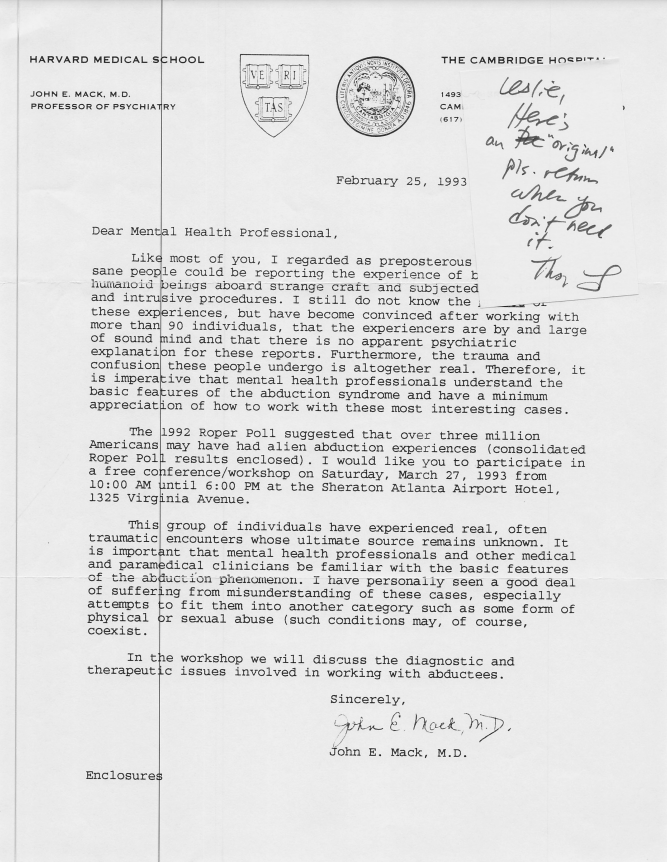
Figure B2
Mack’s explanation of the situation to psychiatric colleague
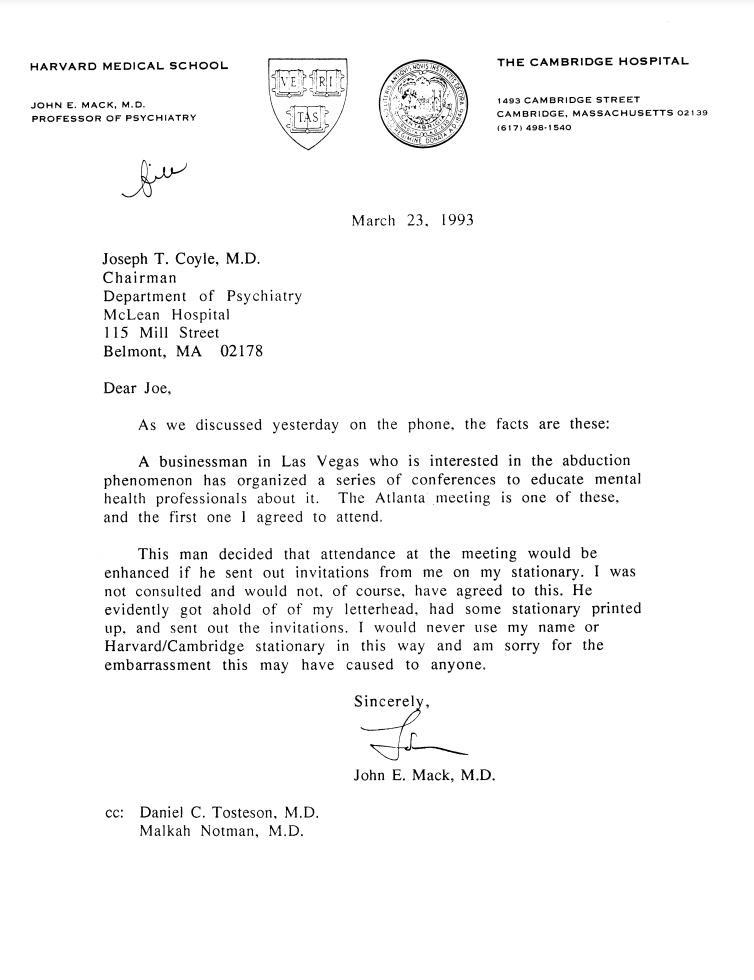
Figure B3
Bueche’s permission for me to quote our correspondence
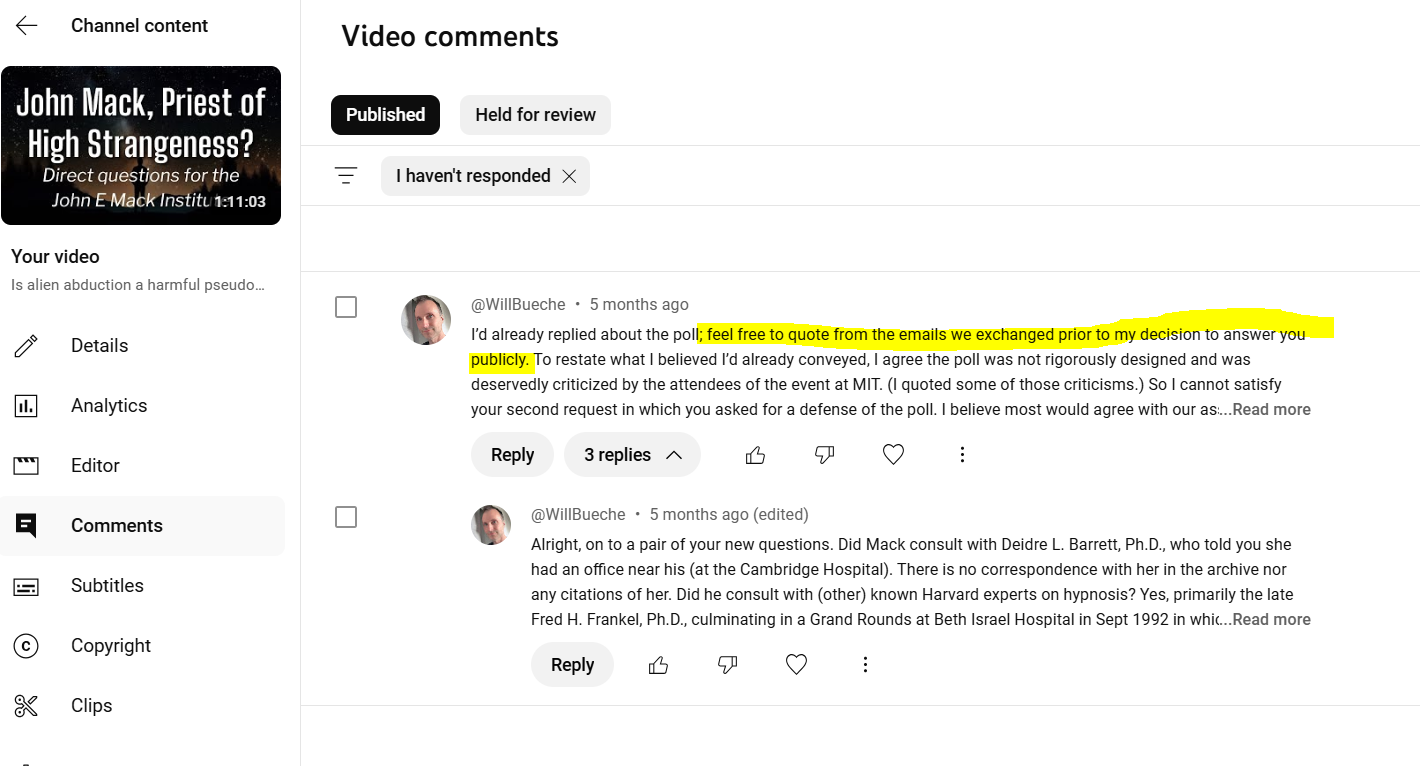
Appendix C
Readme from the ETolomy UAP analysis software
This appendix, along with Appendices G and H, are included in this document to demonstrate my multimodal and highly technical and quantitative inquiry in the ET/NHI/UFO/UAP studies, which are intended to build trust with you that I have considered many NHI/UAP testimonies.
ETolemy - A Demonstration of Geometry with the Pulsations of a UAP
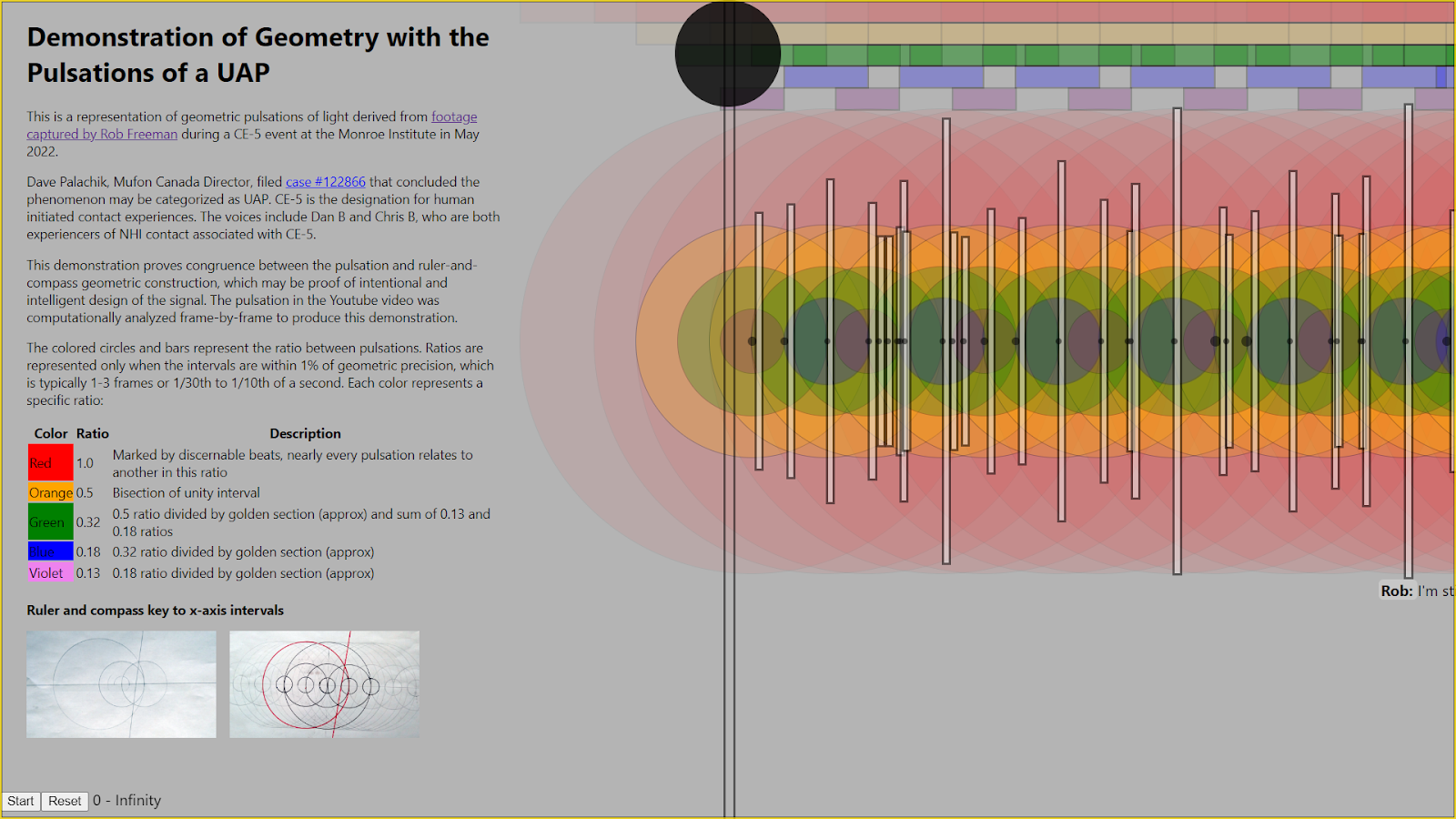
- Full demonstration of geometry in Monroe UAP: https://youtu.be/Z4SDEHk9T6Y
- Video walkthrough of this repo: https://youtu.be/memN6-zlDpc
- Video documentation of analysis technique: https://youtu.be/Mu4-SgFFYlQ
- Presentation of 7 UAP analyses: https://youtu.be/4n0RHaEz39g
This repository contains prototype code for geometry analysis and visualization software that is focused upon the analysis of UAP footage.
The footage was captured by Rob Freeman in May 2022 at the Monroe Institute as part of the first annual UAP Consciousness Conference, which involved CE-5 events with notable experiencers and researchers of the phenomenon.
The footage was analyzed by MUFON Canada director Dave Palachik that concludes the UAP is truly a UAP, not a satellite, space trash, and so on.
This software was designed to test the hypothesis that the UAP pulsation is a geometric signal that is discernible through simple ruler-and-compass geometric analysis.
Links
Original video by Rob Freeman: https://www.youtube.com/watch?v=alloPQFcoLw
Dave Palachik discussing MUFON Case #122866: https://www.youtube.com/watch?v=9BDwSa57EyM&t=175s
For a video demonstration, see: https://youtu.be/Z4SDEHk9T6Y
For more context on this analysis and ruler and compass geometry, please view the Universal Language video series: https://youtube.com/playlist?list=PLc1xaLwy4Qv5unOPOuEubZXDTqdjgwuut
Geometric Hypothesis Testing Method
Geometric analysis involves discernment of regular intervals and description of proportions. It involves simple techniques like bisection or division in ratios. The proportion of values is more important than the numeric values (associated with measurement units), therefore much of the work is simply scaling up or down various dimensions of meaning within the signal so that the eye and brain can recognize patterns.
Obvious pulsation pattern
The pulsation of the UAP over time is obviously regular. Initial analysis involved manual frame-by-frame annotation of brightness, which rendered a discernable pattern of intervals within approximate golden ratio and the whole number ratio 2:1. The manual analysis looked at only 1000 frames, which is about 30 seconds of video.
The publically available footage is around 6 minutes, with about 4.5 minutes of highly stable footage (requiring no stabilization correction at all). Therefore, in order to prove the hypothesis that it is a geometric communication, all frames must exhibit the geometric pattern.
Analysis strategy
The analysis strategy is relatively simple: get a value for the pulsation brightness for each frame. This was accomplished by cropping the original video, converting it to black and white, then applying a mask to various parts of the video such as the UAP, a torus around the UAP, and a star that moves across the frame.
The analysis was performed in Python and focused on two measures. First, it looked at the average brightness of the pixels within the masked area. Second, it looked at the distance from the lowest pixel brightness to the highest.
Pulse detection
Pulse detection was based on a combination of the brightness and valence measures, which was manually calibrated by checking againsts the original frames. This process described pulsations that were undetected in the manual analysis but fit within the geometric pattern.
Atmosphere and intensity
While the interval pattern is clearly discernible and precise, the intensity of the pulse is less clear due to atmospheric effects. Two stars move across the frame and were similarly analyzed to provide a measure of atmospheric variance, which was proportionally applied to the variation of the UAP pulsations.
Geometric congruence of pulsation of intensity
The intensity of the pulsations was visually observed to exhibit similar proportions as the interval pattern (2:1:0.78…). The proportion of the y- and x- axis of the visualization was established through manual calibration of a single coefficient that proportionally scaled the y-axis such that the average intensities aligned with the proportions of the interval patterns, which are described through its ruler-and-compass construction.
The ruler and compass method of construction involves:
- drawing unity circle
- bisection of unity circle
- golden section of unity circle radius
- reflection of golden section to generate interval pattern
Geometric key 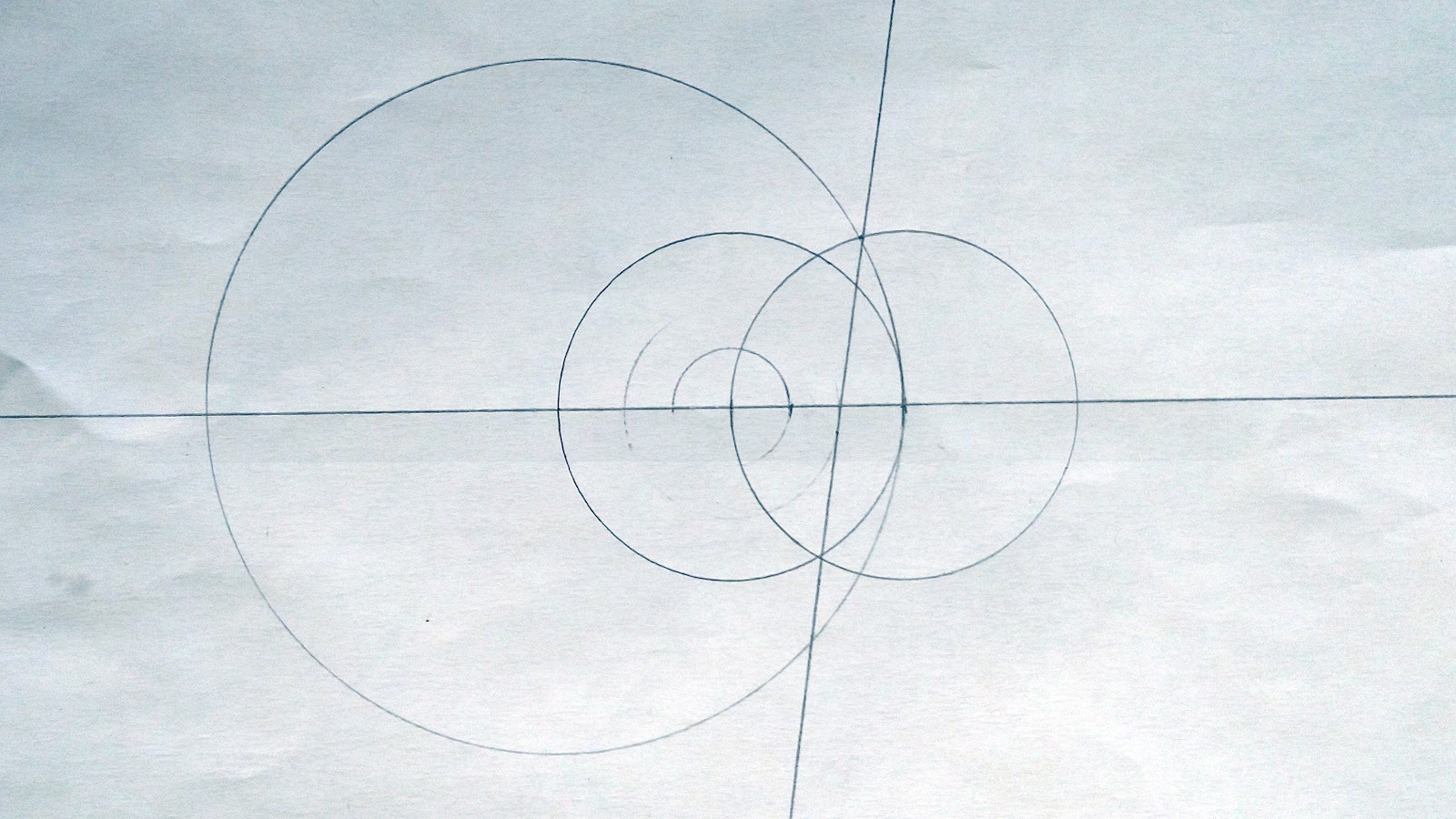
Geometric pattern 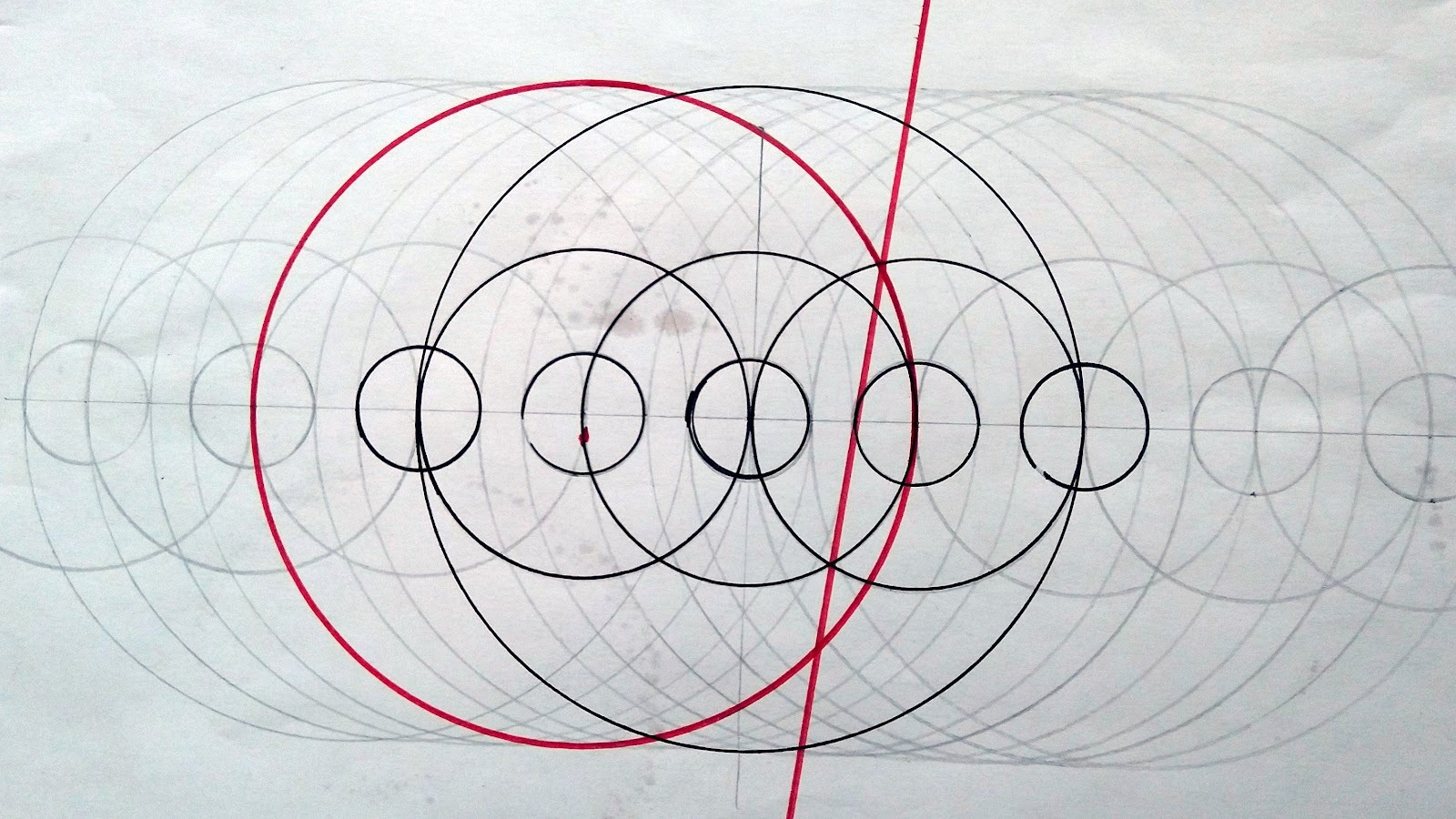
Geometric precision of intervals
The analysis describes the geometric precision of the intervals and signal. Each pulse was analyzed to provide data for peak frame number, intensity, and duration. The analysis tested for proportions between the pulsations that are derived from ruler-and-compass geometry (2, 1, 0.78, 0.32, 0.18).
Only those intervals within 1% of geometric precision were designated in the analysis, which is a precision of 1-2 frames. This is as precise as the frame-rate allowed.
Most pulsations exhibit 4 geometric ratios that are expressive of symmetry and golden ratio.
Visualization
The visualization graphs pulsations over time in a variety of modes, with a frame-by-frame animation of the UAP pulsation. The colored circles and bars represent interval proportions that have geometric precision of more than 1%.
Analysis Inspiration
The inspiration and capacity to perform this analysis is directly derived from dreams involving ET/NHI beings. Quite literally, in my dreams, an ET/NHI told me to learn ruler and compass geometry and then apply it to several sources of signal. It instructed me to document my dreams and hypotheses before analysis, which I did. I am currently exploring the implication of this anomalous dream activity.
Learn more about my story and geometric dreams in the video series The Universal Language: https://youtube.com/playlist?list=PLc1xaLwy4Qv5unOPOuEubZXDTqdjgwuut
If not ET/NHI, then what?
This analysis and visualization demonstrates the presence of geometric, which is quite literally characteristic of the signals some SETI/METI researchers suggest is indicatory of intelligence (golden ratio and various symmetries).
The UAP moved in ways that prove it is not conventional.
The UAP appeared in synchronicity with human intention and invitation.
If it is not ET/NHI, then it may be of human origin, which is equally as interesting, although perhaps stranger.
Analysis Steps
Written with Python3 and Jupyter Notebooks
- Generate images from videos (ffmpeg -i ../circle.mp4 “../circle/%0d.png”)
- Run through Jupyter Notebook Analysis
- Move data files into visualization (csvtojson 3-pulses.csv > pulses.json)
- Run visualization
See Tableau Public workbook for interactive data: https://public.tableau.com/views/ETolemy-MonroeUAPData/Sheet1 See this Tableau I used to print out the signal to analyze with ruler and compass: https://public.tableau.com/views/MUAP-correctedbystarswithvalenceanalysisverticalandhortizontalproportionat4tohalfmeasure/Dashboard1
Visualization Steps
Written with Nodejs and React
- npm i
- npm run start
- click start button in bottom left of web browser
UAP Cases and Definition of Analysis Technique
Video presentation of 7 cases using analysis technique: https://youtu.be/4n0RHaEz39g
Please see the README.md file in the /uap_cases directory for information regarding the cases and the definition of UAP analysis technique.
License
There is a non-trivial likelihood that the pulsation of light in this UAP footage is a documented, mathematical, and empathetic communication signal from an ET or non-human intelligence that responded to conscious invitation and intention.
After producing this analysis, I intuit that the signal is an invitation for peaceful and mutually respectful communication with the ET/NHI.
It appears to be asking for attention and energy, while giving back demonstration of:
- the physical technology required to produce the signal
- the psychical technology required to observe and respond to human emotion and intention
- geometry and mathematics essential to human cognition and scientific progress
If this is truly an ET/NHI signal, we could deduce that they are intelligent, intentional, respectful, peaceful, multidimensional, and patient.
If we, as a culture, work with this and similar signals, we may directly relate with the source of the signal. I am sharing my analysis and visualization files with the Creative Commons license because I want to live in a world where we relate to foreign cultures with respect and beauty.
This work is offered under the Creative Commons Attribution-NonCommercial-ShareAlike 4.0 International. Please see the LICENSE file for more information or visit: https://creativecommons.org/licenses/by-nc-sa/4.0/
This means you can use or adapt any part of the analysis or visualization software for non-commercial purposes, if you provide attribution, and if you distribute your contributions under the same license.
Please give credit to Rob Freeman for the original footage and Dave Palachik for the original analysis, both of which are publically available through Rob’s web presence.
The Paradoxical Compass: a novel UAP analysis technique
This directory contains analysis of UAP footage using the ETolemy technique. It contains data and files sufficient to reproduce, duplicate, or extend the specific analyses or the techique itself.
The repository include the first 100 frames of each video, but requires you to generate the frames from the each video.
Video documentation and walkthrough: https://youtu.be/Mu4-SgFFYlQ
Goals
The goals of the technique include:
- Graphing computationally derived measures in a scale appropriate for manual ruler-and-compass analysis (analysis csv)
- Production of graphics that demonstrate the computational and geometric analysis (countour image files and animation GIF)
Technical Steps
The technique is expressed through the following steps:
- Isolation of UAP in video editing software
- Generation of images from video frames
- Analysis of images
- Brightness, valence, max from PIL
- Contour detection, area, and xy from OpenCV
- Write CSV
- Generation of analyzed frames for animation
- Visualization of CSV data
Required familiarity with programming and Python
These notes assume that you have a basic familiarity with computer programming. If you do not, you can learn enough about programming to reproduce and work with these analysis in 4-8 hours. If you would like to learn, I recommend the following course of study:
- Python tutorial from w3 schools
- Jupyter Notebook tutorial focused on data frames
- PIL and OpenCV documentation
Development Environment
The technique was developed on Windows 10 using Visual Studio Code with Ubuntu WSL and other open source tools.
- GIMP for image creation (masks applied to videos to isolate UAPs)
- Open Shot for video editing
- ffmpeg to extract frames from video
- Jupyter Notebook classic for Python 3 programming
- PIL and OpenCV for image analysis
- Tableau Public for data visualization
- ImageMagick for GIF creation
- OBS Studio for video presentations
Isolate UAP in Video
The process of isolating the UAP within the video footage is a manual process. The entire process of analysis is very simple when it starts with a clear example of the UAP pulsation pattern.
The process requires personal discernment regarding which video to select. I prefer publically available and documented cases or those that have a CE-5 context. The ideal footage involves minimal shaking, keeps the UAP in frame, maintains a steady zoom, does not shift aperature, and keeps only the UAP in frame.
Once the footage is selected, the UAP needs to be isolate from the rest of the frame to perform analysis. The techique of applying a mask over the UAP may be applied to other parts of the frame to provide atmospheric measures, such the analysis performed on the bianary stars in the Monroe UAP footage.
You may use any process you like to isolate the UAP footage. I produce an image with a small transparent circle where the UAP will show and a background similar to the footage background. An example mask is “/video_example/cosmic mask.png”
I use Open Shot video editor to place the mask onto of the video. I ensure that transparent circle always encloses the UAP by shifting the x- and y- position of the mask. Then I export the video.
A sample Open Shot video project is included in /video_example.
Command Line Prompts
Frames
After installing ffmpeg, generate the frames from the videos in ../video by using this command:
ffmpeg -i ./justaplane.mp4 “./frames/%0d.png”
GIF animations
After installing ImageMagick, generate the GIF animation by navigating to the /frames/gif directory and run this command:
convert -delay 5 -loop 0 *.png all5.gif
Cases
These cases have publically available video, which are analyzed here under fair use. Only derivative media are presented here (analysis files).
Just a Plane - Sandy Springs, GA September 2022
Filmed by John Martin, associated with CE-5
- Video: https://youtu.be/aEQOtMxwcwE?t=99
- Data: https://public.tableau.com/views/JustaPlane-SandySpringsGASeptember2022/Dashboard1?:language=en-US&:display_count=n&:origin=viz_share_link
Navy Pyramid
Filmed by US Navy, video published by Jeremy Corbell
- Video: https://youtu.be/qQsmTKYpnoI
- Debunk: https://nypost.com/2021/04/21/ufo-expert-debunks-navy-footage-of-pyramid-shaped-objects/
- Data: https://public.tableau.com/views/NavyPyramidisaPlane/Dashboard1?:language=en-US&:display_count=n&:origin=viz_share_link
Orb Over Lake
Filmed by Reddit user Full_Intern_5507, alleged to be on-duty police footage
- Video and story: https://www.reddit.com/r/UFOs/comments/1147lxj/ufo_i_saw_while_on_patrol/
- Data: https://public.tableau.com/views/OrbOverLake/Dashboard1?:language=en-US&:display_count=n&:origin=viz_share_link
NARCAP TR 20
Filmed by commercial pilots, documented by NARCAP scientists
- Video: https://youtu.be/Gu0EemWzZpM
- Report: https://www.narcap.org/blog/narcaptr20
- Data: https://public.tableau.com/views/NARCAPTR20/Dashboard1?:language=en-US&:display_count=n&:origin=viz_share_link
Hello Beautiful - Sandy Springs, GA September 2022
Filmed by John Martin, associated with CE-5
- Video: https://youtu.be/XTwDYdApydc
- Data: https://public.tableau.com/views/HelloBeautiful-SandySpringsGASeptember2022/Dashboard1?:language=en-US&:display_count=n&:origin=viz_share_link
Cosmic Highway
Filmed by Jimmy Blanchette, associated with CE-5
- Video: https://www.youtube.com/watch?v=fWIO_nMQYIU
- Data: https://public.tableau.com/views/cosmichighway/Dashboard1?:language=en-US&:display_count=n&:origin=viz_share_link
Monroe Institute UAP
Filmed by Rob Freeman, associated with CE-5
- Video: https://www.youtube.com/watch?v=uByuadfNNGU
- Data: https://public.tableau.com/views/MUAP-correctedbystarswithvalenceanalysisverticalandhortizontalproportionat4tohalfmeasure/Dashboard1?:language=en-US&:display_count=n&:origin=viz_share_link
LICENSE
This README file defines the novel technique of UAP analysis and definitively offers this intellectual property with the Creative Commons liscence. While the code itself is simple and modeled directly on examples from documentation of the consistuent parts, the whole process is a novel technical invention.
The process involves a) computational analysis of UAP footage, b) production of geometrically demonstrative graphics such as the GIF animation or the charts proportioned to ruler-and-compass analysis, and c) the identification of ruler-and-compass geometric constructions.
Specific novel aspects of the technique include a) frame-by-frame analysis of UAPs into brightness, valence, and area measures, b) application of ruler-and-compass geometry using charts in proportion to drawing tools, and c) production of graphics that demonstrate geometric qualities.
I, Daniel Rekshan, believe this analysis technique to be a novel invention and, as such, my intellectual property. I claim most ownership of the specific technique of UAP analysis as possible so that I, here and now, publish as open-source and non-commercial in all jurisdictions possible.
This work is offered under the Creative Commons Attribution-NonCommercial-ShareAlike 4.0 International. Please see the LICENSE file for more information or visit: https://creativecommons.org/licenses/by-nc-sa/4.0/
This means you can use or adapt any part of the analysis or visualization software for non-commercial purposes, if you provide attribution, and if you distribute your contributions under the same license.
Appendix D
Correspondence regarding Monroe UAP as an identified geosynchronous satellite
From Rekshan to Earl on Jan 3rd, 2024
Dear Mr. Earl,
I am writing to ask for your opinion regarding the attribution of what appears to be a geosynchronous satellite as a UAP (unidentified aerial phenomenon, aka, UFO) by authoritative sources. I realize that you are a serious person with expertise in this field and could likely settle the question within minutes. This inquiry relates to my professional work and research as a PhD student. I found your work by way of your Master’s thesis that I discovered by searching for pulsation patterns of satellites to compare with my graph of the UAP pulsation. Your light curve of the Raguda 14 seems highly similar and your thesis indicates that you may be one of the most qualified people in the world to answer this question.
The UAP video was filmed on an expensive camera rig at the Monroe Institute by Rob Freeman and was certified by MUFON Canada as a UAP, see https://www.youtube.com/watch?v=9BDwSa57EyM for footage and analysis. I am a PhD student and dreamwork professional focused on ET/NHI contact (not as physical events but as a dream-like intuitions) and researched the UAP because one of my clients was present at the event and had a missing time episode associated with another flashing-type UAP.
I need an expert opinion because the sighting directly relates to my research and the UAP claims are put forward by authoritative voices in the field. The director of MUFON Canada cites an unnamed NASA employee’s consultation of an unnamed database as the reason why it is a UAP, along with the inability to find a satellite in public databases. The sighting was claimed by Chris Bledsoe to be a UAP to nearly a million people on a recent podcast. When I questioned him as to how he knows these things are UAPs, he responded that they were “using 2 artificial intelligence machines that tracks everything including space junk”. If it flashes like a satellite and flies like a satellite, is it reasonable to believe that it is a satellite even though no databases say so?
Here are the facts as I understand them:
- Filmed 5/31/2022 at 12:20am at the Monroe Institute in Virginia (footage), lasting around 45 minutes
- Classified by MUFON Canada to be UAP (PDF report)
- Located near NGC 6366 (astrometry results)
- Regular pulsation pattern, to my eyes, similar to geosynchronous satellites (light curve on Tableau, produced by open source python files)
- It is within 2 degrees of a band of geosynchronous satellites (see attached screenshot of in-the-sky and this Metabunk thread)
I have been in direct communication with all the UAP researchers who are putting forward the claims that this is a UAP, including the organizer of the event and Chris Bledsoe. Their claims are:
- It would be impossible for a satellite to be there because of its position is not associated with known satellites, therefore it is a UAP
- If it were space junk, it would only be visible for 20-25 minutes and not 40 minutes, therefore it is a UAP
- It is not space junk or a satellite because experts (unnamed) have checked it against their database, therefore it is a UAP
I would deeply appreciate it if you would offer your expert opinion on the following questions. I realize that your time is valuable and would not expect more than superficial opinions, although I would ask for your permission to share and publish your response in the context of my research and inquiries. I would be happy to have a conversation with you about the subject, address any questions, or discuss anything else you might need to offer your opinion. The specific questions are:
- May I have your permission to publicly cite your response as an expert opinion in my research?
- Are the UAP claims reasonable?
- Could an unlisted satellite possibly be in that location?
- Is it reasonable to expect a database or ML/AI system to conclusively say an object is or is not space junk?
Thank you again for your time and consideration.
Sincerely,
Daniel
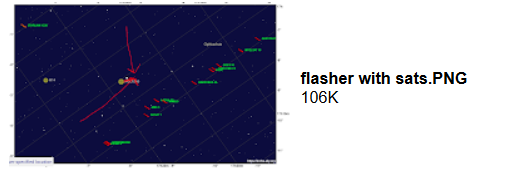
From Earl to Rekshan on January 6th, 2024
Good Evening, Mr. Rekshan,
Thank you very much for taking the time to ask me about this very intriguing observation. Based on my research, given the particulars about the observations, I can conclude that it is most likely a geosynchronous satellite, specifically the now dead Intelsat 29E payload.
I took the time to look through all of the data that you had provided. The only part that is not completely clear is the time of the observation. There was no time stamp on any of the videos, so simply saying “some time after midnight” is not a good time reference. However, I was able to arrive at a most likely identification based on the position of the satellite among the star field.
I was able to positively identify the star field in Mr. Freeman’s videos. The globular cluster NGC 6366 is indeed located just to the west of the object; however, it was not detected by Mr. Freeman’s equipment.
A few clarifications about the MUFON YouTube video, which leads directly into your questions:
- Mr. Freeman’s initial hypothesis was likely the correct one: it is most likely an inactive geosynchronous satellite given its apparent flashing behaviour and apparent motion among the stars;
- Mr. Palachik was completely incorrect when he asserted that from his location Mr. Freeman could not see geosynchronous satellites in his eastern sky at the time. Geosynchronous satellites can be seen in a band from east to west through the southern sky (from the Northern hemisphere). However, most cannot be seen with the naked eye because their orientations are not correct (more on that later). Mr. Palachik was also completely incorrect about not being able to see bright stars and planets in the eastern sky. Whatever his sources or hypotheses were, they are wrong. He had completely misled Mr. Freeman when he asserted what he did;
- Based on my analysis, the mystery object was spotted at an azimuth of approximately 150 degrees, which is not east, but actually south-southeast. Therefore, Mr. Freeman did see the object in the southern sky (somewhat);
- Mr. Palachik is not an astronomer, nor a space surveillance professional, and it shows. I do not know the overall caliber of astronomy expertise that MUFON Canada has;
- Mr. Palachik had asserted that the “intensity was never repeatable”. I do not know what his definition of “repeatable” is, but from what I saw, there was an apparent periodic behaviour of the flashes. This is the kind of behaviour that I see regularly from inactive geosynchronous satellites. My experience suggests to me that Mr. Palachik is incorrect about his assertion to Mr. Freeman;
- Mr. Palachik said that he “put a tracker on it” referring to the 41-minute video. I have no idea what this means or what this “tracker” actually does. He never revealed how it tracked. He only concluded that it moved. How, exactly did it move? He never referred to angles of motion. He never used planetarium software to find the exact star field and check if geosynchronous satellites can actually appear in that area of the sky from Mr. Freeman’s location at that specific time. Once again, that was misleading;
- Palachik had revealed that his “tracker” moved with the stars. A geosynchronous satellite will appear to move with respect to the stars because it will not appear move (very quickly anyway) with respect to the Earth. Mr. Palachik should have not used the stars as a reference but the Earth itself. If he had done that, he would have discovered that the object moved much like a geosynchronous satellite;
- Mr. Palachik then remarked that the object “faded slowly away” and then claimed that that was because of the object “losing energy” or “going further away”. Neither are true in the case of a spinning geosynchronous satellite. As the Earth turns, the satellite will change its orientation with respect to the Sun. Any advantageous orientation will slowly change until the angle is no longer the right one to show flashing sunlight reflections. The result is a slow dimming until the satellite is no longer visible. It is likely that exactly 24 hours later, the object would re-appear and flash again, with a slightly lower or higher period, if it is indeed a geosynchronous satellite;
- Mr. Palachik repeated his incorrect assertion that geosynchronous satellites cannot be seen in the eastern or western skies from the Northern hemisphere. I have seen geosynchronous satellites from the eastern horizon to the western horizon. I can safely conclude that he is incorrect;
- Mr. Palachik then asserts that geostationary satellites do not move. Well, they do move; however, they move such that they orbit the Earth at the same time the Earth takes to rotate. From our location on the Earth, the geosynchronous satellites will not be seen to move with the stars and will appear to be stationary, unlike the stars. This is why we can point out satellite dishes once and not have to move them to track the satellites. The Earth basically tracks them for us as it rotates;
- Mr. Palachik asserts to Mr. Freeman that you can only see a flashing satellite for 15 minutes or less. I would like to see his research for this conclusion because I have seen satellites flashing for much longer than that. Mr. Freeman’s observations are typical for an inactive geosynchronous satellite exhibiting bright sunlight reflections. Mr. Palachik’s assertions are once again incorrect;
- Mr. Palachik’s “checking with NASA” led to his conclusion that no geosynchronous debris is stationary. That is correct, but he does not elaborate on what “stationary” means. A geosynchronous satellite can appear stationary with respect to the stars for a few minutes before its own motion with respect to the Earth is noticed. Mr. Palachik’s assertions seem very uneducated in this respect;
- Mr. Palachik asserts “There is nothing moving under 10,000 miles per hour in our space.” Geosynchronous satellites orbit with a speed of approximately 6,865 miles per hour, so he is definitely incorrect about that. He also doesn’t elaborate on what “motion” means; motion with respect to what reference?;
- Mr. Palachik concludes that the object cannot be man-made. I beg to differ. In fact, I have two images that I have attached that can show that he is likely incorrect in that assertion.
One of the attached images shows a screen capture of Mr. Freeman’s mystery object. The other image shows the same star field shown by a planetarium software with geosynchronous satellites overlaid at a time of 00:39 EDT May 31, 2022 from the Monroe Institute’s location in Virginia, USA. I have added green circles showing the location of the object in Mr. Freeman’s image and the predicted location of Intelsat 29E in the other planetarium screen capture. I can conclude that the Freeman object and the predicted satellite are at the nearly same position with respect to the star field. This is what Mr. Palachik should have done before talking with Mr. Freeman.
Based on what I analyzed so far, I can definitely say that the object that Mr. Freeman saw was most likely a geosynchronous satellite; possibly the inactive Intelsat 29E. I could know more if the observation time was known with more certainty.
Intelsat 29E is no longer active. It went dead on April 22, 2019; nearly three years before Mr. Freeman’s observations. The satellite’s orbit plane is now nearly 3 degrees off a typical active geostationary satellite orbit plane. This is expected for an inactive geosynchronous satellite.
In response to your questions:
- You do have my permission to use this correspondence in your research. I would ask that you cite me if you do quote anything I have written here.
- The UAP claims are not reasonable, in my opinion, based on my analysis and my experience in space surveillance for over 25 years.
- It is always possible that an unlisted satellite was in the vicinity. However, based on my own experience, this is unlikely. A better idea of the observation time would make my conclusions more definitive.
- The answer to this question would depend on how thorough the database or the ML/AI system was that performed the analysis. In any analysis, several databases and systems should be used to perform double and triple checks of the conclusions; something that MUFON Canada apparently did not do. I would not mind if someone else double checked my conclusions, nor would I assert right out of the gate that Mr. Freeman’s initial hypothesis was incorrect.
I can provide you with further analyses, including a second predicted location of the inactive Intelsat 29E payload that would likely once again fit with Mr. Freeman’s observations at another time. Comparing the two locations at a change in time and comparing how far the object appeared to move with respect to the stars in that time would serve to further confirm that the object was indeed a geosynchronous satellite.
Thank you once again for contacting me. Please feel free to contact me again should you require any further information.
Dr. Michael A. Earl
Assistant Professor
Royal Military College of Canada
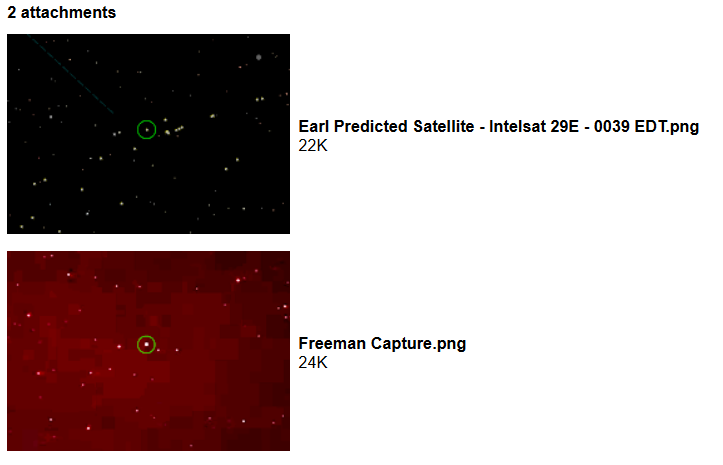
Between Rekshan and Esbjörn-Hargens on January 9th, 2024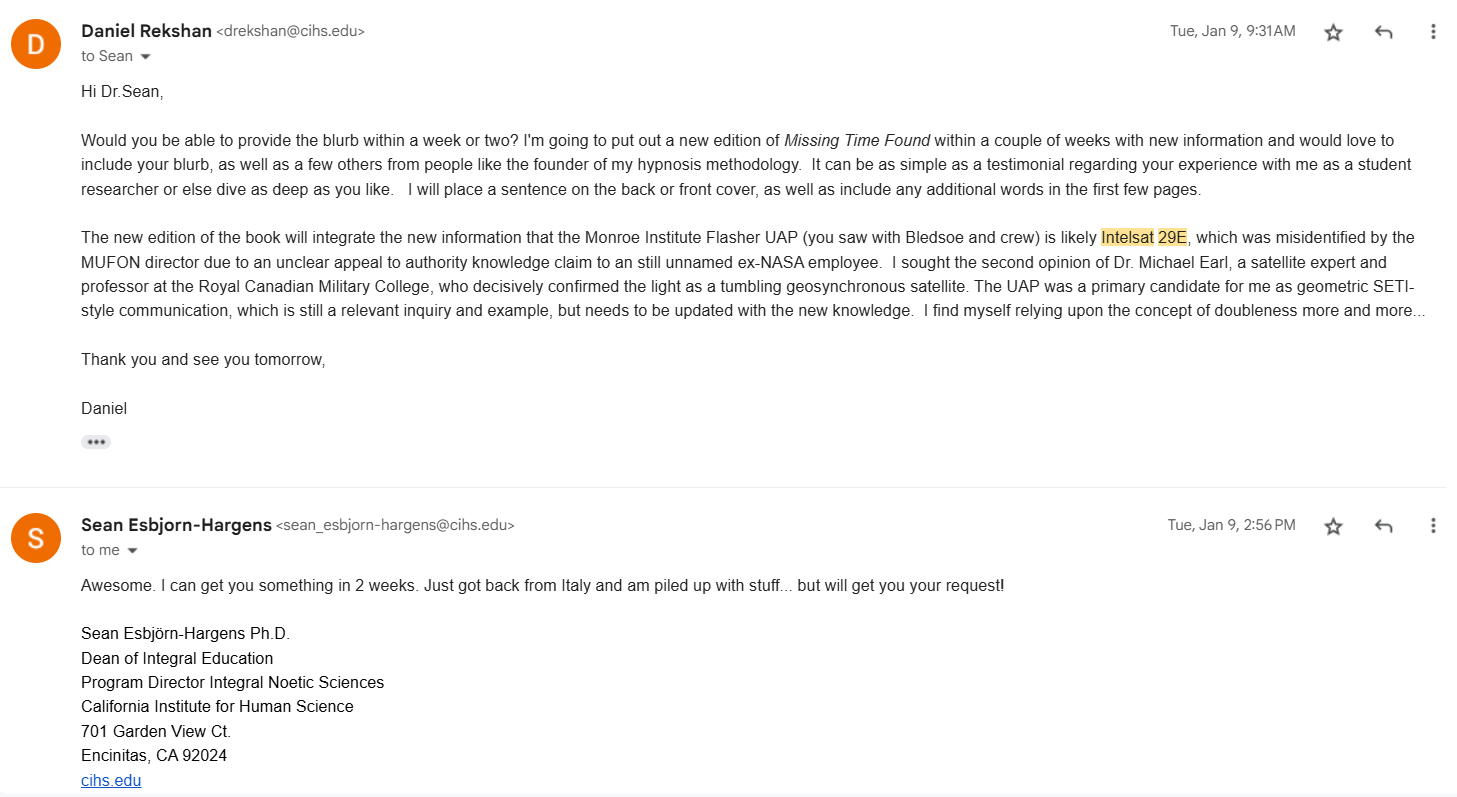
Process paper by Rekshan for Phenomenology of UAP class
Chris Bledsoe’s UFO of God (2022) has presented many lingering questions in my life regarding CE-5, truth, and evidence. I will briefly describe my inquiry, then will seek to relate it to the multiple levels of truth and evidence presented by Sokolowski (1999). My questions resonate with Bullard’s notion that “something yet remains”, as I have personally been affected by exploring the balance of truth and fiction in the last UAP sighting of the UFO of God, therefore I testify to the reality of the phenomenon even though I will present contrary evidence to Bledsoe.
I became aware of Bledsoe’s case when my first missing time client, Dan Berg, was invited to the UAP Consciousness Connection event because he was also an experiencer of orb-related missing time, who has given me permission to name him in my writing on this subject. Berg was the skeptic at the end of the book who apologized to Bledsoe. After he came back, I became aware that there was footage of a stationary blinking light filmed in association with their CE-5 and electronic anomalies, which was later categorized as UAP by the director of MUFON Canada upon the authority of an unnamed NASA employee. The UAP matched the characteristics of one filmed during Berg’s missing time event in the Atacama Desert. The claim involved an anomalous light and the expert classification of that as evidence for beings imagined as aliens in spacecraft by some, as angels by others, but did not involve truth of disclosure.
I looked into the Monroe UAP as a potential candidate for geometric NHI communication in line with the SETI expectation that mathematics is a universal language (Lemarchand and Lomberg, 2011). I thought that if I could discern geometry within the pulsation pattern, then it would demonstrate intentional intelligence. I eventually found a geometric pattern, which is quite remarkable and connected to a series of body marks, crop circles, and other anomalous geometries I have observed. However, its geometry allowed me to discover a precedent in the light patterns of the Raduga geosynchronous satellite (Earl, 2017), which is a synchronicity itself because Raguda is the name of a dream researcher who writes about ET contact in lucid dreams and OBEs and has deeply impacted my approach. I confirmed the conclusion that Monroe UAP was a geosynchronous satellite with Dr. Michael Earl, a professor and expert on tumbling geosynchronous satellites. He identified it as Intelsat 29E, which was not in some databases because it sprung a fuel leak and drifted into that place (Earl, 2024).
While I can not doubt the reality of missing time events, light orb UAPs, and other CE-5 related phenomenon, I must also observe a strong lack of discernment by those surrounding Bledsoe. I have gone through every photograph and video on Bledsoe’s instagram, analyzed their pulsation patterns in the same way as the Monroe UAP, and often find clear precedents in known aircraft. Many of the angelic, ET, or UAP events reported by Bledsoe and those surrounding him are demonstrably known aircraft. However, there are some videos that are inexplicable that also feel like orbs or NHI to me. I personally know that the NHIs use complex patterns of synchronicity and omen to coordinate misapprehension of events.
Bledsoe has reported that the orbs can mimic aircraft, which presents an interesting conundrum. In phenomenological terms, one would have to evidence the truth of the claim that orbs can mimic aircraft, which most people would assume to be magical thinking. The phenomenon reveals itself through remaining vague and indeterminate, yet also clearly disclosed in some way. While effectively “debunking” the Monroe UAP sighting, the NHIs played tricks on me in my dreams and through incredible synchronicities. I do not doubt their reality even though I doubt the experiencers’ discernment of the phenomenon, including myself.
It seems that this CE-5 event has a phenomenological structure that involves anomalies or vague manifestations that require propositional claims to resolve. The process necessarily involves intersubjectivity and consultation with experts because it involves discernment of vague phenomena. An experiencer has an expectation of contact, encounters an anomaly that may be termed a UAP, then there is a process of confirming there is no other explanations, and finally the experiencer may affirm the contents of their inner-world as psi-events with ET/NHIs according to their expectation. Therefore, the UAP is known through the truth of correctness (Sokolowski, 1999), which deals with propositional statements and can be proven or disproven. However, in my experience and other’s testimony, sometimes there are undeniable light orb manifestations that correlate with direct telepathy with NHI entities. Therefore, this type of encounter involves direct experience of the truth of disclosure, which involves states of affairs.
I know from the truth of disclosure of direct experience that NHIs may manipulate perceptions and intersubjective engagements to influence the truth of correctness. In other words, they are real yet play tricks on us. Ultimately, I agree that the Monroe UAP was a manifestation of NHI, but through synchronicity instead of as light orbs. I appreciate the phenomenological method because it is giving me language to positively speak about the reality of the CE-5 encounter recorded at the end of UFO of God and the phenomenological attitude may give me capacity to observe their movements during CE-5 events.
Comments by Phenomenology of UAP instructor on June 11, 2024
Very interesting points!
Appendix E
Correspondence with Esbjörn-Hargens regarding ethics and The Experiener Group
Subject: email from jay
From Esbjörn-Hargens to Rekshan on April 5th at 5:16am
Hey Daniel - I just got a disturbing email from Jay King who runs the Experiencer Group. He is really upset with you - what happened?
From Rekshan to Esbjörn-Hargens on April 5th at 8:00am
Hi Sean,
It’s regarding the presentation of my recent abduction research, which I knew would be triggering but approached like all my other inquiries. I made video presentations that document my thoughts and references at the time of recording, about 1-2 a week on YouTube. They recently documented my inquiry into the 1992 Unusual Personal Experiences booklet as a harmful pseudoscience. On April 1, I published a satire of the UFO Abduction Syndrome called Alien Abduction Believer Syndrome, which was the final form of my “1990s abduction research as a harmful pseudoscience” literature review. Apparently, some of his group members complained to him about me and he kicked me out of The Experiencer Group. He emailed me very briefly to kick me out of his group and claimed I lacked “compassion and tact” , which I took offense at because no one actually talked to me and I have taken care to engage his community with civil dialog to gather feedback about how to tactfully present my arguments. I responded to him with a lengthy email and questions, which I will forward to you.
This is a triggering topic to most people, if I am out of line in any way, please let me know and I will seek to understand the harm I cause and make amends. However, I have conducted a literature review that I am proud of and believe my actions are in line with the ethical guidelines of dreamwork and our school. It seems to me that Jay and the members of his community who have complained about me have not been direct with me and have gone behind my back to enact cliquey drama because I am pointing to challenging literature for abduction/disclosure narratives. In contrast, I have 10 emails and about 3 hours of video call with his community manager regarding my inquiry.
Is there a specific complaint against my academic work or violation of our CIHS ethic code? I would take such complaints very seriously and would do anything to remedy that situation. However, since Jay and members choose to gossip behind my back and not engage with my literary arguments, I will assume there is a trigger because of the triggering nature of abduction research in general and not a specific complaint about my academic behavior.
My strategy in general was to produce the Alien Abduction Believer Syndrome satire, then send my research proposal to Bigelow. The document was necessary for the proposal to demonstrate the need for research to Bigelow, which is why I satirized his 1992 document. My engagement strategy is to produce documentation of critical literature review or research and then bring conversation back to the literature or arguments. I observe that people will either encounter my argument, feel challenged by it, then either seek to integrate what I’m saying or else respond from a place of deep trigger. In general, I observe a positive response to the inquiry among my clients and people in general, but a negative response from those deeply identified with abductee identities or attached to the Mack/Blumenthal and Hopkins/Kean lineage of storytellers.
I’m not sure how to resolve this. I understand that you are connected to him in some way and would be grateful for your advice. I would be happy to go on a call with him to hear his complaints and arguments, to apologize for lack of tact or any offense I have called. However, I will not tolerate being ostracized behind my back by people who do not have the courtesy to speak to me directly. He and his community members have had many opportunities to speak to me directly (you can literally just book time with me on my website) and they haven’t, rather they have all tattled about me behind my back.
How would you advise proceeding?
Thank you,
Daniel
From Esbjörn-Hargens to Rekshan on April 5th at 8:06am (in response to my emails and forwarded correspondence with Jay)
Thanks for your email and context. This is very helpful. I’ve also emailed Jay for more details. Let me sort though all this and watch your video and get back to you in the coming days.
For now can you say a little more about how you are using the notion of satire - e.g., is your video to be seen as satirical? And if so in what sense. This will just help me under stand the dynamics at play.
From Rekshan to Esbjörn-Hargens on April 5th on 8:54am
Perhaps the more appropriate term is “parody” because I directly imitated the UFO Abduction Syndrome report within Unusual Personal Experiences. I went paragraph by paragraph to establish literary connection in the tone and content of the piece. It is intended to be satire in that I do not necessarily believe the argument put forward, but that I believe the argument must be considered to move forward with abduction research. The framing as a public service announcement parodies the Unusual Personal Experiences booklet. It is intended to demonstrate the absurdity of non-clinicians forming a clinical syndrome regarding abduction.
Basically, it is a statement that if the viewer is concerned about the definition of Alien Abduction Believer Syndrome, then the viewer should be concerned about the effect of the 1992 Unusual Personal Experiences booklet.
The other motivation for contextualizing the argument within a satire is that I think that McNally/Clancy’s observations are actually relevant and better science than Mack’s on abduction. They basically say that most abductees are schizotypal and that adoption of alien abduction false narratives cause PTSD. There’s not enough science to justify those claims, but it’s much better science than Mack or Hopkins. I wanted to bring in their argument as devil’s advocate, but felt a need to distance myself from it by framing it as a satire on the UFO Abduction Syndrome.
Subject: let me ask real quick
From Esbjörn-Hargens to Rekshan on April 5th at 8:22am
Here is my position on abduction:
There are real physical and subtle ET abductions. Likely not as many physical abductions as experiencers tend to indicate. Many abduction events are likely happening in the subtle realm but are real nonetheless (i.e., the imaginal is ontologically real). There is a lot more “ET” contact that occurs during dreams than many realize. As a result the line between dreams, OBEs, contact, abductions is blurry and hard to draw with many reports likely being presented as one of these when in fact they are one of the others. Some subtle abductions can end up leaving physical marks which then are viewed as evidence that the whole event was physical. So the line between physical and subtle is also blurry at times. The fact that we live in a modern culture that only believes in physical realities - the abduction events have in some ways internalized a physicalist narrative around their events that might not always be justified. It will take time to unravel the complex cultural and imaginal and experiencer dynamics at play in all of this.
In brief how would you state your position - where do you resonate and disagree with this. I’m not assuming you share my views at all. And I don’t need or want you to. I’m only asking so that I can better understand your position as I sort through the emails and video - using my position as a way of helping me clarify what your position is.
Warmly, Sean
From Rekshan to Esbjörn-Hargens on April 5th, 2024 at 1:39pm
Hi Sean,
My response has two levels, in general about the phenomenon and in particular about abduction research literature:
- In general, yes I agree that it is mostly a dream/subtle phenomenon. Maybe there are some physical events that are described by skeptics as “kidnap by space aliens” (I’ve not yet seen a compelling case or evidence, but I have seen collections of testimony that purport to be evidence), but it seems most of the physical evidence may be explained through other means that do not necessitate physical alien bodies in nuts and bolts craft.
- In particular, I say that we may address existing literature about abduction in terms of literature review and critique. My arguments focus on the 1992 definition of the UFO Abduction Syndrome in Unusual Personal Experiences and all derivative research. I argue that it is harmful pseudoscience that misappropriated natural and empowering dream phenomena into a disempowering victim identity that may lead to harm through PTSD. Further, I argue that the epistemological fallacies may be active today just as the myth of repressed memory is still active and growing
I’ll provide as brief a statement as I can and would be happy to jump on a call to address any specific questions you have. While I hold my own personal opinions on the topic, I will likely hold the position defined in Alien Abduction Believer Syndrome for the purpose of dialectical inquiry.
-Daniel
General response
In general, there seems to be a real encounter phenomenon that is mostly subtle, but with physical effects like body marks, apports, or other trace evidence. In this view, the term “abduction” is a harmless stand-in for “encounter”. In this view, we may understand that regression hypnosis helps people “remember” their experiences, with the term “remember” standing-in for a complex system of intuition. I believe this view is best represented by the Quantum Healing traditions, like in Cannon’s book Custodians. In this way, I believe that most abduction testimonies use the language of “abduction”, “alien”, and “regression/hypnosis” as religious/spiritual community jargon that stands in for complex religious/spiritual beliefs regarding the encounter. I have personally worked with people who present medical evidence for hybridization narratives and I do not deny a physical component. However, I have not seen literature, evidence, or personal experience that indicates that physical alien abduction occurs as imagined by the early 1990s researchers who defined the field. I have spoken with perhaps hundreds of body mark experiencers, as well as the only doctor I know who is doing alien implant surgeries, and I have not encountered a single case that would indicate the physical abduction hypothesis is more physical than poltergeists or angel visitations. Rather, they seem mediated or co-created in the same way as dreams or dream omens.
I observe that most abduction narratives and identities involve dream or dreamlike encounters, not physical or historic events, that must be interpreted like angel/fae testimony. I say that anyone working with abduction tales may be consciously or unconsciously a dreamworker and therefore may be subject to ethical/epistemological guidelines of dreamwork. I say that any interaction with an interlocutor such as therapist, support group leader, reporter, etc., may consolidate an abductee identity (they used to call it hypnotic false memory) and therefore is akin to something like a religious conversion event. If the interaction is not held well, e.g. defined analogous to a religious sacrament, then it runs the risk of coercively consolidating a disempowering, therefore harmful, identity. I argue that if the physical abduction narrative/identity is put forward outside of an explicitly defined spiritual/religious context, such as to promote an agenda of political activism based upon those worldviews, then its application must be interpreted within the context of published scientific research on the topic, namely the thread of research about hypnotic false memory and PTSD-associated with abduction narratives.
Particular response from literature perspectives
In particular, my position addresses specific research published on abduction (not the phenomenon in general). I look to the 1992 Unusual Personal Experiences booklet as a definitive document of the UFO Abduction Syndrome, which defines abduction as physical, invasive, and disempowering. I argue that the UFO Abduction Syndrome may be harmful pseudoscience that needs to be considered outside of the context of abduction in general. For example, I don’t care if Jay and his friends believe they were physically abducted by aliens and they use the terms in spiritual/religious senses. Rather, I care that Bigelow, Mack, and Carpenter aggressively propagated the UFO Abduction Syndrome definition to 100k mental health professionals and used the document to establish abduction research relevant to clinical practice and national issues. I argue that the 1992 booklet appropriated natural, albeit strange, dream phenomenon as alien abduction. I argue that the appropriation is harmful pseudoscience because it a) appears to be unconscious dream interpretation and b) locks in the abductee identity, which McNally/Clancy demonstrated to cause PTSD akin to genuine trauma. Further, I argue that the pseudoscientific definition of the UFO Abduction Syndrome is characterized by fantastic sexual trauma narratives, which are not as prevalent outside of Mack, Hopkins, and Jacobs. Therefore, I say that perpetuating false belief in the UFO Abduction Syndrome, when considered in the context of McNally/Clancy’s research, may be a form of sexual assault via the coersive propagation of the abduction belief system (as modeled by Lynne and Kirsch in 1996).
The reason why I am following this path is that I believe the confusion regarding physicality and dream is causing harm to our culture and will obscure my research in dreams unless directly addressed. It appears to me that there was a coordinated and funded PR campaign to establish the physical alien abduction hypothesis using misappropriated prevalence rates of dreams and other psi-phenomenon. When I look at the growing prevalence rates of belief in the myth of repressed memory (around 60% of people and growing among clinicians), I realized that the direct engagement of the mental health community in the early 1990s may be a direct cause of confusions regarding abduction and dreams that are still relevant today. There was good dream research back in the 1980s that would have identified the connection, except that Mack claimed to be an expert on nightmares when he was actually just an expert on psychoanalysis, so the 1990s abduction cohort and its derivatives still believe these events can not be explained by dreams and therefore are physical events.
A note on my transforming understanding
I really did not expect my research with you at CIHS to lead me to these conclusions, rather I expected it to reveal the physical reality of ET/NHI encounters behind many of the dream encounters I focus on. I would love to have my view changed, but need to do so in a way that is coherent with both skeptical and credulous research streams. The whole inquiry is rather triggering to me because I’ve discovered that a) I didn’t need to be afraid of alien abduction as a kid and b) I was afraid of alien abduction as a kid because most of the UFO Abduction Syndrome authors made (arguably) a mockery of real dream encounters for their personal benefit or biases (see Rainey’s Priests of High Strangeness article).
Since realizing these things, I have been contemplating how to move forward in nonharmful ways. The most conservative hypothesis suggests that alien abduction is literally just a dream, that there is no physical evidence for abduction, and that the major researchers of the UFO Abduction Syndrome have compromised their research ethics and integrity. Further, the literature suggests that abduction narratives, when involving trauma and are adopted as an identity, are as impactful as genuine trauma. I was tempted to not document this inquiry because of its triggering nature, but I believe that the argument that the UFO Abduction Syndrome is a harmful pseudoscience is weighty enough that I should offer documentation of my findings, which I have done through publishing several articles with reference lists on my blog supported by video presentations. Ultimately, it seems immensely important to communicate that abduction in general is not particularly disempowering or victimizing.
I have had two clients I keep thinking about. Both were women afraid of hybridization abduction who reported issues conceiving, one had tried for more than a decade and had many miscarriages assumed to be abduction events. We worked with their fears like nightmares. One woman has had no recurrence of abduction dreams and has a healthy baby. The other and her entire family thanked me for helping her release her recurrent fears and attributed our dreamwork as the cause for her successful pregnancy. Her baby is almost a year old. It seems that belief in the disempowering abduction narrative actually does have real world impacts and I wonder what would happen if society recognized that most abduction reports are derived from subtle experiences like dreams, which in themselves are empowering because they are co-creative.
The complexity of the issue is one of the reasons why I have produced the Alien Abduction Believer Syndrome satire and am targeting Bigelow in that research. If the lineage holders of the 1990s abduction research (Bigelow, Mack/Blumenthal, Hopkins/Kean, Jacbos, etc) acknowledged the co-creative dreamlike aspects of abduction, I believe our culture in general would be liberated from the disempowerment and victimization of the UFO Abduction Syndrome narratives.
Appendix F
Sketch of false memory ethical calculus
This excerpt from my essay UAP Crash Narratives as Iteration of 1990s Alien Abduction Research Conspiracy the question, “What is the legacy of the UFO Abduction Syndrome defined in 1992 with extraordinary research funding from a conspiracy between Robert Bigelow, Hans-Adam II, Prince of Liechtenstein, and three best-selling abduction authors?” This excerpt provides an example of an potential ethical calculus that may weight the risks of harmful false memories associated with the UFO Abduction Syndrome
UFO Abduction Syndrome Legacy Calculations
Unusual Personal Experiences calculated the impact of the UFO Abduction Syndrome by defining rates of occurrence within populations. They concluded that 2% of the sample experienced the syndrome and extrapolated that 3.7 million Americans may be abductees, therefore justifying their extraordinary actions to mail the booklet to 100k mental health professionals, organize lectures and conferences, and coordinate further research to support the researchers’ appearances on national television through the 1990s. It must be noted that the Bigelow repeated Unusual Personal Experiences in 1998 with an explicit question about alien abduction and received only three reports out of 2,009 responses (0.15% of the sample).
There are several prevalence rates that may be relevant to the calculation. Bullard (1987) observed that only several hundred abduction reports were known at the time of his study. A word search of UPDB.app (2024), a database compiled from archives of many UFO reporting centers from as early mid-20th century, reveals that the annual rate of reports containing the word “abduction” is less than 200, with a total number 3,916 of 336,665 (around 1%). The lifetime prevalence rate of schizotypy appears to be 4% (Rosell et al., 2014), which Clancy (2005) associated with abductees. Around 2-4% of people are classified as fantasy-prone (Merckelbach et al., 2022), which is a personality characteristic associated with belief in alien abduction narratives and is a component of schizotypy. A 2012 survey of 1,000 British people found that around 8% of them reported at least one out of body experience (Pechey and Halligan, 2012). In a study of 1,666 dreams, Faith and Krippner (2001) classified around 8% as exotic, with 1.4% containing out-of-body elements and 1.1% containing visitation dreams, like alien abduction. In general, people seem to remember 3-4 dreams a week, but have many dreams throughout the night. A survey of typical dream themes agrees with the Unusual Events Survey revealing that around 6.5% of people have dreamed of an alien and 4.5% dreamed of a UFO at least once in their life (Schredl et al., 2004).
Therapists see between 15-30 or so clients in a full caseload, which we may estimate at 20 clients per therapist. If all the 100k professionals read and believed the document, then 2 million people in therapy may have received the suggestion that their natural dreams and NHI encounters were unnatural and traumatic. If only 2% of therapists believed the report, which is the lower estimate of fantasy-proneness, then 40k clients received the suggestion. If only 2% of those clients believed their suggestion, then 800 may have been directly impacted by the suggestion of UFO Abduction Syndrome.
It appears that people naturally have out of body experiences and visitation dreams. I argued alien abduction involve co-creation of the lived experience such that the screen-memory of the encounter is generated in part from the personal imagination. The legacy may be calculated by estimating the number of NHI visitation dreams that may contain elements from media informed by the UFO Abduction Syndrome. I argue that the alien abduction narrative saturated the population of the USA by 1997 as demonstrated by the box office success of the movie Men in Black (Willis, 1997). The population of the USA in 1997 was 270 million. Multiplied by 2% (either for abduction or fantasy-proneness rates) yields 5.4 million people who may have been impacted by the UFO Abduction Syndrome. On average people remember 3 dreams a week, yielding 156 recalled dreams per year. Assuming that 1% of them involved an entity visitation and 63% of those had a telepathic quality, then it may be estimated that 5.3 million encounters in 1997 in the USA were impacted by the UFO Abduction Syndrome. If the purpose of NHI visitation is to inspire technical, philosophic, or scientific creativity, then actions of the abduction study cohort may have obscured 5.3 million innovations likely regarding the topics of environmental responsibility, free energy, and the power of consciousness.
There were 22.2 million children aged 6-11 like me in 1992 (Childstats.gov, 2024). Multiplied by the 2% rate of either fantasy-proneness or alien abduction yields 444k children that were likely impacted by the UFO Abduction Syndrome. If only 1% of these children experienced NHI visitation (based on the rate of visitation dreams), then we may estimate that 4,440 interactions between human children and NHIs were directly influenced by the abduction study cohort. Given that it has taken me two decades and the continual assistance of dream NHIs to trace this story, I wonder what would have been possible if the researchers informed us of the positive and empowering aspects of NHI encounters through dreams and OBEs, rather than solely the negative and disempowering aspects of alien abduction?
Another method to estimate the legacy of the UFO Abduction Syndrome is to count Amazon.com book reviews of the major researcher’s books (Hopkins, Jacobs, and Mack). At the time of writing, their books have received 3,058 reviews on Amazon. For context, Pasulka’s American Cosmic published in 2019 received 1,164 reviews. All publishers of the abduction researchers described them as best-selling, while Pasulka’s publisher did not. Therefore, we may assume the historic reach of the researchers is much greater than implied by current reviews. Estimates for purchase to review ratios are varied, from 1 in 10 to 1 in 200 or more. Assuming 1 in 20 left a review, this represents 61k people. The US GAO (2022) estimated that there were 1.2 million behavior health professionals in the US, which gives us the rate of 0.3% of the population. Therefore, we may estimate that 183 behavioral health professionals have read one of the major researchers’ books since Amazon implemented its review system in 2004, which in turn may have directly impacted their caseloads of 3.6k clients. Multiplying by the abduction/fantasy-proneness rate of 2% yields 73 individuals who may have had a traumatizing abduction instead of a more natural NHI visitation event. While this number may seem trivial, it must be noted that Bigelow and the Prince are only two individuals motivated by their UAP, not apparently abduction, experiences. How might they have impacted the world if their childhood UAP narratives involved traumatizing fear instead of inspiring mystery?
The entire scope of their impact may be estimated using the 2% abduction or fantasy-proneness rate, multiplied by the ratio of remembered to unremembered dreams (10%), and multiplied by the 1% rate of exotic visitation dreams and further multiplied by the 63% hit rate of telepathic dream experiments. The population of the US around 1992 was around 257 million. 5.14 million people may be abductees or fantasy-prone. Each person may have recalled 150 dreams per year, with an estimate of about 1.5 recalled exotic visitation dreams. Unusual Personal Experiences was published in 1992, while Loftus’s Myth of Repressed Memory was published in 1994, the argument of which was applied to alien abduction by Lynn and Kirsch in 1996. We may estimate that 3 years passed before major scholarly arguments against alien abduction could permeate the culture. Therefore, we may estimate that 14.5 million dreams (257 million people, times 2% abductee rate, times 1.5 exotic visitation dreams per year, times 63% telepathic, times 3 years). This figure may represent 14.5 million interactions between humanity and NHIs that could have resulted in inspiration of technical, political, scientific, or artistic inspiration but may have resulted in traumatizing fear due to actions of the abduction study cohort.
I argued that the contemporary UAP crash retrieval narrative is an iteration of the 1990s abduction study cohort. It appears that Bigelow and the Prince considered funding dream telepathy to identify the location of crashed UFOs in 2011. It appears that both journalists who introduced the UAP whistleblower have direct ties to the group. Kean is connected through her companionship with and her alleged training by Hopkins. Blumenthal is connected to Mack through his biography. Both are connected to Bigelow through the 2017 New York Times article. It is difficult to estimate the impact of the UAP crash narrative on culture because we are living through it. I hypothesized that UAP crash retrievals may be nothing more than elaborate examples of the spiritualistic phenomenon of apports, meaning that their physical manifestation may be physically real, but that their presence in our world follows the same rules as dreams. If the underlying phenomenon of ET/NHI contact is primarily psychical, mental, or based in dreams, then the media narrative surrounding crash retrievals may simply be a distraction to understanding and engaging the true phenomenon.
Another way to quantify the legacy of the abduction study cohort is to imagine what may have been possible if the researchers engaged in a campaign to explore the phenomenon through lucid dreaming, rather than propagate disempowering fear. If the phenomenon is primarily dream, then it may respond to lucid dream intentions. Lucid dreams are dreams that involve the awareness of dreaming along with some degree of control. Lucid dreams are often connected with OBEs, sleep paralysis, and entity visitation. Dream researchers Raduga et al. (2020) used lucid dreaming to emulate ET/NHI encounters, with 74% of participants successfully emulating a visitation or abduction. In an online survey of lucid dreamers, Stumbryes et al. (2014) found that lucid dreamers had around 3.5 lucid dreams a month and accomplished their intention 48.5% of the time.
If the abduction study cohort focused on lucid dream, OBE, and NHI visitation phenomena education instead of fearful alien abduction narratives in their mailing and conferences, how many NHI encounters may have naturally occurred in one year? Assuming that their campaign reached market saturation in 1997, the calculation begins with 270 million Americans. The rate for abduction or fantasy-proneness is 2%, giving 5.4 million. A common application of lucid dreaming is training, visualization, and practice for a skill. Erlacher et al. (2014) observed that 24% of their sample of German athletes are frequent lucid dreamers and 9% use lucid dreaming to practice sports, therefore we may estimate that 20% of the NHI dreamers use lucid dreams, giving 1.08 million lucid dreamers. Over the year, they might have 38.8 million lucid dreams (3 a month over 12 months). They might achieve their lucid intent 48.5% of the time, giving 18.9 million lucid dreams that accomplished an intent. Applying the visitation dream rate of 1% gives 188.5k dreams. Applying the rate of successful dream telepathy of 63% gives 118.8k potential lucid and telepathic NHI visitation dreams. This figure represents the number of times the US population had the opportunity to ask NHIs for information regarding their propulsion systems, free energy, or innovations that may benefit humanity in 1997.
The legacy of the abduction study cohort may be calculated as lost opportunity. It has been 32 years since the publication of Unusual Personal Experiences, giving possible 3.8 million encounters, which is about 10 times the total magnitude of all the UFO reporting centers’ databases (MUFON, NUFORC, NICAP, etc). Unlike UFO reports, intentional lucid dream experiments generate knowledge and understanding in themselves. The UFO reports represent puzzles, while the dream reports may represent solutions. What innovations and discoveries were lost because the abduction study cohort was afraid of the New Age and its dreams, ESP, and OBEs?
Appendix G
Study of UFO Abduction Syndrome Dreams
This excerpt from my final paper for Subtle Bodies II class, Subtle Energies of Alien Abduction, demonstrates my commitment to the application of dream studies methods to ET/NHI contact research. The paper presented a content analysis study of over 200k dreams about themes derived from the indicators of the UFO Abduction Syndrome. This excerpt includes the Methods and selections from Tables and Figures sections.
Methods
A standard approach to deriving meaning from collections of dreams is the process of content analysis (Schredl, 2010). The process involves counting the number of occurrences of an element within the narrative according to an established code manual, the most famous of which is the Hall / Van de Castle (HVDC) code manual, which was developed in the mid-20th century. Bulkeley and Domhoff (2010) demonstrated that a) content analysis may be used to accurately predict aspects of the dreamer’s waking life and b) computational methods may be more efficient than the standard labor-intensive multiple rater system standard associated with the HVDC. In a methodological appendix, Domhoff (n.d.) suggested that sample sizes of 50 may be sufficient for analysis, with an ideal sample size of around 125 dream reports to make statistically valid conclusions about infrequent dream elements. Given that UFO, visitation, and alien dreams are typical dream themes (see Schredl et al. 2004 and Krippner & Faith, 2001), it may be assumed that a sample of 50-125 dreams for each type may be sufficient for initial comparisons. However, the analysis does not involve the statistical tests that Domhoff used because the purpose of this analysis is description and exploration, not hypothesis testing.
HVDC content analysis is not ideal for several reasons. First, the coding system was developed in the mid-20th century on undergraduate’s dreams, which is problematic (see Henrich et al., 2010), with explicit focus on topics like “penis envy” and “castration wish” that are clearly informed by psychodynamic theories and not the dreams themselves (Schredl, 2010). Second, the process is time-intensive because it requires multiple trained raters to read and code each dream (Schredl, 2010; Bulkeley & Domhoff, 2010). Finally, the system leads to tautological conclusions like the continuity hypothesis, which suggests that dreams are a continuation of waking life. For example, Fogli et al.’s (2020) analyzed 24k dreams using an automated coding system based on the HVDC to test hypotheses like “a war veteran’s dreams are characterized by negative emotions and aggression”. In contrast, it is impossible to make hypotheses about visitation phenomenon because all characters like monsters, angels, aliens, or fairies are classified as “imaginary”.
Many researchers have explored methods outside of the HVDC system. McNamera et al. (2019) explored content analysis using artificial intelligence. Yu (2022) explored automatic sentiment analysis to classify dream reports. Bulkeley and Graves (2018) explored the LIWC system, commonly used in social sciences outside of dream studies, to analyze dreams. It appears that most researchers strive to connect their analysis systems to the legacy of the HVDC system using similar methods as described by Bulkely and Domhoff (2010) in their application of automatic word searches to dream content.
I have developed a system of automatic analysis over the course of ten years, recently in collaboration with the DreamWell mobile app team, that uses advanced word search techniques to provide descriptive analysis of a massive database of dreams. The system was the subject of my Master’s capstone project, three presentations to the International Association of the Study of Dreams conferences, and two research articles in preparation. My major collaborator is my brother, who was the statistician on several peer-reviewed neuroscience papers and a data analyst for award-winning mobile apps. DreamWell has collected around 200k dreams from social media sources and academic databases to produce a representative sample of internet dream reports, upon which the app’s dictionary and analysis features are based (DreamWell, 2024).
We have chosen to separate hypothesis generation and testing phases, therefore this system does not test for statistical significance. Rather, it simply compares a set of dreams, typically identified by a set of keywords like “aliens” or “ufo”, with other known sets of dreams using a raw percentile difference calculation. We have developed several word lists to specifically describe dream phenomena similar to key indicators of the UFO Abduction Syndrome, as listed in Table 1. Raw numbers derived from content analysis are presented in a coherent visual system. Rather than produce tables of numbers and test for statistical significance, we are producing graphs designed to be shared on social media or as part of the online dream dictionary that tell a story through numbers. While the system may eventually output APA-standard tables and figures, it is outside of the scope of this paper to change anything in the DreamWell analysis system outside of the wordlists. This paper focuses solely on data from the DreamWell database because it represents a comprehensive and contemporary set of reports. While I will eventually compare dreams with explicitly identified alien abduction, sleep paralysis, and out of body reports, the additional data collection is outside of the scope of this inquiry. In this initial inquiry, I have chosen to focus on nine wordlists listed in Table 2.
The procedure by which the results are generated and discussed is simple. First, I have defined the specific word lists indicated above. Second, the team produced over 300 charts presenting various aspects of the content analysis, some of which are presented in the Figures Appendix. Third, I review the graphs for the following themes: prevalence of phenomenon, characters, emotions, events, and common keywords. Finally, I compare alien and ufo dreams with other exotic dream types as a way of exploring dreams possibly related to the UFO Abduction Syndrome. The discussion section will relate these results to the literature, as well as consider the dream phenomena described in the results section from relevant subtle energy system perspectives.
Like Unusual Personal Experiences, this paper presents prevalence rates of phenomenon and their interpretation. Every chart in the figure section is directly derived from an occurrence of a word or phrase in a dream report. Regardless of interpretation, these prevalence rates show that exotic dreams and entity visitations are uncommon, yet still discernibly prevalent. Unlike the Unusual Personal Experiences authors, I conclude that alien abduction may be primarily a subtle energy experience. While it appears similar to OBE or sleep paralysis as suggested by Leland (2018) and abduction skeptics (Blackmore, 1998), alien abduction narratives appear to be a distinct literary genre. It appears that dreams of aliens share characteristics with classic abduction tales, suggesting that there may be a spectrum of manifestation from subconscious alien dreams to abductions as OBEs and finally to physically manifested abduction episodes.
Table and Figures
Table G1
Unusual Personal Experiences indicators
| UFO Abduction Syndrome Indicator (Mack et al., 1992) | Corresponding wordlists |
|---|---|
| Seeing a ghost | Fantastic character |
| Feeling as if you left your body | Out of body, exotic dream, false awakening |
| Seeing a UFO | Not applicable |
| Waking up paralyzed with a sense of a strange person or presence or something else in the room | Sleep paralysis, fantastic character, exotic dream |
| Feeling that you were actually flying through the air although you didn’t know why or how | Out of body |
| Hearing or seeing the word TRONDANT and knowing that it has a secret meaning for you | Not applicable |
| Experiencing a period of time of an hour or more, in which you were apparently lost, but you could not remember why, or where you had been | Not applicable |
| Seen unusual lights or balls of light in a room without knowing what was causing them, or where they came from | Luminous body, alien and UFO |
| Finding puzzling scars on your body and neither you nor any one else remembering how you received them or where you got them | Not applicable |
| Having seen, either as a child or adult, a terrifying figure which might have been a monster, a witch, a devil, or some other evil figure-in your bedroom or closet or somewhere else | Fantastic characters, sleep paralysis, false awakening, |
| Having vivid dreams about UFO’s | Alien and ufos, luminous bodies |
Table G2
Wordlists used in dream analysis
| Worldlist | Reason for inclusion |
|---|---|
| Aliens and ufos | Direct measurement of an indicator of UFO Abduction Syndrome |
| Animals | Comparison for normal dreams |
| Exotic dreams | Defined as an extraordinary dream event like precognition, dream loop, false awakening, etc |
| False awakening | Named dreaming phenomenon similar to alien abduction screen memories |
| Family | Comparison for normal dreams |
| Fantastic beings | Direct measurement of an indicator of UFO Abduction Syndrome, including angels, spirits, witches, ghosts, centaurs, fairies, etc. |
| Luminous bodies | Direct measurement of an indicator of UFO Abduction Syndrome, defined as light orbs, shining figures, etc |
| Out of body | Named phenomenon that has been mistaken for alien abduction and was explored in Unusual Personal Experiences as the indicator of “flying” |
| Sleep paralysis | Named dream phenomenon that skeptics use to explain alien abduction narratives |
Figure G1
Prevalence rates summary
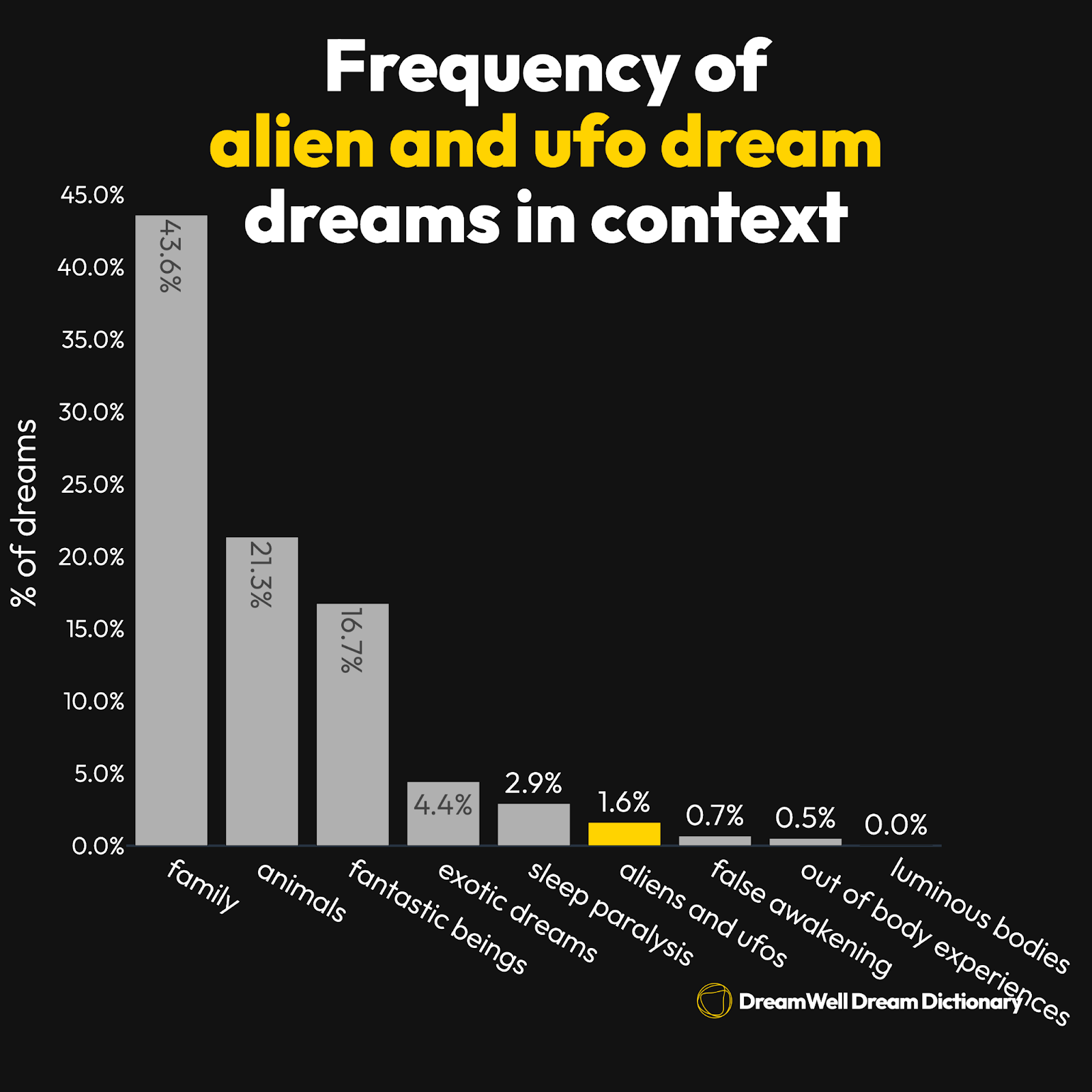
Figure G2
Types of dreams by category
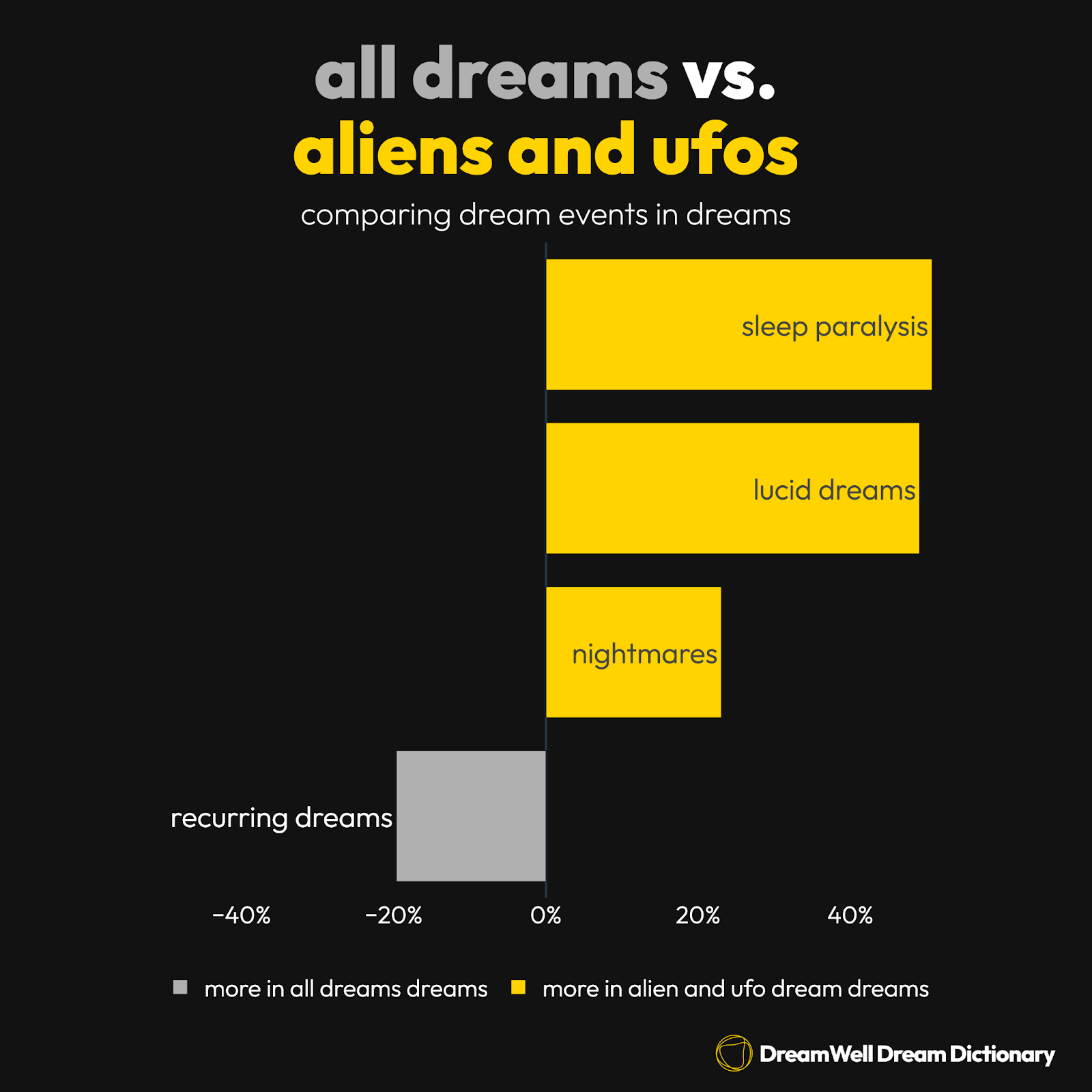
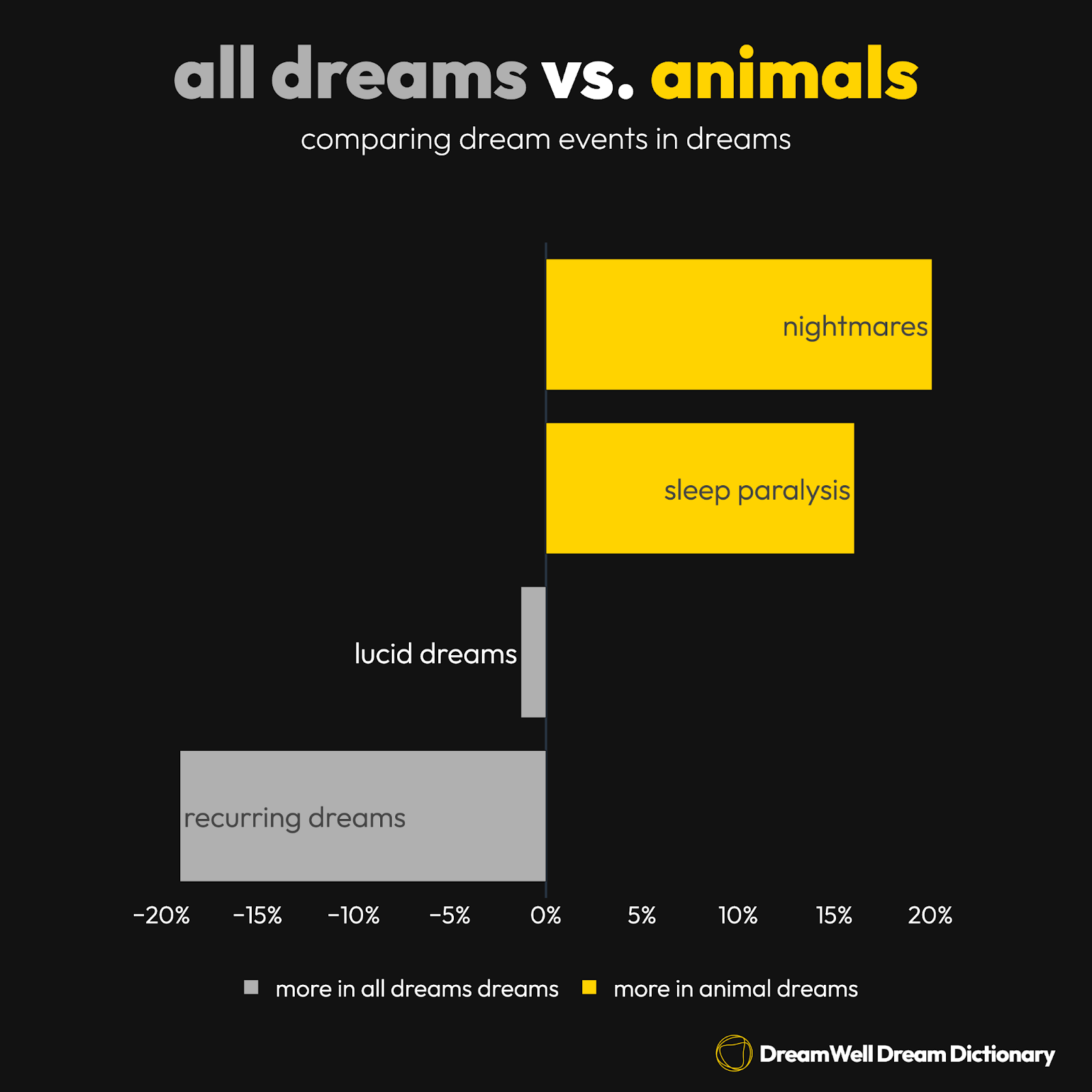
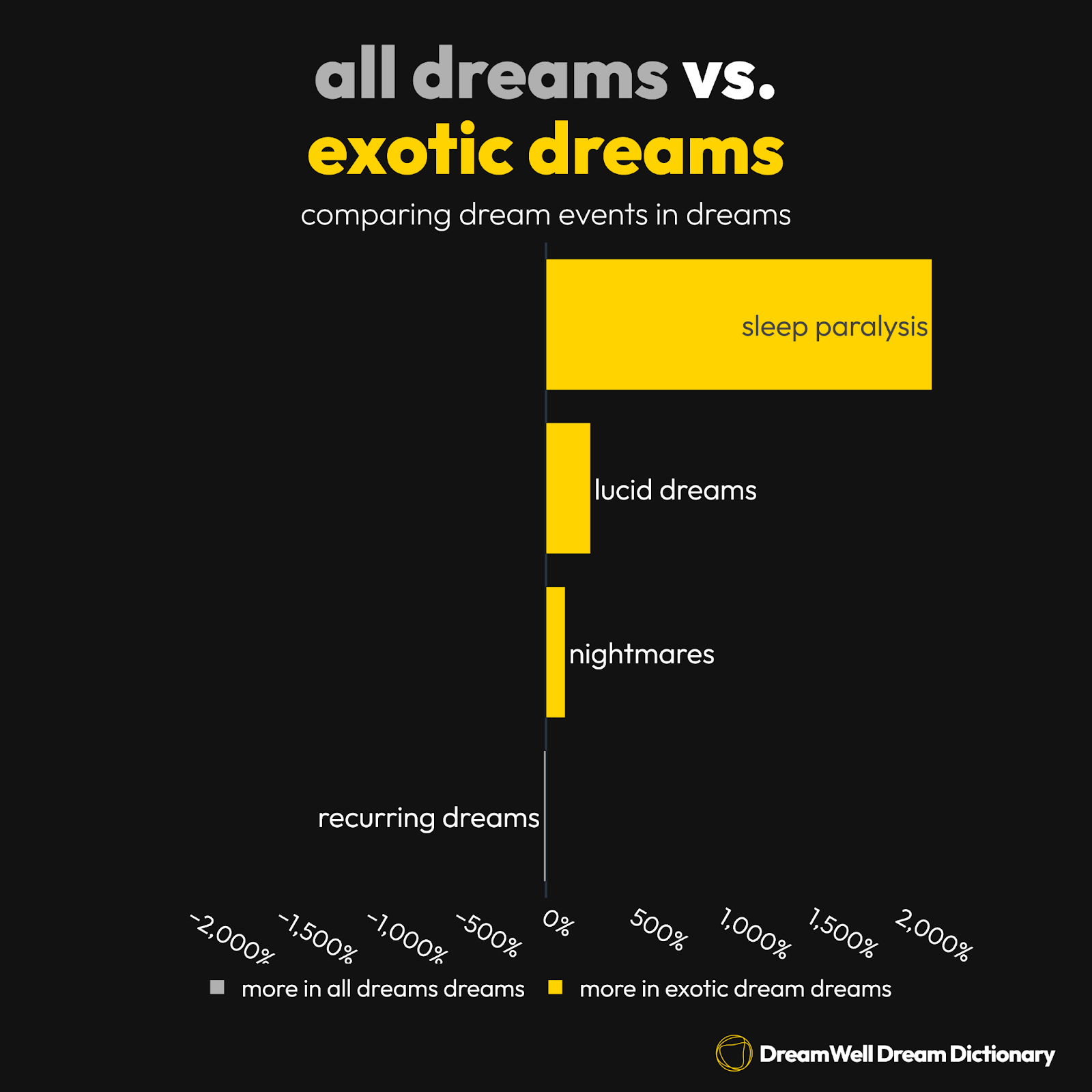
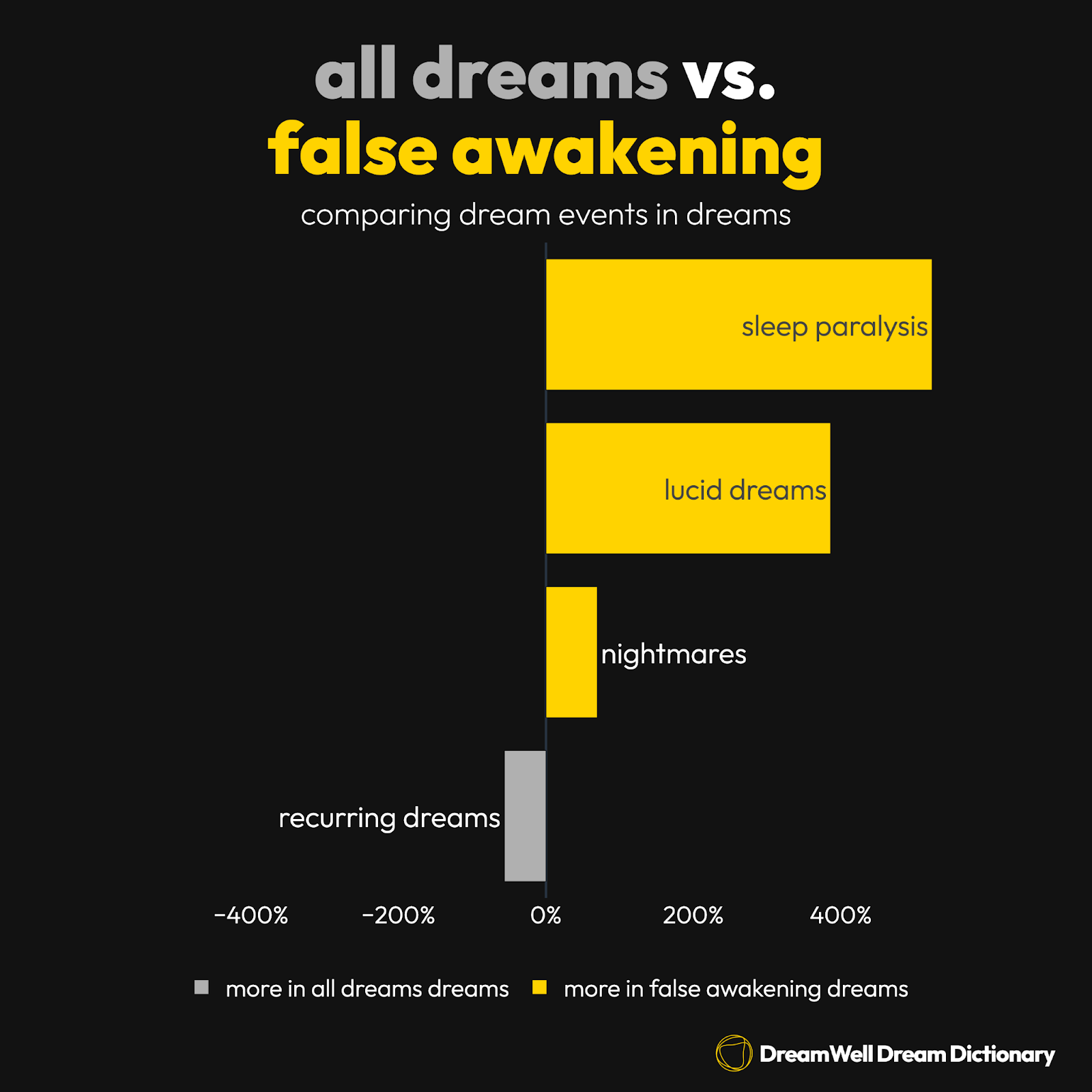
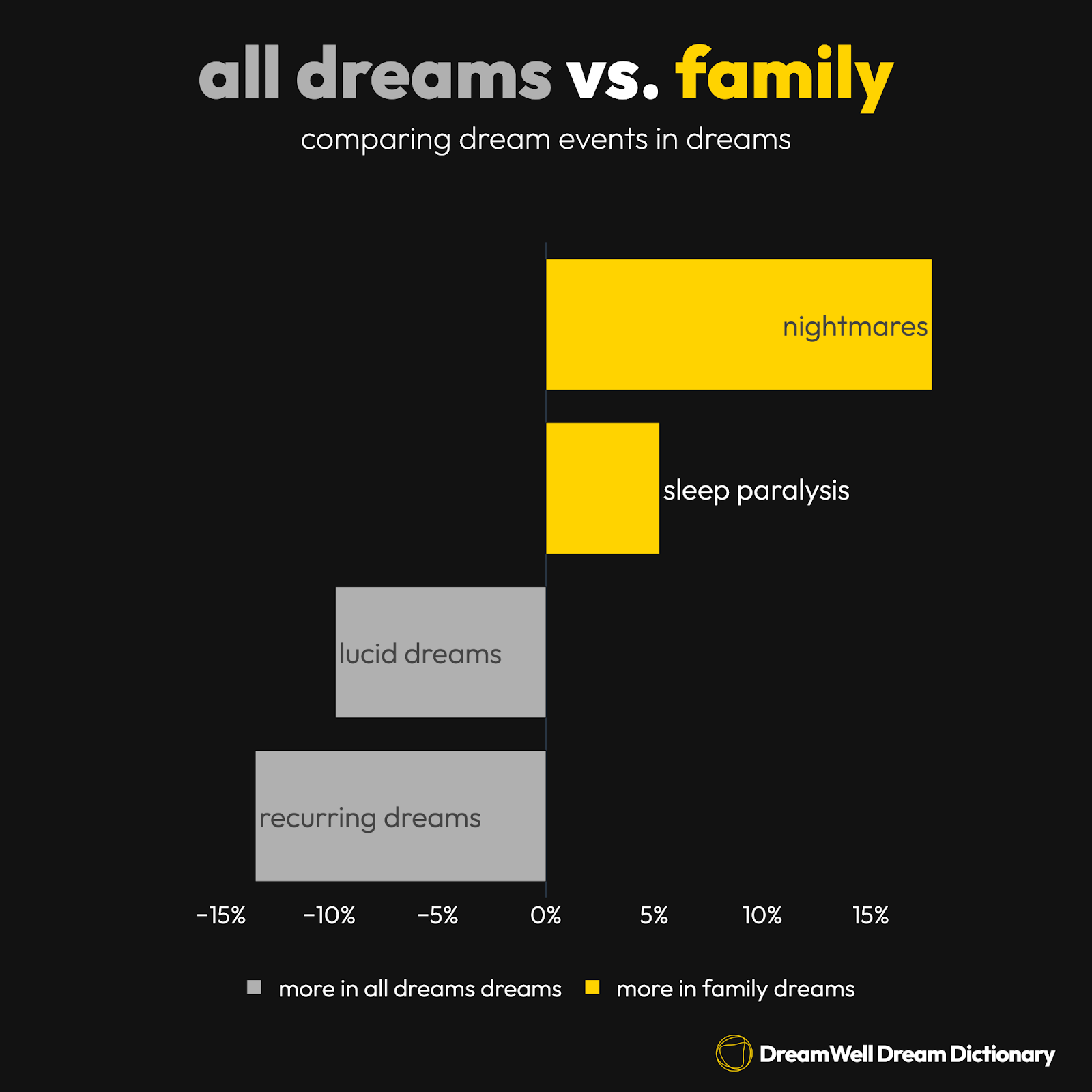
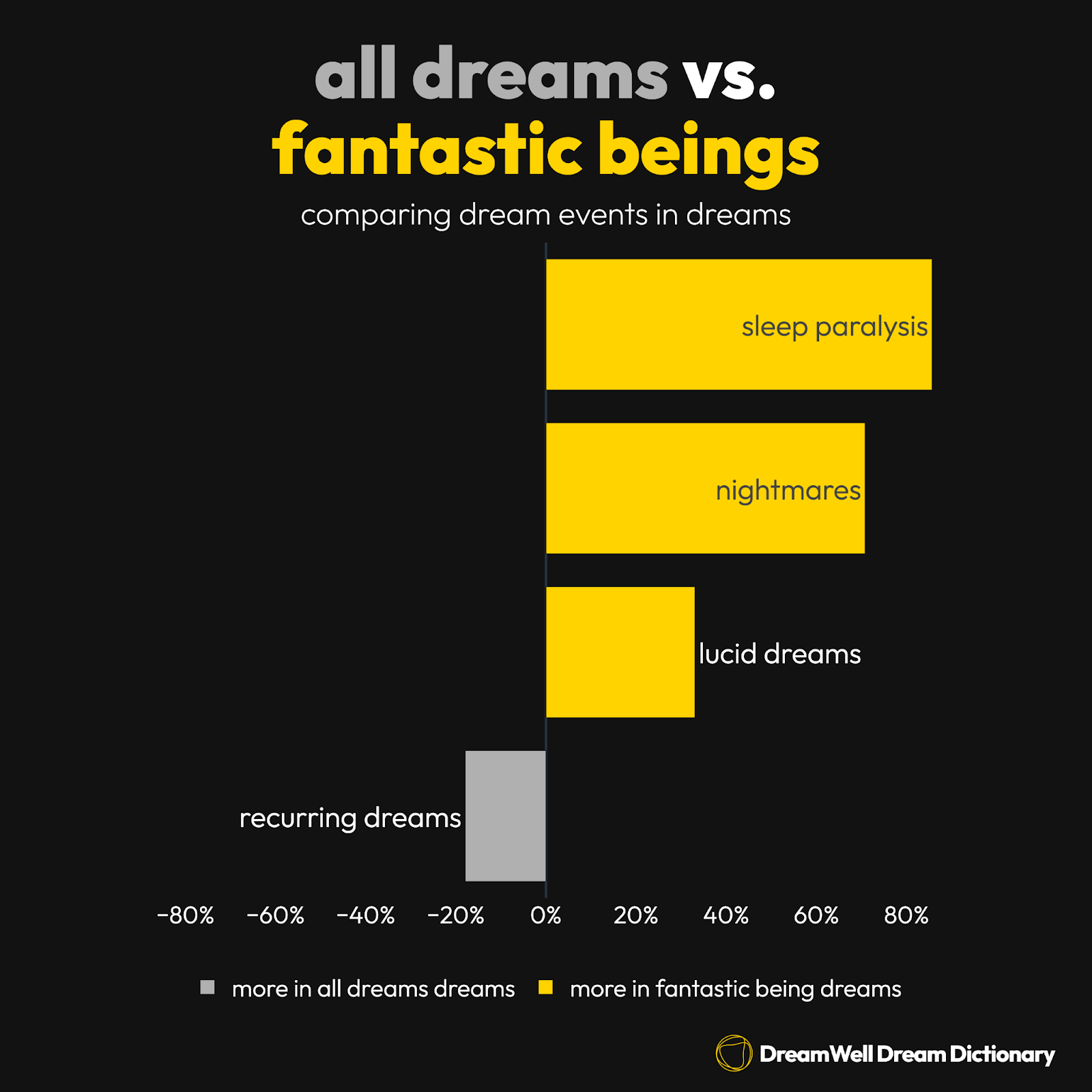
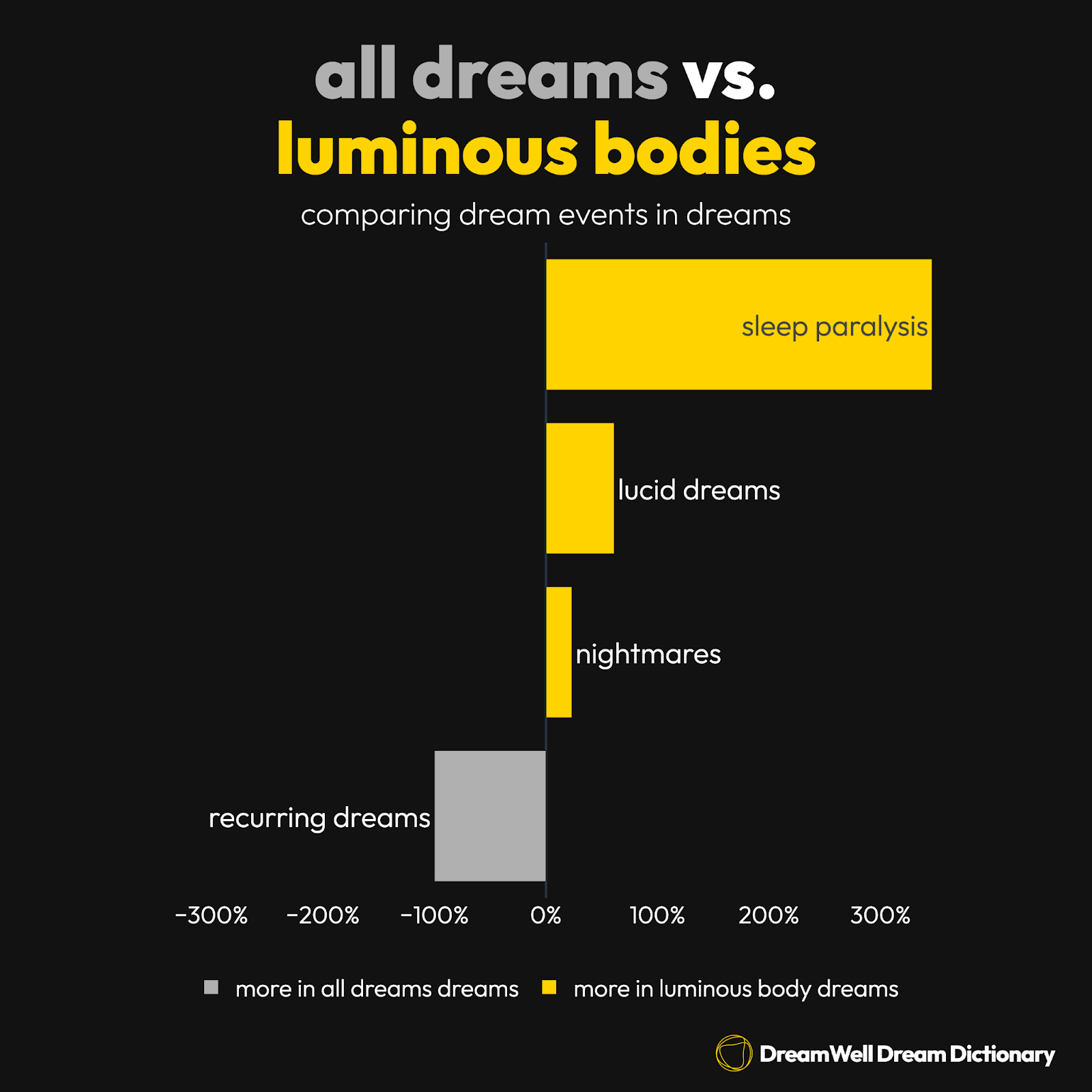
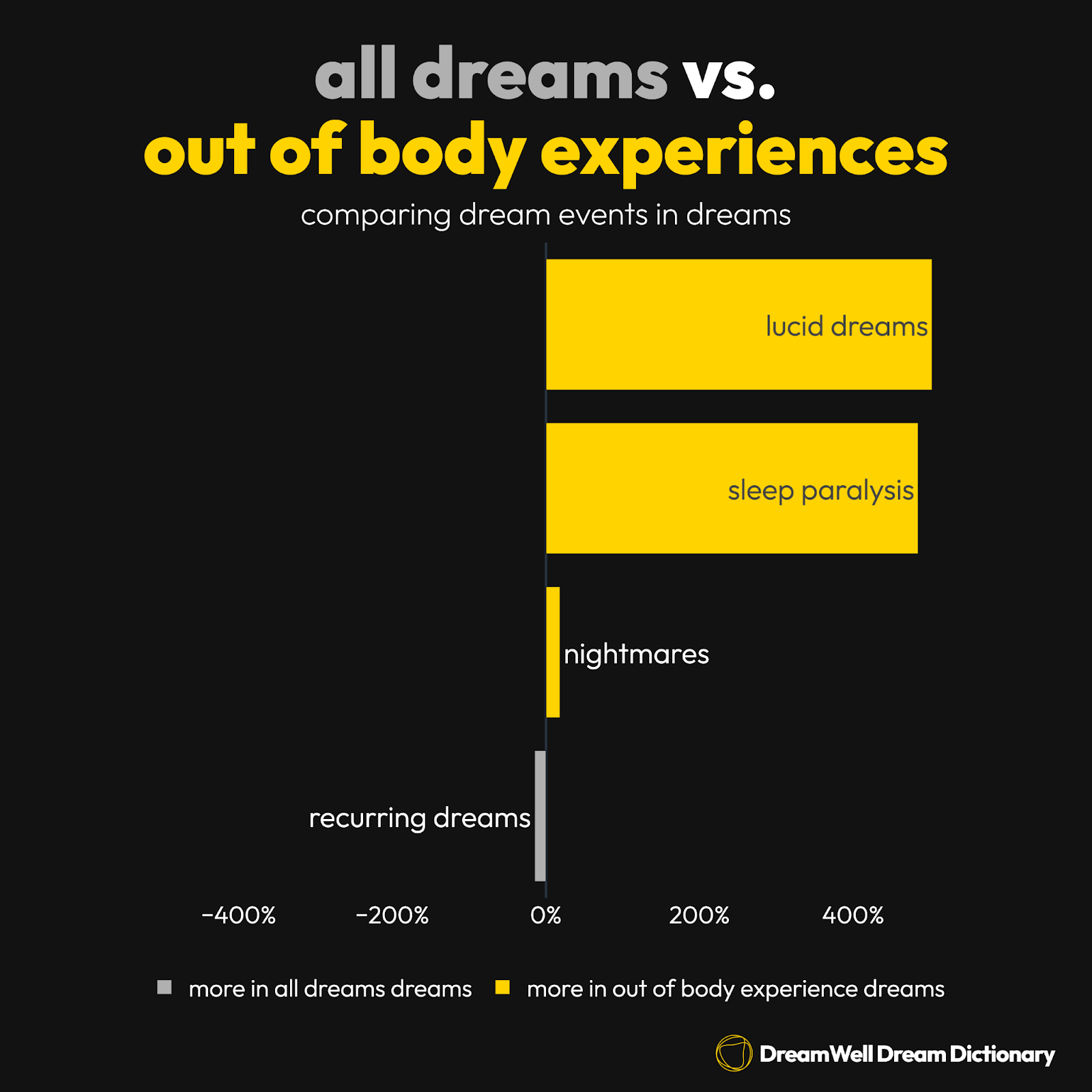
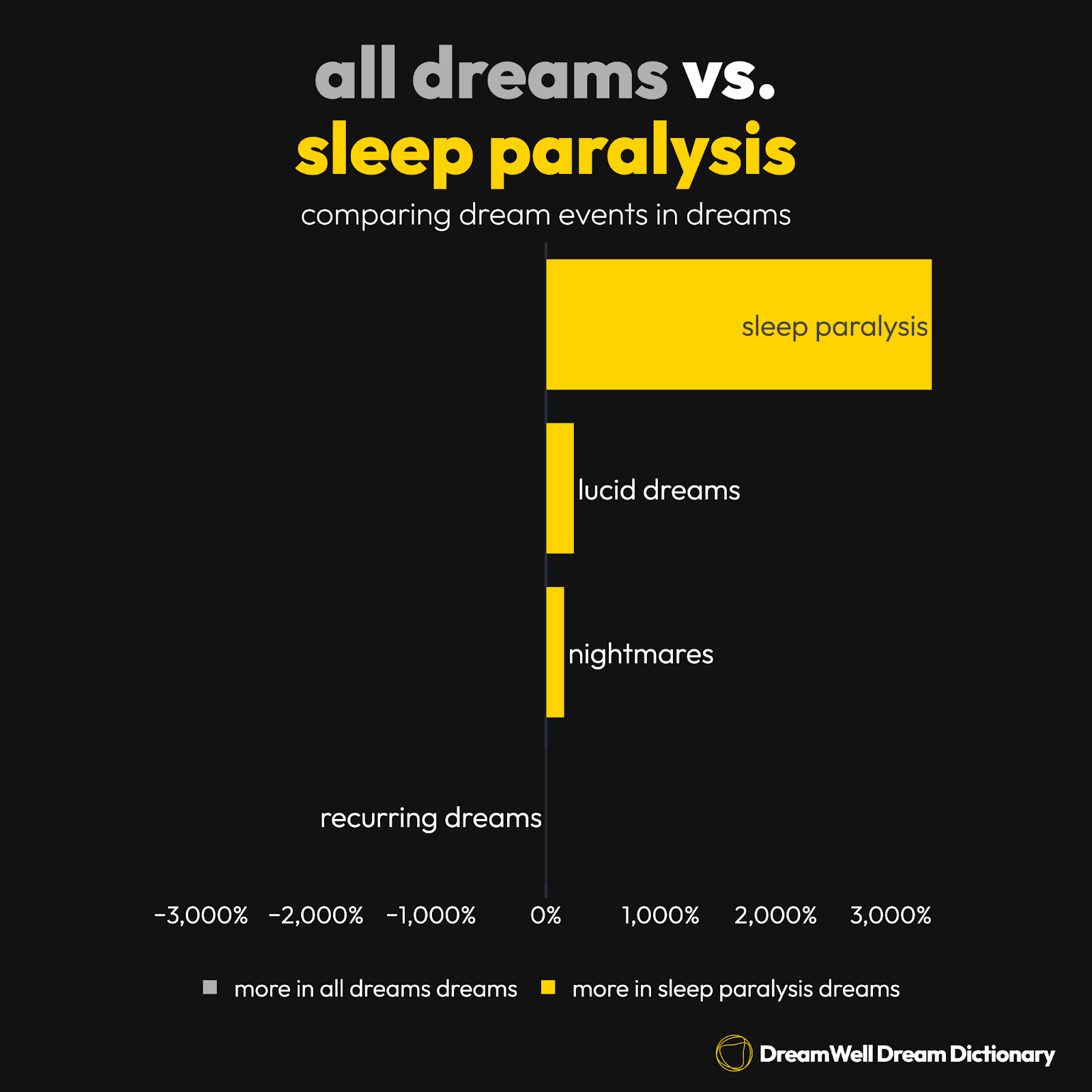
Figure G3
Summary chart of sleep paralysis dreams
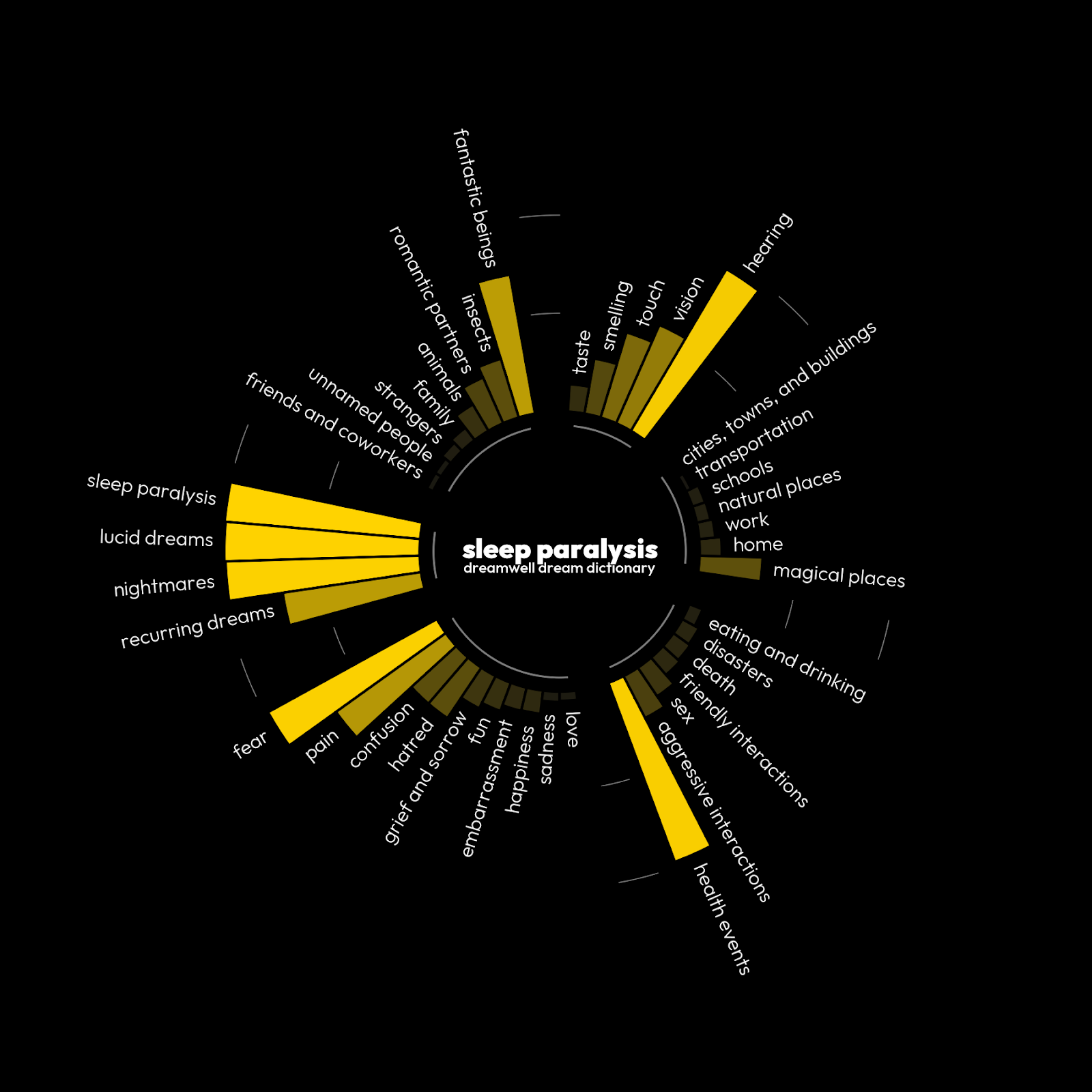
Figure G4
Summary chart of alien and ufo dreams
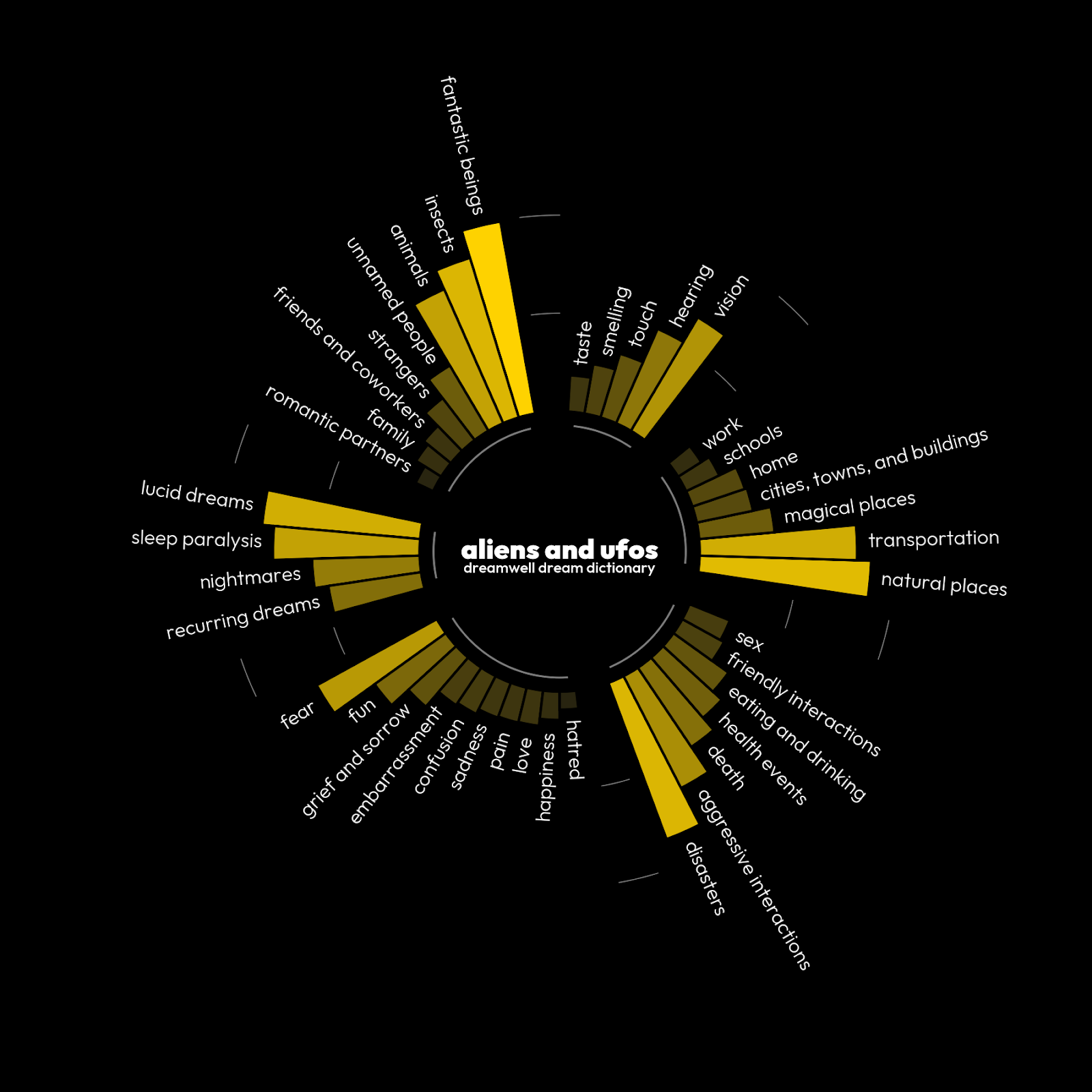
Figure G5
Summary chart of OBE dreams
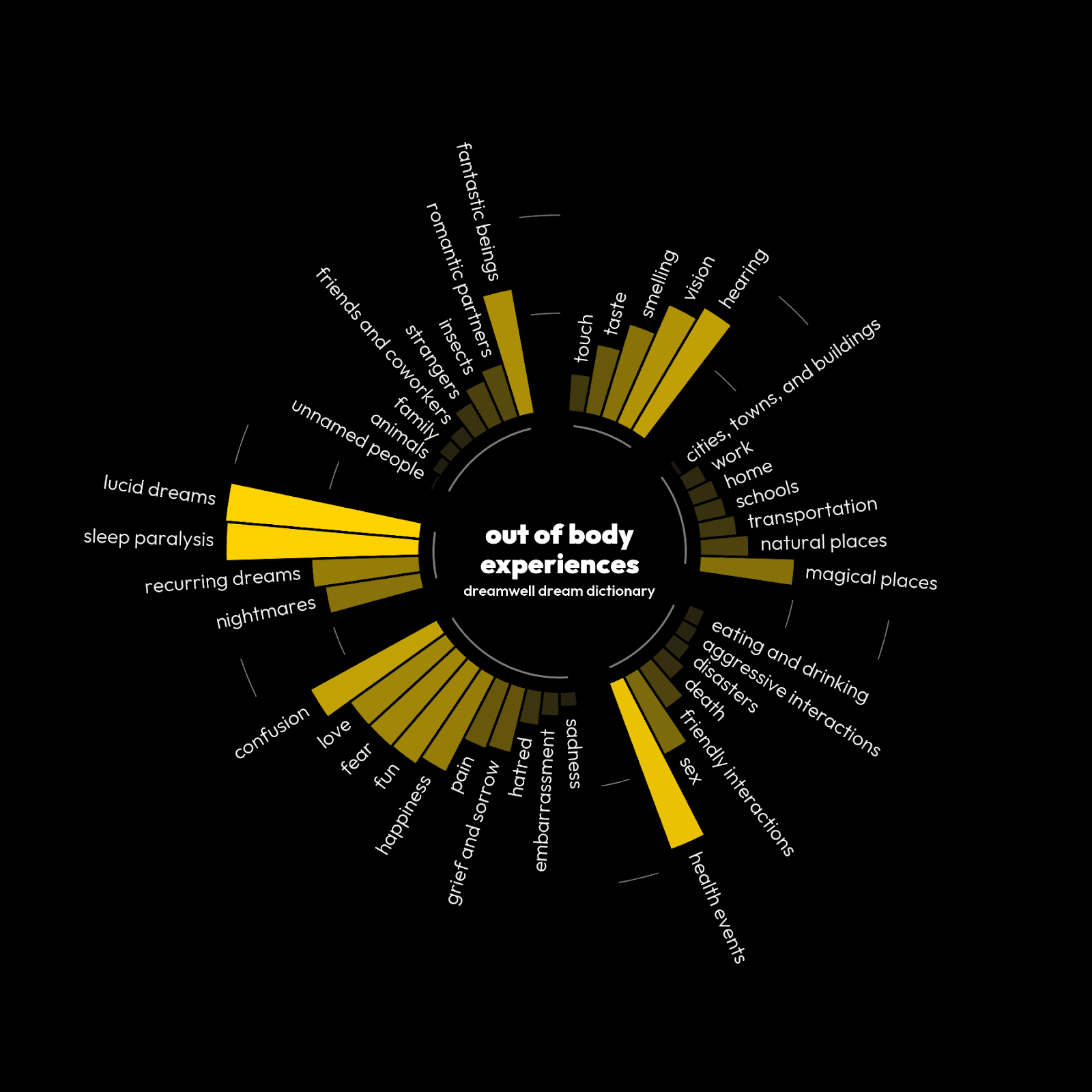
Appendix H
Excerpt from open data presentation of CE-5 and UAP reports
These reports compare human initiated contact reports with UAP reports (Rekshan, 2024d). These pages excerpted from a Tableau Public dashboard demonstrate that I have deeply and seriously considered both conventional UAP sightings reports and CE-5/HICE reports.
Figure H1
Report Cover
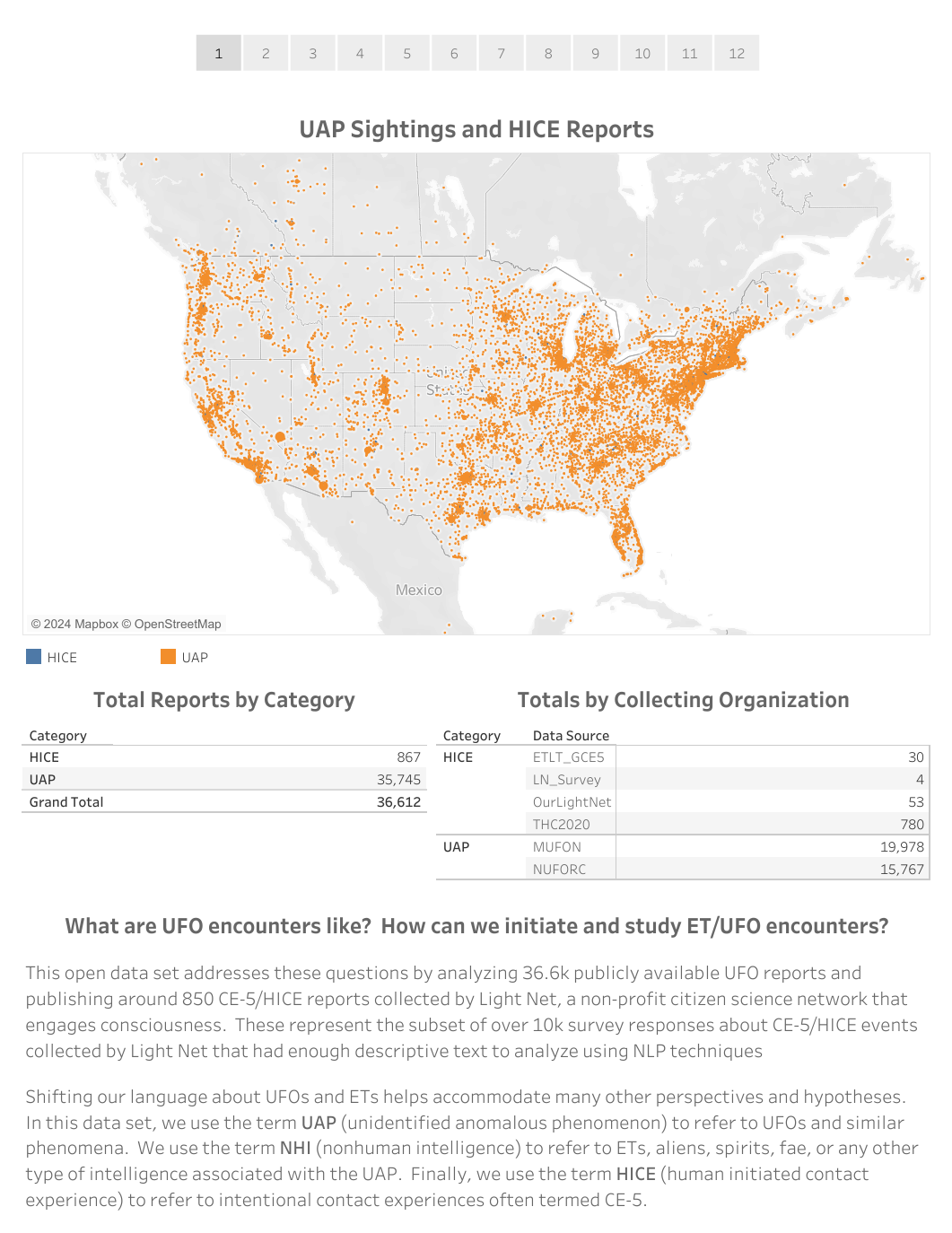
Figure H2
Report methods
Figure H3
Correlation of moon phase and UAP sightings
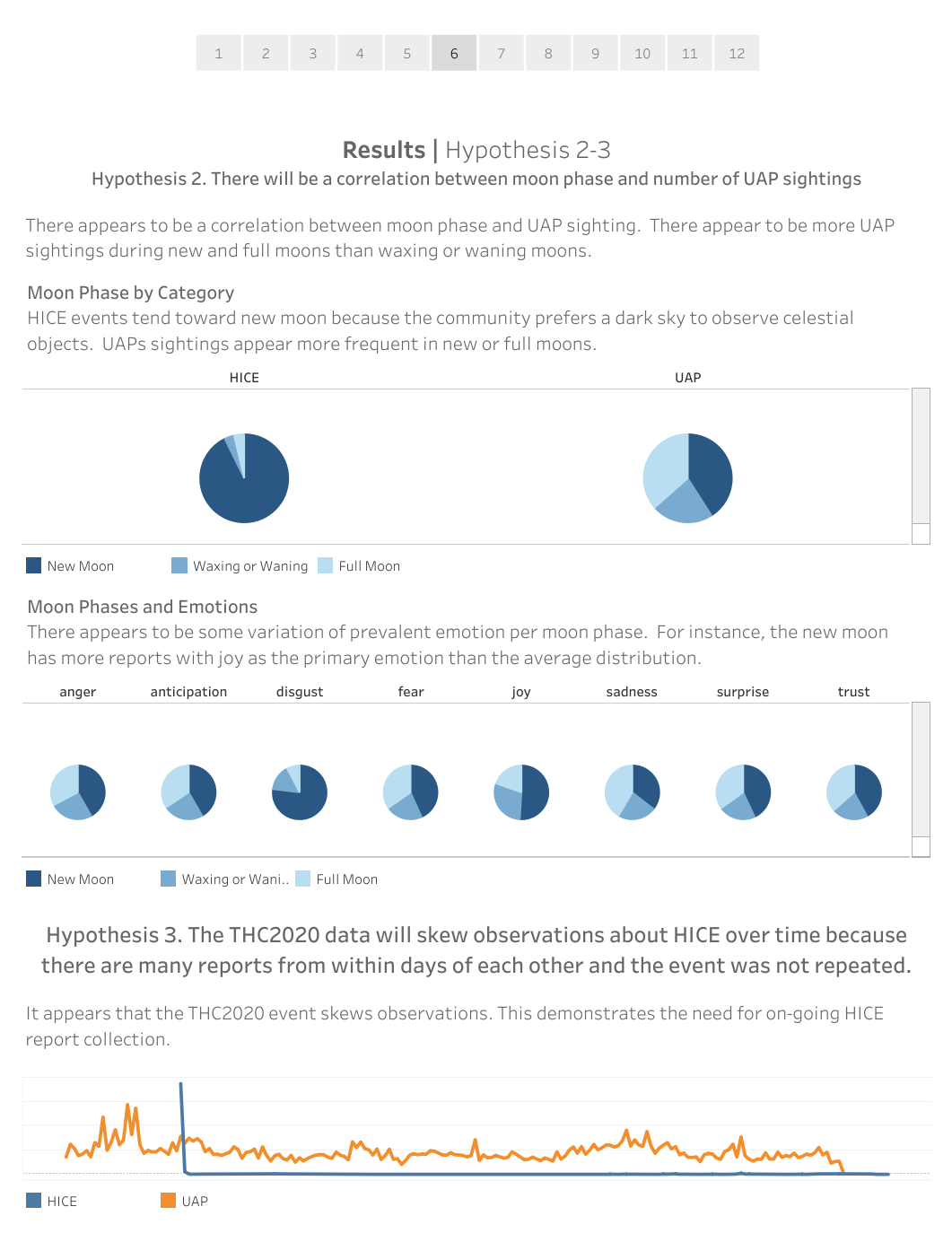
Figure H4
Correlation of CE-5/HICE and UAP sightings
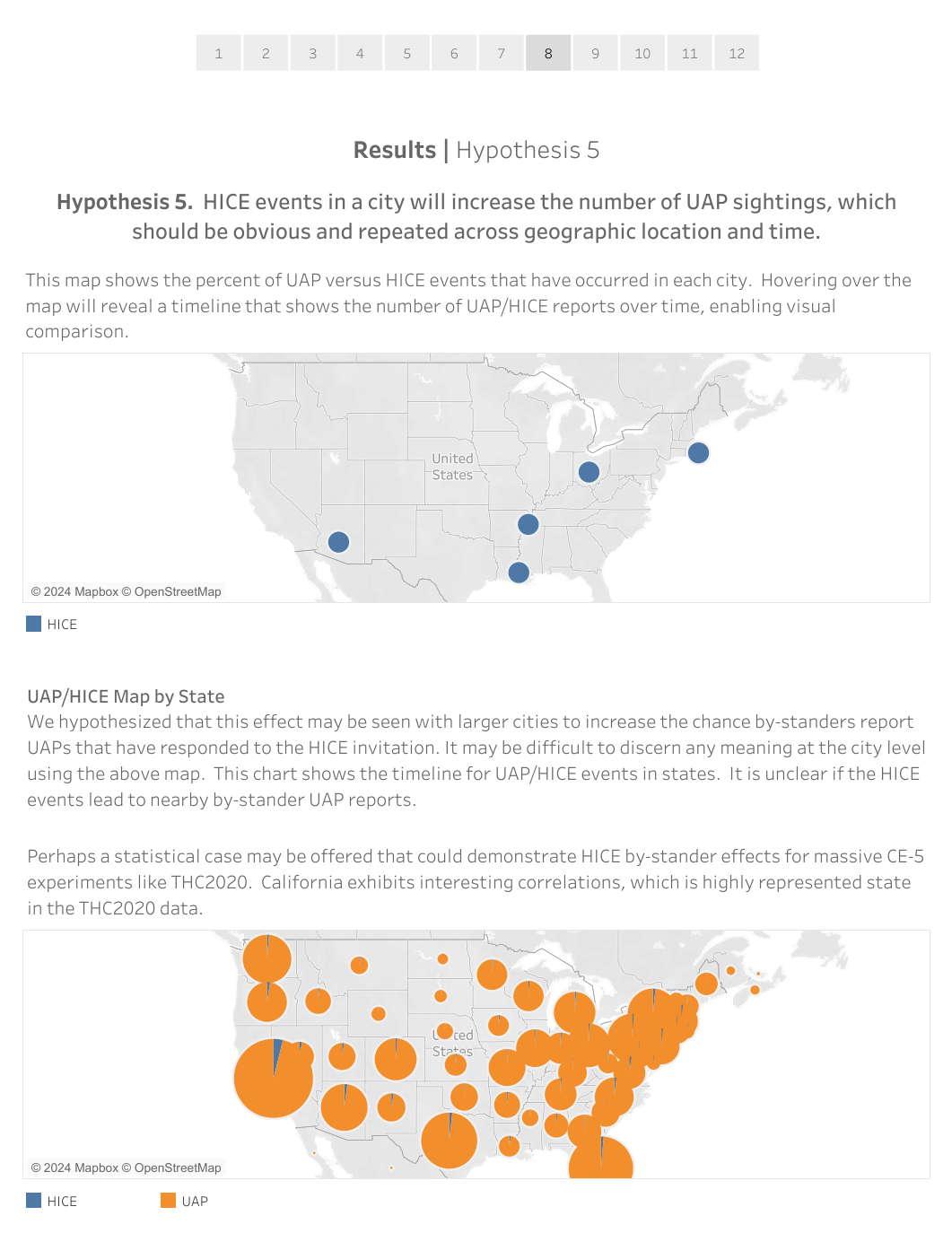
Figure H5
Emotional analysis of UAP and HICE sightings
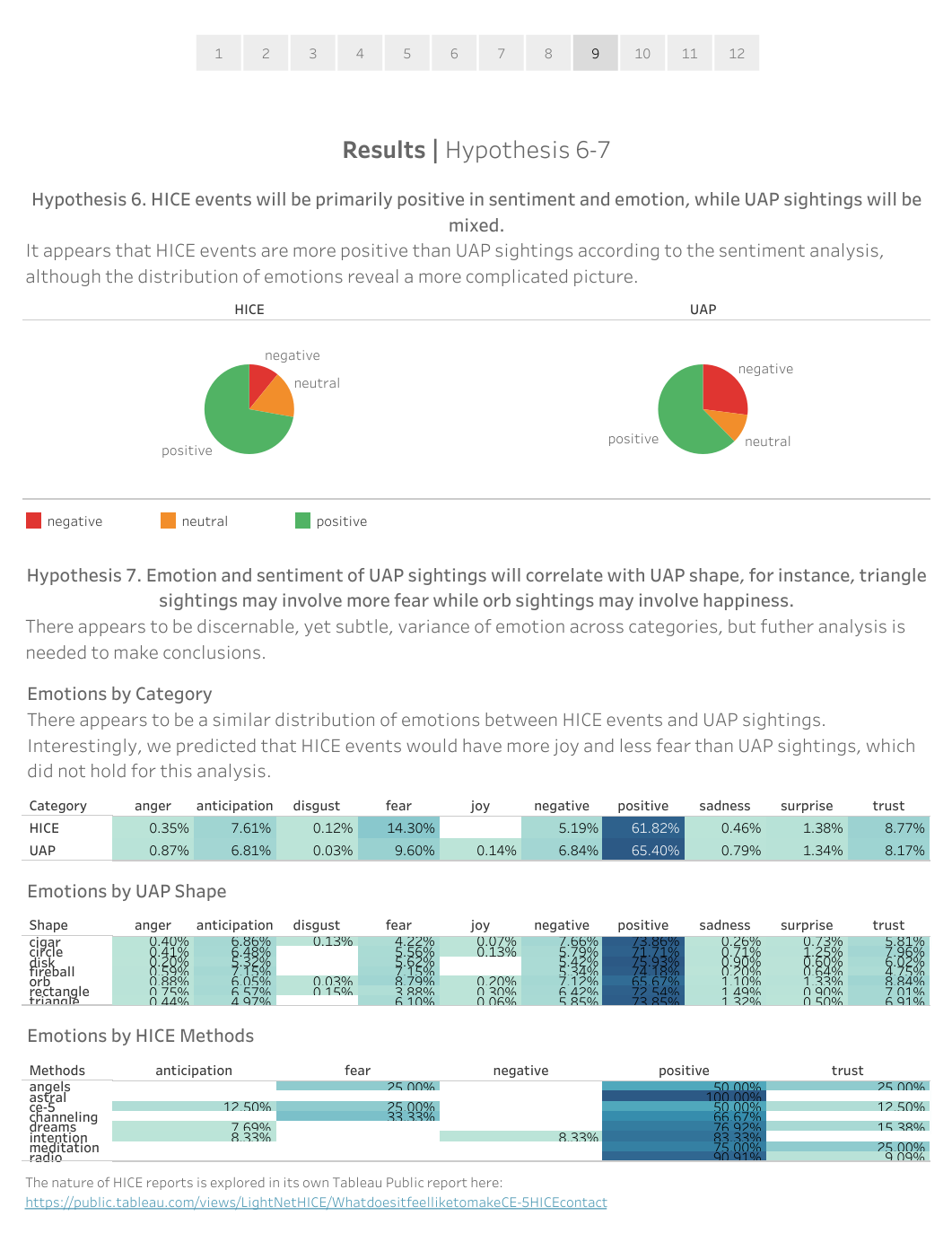
Appendix I
Excerpt from my position paper on the UFO Abduction Syndrome
This excerpt from UFO Abduction Syndrome May Be a Special Dream Phenomenon with Anomalous Physical Effects position paper (Rekshan, 2024c cite) presents my argument that the Bigelow-published Unusual Personal Experiences booklet is the authoritative definition of alien abduction for research literature.
Abstract
Alien abduction is a special type of dream phenomenon with anomalous physical effects. The most influential definition was published as the UFO Abduction Syndrome in Unusual Personal Experiences (Mack et al., 1992), a booklet sent by Bigelow Holding Corporation to 100,000 mental health professionals and a basis for the literary success of abduction literature by Hopkins, Jacobs, and Mack in the 1990s. Dreams and hypnosis were essential to the UFO Abduction Syndrome definition, yet no abduction researcher backing the ET hypothesis in the 1990s referenced scientific literature regarding sleep and dreams in their definitive works (see Table 1). While mainstream science argues that abduction is no more than sleep paralysis or fantasy proneness, this paper argues that it is a unique type of dream with anomalous physical effects, therefore blurs the conventional boundaries of dream and reality. This paper supports this position through several methods including a literature analysis of the UFO Abduction Syndrome authors’ references to sleep and dream science, a demonstration of similarity between dreams, abduction, and hypnosis based upon scientific findings, and a consideration of anomalous evidence used to support the UFO Abduction Syndrome hypothesis in the context of dream studies. Several common challenges and misconceptions regarding the argument are considered. This paper presents testable hypotheses with references to relevant experiment designs for scientific validity testing of the thesis that abductions are a special type of dream.
Introduction
This paper is an argumentative essay intended to convince the reader that alien abductions are a special type of dreams, which may be the subject of valid science. The topic is particularly complex because of misinformation regarding UFOs, biases against consciousness-primary systems and means of knowledge, and the strangeness of the abduction experience itself (see Vallee, 1977 regarding the complexity of UFO cover-ups). Testimony and research into alien abduction is characterized by a confusion between dreams and reality, such as Peter Faust from Mack’s Abduction (1994) who claimed he first thought of his experience like a dream until Mack hypnotized him to accept the belief that space aliens kidnapped him to perform fantastic and traumatic sexual acts upon a spacecraft (OWN, 2019). It may be argued that all abduction testimony is questionable because hypnosis is essential to the UFO Abduction Syndrome definition (Mack et a., 1992) and hypnosis, or even interview techniques, may induce false memories (Oeberst et al., 2021).
Given the confusion and strangeness of abduction, I will adopt the perspective that academic and scientific literature is representative of the abduction phenomenon in general, therefore I may limit my focus to only literature that presents references lists or bibliographies. In addition to providing citations, I will introduce and justify my use of the specific reference within the context of my argument, for example the Unusual Personal Experiences booklet is essential to the history of abduction, but is generally unavailable and unknown, therefore this essay will take time to introduce it. While some researchers suggest that abduction is beyond reason (see Mack, 1994 for apt discussion on nonduality in abduction research), I say that we may come to strong conclusions through literature arguments based in dream, sleep, hypnosis, and memory science that are set within logical arguments, which can produce scientifically testable hypotheses.
What is alien abduction? The first consideration of any literature argument is definitions. There are a wide range of ideas, hypotheses, and definitions of alien abduction. Since this argument is concerned with scientific and academic literature, we will begin with a definition of alien abduction offered in the book Varieties of Anomalous Experiences, which was first published in 2000 and updated in 2014 by the American Psychological Association (APA), therefore is perhaps the most academically grounded definition. It was edited by a team of experts including notable dream researcher Krippner and hypnosis researcher Lynn (Cardeña et al., 2014). Its chapter on abduction experiences (Appelle et al., 2014) was written by long-time experts on abduction including Appelle, who wrote a review article of abductions in 1996, Lynn, who is a prolific hypnosis researcher, and Newman, who wrote on false memory and abductions in 1996. In the chapter’s section on definitions, the 1992 UFO Abduction Syndrome in Unusual Personal Experiences was the first and only credulous definition of abduction. The chapter authors pointed out that the definition may be explained as sleep paralysis hallucinations, which Harvard researcher Clancy (2005) confirmed were essential to abductions experiences.
The Varieties of Anomalous Experiences chapter on abductions provides a map for the landscape of abduction research. The chapter identified Unusual Personal Experiences as the primary source for the original definition and prevalence rates of alien abduction. Hopkins, a modern artist turned abduction researcher and hypnosis trainer, and Jacobs, a Temple University history professor and amateur hypnotist, were identified as primary authors for the abduction hypothesis, primarily through their definition of the UFO Abduction Syndrome, which cited their earlier work like Hopkins’s 1981 Missing Time or Jacobs’s 1992 Secret Life. Mack, a Harvard professor of psychiatry, is identified as a proponent of the ET hypothesis, particularly through his 1994 Abduction. Bullard, a folklore professor, is identified as the authority on the common features of abductions due to his 1987 UFO Abductions folklore study. The chapter offers ten theories of abductions ranging from hoaxes to the ET hypothesis. All but the ET hypothesis asserted that abductions were misidentifications like hoaxes, false memory, or sleep paralysis hallucinations.
UFO Abduction Syndrome is the influential definition of abduction
Unusual Personal Experiences published the definition of the UFO Abduction Syndrome in a booklet composed of sections written by different authors. The booklet has a foreword and afterword by Bigelow, the publisher and a funder of the text. The heart of the booklet is a survey report by the Roper Organization that presents data regarding 11 questions posed to nearly 6,000 people. The questions were hypothesized to be indicators of the UFO Abduction Syndrome, as defined and interpreted by Hopkins, Jacobs, and Westrum. Mack introduced the booklet from a clinical perspective. Carpenter, a mental health professional, added his testimony that abductions are real and that clinicians should seriously consider them. While Westrum and Carpenter have contributed to the history of abduction research, this essay will focus on Hopkins, Jacobs, and Mack because of their continued research and publications on abduction.
Mack clearly provided clinical recommendations using his Harvard psychiatry and M.D. credentials. He identified nightmares as an essential symptom of the syndrome, as well as affirmed that clinicians should be educated about the syndrome so that they may be able to provide adequate care, implying that hypnosis is the recommended intervention for abduction. In this quote, Mack outlines the symptoms of the UFO Abduction Syndrome:
Above all, mental health clinicians should learn to recognize the most common symptoms and indications in the patient or client’s history that they are dealing with an abduction case. These include fears of the dark and of nightfall; nightmares, especially containing repetitive accounts of being taken by threatening figures inside a craft or enclosure; other fears or phobic symptoms (which may later prove to be related to an aspect of the abduction experience) that seem unrelated to what is otherwise known of the patient’s life; a history of small beings or a presence around the patient’s bed as a child, adolescent or adult; reports of unexplained missing time episodes; the appearance for no apparent reason of small cuts, scars or odd red spots; encounters with strange intense light, or even close-up sightings of oddly shaped craft. (p. 8).
Hopkins, Jacobs, and Westrum define the UFO Abduction Syndrome in terms of dreams and hypnosis. In their abstract, they write:
The result of an ostensible UFO abduction are symptoms akin to post-traumatic stress, with subjects reporting diffuse anxieties, disturbing dreams, sleep disturbances and imagery related to the abduction experience. UFO abduction memories may be as unacceptable to the subject or therapist, or both, so eliciting them may require additional effort. (p. 9.)
The authors then describe a typical abduction case, identifying strange dreams as the primary symptom and hypnosis the primary means of knowledge regarding the event:
These patients might also have dreams or vague remembrances of such images as hospital operating rooms, bright lights, huge-eyed alien beings, or even “impossible” animals such as very large owls or spiders. Careful questioning -especially under hypnosis -may reveal that these patients have specific memories of having been immobilized by impassive alien beings who remove them, typically from a car or home, and then transport them into a UFO. (p. 10-11).
Both Mack and the UFO Abduction Syndrome authors asserted that the abductee is a powerless victim, consistent with a naive interpretation of the sleep paralysis experience. Mack asserted that the fact an abductee could not prevent their recurrent abduction, or their children’s abduction, is a primary source of trauma (p. 7). Hopkins, Jacobs, and Westrum asserted that hypnosis may elucidate memories and awareness of abduction, but that nothing could bring about the cessation of abduction (p. 15). However, if abduction is similar in kind to recurrent nightmares and sleep paralysis, then simple interventions like education, mindful breathing, and image reversal therapy may stop abductions (see Hensen et al., 2013 or Rauf et al., 2023).
Table I1
Survey of abduction literature and dream references
| Title | Author | Year | Dream count | Dream references | Total references |
|---|---|---|---|---|---|
| Missing Time | Hopkins | 1981 | 44 | 0 | 25 |
| Secret Life | Jacobs | 1991 | 35 | 0 | 35 |
| Abduction | Mack | 1994 | 163 | 1 | 77 |
| Passport to Magonia | Vallee | 1969 | 17 | 0 | 107 |
| Unusual Personal Experiences | Mack, Hopkins, Jacobs, Bigelow | 1992 | 25 | 0 | 6 |
| Abducted | Clancy | 2005 | 22 | 7 | 120 |
| Extraterrestrial Contact | Marden | 2019 | 43 | 1 | 51 |
| Sleep Paralysis, Sexual Abuse, and Space… | McNally and Clancy | 2005 | 8 | 7 | 26 |
| Memory Illusion | Shaw | 2016 | 13 | 10 | 227 |
| Alien Abduction or Sleep Paralysis? | Marden | 2022 | 8 | 8 | 12 |
| Ethical Implications of Unquestioned Mackian Research at CIHS | Rekshan | 2024 | 564 | 19 | 70 |
It’s traumatic (sleep paralysis dreams interpreted as alien abduction). Real experiences are the only thing that occurs like that. Psychosis isn’t like that. Madness is not like that. Dreams are not like that. Fantasy is not like that. Now, if these are real experiences, what is going on?
— John E. Mack to Oprah in 1994 (OWN, 2019)
Epilogue. A dream.
I am walking through the forest with my son Jonah. The forest is lush, warm but not hot, and the sky is clear. I see a big bear, light brown almost tan with long fur, like the numinous bear from past dreams. I pick up Jonah and back away, then turn around. As we walk out of the forest meadow, my son Gabriel toddles from the bear to me, which I didn’t know. He touches the back of my legs, I realized he was with the bear but he was let go, then I pick him up and woke up.