
NOTE
My views on alien abduction research have significantly changed after writing compiling this book, especially because of my ethical research summarized in Risk of Harmful False Memories in UAP Studies. I have more a more nuanced proposal strategy that will not be public or digitized, to but discussed through secured analog channels. I have often wondered whether or not to remove this book from the Quadrilogy, but I keep it because I find it compelling as a literary response to the 1992 Unusual Personal Experiences booklet.
This proposal assumes participation in the Integral Noetic Science program at the California Institute for Human Sciences, which is a WASC-accredited graduate research institute that I withdrew from for ethical reasons deeply documented in Risks of Anomalous Retrocognition, culminating into a grievance document Grievance Definition Regarding Risk of False Memory to Human Subjects in UAP Studies and Experiencer Research at CIHS.
Further, the rise of AI and the Epstein revelations have shifted the technological and academic landscapes such that I question the value continuing D-SETI activities within academia. At the time of writing this note, I consider my continued writing on alien topics and dreamwork to be my spiritual practice and akin to creative dreamwork, not accredited research. However, I would be interested in operationalizing D-SETI at the institutional level given the context.
D-SETI
THE DREAM SEARCH FOR EXTRATERRESTRIAL INTELLIGENCE
A Research Institute Proposal
To explore the legacy of the 1990s Abduction Studies derived from Unusual Personal Experiences. Supported by the academic papers presented in this booklet along with a trilogy of books:
- Book of Galactic Lightexplores John Dee as a precedent for contemporary NHI contact, interlocution, and trance work operationalized for intelligence purposes.
- Missing Time Found presents the shamanic dreaming hypothesis of NHI contact, arguing that unremembered REM dreaming is the only natural precedent for missing time, therefore shamanic dreaming is the natural precedent for regression hypnosis.
- Galethog the Grey’s Field Guide to Anomalous Geometry explores body marks as physical evidence for alien abduction, concluding that the body mark evidence supporting the 1992 definition of UFO Abduction Syndrome were religious testimonies and not scientific claims, yet also demonstrating there is a real NHI encounter phenomenon underlying alien abduction narratives.
Daniel Rekshan, MA, CHt
Copyright © 2024 Daniel Rekshan
All rights reserved.
Books by Daniel Rekshan
Available on Amazon or D-SETI (https://dseti.org)
The D-SETI Quadrilogy
- Galethog the Grey’s Field Guild to Anomalous Geometry
- Missing Time Found
- Book of Galactic Light
- D-SETI Research Institute Proposal
Other Books by Daniel Rekshan
- The Alchemists’ Dream is Now Achieved
- Preface and Epilogue to the History of the World
- Prophecies for New Babylon
- On Realizing Divine Identity
- An Illustrated Guide to Practical Dreaming
DEDICATION
To Hans-Adam II, Prince of Liechtenstein and Robert Bigelow for supporting the 1990s research that defined the UFO Abduction Syndrome.
May your legacy empower humanity to engage the nonhuman world with dignity for the benefit of all.
Dear Reader,
This booklet invites you to consider the legacy of the early 1990s alien abduction research that defined and propagated the clinical definition of the UFO Abduction Syndrome. I am a PhD student researcher, credentialed hypnotist, and author of Missing Time Found, a book in the tradition of Hopkins, Jacobs, and Mack that presents shamanic dreaming as a precedent for ET/NHI encounters and regression hypnosis. I have personally experienced the legacy of the UFO Abduction Syndrome as a conditioned traumatizing fear response to natural OBE and shamanic dream phenomena, sometimes involving ET/NHI. While I argue that Unusual Personal Experiences overstepped science and created a panic akin to the recovered memory sex abuse controversy, I also argue that the Unusual Events Survey measured a real NHI visitation phenomenon that co-creates its lived experience as dreams and physically manifests as structured light capable of radiation and self-movement.
I have prepared this booklet in response to the invitation for funding at the back of the Unusual Personal Experiences booklet from the sponsors of the 1990s abduction studies. While I am not a clinical professional, I hold a scholarly MA in Psychology and two hypnosis certificates. I propose to directly engage mental health professionals in an education campaign after I conduct my dissertation research on the subject at an accredited institute. Therefore, I believe this proposal would still be relevant to the original invitation from 1992. Additionally, I look to the precedent of John Dee’s dedication of the Monas Heiroglyphica to Emperor Maximilian of the Holy Roman Empire in 1564 to model this work.
If my hypothesis is accurate, then the impact of the early declaration of the UFO Abduction Syndrome in 1992 may still obscure real NHI encounters with traumatizing fear. The proposed D-SETI Institute will conduct original research and public education campaigns to elucidate the phenomenon underlying the Unusual Events Survey indicators. I argue that the legacy of the early 1990s abduction studies is currently understood as a pseudo-science that conditioned a generation of schizotypal individuals to to have a traumatizing fear response to natural dream phenomena, which is not a legacy I would choose.
I propose to initiate a course of research that a) confirms the physical reality of NHI light body visitation and b) elucidates the co-creative nature of the NHI encounter phenomenon. Further, I propose a course of action that operationalizes dream-based NHI encounters for the generation of knowledge, expansion of scientific and technical intuition, and the mediation of human and nonhuman relationships.
The Proposal chapter outlines the establishment of D-SETI Institute through two phases: before and after my accredited dissertation on the legacy of the 1990s abduction studies. The next chapter, the Abduction Study Legacy, reviews the history of alien abduction research and presents my arguments for a reinterpretation of the Unusual Events Survey responses. The next several chapters present my PhD program research at California Institute for Human Science and previous related work.
In addition to these chapters, I have authored several books on the subject matter. The Book of Galactic Light explores the precedent for ET/NHI encounters in Western culture through engagement with the history and practices of John Dee, the 16th century scholar and magus. Missing Time Found presents the shamanic dreaming hypothesis of NHI/UAP-associated missing time, observing that unremembered REM dreaming is the only natural precedent for missing time and that shamanic dreaming may be a precedent for regression hypnosis. The book explored a dozen case studies using the ethics and epistemology of dreamwork. Missing Time Found also introduced the notion that anomalous geometry may be a means of SETI-style communication, such as from physical body marks or UAP documentation.
Galethog the Grey’s Field Guide to Anomalous Geometry examines body marks as physical evidence for alien abduction, collecting and analyzing dozens of cases over several distinct typologies. The book observed common themes between body mark geometry and UAP formations, particularly ball of light orbs. A chapter of the book was written using automatic trance channeling and dreamwork technique in the voice of my personal NHI visitor. This chapter was dedicated to the Prince of Liechtenstein by the NHI, in honor of both the Prince’s support of abduction research and his spiritual significance as cultural heir of the Emperor Maximilian, to whom Dee dedicated his potent Monas Hieroglyphica.
These books, along with this booklet, invite patronage for my research from the same sponsors as the 1990s Abduction Study research for several reasons, as well as other stakeholders in alien abduction research. I believe that the publication of the UFO Abduction Syndrome in the 1990s is a limiting factor for contemporary research into UAP and NHI phenomena. The proposed research may demonstrate that victims of the UFO Abduction Syndrome may transform their nightmarish experiences into sources of insight and intuition. My research reveals that abduction research, particularly through its appeal to body marks as physical evidence, relies upon unconscious authority claims rather than science. In other words, the feeling of certainty in the alien abduction interpretation of Unusual Events Survey, which inspired the Unusual Personal Experiences booklet and the Abduction Study conference, was derived from the personal charisma of Hopkins and not scientific claims. I believe that similar authority claims based upon the personal charisma of the original 1990s alien abduction research group would have unconscious authority. Therefore, I believe that if the same funders sponsored my work, a generation of people who may have been conditioned to fear NHI encounters may be transformed into citizen scientists to document and study the phenomenon.
I would be happy to answer any question or inquiry regarding the proposal and my research from the intended sponsors or any other interested party or collaborator. Thank you for your consideration.
Sincerely,
Daniel Rekshan
February 1, 2024
Dunster, British Columbia, Canada
daniel@dseti.org
D-SETI Research Institute and the Abduction Study Legacy Program Proposal
This proposal was drafted in April 2022 and updated after writing the 1992 Abduction Study Legacy as a proposal to elucidate the legacy of the 1990s abduction studies funded by Bigelow and Liechtenstein.
Mission
The mission of D-SETI Institute is to lead humanity’s quest to understand our place in the cosmos and mediate our relationships with non-human intelligence through research and education on the ET/NHI encounter phenomena in dreams.
Summary
This document drafts a proposal for the funding and establishment of D-SETI Institute for ET/NHI encounter research. D-SETI stands for the dream study of extraterrestrial intelligence. The Institute will accomplish its mission through the following activities:
- perform original research through collaboration and the founder’s PhD dissertation
- study ET/NHI encounters and dream reports via large databases and NLP/ML analysis
- engage citizen science research through dreamwork training, facilitation, and reporting
- educate the public about NHI encounter phenomenon and dreams via content creation through public relations with the mental heal community
- operationalize psionic dream skills like telepathy, precognition, and remote viewing
- generate and defend NHI testimony though professional interlocution services such as interview, hypnosis, or dreamwork for experiencers and researchers informed by integral theory
This proposal is written in direct response to the Unusual Personal Experiences (Mack et al, 1992) booklet, which offered funding to engage the mental health community regarding alien abduction. It is presented under the hypothesis that the Unusual Events Survey questions accurately measured an ET/NHI contact phenomena, but inaccurately concluded alien abduction was the primary cause. Rather, it may be hypothesized that dream shamanism is a primary precedent for alien abductions as a special type of ET/NHI encounter phenomena that manifests through two modes: 1) physically as self-moving structured light, typically as orb or figure capable of radiation and 2) psychically as a dream shaman capable of generating, sustaining, and controlling shared dream experiences. The Institute’s first five year plan would focus on understanding and addressing the legacy of 1990s abduction studies funded by Robert Bigelow and Hans-Adam II, Prince of Liechtenstein.
This proposal represents 5-year seed funding for the D-SETI Institute, its founder’s supporting dissertation, support for its baseline operations as education and reporting center, and its initial program designed to address the legacy of the 1990s abduction study, henceforth called the Abduction Study Legacy Program.
Impact
D-SETI research will spark a renaissance of ET/NHI and UFO/UAP research by addressing the materialist and monophasic biases inherent in Western science. All NHI encounter researchers testify that dreams are an essential component of the phenomenon. Dreams are a traditional domain of ET, NHI, angel, and daemonic encounters (see Mota-Rolim et al., 2020), which are documented to inspire philosophic, scientific, and technical creativity (Abraham, 2017). Dream telepathy and precognition experiments demonstrate a significant effect (see Katz et al., 2019 and Storm and Rock, 2015), thought to be a nonlocal phenomenon (Ibison and Hathaway, 2011). Lucid dream incubation experiments demonstrate that alien abduction encounters may be emulated or induced by most lucid dreamers (Raduga et al., 2021). Hypnosis has been demonstrated to induce dream-like states (Barrett, 1979), suggesting that ET/NHI contact experimentation using dream methods may be operationalized during all phases of consciousness.
A new reading of the Unusual Personal Experiences booklet based on the Unusual Events Survey indicates that 2% of the population may experience NHI visitation in exotic, anomalous, or shamanic dream states. Given that dreams respond to attitudes and intentions, the alien abduction conclusion may have shifted naturally occurring NHI encounters into nightmarish abduction experiences. Comparison with the recovered memory sex abuse controversy indicates that the impacts of study may still be active in culture today (Otgaar et al., 2021). D-SETI will explore the legacy of the 1990s abduction conclusions and will engage an similar education campaign to transform its disempowering message into inspiration for citizen science research into NHI contact phenomena.
The cultural impact of dreams is incalculable because of their significant transformative power, for example Descartes, Jung, Dee, Ramanujan, Bohr, and so on all reported inspiration through dreams. However, the impact of this research may be estimated by our opportunity to study the phenomenon. The Abduction Study Legacy Program would directly study the phenomenon measured by the Usual Events Survey, then engage a similar public relations campaign as in 1992 to educate mental health professionals and gather subjects and reports of NHI encounters. In addition to the D-SETI Institute deliverables, the Abduction Study Legacy Program proposes the following deliverables: 1) accredited PhD dissertation on the topic, 2) mass-market book based upon the dissertation, and 3) public relations campaign to engage the mental health community.
The impact of the Abduction Study Legacy Program may be estimated by its capacity to generate research subjects and reports like a marketing funnel. Assuming the campaign targets 100k mental health professionals, 5% may engage with it, yielding 5k professionals. Estimating their caseload at 20 clients, yields 100k potential subjects. Applying the 2% rate of UFO Abduction Syndrome, yields 2k subjects of possible NHI encounters within reach. Assuming 20% have periodic lucid dreams, yields 400 subjects (see Erlacher, 2012). Assuming each dreamer remembers 36 lucid dreams a year, 45% of which responded to their intention (see Stumbrys et al., 2014), and 63% percent of which may have a telepathic quality (see Storm and Rock, 2015), yields around 4.1k potential encounters with NHIs that a) match the phenomenology of the UFO Abduction Syndrome, b) respond to experimental variables, and c) are within the reach of study.
This estimate represents 4.1k times the researchers would ask a question and receive an answer. Applying remote viewing or dream telepathy methodologies may minimize the subjective quality of the response and maximize its accuracy. An adequate sample size for dream content analysis is around 100 dream reports (Domhoff and Schneider, 2008). If a single question would involve the comparison of two samples and replication (400 reports), then researchers may ask 10 questions per year with this sample size.
Background
This proposal arose from Daniel Rekshan’s research into the alien abduction phenomenon. The main ideas were drafted in April 2022 after intuitive communications with NHIs, who advised Daniel to shift his focus from hypnosis as a spiritual practice to SETI-inspired activities using telepathic dreams as a contact modality. The proposal draft was updated in February 2024 after research into the 1992 publication of Unusual Personal Experiences and related events. The research made Daniel realize that addressing the legacy of the publication is deeply aligned with his personal and academic goals. The update focused on the initial 5-year research plan to elucidate the phenomenon measured in the Unusual Events Survey and to address the legacy of alien abduction research around 1992.
He experienced contact with NHI through dreams and dedicated his career and education to studying this phenomenon. Daniel holds a BA in Classical Liberal Arts from St. John’s College, an MA in East-West Psychology from the California Institute of Integral Studies, and a certificate in Depth Hypnosis. He is currently a PhD student in Integral Noetic Sciences, with an Anomalous Studies concentration, at the California Institute for Human Sciences. His Master’s capstone project outlined the massive collection and analysis of dreams, which is now demonstrated through his app DreamWell. Since 2020, Daniel has professionally and academically engaged in the subject of ET/NHI contact, missing time, hypnosis, shamanic dreamwork, human initiated contact, and other subjects at a public level. He explicitly wrote his PhD entrance essay on the topic of ET/NHI contact and dreams. He has written several research papers on NHI contact through dreams in this academic context.
Daniel is the Chief Dream Officer of DreamWell, a mobile app for mindfulness through all phases of waking, sleeping, and dreaming. It has foundational capacities to administer lucid dream intent experiment instructions and to collect dream reports. DreamWell offers a data-driven dream dictionary based on a massive database of 125k+ dreams analyzed through advanced content analysis and machine-learning techniques. Daniel produced an open data presentation of 7k human initiated experience reports, compared with 30k+ UAP reports, through his engagement with CE-5/HICE communities. Daniel has worked in technology start-ups such as Goodreads.com. He served as lead developer for Community Attributes, Inc, through which he architected mapping and data visualization projects for government and non-profit clients. At the time of writing, he is contracted with the University of Washington to produce data tools regarding global data accessibility in support of the UN’s 2030 SDG agenda.
Daniel is an experiencer of the phenomenon, a hypnotist/dreamworker, and researcher. He has conducted dozens of missing time regressions, under the theoretical framework of shamanic dreamwork. His book Missing Time Found presented the shamanic dreaming hypothesis through literature review and case studies. He researched the use of anomalous body marks as physical evidence for alien abduction, concluding that they may be additionally modeled as oracular communication, through his book Galethog the Grey’s Field Guide to Anomalous Geometry. He explored the historic Western precedents of ET/NHI contact and hypnosis as dreamwork through his engagement with the topic of John Dee and so-called Enochian Magic through his work The Book of Galactic Light.
Activities
The proposal put forward here represents a minimum viable project to effectively serve the D-SETI mission and the objectives of the Abduction Study Legacy Program. Additional projects may be considered on an on-going basis after establishing the research organization. The major domains of activity include: original research, collection and analysis of reports, citizen science using lucid dream methods, operationalized dreamwork, and the Abduction Study Legacy Program.
D-SETI activities will occur in multiple phases. First, is the establishment of the institute to fund Daniel’s PhD research and generate public, tested, and accredited knowledge regarding the legacy of the 1990s Abduction Study. Second, D-SETI will engage a public relations campaign with mental health professionals regarding the underlying phenomenon of NHI encounters formerly understood as the UFO Abduction Syndrome. Finally, the Institute will engage in on-going research, education, and operations at the conclusion of the Abduction Study Legacy Program upon the completion its first five year plan.
Original research and academic work
D-SETI founder, Daniel, will focus on ET/NHI contact and dreams during his PhD studies. Project deliverables will include at least 2 academic research papers and 1 dissertation. Daniel is currently in the CIHS’s PhD program in Integral Noetic Sciences with a concentration in Anomalous Studies, which is the first accredited PhD program to explicitly study ET/UFO contact and psi phenomenon.
Massive database of reports
An objective of D-SETI is to collect, analyze, and report on potential psionic dream contact with ET/NHI. This will involve the development and hosting of:
- Database and search index to hold dream reports
- Pipeline to apply NLP and content analysis
- APIs for adding records and querying index
- Advanced search and export features
- Content analysis reports and visualization
All these features have been prototyped in the DreamWell Dictionary project, aligned with DreamWell research, and may be supported with the existing app team. The CE-5/HICE open data report is another prototypical example of the database, analysis, and visualization techniques. Links to these projects may be found in the Links section at the back of this book.
Citizen science on ET/NHI encounters and dreams
Dreamwork and dream sharing are important aspects of a holistic study of dreams. Therefore, an objective of D-SETI is to publish educational materials related to individual and group dreamwork, as well as to host dream groups. The content deliverables may include:
- ET/NHI dream contact resource library
- ET/NHI dreamwork guides
- Online dream group directory and facilitation
- Online education and training courses
- Other educational activities
Daniel has supported multiple online communities: Goodreads.com, Ancestral Medicine, LightNet, and various previous iterations of DreamWell. His current website, D-SETI Dreamwork, offers online courses through research-based lectures.
Lucid dream intent experiments may provide significant signals for ET/NHI contact through dreams. This will involve:
- Collection of dreamer data
- Administration of lucid dreaming instructions
- Collection of dream journal reports
DreamWell encompasses all these features in a mobile app. The app currently is based on two features: 1) instructional courses that guide users to perform exercises and 2) report forms that collect data and dream narratives. The app would require minimal adaptation to administer lucid dream intent experiment instructions and collect the resulting reports.
Operationalized Psionic Dreams
This proposal establishes the D-SETI Institute as a foundation for additional future or special dream telepathy programs as on-going operations in support for other institutions’ specific research or communication goals. Relevant institutional models may include the Monroe Institute or Project Stargate, which may be particularly relevant given Dale Graff’s overlapping interest in operationalized dream telepathy and role in the remote-viewing program.
D-SETI would operationalize dream phenomena like precognition, telepathy, and NHI encounters for general and specific research questions, which have operational or experimental precedents in the literature. D-SETI would likely operationalize two populations: 1) representative samples of various populations through the app DreamWell and 2) specific groups and individuals with extraordinary dream skills.
Professional Interlocution Services
ET/NHI contact reports and abduction testimonies involve the dynamic between an experiencer and an interlocutor. Their interaction is non-dual, as noted by Mack (1994), meaning that they are neither subjective nor objective, although they may be framed in either light. Abduction narratives typically arise from hypnosis-like processes, including self-hypnosis or personal dreamwork. Researchers, documentarians, journalists, politicians, and many others consciously or unconsciously are informed by professional interlocutors. For example, Bigelow and the Prince relied upon Hopkins, Jacobs, and Mack as interlocutors who generated and interpreted abduction testimonies like dream interpreters of old advised the Pharaohs.
D-SETI Institute will offer professional interlocution services from an integral perspective under the shamanic dreaming hypothesis of missing time regression hypnosis. The hypothesis affirms about hypnosis/dreamwork that it a) is an unreliable means of memory recovery, b) generates actionable insights, c) mediates real relationships with nonhuman intelligence that negotiate human fortune, d) expands creative and scientific intuition, e) is an operationalizable means of psi-based inquiry, and f) provides insight regarding missing time and NHI encounters.
D-SETI Institute will archive hypnosis/dreamwork sessions, administer surveys and polls, publically advocate for the ethics and epistemology of dreamwork regarding regression hypnosis, and facilitate interpretive meaning-making inquiries.
Abduction Study Legacy Program and Public Education
The efforts surrounding the 1992 Unusual Personal Experiences booklet and the Abduction Study Conference at MIT may represent the discovery and misclassification of a natural dream-related phenomenon of NHI encounters. The encounter phenomenon may be related to both a) sleep paralysis and false awakening dreams and b) physical visitation of a NHI light body. If the lived experience of the NHI encounter is co-created by the personal imagination of the experiencer and the reality of the NHI (like dreams are co-created by the individual and collective unconscious), then the clinical definition and propagations of the UFO Abduction Syndrome may have had the unintended consequence of programming experiencers of NHI contact to experience alien abduction narratives when they otherwise would have had clearer or more empowering NHI encounters.
D-SETI will seek to understand the legacy and impact of the Abduction Study, both in terms of its discovery and measurement of a possible visitation phenomenon and in terms of its impact on culture. If the actions of the Abduction Study inadvertently programmed the theme and contents of NHI encounters to be alien abductions, is it possible to program the public in such a way as to directly yield benefits for humanity, such as through inspiration of technical or scientific intuition? The objectives of the Abduction Study Legacy Program would be:
- Elucidate the feedback mechanism between NHI visitation and UFO Abduction Syndrome definition
- Define NHI visitation in terms of the co-creative shamanic dream hypothesis
- Educate public on phenomenon in similar fashion as Unusual Personal Experiences, additionally including dreamwork experiment and reporting instruction, after PhD defense to ensure blessings of academic orthodoxy
- Quantify results through analysis of dream reports and validity testing NHI communications
If the hypothesis that the Unusual Events Survey measured a real, yet co-creative, NHI contact phenomenon, then public education and dreamwork may transform the legacy of the 1990s Abduction Study from a declaration of human victimization by extraterrestrials to a declaration of human dignity, creativity, and partnership with NHIs.
The deliverables of the program will include:
- PhD dissertation on the topic in accredited program
- Mass-market book based upon PhD-level research
- Public relations campaign with mental health professionals
- Operationalized citizen science reporting for NHI encounter events
Organization
The missing of D-SETI is currently served through D-SETI Dreamwork, a Canadian sole-proprietorship through which Daniel offers dreamwork sessions and education. The D-SETI Institute is currently unincorporated pending initial board meetings. It will likely be a Canadian or US-based non-profit or public benefit corporation. D-SETI values transparency and will publish board meetings, notes, and reports. It will allow for consideration of stakeholders through a system of governance that is published on the website.
D-SETI likely will adhere to frameworks of governance and policy such as:
- US or Canadian-based non-profit
- Open Data Commons for data repository
- Creative Commons, non-commercial, attribution required license for software
- GDPR and CCPR privacy policy compliance
- Sociocratic meeting structures
D-SETI will produce quarterly and annual reports regarding Institute research and governance. D-SETI governance will occur in two phases. First, it will convey quarterly advisory board meetings to discuss activities and advise policies. These meetings will be recorded and will be publicized in the D-SETI Quarterly Reports. The board of directors will have an annual meeting to discuss activities and decide upon policies. Most of the meeting will be recorded and will be publicized in the D-SETI Annual Report.
Five Year Plan
This proposal seeks seed funding for 5 years of operations, after which the Institute will be positioned to become the world-class research institute on the topic of NHI contact and dreams, inclusive of the UFO Abduction Syndrome and proudly advocating for the legacy of the 1990s Abduction Study efforts. Daniel will conduct original research in an accredited institute to produce a dissertation to elucidate the 1990s Abduction Study legacy by defining actionable knowledge on the phenomenon that the Unusual Events Survey measured.
Deliverables
Deliverables of the initial funding include:
- Two original research paper within PhD program
- One dissertation focused on legacy of 1990s Abduction Study and implications through the lens of dream shamanism
- Annual interdisciplinary white-paper or book publication
- Annual and quarterly reports on dream NHI research
- NHI dreamwork training and certification program
- Open data commons of NHI contact reports
- Open source NLP/ML report analysis tools
- Facilitation of massive lucid intent experimentation via DreamWell
- Research and social foundation for operationalized psionic dreaming similar to Project Stargate or other validated methods
- Mass-market book advocating for the positive legacy of 1990s Abduction Study as most impactful measurement of at least the dream NHI encounter phenomenon and likely the NHI light body phenomenon.
- Public relations campaign with mental health professionals
- Capital fundraising plans for year 5+
Schedule
The deliverable schedule aligns with Daniel’s PhD work through which he will define scientific knowledge to elucidate the nature of the NHI encounter phenomenon originally measured by the Unusual Events Survey.
Year 1: Establish Institute
- Establish institute by funding, incorporation, filling boards, and establishing partnership
- White paper on UFO Abduction Syndrome as potential NHI light body visitation and dream shamanic phenomenon
- White paper on operationalized psionic dreaming
- Open database of NHI encounter reports and open source analysis tools
Year 2: Initial Research and Foundations
- PhD research paper regarding UFO Abduction Syndrome legacy and NHI light body as dream shaman hypothesis
- Dreamworker training and certification curriculum development
- Lucid dream intent experiment design and prototype
Year 3: Continued research and public engagement
- PhD research paper regarding operationalized psionic dreaming
- Dreamworker training
- Lucid dream intent experiment execution
Year 4: On-going Institute activities and dissertation work
- Continued education and citizen science
- Lucid dream intent experiment report article
- Dissertation focused on the Abduction Study legacy
- Dissertation defense and conclusion of PhD program
Year 5: On-going Institute activities, perpetuity planning, and Abduction Study Legacy Program finalization
- Mental health community engagement
- Mass-market book on Abduction Study Legacy and D-SETI research findings
- Capital fundraising plans for on-going Institute activities
- Institute partnerships for on-going research and operationalized psionic dreaming
Available Resources
D-SETI founder, Daniel Rekshan, is an experiencer, a trained hypnotist, former software development lead, and a PhD-student researcher. He may be the only researcher in the alien abduction field who is a) a public experiencer, b) studying within an accredited institute, c) capable of missing time regression hypnosis (henceforth understood as shamanic dreamwork), d) maintains collaborative relationships through the experiencer communities, e) experienced in project management with similar budgets, and f) directly inspired by NHI contact through dreams.
A major available resource is the DreamWell mobile app, of which Daniel is a co-founder. Its core functions include education and dream report collection. The team maintains a massive database of dreams, which is analyzed using NLP/ML techniques, and is in the process of completing two research articles. The CEO of DreamWell was the statistician on nine peer reviewed papers for neuroscience startups. The app is positioned to administer and analyze lucid dream experimentation at a massive scale. It emerged from nearly a decade of effort beginning as his capstone project for his MA in East-West Psychology during the time he worked as an engineer for San Francisco web startups.
Another relevant resource is Daniel’s PhD studies at the California Institute for Human Sciences. Its new Integral Noetic Science program offers an Anomalous Studies concentration, which explicitly engages research topics on ET/NHI contact. Daniel wrote his admissions essay on his research focus of ET/NHI contact in dreams, along with every assigned research paper. His inquiry is known and supported by the faculty of CIHS, particularly program director Sean Esbjorn-Hargens. Daniel’s dissertation will be one of the first that defines public knowledge on the subject of ET/NHI contact in dreams within an accredited academic context.
Daniel’s active connections with experiencer communities is another resource. He frequently receives inquiries regarding missing time, UAP sightings, NHI dreams, and anomalous body marks. He has presented his SETI theories to the International Association of the Study of Dreams in a symposium lead by Dale Graff. He was a co-founder of the experiencer network, LightNet, which archived over 7k reports of HICE encounters. He is a moderator of the Red Grid Mark Phenomenon Experiencers and Researchers group, which is the largest anomalous body mark community on the internet at around 2k members. He maintains professional contact with the Quantum Healing traditions based on the work of Dolores Cannon, as well as it’s ET and disclosure focused subcommunity. Daniel is currently collaborating with HICE practitioners and several experiencer-researchers to produce a book on the subject of geometric communication with NHI through HICE protocols. He has written books on the subject of missing time, regression hypnosis, and anomalous body marks that serve as an entry point of contact from other experiencers.
Abduction research appears to be objective, but it is more similar to cults of personality than science. The production of abduction reports requires an active interlocutor who must relate to the experiencer testimony in nondual ways to produce apparently objective knowledge (Mack, 1994). The Abduction Study of 1992 would have been impossible without the charisma of Hopkins, Jacobs, or Mack. Daniel has demonstrated his capacity to magnetize experiencers and serve as an interlocutor through the publication of his book Missing Time Found. The book’s hypothesis resolves the paradox of recovered memory by applying the theoretic framework of shamanic dreamwork to the regression session.
The final resource Daniel brings is his active and on-going relationships with NHIs through dream, intuitive, shamanistic, and ritualistic contact modalities. The relationship began when he was around 2 years old and witnessed an NHI light body approach his home, co-creating the screen memory of the Easter Bunny. He experienced missing time, corroborated by his twin brother in independent recollections of the events, which Daniel explored through as a case study in Missing Time Found. The NHI claimed responsibility for anomalous body marks and the dreams that taught Daniel how to use geometry to make meaning from those marks. While Daniel attributes the same level of reality to this character as Robert Louis Stevenson attributed to his brownies, this character appears to have independent agency. Although Daniel would caution about its mercurial nature, it must be noted that the NHI is the main instigator of this research proposal and invites collaboration.
Budget
| Domain | Deliverable | One time | Annual | Total |
|---|---|---|---|---|
| PhD Program | $45,000 | |||
| Stipend | $30,000 | $150,000 | ||
| Conferences | $2,000 | $10,000 | ||
| Research project | $30,000 | |||
| Open Data Commons & API | ||||
| MVP | $10,000 | $10,000 | ||
| Monthly project work | $7,200 | $36,000 | ||
| Yearly iteration project | $8,000 | $40,000 | ||
| Lucid Dream Experiments | ||||
| Dream Well Upgrades | $8,000 | $8,000 | ||
| Experiment design | $4,000 | $20,000 | ||
| Administration | $4,000 | $20,000 | ||
| Reporting | $4,000 | $20,000 | ||
| Dream Work | ||||
| Quarterly publication | $4,000 | $20,000 | ||
| Monthly dream group | $1,200 | $6,000 | ||
| Abduction Study Legacy Program | ||||
| Mass-market book writing | $15,000 | |||
| Public relations campaign | $30,000 | |||
| Non-profit corporation | ||||
| Incorporation | $5,000 | $5,000 | ||
| Management | $4,800 | $24,000 | ||
| Volunteer coordinator | $6,000 | $30,000 | ||
| Contingency | $46,000 | |||
| Development | $6,000 | $30,000 | ||
| Total | $23,000 | $81,200 | $595,000 |
Note: In USD (595k. It represents the budget for a minimum viable project executed over the 5 years of a PhD program for the establishment of D-SETI Research Institute through the Abduction Study Legacy Program. Web development projects will leverage Daniel’s current role in DreamWell (budget estimates here are based on compensation of the company’s for time and resources devoted to D-SETI mission at a rate of $50/hour).
The estimated budget is a value for the deliverables because it leverages the work of Daniel and DreamWell who are all devoted to serving the public good. In comparison, similar development of custom web database applications may cost $500k in a single year based on the salaries of a small development team.
The estimated yearly budget for D-SETI is approximately 0.5% of SETI Institute’s yearly budget. Compare the potential effect of SETI and D-SETI. SETI is searching for ETs using extremely expensive technology based on incalculable probabilities, which if successful, will take generations to establish cultural dialog. In contrast, D-SETI proposed that there are already signals of ET/NHI contact through psionic dreaming based on rates derived from peer-reviewed publications and the overwhelming testimony of experiencers, which if successful will immediately establish a intercultural dialog.
This estimate budget is approximately equivalent to the early 1990s sponsorship of abduction research, adjusted for inflation, from Bigelow and Liechtenstein that resulted in the Unusual Personal Experiences publication and the 1992 Abduction Study Conference at MIT.
References
Abraham, R. H. (2017). Mysticism in the history of mathematics. Progress in Biophysics and Molecular Biology, 131, 261-272. https://doi.org/10.1016/j.pbiomolbio.2017.05.010
Barrett, D. (1979). The hypnotic dream: Its relation to nocturnal dreams and waking fantasies. Journal of abnormal Psychology, 88(5), 584.
Domhoff, G. W., & Schneider, A. (2008). Similarities and differences in dream content at the cross-cultural, gender, and individual levels. Consciousness and cognition, 17(4), 1257-1265.
Erlacher, D., Stumbrys, T., & Schredl, M. (2012). Frequency of lucid dreams and lucid dream practice in German athletes. Imagination, Cognition and Personality, 31(3), 237-246.
Katz, D., Smith, N., Bulgatz, M., Graff, D., & Lane, J. (2019). The Associative remote dreaming experiment: A novel approach to predicting future outcomes of sporting events. Journal of the Society for Psychical Research, 83(2).
Ibison, M., & Hathaway, G. (2011). SETI by entanglement. Journal of Cosmology, 14. http://cosmology.com/Consciousness153.html
Mack, J. E. (1994). Abduction: Human encounters with aliens. Ballantine Books.
Mack, J. E., Hopkins, B., Jacobs, D. M., & Westrum, R. (1992). Unusual personal experiences: An analysis of the data from three national surveys conducted by the Roper organization. Bigelow Holding Corporation.
Mota-Rolim, S. A., Bulkeley, K., Campanelli, S., Lobão-Soares, B., De Araujo, D. B., & Ribeiro, S. (2020). The Dream of God: How Do Religion and Science See Lucid Dreaming and Other Conscious States During Sleep?. Frontiers in Psychology, 11, 555731.
Otgaar, H., Howe, M. L., Dodier, O., Lilienfeld, S. O., Loftus, E. F., Lynn, S. J., … & Patihis, L. (2021). Belief in unconscious repressed memory persists. Perspectives on Psychological Science, 16(2), 454-460.
Raduga, M., Shashkov, A., & Zhunusova, Z. (2021). Emulating alien and UFO encounters in REM sleep. International Journal of Dream Research, 247-256.
Storm, L., & Rock, A. J. (2015). Dreaming of psi: A narrative review and meta-analysis of dream-ESP studies at the Maimonides Dream Laboratory and beyond. In J. A. Davies & D. B. Pitchford (Eds.), Stanley Krippner: A life of dcareams, myths, and visions: Essays on his contributions and influence (pp. 117–138). University Professors Press. https://psycnet.apa.org/record/2015-08976-007
Stumbrys, T., Erlacher, D., Johnson, M., & Schredl, M. (2014). The phenomenology of lucid dreaming: An online survey. The American Journal of Psychology, 127(2), 191-204.
The 1992 Abduction Study Legacy
This essay justifies the D-SETI Research Proposal and explains why addressing the legacy of the 1990s Abduction Studies may be directly relevant to the contemporary study of the phenomenon. This essay was written as the Prologue to the book Galethog the Grey’s Field Guide to Anomalous Geometry.
What is the legacy of the UFO Abduction Syndrome defined in 1992 by an extraordinarily funded research effort between Robert Bigelow, Hans-Adam II, Prince of Liechtenstein, and three best-selling abduction authors?
In 1992, the alien abduction research community defined the UFO Abduction Syndrome on the basis of the 1991 Unusual Events Survey by the Roper Organization (Mack et al., 1992). They concluded that 2% of the population, and their children, were powerless victims of alien abduction for unknown purposes like horrific genetic harvest, resulting in a lifetime of trauma. The group mailed 100,000 mental health professions a booklet titled Unusual Personal Experiences, that publicized the Unusual Events Survey, which was designed to appear like a clinical science paper, but was written by a history professor, a modern artist, and a sociologist. Although it was forwarded by the prominent Harvard psychiatrist, skeptics noted that Mack already signed a 250k (around $560k today, see Kummer, 2020 and FUFOR, 1992). It was orders of magnitude more than any other grant administered at that time through the Fund for UFO Research (see FUFOR quarterly reports for 1987-1993 on the Internet Archive).
Like many before me, I argue that the funding of Unusual Personal Experiences and the 1992 Abduction Study conference was based upon pseudo-scientific claims, which may be interpreted as the true conspiracy behind alien abduction. It must be noted that I am using the word “conspiracy” in its rhetorical, not legal, sense for several reasons: 1) it connects the research agenda of the group with popular alien abduction narratives such as from the X-Files, 2) the word highlights the hidden nature of the funding and research agenda, and 3) it raises the question of the potential harmful implications of the promotion of clinical definitions outside of the normal mechanisms of clinical science. I argue that the definition of the UFO Abduction Syndrome is pseudo-science because it appears in the guise of clinical science but was a) written by non-clinical and non-scientifically trained researchers, b) grounded their arguments in folklorish studies, and c) relied upon an unconscious appeal to the authority of so-called abduction body marks to justify the physical abduction hypothesis over dream-related phenomena.
However, I do not believe the group intentionally caused harm, therefore the term “conspiracy” is inappropriate except as an explicitly defined rhetoric device. I will use the term “abduction study group” to refer to these individuals. Further, I argue that the same group may be active in contemporary UAP craft recovery narratives, which may turn out to be as substantial as alien abduction. As will be demonstrated, there is a chain of relationships and activities that tie all major players of the alien abduction research group with the UAP craft recovery narrative.
What is the legacy of the UFO Abduction Syndrome? I will answer that question by presenting historical context from FUFOR quarterly reports published on the Internet Archive, letters between the group members held within the John E Mack Archives within the Archives of the Impossible at Rice University, and a scholarly review of abduction-related literature. I argue that the legacy involves major impacts on society that may be considered harmful.
My argument is more complex than most other critics of alien abduction or recovered memory. I am an experiencer of the phenomenon, I have training in hypnosis, an MA in East-West Psychology, BA in classical liberal arts, and a PhD student in Integral Noetic Science at an accredited institute and my explicit focus is on ET/NHI contact in dreams. I hypothesize that there is an NHI visitation phenomenon that the Unusual Events Survey accurately described, but one that is primarily psychical and secondarily physical. On the mental or psychic levels, the NHI may appear in a dream that it may control, which may explain screen memories, missing time, oz factor, prophetic visions, similarity to OBEs, and clear derivation from imagination or science fiction. On the physical level, the NHI may appear as structured light capable of self-movement and transformation, but typically as an orb or a figure. I hypothesize that the orb is capable of radiation, which may explain body marks and other trace evidence. The precedent of dream apportation, which is the teleportation of objects from dreams to waking, may be a relevant precedent to genetic harvest or UAP metamaterial. Therefore, my argument calculates the impact of their legacy relative to the possible reality that the phenomenon is exactly as the experiencers reported and requires no expert explanation through extraordinary hypotheses like alien abduction.
The abduction study group’s activities in 1989-1993 defined a clinical syndrome for mental health professionals outside of normal science using the credentials of John Mack as Harvard professor of psychiatry and the financial backing of Bigelow and Lictenstein to bypass the checks and balances of science and directly engage mental health professionals. I argue that their message redefined the natural and enriching activities of shamanic dreaming and OBE (out of body experience) as something unnatural and disempowering. I argue that Mack’s therapeutic recommendations, based upon the uncredentialed work of Hopkins and Jacobs, may be as impactful as the recovered memory techniques used in memory wars controversy involving false accusations of sex abuse based upon the myth of repressed memory (see Loftus, 1994).
Consequently, the entire field of UAP crash retrieval and disclosure may simply be a distraction from the underlying phenomenon in the same way that the alien abduction hypothesis may have been a distraction from understanding the underlying NHI contact phenomenon. I will point out that many of the people credited for bringing UAP disclosure to the public are the same that brought abduction to the mental health community: Bigelow through direct participation in both events, Kean through her connection to Hopkins, and Blumenthal through his biography of Mack. I will argue that a 2011 article published in the Journal of Cosmology indicates that Bigelow and the Prince may have considered funding dream telepathy experiments, similar to remote viewing, to find the location of crashed UFOs.
To my eyes, all the players in the abduction study group acted out of passionate curiosity in the phenomenon with positive intent. Both Bigelow and the Prince had family stories of UFO visitations that they were driven to understand. Mack, Hopkins, and Jacobs believed in experiencers enough to bravely dedicate their careers to the subject. They all did something no one else would: research and discuss extraordinary tales of ET/NHI visitations that the materialist worldview denied as anomalies. I grew up in the 1990s and my nightmares were directly scripted by their research through the TV programs it inspired. Rather than two decades of peaceful OBEs and gentle visitations of light shimmers and orbs, I experienced traumatizing fear of aliens and their technology said to leave marks on the body and wipe the mind of memory. I commend their efforts and am grateful for their courageous actions. I bring light to their actions to inspire them to imagine a narrative that empowers, not victimizes, all dreamers everywhere.
Alien abduction research
The topic of alien abduction has been raising powerful questions since its first mainstream reports in the 1950s and 1960s. It became a serious subject of scientific research in the 1980s through the efforts of the Fund for UFO Research (FUFOC), which supported the work of many notable researchers including Bullard, Jacobs, Hopkins, and Mack. Bullard (1987) compiled a rich set of abduction tales using his craft as a folklore researcher, which chronicled the development of abduction stories in the 20th century and before. The research activities came into public view in the 1990s after a series of conferences and a major survey funded by Bigelow and an anonymous donor later identified to be Hans-Adam II, Price of Liechtenstein. Bigelow is associated with contemporary UAP disclosure because he owned Skinwalker Ranch where $22 million was spent on UAP, cryptid, and poltergeists research on behalf of the US government (see Cooper et al., 2017 and Farley and Greenstreet, 2023). I argue that the 1992 Unusual Personal Experiences booklet is the publication that defined abduction as a clinical syndrome, which will be explored after a brief literature review. The 1990s were dominated by three abduction researchers: 1) Hopkins, the modern artist turned best-selling abduction writer, 2) Jacobs, the Temple University history professor turned hypnotherapist and best-selling abduction writer, and 3) Mack, the Pulitzer-prize winning former head of Harvard psychiatry and best-selling abduction writer.
The prevalence and power of the alien abduction hypothesis is functionally tied to the myth of repressed memory, which suggests that hypnosis, therapy, or other means of interlocution (see Laycock, 2012) may recover memories that have been repressed from the conscious mind. The myth spawned the memory wars controversy (Patihis et al., 2014) regarding the validity of recovered memory as criminal evidence, of which alien abduction was a footnote. Loftus and Ketcham (1994) demonstrated that memory, especially recovered memory, is unreliable and requires additional evidence to support conclusions. In their 1994 book, they described numerous cases of families destroyed by criminal accusations of incestuous sexual abuse, often with Satanic, ritual, or fantastic themes. They described how therapy and hypnosis may produce a suggestible and imaginative state of consciousness, observing that the narratives often satisfy some other psychological need.
In the same year, Mack (1994) published his definitive work Abductions, which relied upon hypotheses informed by hypnosis. In 1996, Lynn and Kirsch applied similar reasoning as Loftus to the alien abduction narrative. In 2002, Clancy et al. studied memory distortion in self-identified abductees, eventually linking abductees with schizotypy through higher rates of hypnotizability and proneness to false recall. Schizotypy is defined as personality disorder involving magical thinking and eccentric behavior, with a prevalence rate around 4% (Rosell et al., 2014). Mack (1999) and Clancy (2005) appeared to agree that alien abduction narratives may arise from spiritual yearnings, observing that the tales may serve a social function within a society that rejected spirituality and religion.
Even though science has demonstrated that hypnosis is an unreliable means of memory recovery and that abductees may be schizotypal people who have mistaken sleep paralysis dreams for reality, the field of abduction research sporadically continued into the 2000s, supporting the mainstream media fascination with the subject. Bigelow repeated the 1991 poll in 1998 (Bigelow, 1998), which was repeated for the Sci Fi channel in 2002 (Stien, 2002). It appears that the myth of repressed memory is deeply embedded within culture as 58% of clinical psychologists believe in it (Otgaar et al., 2021), despite law court rejection of its reliability. Mack was killed by a drunk driver in 2004, leaving only Hopkins and Jacobs to represent abduction research. In 2011, the Skeptical Inquirer (Sheaffer, 2011) announced the “implosion of abductology” precipitated by an article written by Rainey, an award-winning documentarian and Hopkins’s former third wife. Rainey (2011) presented testimony Hopkins’s and Jacob’s clients, as well as her companionship with Hopkins, that clearly demonstrated the researchers compromised their integrity.
Given that the two previous decades of abduction research has produced minimal physical evidence, direct original research on the topic seemed to have evaporated. However, abductions are still a topic of conversations, Jacobs published another book in 2015, hypnotherapists continue to offer regression hypnosis for alien abduction, and abduction reports are still collected by MUFON. In 2018, Hernandez et al., published a survey of several thousand experiencers of extraterrestrial (ET) contact, although the study explicitly rejected testimony from dreams and hypnosis. Blumenthal (2023) published contemporary abduction narratives that described abductees as experiencers of a variety of phenomena, which traces the emerging experiencer identity back to the abductee identity of the 1990s through abduction research.
UFO and ET contact research shifted in 2017 with the New York Times article on the secret AATIP program, through which the US government spent $22 million to study UAPs and other supernatural phenomena in part at the Bigelow-owned Skinwalker Ranch (Cooper et al, 2017). Around that time, the terminology of UFO became UAPs, ETs became NHIs, and abductees became experiencers. It appeared that these topics were now acceptable to discuss in mainstream media and whispered in the halls of academia. Blumenthal and Kean (2023) transformed the field again by introducing Grusch, the so-called UAP whistleblower and former intelligence official, who testified before Congress that there is a secret UAP recovery and reengineering program hidden throughout the military and aerospace industries. There is a strong cultural expectation that governmental UAP disclosure will confirm the reality of the phenomenon and therefore will transform society, likely by enabling public scientific research and free-market exploitation of the recovered technology (consider Dr. Nolan’s claims through the Sol Foundation).
There is an inherent paradox within the notion of alien abduction experience. On the one hand, they are clearly dreamlike because of their typical timing around dreams, lack of memory, and the presence of fantastic beings. On the other hand, experiencers testify to their reality. When researchers like Bullard, Hopkins, Jacobs, and Mack considered the possibility of their dreamlike nature, they all turned to a) the consistency of content and themes across disconnected individuals and b) the presence of body marks or other trace evidence. The consistency of themes is only support for the physical alien abduction hypothesis within a materialist worldview. Experiences like shared dreaming or OBEs may help explain the consistency of themes. The use of anomalous body marks as physical evidence for supernatural encounters is the subject of my book Galethog the Grey’s Field Guide to Anomalous Geometry, which surveyed dozens of body marks associated with ET/NHI intuitions and several body mark types, including those researched by Hopkins.
Missing time and abduction body mark research
I entered the field of NHI/UAP research in 2020 through three different modes of inquiry. First, I supported the CE-5/HICE communities by developing report forms, analysis tools, community software, and reports about HICE experiences. Second, I wrote a chapter on lucid dreaming for A Greater Reality, which was a four volume book published by CCRI as a follow-up to Beyond UFOs that presented the FREE Survey data (Hernandez et al., 2022). The book put forward the hypothesis that consciousness is a primary (greater) reality and that humans make contact with that greater reality through the contact modalities, which are envisioned as different spokes on the same wheel. The contact modalities include near death, out of body, mediumistic, extraterrestrial, and otherwise supernatural experiences. Third, I offered regression hypnosis for missing time experiencers with a psycho-spiritual framing based in dreamwork, which culminated in my publication of Missing Time Found.
My inquiry has been directly guided by my dreams. In addition to their scholarly literature reviews and theory, my books are a documentation of my dream interactions with ET/NHI characters who may actually be ontologically distinct entities. My entire inquiry into body marks is inspired by my supernatural interactions with these characters. They, not me, have injected body mark research to my missing time research by marking my body, inspiring mystery, and instructing me on its interpretation through geometry, which is a journey described in Galethog the Grey’s Field Guide to Anomalous Geometry.
Body marks demonstrate some paradoxes of alien abduction. On the one hand, abduction research has been conclusively discredited by false memory research (see Loftus or Lynn and Kirsch) and researcher controversy (see Reiney or Sheaffer). The extraordinary claims of physical alien abduction, defined as the UFO Abduction Syndrome in 1992, are not supported by defensible methods in my opinion as an experiencer, certified hypnotist, and researcher. Therefore, the claims of physical alien abduction are supported only by the trace evidence of residue, materials, implants, and body marks. However, no major research has been done on such materials. In scanning the FUFOR reports from 1984-1992, I noted that they tested a small implant with an unknown researcher and testing of residue collected by Jacobs (FUFOR, 1987b). Leaked NIDS memos suggest that Kit Green has conducted medical studies (Perry, 2019), although I have found no additional supporting evidence beyond hearsay.
Additionally, there has been research into alien implants by Leir (1998) that described the implants as a highly strange phenomenon. Interestingly, his book was sponsored by Bigelow’s NIDS. Skeptical scientists noted that the descriptions of implants by Leir may be explained by natural reactions to foreign bodies and that Leir’s research materials have been mysteriously lost preventing future study (Perrotta, 2020). Both body marks and implants epistemologies clearly suffer from confirmation bias, in which the researcher searches for something to confirm their hypothesis and finds it because the world has many anomalies and much variation, not because the hypothesis is accurate. Therefore, abduction research relies upon faith claims that feel certain and clear because of the natural, yet unexplained, authority of fantastic sexual trauma narratives substantiated by epistemologies developed in medieval witch-hunts, which is termed carnal knowledge (Laycock, 2012). In other words, I must follow the conclusions of Mack (1999), Clancy (2005), Hernandez et al. (2018), Pasulka (2019), and many others that claims related to human abduction phenomenon ar primarily spiritual, religious, or faith-based claims.
However, humans are transrational creatures not limited by the bounds of good science, as demonstrated by the fact that the myth of repressed memory is thriving today within clinical psychology (Otgaar et al., 2021). Just as dreams may arise from personal attitudes and intentions, so too may waking experiences of dreamlike phenomena may arise from personal attitudes and intentions. If the alien abduction experience is a real phenomenon, but one that is co-creative with personal beliefs like dreams or OBEs, then alien abduction research may have actually caused the amplification of the phenomenon through an undiscovered feedback loop. Therefore, we must dive into body mark research to resolve the paradox of alien abduction research.
Alien abduction body mark research has focused on documentation of anomalies. Body mark photos and data are often noted in abduction reports as anomalies, for example in the 1961 Hills case or the 1967 Falcon Lake Incident. Bullard (1987) observed their prevalence in abduction reports and their similarity to fairy and witches’ marks, which Vallée (1988) also noted. While many individual cases have included body mark data, there is little research that considers the body mark phenomenon as a whole. Several abduction related websites present compilations of body mark photos (such as Alien Jigsaw, 2024) and I have found one publicly available recording of Hopkins’s 2004 lecture to MUFON that presented a dozen or so cases (MUFON, 2015). Galethog the Grey’s Field Guide to Anomalous Geometry presents the only print catalog of body mark data in association with ET/NHI contact intuitions, although most cases do not imply alien abduction. The authority of body marks as evidence is derived from religious, not scientific, claims and therefore must be dealt with both a religious and rational approach, which is one reason I used the religious or spiritual methodology of trance channeling and my integral research practice of data collection and geometric analysis to integrate rational perspectives.
Physical evidence for the supernatural as literature
My comprehensive body mark research yielded a major insight, which is that body mark and abduction reports are intertextual literature that are generated by the dynamic between the experiencer and interlocutor, which derive their meaning from reference to authoritative original reports of supernatural conjecture supported by documentation of anomalies. Intertextuality refers to the interplay of ideas within literature, which is pointed to by the connection between the Hills’ description of an alien and the Outer Limits TV presentation of the same alien before their hypnotic recall of their encounter (as noted by Dunning, 2008). An interlocutor is a social role for one who questions an experiencer to generate a public testimony, such as an investigator, researcher, hypnotist, or priest (see Laycock, 2012). Every report of a supernatural event occurs through the dyad, otherwise we would not be aware of the event. An authoritative original report is a document that inspires other reports. For example the Target Symbol Mark Phenomenon (TSMP) has several original reports within several different research communities that collected dozens of similar marks, which inspired Vallée (2021) to conclude it was a global unexplained phenomenon, although it is highly congruent with hair dryer burns as discussed by Metabunk (West, 2022).
Even though abduction and body reports are intertextual literature, which are clearly influenced by science fiction and pseudo-science, the ET/NHI contact phenomenon appears to be real at some level. Over the course of my research, I have falsified some claims, which has left me with a greater conviction that something is truly happening and that we already have enough data to figure it out. It is not just sleep paralysis, OBE, or fantasy, but it is not alien abduction either. People say that research is highly strange and that it is impossible to make conclusions, but those people apparently ignore their nocturnal dreams, therefore are unacquainted with the clearest precedent for ET/NHI missing time, which is unremembered dreaming. If the phenomenon integrated all phases of consciousness (waking, dreaming, sleeping) into a singular experience, then its reality is sustained must be through the dreaming phase of consciousness. Therefore, the subjective and psychical experience of the phenomenon is as real and meaningful as the physical or sensor data level. Vallée and Davis (2005) offered a 6-layer model of UAP encounters that described both a physical and psychical layer. What if the materialistic abduction researchers (Hopkins, Jacobs, and Mack in 1992) simply could not discern which elements were dreams, confusing the physical and psychical layers of the experience? What if the physical experience of ET/NHI contact was generated in the same way as dreams?
If dreams are relevant to the experience of the phenomenon, then the original authoritative reports of abduction and body marks must be interpreted as religious documents akin to scripture. The original authoritative reports, no matter how accurate or scientific, have unconscious authority over our imagination and beliefs, which in turn influences our direct experience of the phenomenon. For example, scoop marks are indentations of the skin that appear as if an instrument scooped out the skin, which people discover but have no memory of wounding. Hopkins (1987 and 2004) presented scoop marks as typical body mark evidence supporting alien abduction. However, I have found them independently described as evidence for reincarnation (Stevenson, 2017) and witchcraft (Darr, 2009). The authority of body marks as physical evidence appears to be a function of the social reach of the researcher, not the quality of their science, which is a primary reason to engage the funders of the 1990s abduction research with contemporary NHI encounter research.
Upon realizing that alien abduction and body mark evidence may be considered religious or literary documents, the question arises, what was the original authoritative document that associated body marks with alien abduction? The question is important because it may elucidate the cause of the 1990s alien abduction frenzy, which I personally must address before I can study the phenomenon behind the phenomenon of ET/NHI encounters. Perhaps others can by-pass alien abduction, but I am a child of the 1990s and my nightmares were scripted by the sensationalist TV presentations of alien abduction. If alien abduction is not real, then someone or group of people in this world are responsible for injecting fear into my childhood by presenting alien abduction research as science. Equipped with my new insights, I could now find who was responsible for my fears of alien abduction by finding an original authoritative association of body marks and alien abduction literature.
The inquiry to uncover the human “conspiracy” behind alien abduction was swift and occurred in less than a week using public documents. My first step was to identify that Hopkins was the main authority on physical evidence for the main abduction researchers, primarily because he inspired Jacobs and Mack. Jacobs sought to collect residue and stains from experiencers as described by Rainey (2011), which was noted as inconclusive in the FUFOR reports on the Internet Archives. The authors of Unusual Personal Experiencers appear to have relied on solely Hopkins’s scrapbook of weird marks (see Bunn, 1999) to justify the claim that puzzling body marks are a key indicator the UFO Abduction Syndrome, which in turn was used to justify the physical alien abduction hypothesis.
While other researchers like Bullard (1987) and the Lorenezens (1977) noted the connection of individual cases with body marks, I have only found evidence that Hopkins (MUFON, 2015 and Bunn, 1999) collected photos and considered body marks. I argue that Hopkins was the body mark authority because he carried around a folder of photos and showed them to people claiming that they may be evidence for alien abduction. Such evidence is much more persuasive, especially to the unconscious, than Bullard’s 1987 folklore study of abduction tales, which was a printed text that references other texts, but offered no photos or general study of body marks like Hopkins. Therefore, I argue that Hopkins’s collection of puzzling body mark photos was the primary physical evidence by which anomalous body marks became definitively associated with alien abduction through the clinical definitions presented in Unusual Personal Experiences.
To this day, body marks continue to be associated with alien abduction, which I track through hundreds of social media posts inquiring about the possibility of abduction due to an unexplained mark. Hopkins alone did not have enough authority to generate the alien abduction frenzy of the 1990s. As a sensationalist mass-market author, Hopkins work is more similar to the Lorenezen’s Abducted!, which is barely remembered as a precedent for his work, than the credentialed academic work put forward by Jacobs or Mack. Therefore, I argue that the authoritative original report of abduction body marks occurred in collaboration with academics, which established the connection for our entire culture, not just small groups of researchers or UFO enthusiasts.
Roper Poll
I say that the 1992 publication Unusual Personal Experiences is the original authoritative report that established the connection between alien abduction and body marks for our culture, as well as the notion of alien abduction in general. This document was used by all the abduction researchers to justify their hypothesis to national audiences and mental health professionals. It claimed to be sent to nearly 100,000 mental health practitioners by the Bigelow Holding Corporation. I argue that it is the authoritative definition of the alien abduction phenomenon that inspired the 1990s fascination with, or perhaps panic about, the subject of abduction. If my traumatizing fear of alien abduction in the 1990s had a cause outside of myself, this document would be that cause. I argue that its authors, funders, and publisher are responsible for creating the 1990s alien abduction panic. Given its small role in the memory wars controversies and its similar epistemologies (as noted by Laycock, 2012), we may expect that the alien abduction panic similarly impacted individuals, families, and society. Further, I argue that its impact may be entrenched like the myth of repressed memory and may require similar research to address, which is why I have crafted a proposal to the original funders of that research.
I personally testify that the pseudo-scientific definition of the UFO Abduction Syndrome, which was systematically and intentionally publicized to national audiences, has directly resulted in traumatizing fear that inspired my research journey. Unusual Personal Experiences classified symptoms common to OBEs (Blackmore, 1998) as the UFO Abduction Syndrome. I have personally experienced spontaneous and consciously-induced OBEs. I testify that OBEs are a closer fitting model to the indicators used in the report. Further, I testify that the traumatic fear caused by media presentation of alien abduction as a scientific, not folklorish or spiritual, phenomena prevented my exploration of the fascinating, inspiring, and natural experience of OBE and NHI contact. I argue that the systematic publication of the UFO Abduction Syndrome to the mental health community through Unusual Personal Experiences and subsequent conferences and lectures, along with claims based upon it, may have clear and quantifiable impacts for which individuals are responsible. These individuals include:
- John Mack, M.D., author of the forward that associated his credentials with the UFO Abduction Syndrome, Pulitzer-prize winning Harvard professor of psychiatry, and best-selling author of Abduction: Human encounters with aliens and Passport to the Cosmos
- Budd Hopkins, project director, modern artist, famed abduction researcher, best-selling author of Missing Time, Intruders, and Witnessed
- David Jacobs, Ph.D., project director, Temple University professor of history, best-selling author of Secret Life, The Threat, and Walking Among Us
- Ron Westrum, Ph.D., project researcher and Eastern Michigan University professor of sociology
- John Carpenter, MSW, ACSW, LCSW, author of commentary that argued against the strict psychological interpretation of abduction and licensed mental health professional
- Robert Bigelow, project funder, publisher of the report, wealthy supporter of UFO and life-after-death research, and said to be motivated by childhood UAP narratives
- Hans-Adam II, Prince of Liechtenstein, project funder, wealthy anonymous supporter of UFO research and energy research, and said to be motivated by childhood UAP narratives
The 64-page booklet is titled Unusual Personal Experiences, subtitled An analysis of the data from three national surveys conducted by the Roper Organization. The Roper Organization is a polling center that conducts national surveys, generally for marketing, research, or political opinions. The Roper Organization’s data is now held by a non-profit institute at Cornell University as an archive of public opinion. The booklet cover is printed in blue and features a line drawing of six people wearing business attire looking over a desert landscape. The horizon is indistinct, with no clear boundary between earth and sky. The title is bold printed above the horizon in the line drawing, while the subtitle is printed below the frame of the drawing in white text on the blue background. The booklet was copyrighted in 1992 for the Bigelow Holding Corporation based in Las Vegas, Nevada.
The table of contents outlined the booklet. It began with a note from the publisher, Robert Bigelow. John Mack introduced the UFO Abduction Syndrome and offered clinical commentary and admonishes mental health professionals to prepare for an influx of clients who may explore the notion of abduction after the airing of a CBS miniseries docudrama in May of that year. Hopkins, Jacobs, and Westrum presented the report through their definition of the UFO Abduction Syndrome, offering a clinical description and therapy recommendations. The next chapter reprinted the Roper Report on the national surveys. It is followed by discussion and interpretation by Hopkins, Jacobs, and Westrum that argued for the association of the key indicators with UFO abduction, even though the survey did not ask about alien encounters. The penultimate chapter was commentary by John Carpenter, who offered his testimony as a credentialed and licensed mental health practitioner as authority for his argument that the syndrome is a physical reality for which therapists must prepare. Finally, Robert Bigelow discussed his involvement and offered funding to engage mental health professionals. The booklet included a mail-in card to indicate interest in attending a free conference on the phenomenon.
I argue that Unusual Personal Experiences performed two functions. First, it reported on data from national surveys by the Roper Organization. The organization’s methodologies are well established and we may assume that their reports are accurate within the margin of errors they report, just as the skeptics accepted the data(Stires and Klass, 1993). The Roper data is interesting in itself on the basis of its questions also. The survey was repeated by Bigelow in 1998 and by the Sci Fi Channel in 2002, enabling comparison over time. Second, the booklet defined and promoted the clinical definition of a syndrome outside of the normal process of peer-review or scientific orthodoxy, which may be justifiable due to the anomalous nature of the phenomenon. Rather than publish their findings in an academic peer-reviewed journal, the project used its sponsor’s significant financial resources to directly engage the mental health community through mailing, lectures, and conferences. The document was used to gather attendees for the 1992 Abduction Study conference at MIT. Mack, Hopkins, Jacobs, and other members of the abduction research community cited the poll on national television.
The Roper poll is titled Unusual Events Survey, which was conducted in 1991 on behalf of Bigelow Holding Corporation, in 1998 again for Bigelow, and finally in 2002 for the Sci Fi Channel. As explained in their report, the Roper Organization conducted in-home surveys about a broad range of opinion and lifestyle, to which they appended the Unusual Events Survey questions as part of their trademarked Limobus service to their trademarked Roper Reports. Roper originally conducted the survey of 5,947 over three months in late summer of 1991. They claim a +/- 1.4% margin of sampling error. The organization described their polling methodology, which appears to be robust. The organization’s polling data is now held at Cornell University as a database of public opinion, which suggests that its methods are academically acceptable, called the Roper Center for Public Opinion.
After the survey results, Hopkins and Jacobs explained the survey design. The Unusual Events Survey asks the respondent to indicate how many times something has happened to them: never, once or twice, or more than twice. The survey focused on indicators of UFO Abduction Syndrome and direct questions about abduction because it was assumed that most respondents would classify their dream-like memories of abduction as dreams or would be too shy to say. Much of their discussion on survey design focused on the specific wording of the questions, justifying their use as key indicators of abduction. For example, the authors emphasized the importance of the word “puzzling” in the question “do you remember finding puzzling scars on your body…?” Similarly, the word “actually” in the question “do you remember feeling that you were actually flying through the air…?”. The emphasis words were supposed to separate true UFO abduction syndrome events from merely out of body experiences or dreams or “wannabe” experiences as Hopkins would later call them (Davis et al., 2013).
Five topics were selected as key indicators of the UFO abduction syndrome, five were related topics, and one question intended to test positive response bias. The questions are:
- Seeing a ghost
- Feeling as if you left your body
- Seeing a UFO
- Waking up paralyzed with a sense of a strange person or presence or something else in the room (key indicator)
- Feeling that you were actually flying through the air although you didn’t know why or how (key indicator)
- Hearing or seeing the word TRONDANT and knowing that it has a secret meaning for you (positivity response test)
- Experiencing a period of time of an hour or more, in which you were apparently lost, but you could not remember why, or where you had been (key indicator)
- Seen unusual lights or balls of light in a room without knowing what was causing them, or where they came from (key indicator)
- Finding puzzling scars on your body and neither you nor any one else remembering how you received them or where you got them (key indicator)
- Having seen, either as a child or adult, a terrifying figure, which might have been a monster, a witch, a devil, or some other evil figure-in your bedroom or closet or somewhere else
- Having vivid dreams about UFO’s
The results of the poll surprised the researchers, which may have inspired their actions to bypass scientific prudence to propagate their findings directly to the mental health community. The percent of respondents who experienced at least one indicator for abduction was around 18% (1,033) and with all five was around 0.3% (18). The authors decided that four of the five indicators were sufficient to classify the respondent as a victim of the UFO Abduction Syndrome, which suggested that around 2% (101) of the respondents were abductees. The authors conclude that “one out of every fifty adult Americans may have had UFO abduction experiences”, claiming that the survey statistically implies that at least 3,700,000 people have been abducted.
We must take a moment to discuss the context of this survey in order to understand the drastic response of the stakeholders to directly engage the mental health community. Although the Monroe Institute was founded in 1974, there was no mainstream consensus on OBEs and sleep paralysis. In 1998, Blackmore published an essay in the Skeptical Inquirer exploring the connection of the UFO Abduction Syndrome with sleep paralysis. Many of her references to sleep paralysis literature were published after 1991. Earlier studies often involved small surveys of undergraduate populations. At the time, dream studies was an extremely small field as its only professional and academic association, the International Association for the Study of Dreams, was founded in 1983. It is reasonable to assume that the researchers may not have seriously heard of sleep paralysis, OBEs, or other exotic consciousness phenomena that may contextualize the key indicators of the survey.
Finally, the Roper Report included statements from the organization about the survey methodology, summary of results, comparison with known demographic segments, and tables of results. While I have already discussed the results, the demographic comparison requires attention. Roper used eleven standardized demographic breakdowns and additional key analysis groups to conclude that “Influential Americans are significantly more likely than the rest of the population to report all items on the list.” Influentials are defined as trend setters, better educated, and wealthier than most Americans.
The Unusual Events Survey, often called the Roper Report or Poll, forms the center of the Unusual Personal Experiences booklet. It is surrounded by commentary from the project authors, mental health professionals, and a project sponsor. The authorship of some sections is not clear, for example, the Analysis of the Survey Results section immediately follows the Roper-produced results tables. Although I have read the booklet several times, I frequently mistook Hopkins and Jacobs for Roper and needed to scan forwards and backwards to discern who was the actual author of the text.
While the document reads like a scientific paper or clinical definition of a syndrome, its reference list is extremely sparse. It contains only six references to other materials in a bibliography, but not clearly cited in the text. Hopkins and Jacobs each have a book on the list, but neither are clinicians or scientists. Bullard’s research appeared on the list, but again, he is a folklorist and not a clinician. The only reference that appears clinical is the Final Report on the Psychological Testing of UFO “Abductees” by Maccabee, Westrum, Bloecher, Clamar, Hopkins, and Slater, which applied a psychological testing to Hopkins’s subjects to show that they do not suffer from mental disturbances.
Critics, such as Stires and Klass (1993), did not find fault with the poll methods because the organization was credible and effective. However, they found fault with the conclusions, which were supported by appeal to authority claims instead of references to relevant literature, as one would expect with a clinical definition and therapy recommendations. The major authority claim is based on John Mack, who introduced the booklet with the warning that mental health workers may have an influx of patients inquiring about abduction “after the intensely promoted CBS miniseries docudrama”, which was a science fiction program based on Hopkins’s Intruders. Mack concluded his introduction with a recommendation to heed the contents of this book, and a personal invitation to a lecture or conference. John Mack, M.D. was a Pulitzer-prize winning author and professor of Harvard psychiatry. The second major appeal to authority is to John Carpenter, a credentialed and licensed mental health worker (MSW, ACSW, LCSW), who admonished the reader to take abduction narratives seriously and addressed concerns about hypnosis, fantasy, or psychological explanations.
Klass’s observation that Mack signed a $200k book deal on abduction prior to this publication may be relevant. Hopkins, Jacobs, and Mack all eventually published books that their major publishers described as bestselling. Regarless of validity, they used the apparent credibility of this report to establish their book careers. Mack did not warn therapists about the possibility of alien abduction, rather he warned therapists that many of their clients may respond to the suggestion that they were abducted. He warned that their memories may be recovered by watching the fictional “miniseries docudrama” based upon Hopkins’s research. Just like the therapists that caused the incest sex abuse recovered memory controversy described by Loftus (1994), the UFO Abduction Syndrome authors used clinical language to suggest that the traumatic memories of abduction are repressed but may be recovered through hypnosis or other creative therapy activities.
It must be noted that all the researchers argued for the physical reality of abduction based upon several factors. First, independent reports of abductions are consistent, although this would be expected if abduction was primarily an OBE or dream. Second, some abduction events are corroborated by witnesses such as seeing the abductee levitate through the window, which may be explained as a shared dream. Third, the researchers pointed to the “massive weight of evidence, both physical and psychological”, particularly puzzling scars and residue. The only record of physical evidence I have found for abduction is Hopkins’s body mark collection (see Hopkins, 1987 and 2004 and Bunn, 1999) and failed tests on residue collected by Jacobs (FUFOR, 1987), although Bullard (1987) noted that many abduction reports include reference to unexplained body marks.
The true alien abduction “conspiracy”
I argue that the 1992 publication and mailing of Unusual Personal Experiences defined a clinical syndrome and used wealthy sponsorship to intentionally influence mental health practice based upon unfounded and unscientific claims. Up until this publication, most abduction research was mass-market or pulp writing and performed by professional or amateur author-researchers who had no clinical or mental health training, like the Lorenezens, Fuller, or Hopkins. The fact that the Fund for UFO Research provided a grant for $500 to Bullard, a folklorist, in 1987 demonstrates that abduction narratives were like ghost or angel stories rather than clinical symptoms. I argue that the true conspiracy of alien abduction involved Hopkins, Jacobs, Mack, Bigelow, and Lichtenstein, which was not a conspiracy at all because they seemed well-intentioned. However, I say that these people are responsible for the alien abduction frenzy of the 1990s, which obfuscated the study of the phenomenon for decades and may have conditioned a generation to fear natural dreamlike experiences like OBEs, astral projection, and entity visitations.
Hypothesis of alien abduction
Before I continue, I must offer some clarifications and my own hypotheses. I am not arguing against the testimonies of abductees or against the fact that physical alien abductions may occur. Rather, I hypothesize that an NHI visitation event occurs, which may be physically modeled as structured sentient light such as an orb or light being and psychically modeled as a shared dream. The NHI has the capacities of a dream shaman, capable of generating and controlling shared dreams. Krippner (1994) lists documented dream anomalies including shared dreams, precognition, and apportation (teleportation of objects from dreams to physical waking reality). In Missing Time Found, I argued that missing time may happen for the same reason that dreams are forgotten, not because of alien mind control or repressed trauma. I hypothesize that the dream shamanic skill of dream control, informed by the experience of false awakening, sleep paralysis, and shared dreaming may explain the lived experience of abductees. Further, I hypothesize that the physical manifestation of the NHI as a structured light capable of radiation may explain body marks and other trace evidences.
I am not arguing against other conspiracy theories, such as UAP crash recoveries or intelligence community psy-ops. Rather, I argue that the phenomenon primarily happens through a complex interaction between ontologically distinct NHIs, the collective unconscious, and the personal imagination, following Esbjorn-Hargens’s mutual exactment hypothesis of NHI encounters (2020). I imagine that alien abductions, ET/NHI visitations, or UAP sightings primarily involve the visitation of ontologically distinct NHIs, who have been envisioned as fairies, angels, aliens, or spirits. They use their advanced skills of dream shamanism, which the materialist West has persecuted, to generate real and imagined experiences. I hypothesize that the dream shamanic skill of apportation may relate to genetic harvest, animal mutilation, physical abduction, and UAP crashes. While the NHIs might physically be Zeta Reticuleans or future humans, but they appear to act through a light body that is capable of projecting any form. The light body is both indigenous to the Earth and entangled with all that is.
Dreams respond to attitudes and suggestions. If the underlying phenomenon of the UFO Abduction Syndrome is a special type of dreaming, then the publication and mailing of Unusual Personal Experiences may be responsible for creating alien abduction experiences in people who would otherwise have less nightmarish, yet equally phenomenal, NHI encounters. By grounding the phenomenon in dream shamanism, I reverse Mack’s four dimensions of abduction traumata. Mack’s traumata are (p. 7):
- “The physically and emotionally intrusive abduction phenomena themselves, which may have recurred repeatedly during the lifetime of a particular abductee; “
- “The personal isolation the experiencer has undergone, reinforced whenever their communications are misunderstood or treated as a form of strangeness or evidence of mental illness; “
- “The shattering of socially agreed upon or consensus definitions of reality, which abductions bring about and that abductees, like ourselves, must undergo in their confrontation with this phenomenon;”
- “The fact that the trauma, whatever its source is not over i.e. abductees cannot prevent its recurrence or protect their children and other loved ones from its effects.”
The application of dream shamanism reverses the four traumata by framing the NHI encounter within naturally occurring states of consciousness of which the experiencers does have some measure of control:
- The alien abduction experience is not intrusive, rather arises from within the self like a dream, which may be transformed just as a recurrent nightmare (see Johnson, 2021).
- The alien abduction experience is natural and common when understood as a dream, the sharing of which will likely lead to empathy and insight (see Blagrove et al., 2021 and Voss et al., 2018).
- The alien abduction experience only shatters the monophasic bias and materialistic definitions of reality by demonstrating that dreaming phases of consciousness are real (see Laughlin and Rock, 2014).
- The alien abduction experience may resolve like any dream for the benefit of the individual and their community (see Guzy, 2021)
I hypothesize that most of the special dreams we call abduction or UAP sightings do involve a physical component. Missing Time Found developed my view that dream shamanism is a primary precedent for alien abduction and regression hypnosis, but it does not argue that alien abductions are nonphysical. Rather, I observed that dreams may happen throughout all phases of consciousness and may involve physical components like apportation and body marks. Just as a dream shared between two humans involves two distinct bodies, so too may the shared dream of alien abduction screen memories may involve two distinct bodies (the human body and the NHI light body).
I hypothesize that the NHI body physically manifests as structured light that is capable of intentional and immediate transformation of its form or location in spacetime. The NHI body is the light that the experiencers see as tractor beams or orbs. The light seems capable of frequency shifting out of the visible spectrum and seems capable of superimposition. The NHI light body seems capable of radiation in the form of visible light, but also perhaps as the radiation that forms crop-circles, which may be responsible for some anomalous geometric body marks. The light appears to be entangled with all that is, explaining both the mystical nature of its messages and its physically nonlocal capacities.
There are several relevant discussions and precedents for the orb hypothesis. John Rameriez (2023), a former CIA analyst, asserted that the government and intelligence community has sensor data of light orbs. Orbs have responded to HICE invitations (see Freeman, 2017; Anderson, 2021; Ramirez, 2021; Sims, 2021). The Phoenix Lights may be the most famous modern example of orb UAPs (Kitei, 2017), while the Celestial Phenomenon over Nuremberg may be the most famous historical example (Public Domain Review, 2017). The Orb Project (Heinemann and Ledwith, 2007) offered a scientific and religious view of the phenomenon. Bledsoe’s UFO of God (2023) demonstrates the intelligence community’s interest in orb phenomenon. Astrophysicist and others have observed self-moving plasmas in the thermosphere that suggest life (Joseph et al., 2024). Finally, I consider Shaw’s (2013) description of the luminous bodies associated with Neoplatonic theurgy to be the most explicit and sophisticated discussion of the phenomenon to date, although Shaw likely had no idea his scholarship regarding late antiquity would relate to UAP sightings.
Rather than explain the five indicators of UFO Abduction Syndrome as indicators that something otherworldly happened, which was eventually forgotten due to mind control or trauma repression, what if the five indicators described what was actually happening in the alien abduction event? The hypothesis of immaterial yet physical NHI light bodies may order the five indicators in a story:
- “Balls of light in room “ may happen when an NHI, typically as a ball of light orb or other structured light body form, visits the experiencer while in an entranced state like dreaming, driving, walking, etc.
- “Waking up paralyzed with sense of strange figure” may happen when the NHI engages an OBE-like experience, occasionally “waking” the experiencer up into the sleep paralysis experience, which is often cited as a transitory state to OBEs
- “Feeling of actually flying” may happen when the NHI and experiencer engage in OBE or astral projection like experience, which is typically associated with feelings of flying. If dreams are considered real, then the flying must be considered actual.
- “Puzzling scars” may happen when some real interaction took place between the NHI and experiencer, perhaps for various reasons. The interaction may be explained through psychosomatic markings like stigmata or else light body radiation like crop circles. Alternatively, some marks and perhaps genetic harvest, may be explained through apportation.
- “Missing time” may happen for the same reason that dreams are forgotten, not because of alien mind control or trauma repression. Therefore, missing time may be alleviated through the same mechanisms that improve dream recall, namely mindfulness and intention.
Story of the abduction study group
Unusual Personal Experiences may be the single most important document in the definition, and I argue the creation of, the alien abduction phenomenon as a special type of NHI encounter. The last major events in abduction research both occurred in 1987. Hopkins published Intruders as a follow-up to his definitive Missing Time in 1981. Both books are presented from the same informed-amateur voice as the Lorenezen’s Abducted! (1977) and therefore may be interpreted as similar to ghost stories, séances, or pseudo-science. Bullard (1987) received a grant of 1,375 adjusting for inflation) from the Fund for UFO Research (FUFOR, 1987a) for his folklore study of abduction tales. Both researchers testified to the physical reality of abductions, offering the consistency of tales and assertions that there was physical evidence. According to quarterly reports published on the Internet Archive, FUFOR frequently had an account balance of less than a few thousand dollars for much of the 1980s.
The difference between 1987 and 1992 in abduction research is staggering. In 1987, the FUFOR was earning money through smaller donations and book sales, providing research grants of hundreds or a few thousand dollars. In December 1989, the fund sent a letter to supporters that celebrated funding nearly 10k for the Recollections of Roswell project and received 200k, which would be around $455 adjusting for inflation (Kummer, 2020).
The anonymous donor appears to be Hans-Adam II, Prince of Liechtenstein, who also funded the 1992 Abduction Study conference at MIT. The organizer of the 1992 conference, David Pritchard, apologized to the Prince for unwanted publicity in a letter sent January 20th, 1993, now held in the Archives of the Impossible wrote, “your previous financial support of this field is so well known that many people assumed that you were the ‘anonymous donor’ that we had agreed to refer to in the acknowledgements (Pritchard, 1993). FUFOR administered 109k adjusted for inflation (FUFOR, 1992).
While most other members of the abduction study group were vocal about their activities and opinions, the Prince has been relatively quiet. We know that he supported alien abduction research in the 1990s. Richard Hall of FUFOR sent a letter, now held at the Archives of the Impossible, to the Prince on July 7th, 1992 regarding the Abduction Study conference at MIT, cc’ed to David Pritchard and John Mack. He reported on the success of the conference, recommended that a special abduction fund be established, and personally reflected on his own ontological shock. While we do not know what the Prince thought, we may deduce that the following reflections from Hall may have been welcomed by the Prince:
I personally found the content of the conference very mind expanding and stimulating, but also rather startling and disturbing in many ways. Up until recently, I have been able to view the subject in a very detached and objective manner. Now that the apparent literal reality of it is sinking in (due to Budd’s important case with outside witnesses, the global patterns, and the credibility of some of my clients), I may have some trouble in the future.
Like the “victims” (as I consider them to be), my conception of reality and my world view are being shaken and I have to adjust in some way. Fortunately for me, I have had a lot of preparation and the adjustment will be easier for me than for many people. Still, I got a strong dose of “reality” which has not been easy to digest. Another disturbing thing is that a New Age ‘religion’ of sorts evidently is emerging, based on a benign interpretation of the aliens. I agree with Budd that different people manage to cope in different ways, but self-delusion is not a healthy way to cope in the long run, and we certainly don’t need New Age notions attached to this already difficult and confusing subject (Hall, 1992).
The only information I could find about the Prince’s interest in UFOs comes from the diaries of famed researcher Jaques Vallée (1997). He documented a visit to Liechtenstein in 1989, in which he discussed the topic of UFOs with the Prince. The diary indicated that the Prince and his cousin saw UFOs in the 1950s. It also indicated that the Prince was exploring propulsion systems related to UFOs with an engineer named George Hathaway. Vallée (2017) writes, “Hathaway is an engineer (EE) who has worked in collaboration with the Planetary Association on Clean Energy, a group that brings back memories of Andrija Puharich.” Vallée also names some of the Prince’s contacts, “Hal [Puthoff] met Prince Hans-Adam was at the SSE meeting in Cornell, where the Prince argued knowledgeably with Carl Sagan.” Interestingly, Vallée wrote that the Prince questioned him about whether Vallée believed the phenomenon was physical, to which Vallée responded with an analogy of a movie projector.
Just as Unusual Personal Experiences is the single authoritative document that I say defined the so-called alien abduction conspiracy, I say that there is one representative document that characterizes this early 1990s abduction research. It is a letter from John Mack to Joseph Coyle of the Department of Psychiatry at McLean Hospital, which was sent on March 23rd, 1993 and is now held at the Archives of the Impossible. It is in regards to the conferences organized from the responses to Unusual Personal Experiences. Apparently Bigelow sent a mailing of invitations to the abduction events to mental health professionals in the personal voice and Harvard stationary of John Mack. In this letter, Mack apologizes for the incident:
As we discussed yesterday on the phone, the facts are these: A businessman in Las Vegas who is interested in the abduction phenomenon has organized a series of conferences to educate mental health professionals about it. The Atlanta meeting is one of these, and the first one I agreed to attend.
This man decided that attendance at the meeting would be enhanced if he sent out invitations from me on my stationary. I was not consulted and would not, of course, have agreed to this. He evidently got ahold of my letterhead, had some stationary printed up, and sent out the invitations. I would never use my name or Harvard/Cambridge stationary in this way and am sorry for the embarrassment this may have caused to anyone (Mack, 1993).
This letter, for me, reveals the humanity behind alien abduction research. The letter shows me how deeply the abduction research group believed in the alien abduction hypothesis because they were willing to take decisive action despite the constraints of a worldview that ridiculed such experiences. I enjoy the liberty to speak about my interest in NHI encounters in my domestic, academic, and professional spaces because of their brave actions. The “conspiracy” behind alien abduction did not involve aliens, dark cabals, or other fantastic elements. Rather, it involved less than 6 men spending and earning large sums of money in shifting public opinion regarding the normal and native psychospiritual phenomena of dreaming and NHI visitation. Their purpose may not have been nefarious, rather they simply sought to understand a nonmaterial-yet-real phenomenon using the concepts available within a materialist worldview. The researchers may have accurately identified key indicators of real encounters that must be explained from a post-materialist perspective because of a) the physical manifestation of the NHI as structured light and b) the co-creative and nondual nature of the encounter. They tried to explain NHI encounters from a materialist perspective and were forced to make extraordinary conclusions, which then inspired extraordinary actions.
UAP disclosure as iteration of alien abduction myth
I argue that Unusual Personal Experiences and the UFO Abduction Syndrome are materialist categories for natural psychospiritual phenomena such as orb and spirit visitation, out of body experience, and dream shamanism. Mack (1999) eventually opened to spiritual possibilities in his book Passport to the Cosmos. Blumenthal (2023) documented the shift from abductee to experiencer identities. Clancy (2005) speculated that those who believe they have been abducted by aliens do so for religious and spiritual yearning. Pasulka (2019) put forward the hypothesis that the field of UFOlogy is an emergent religion.
What happened to the abduction study group after the publication of Unusual Personal Experiences? Mack went on to write two books, his first Abduction was a 100k. Hopkins and Jacobs went on to write more books described by their publishers as best-selling. Both were discredited in the “implosion of abductology” (Sheaffer, 2011) by Rainey’s article (2011). Westrum continued his career as a sociology professor and served as a consultant to MUFON. Bigelow continued research through the National Institute for Discovery Science (NIDS) from 1995-2004, funding researchers including Kit Green and Hal Puthoff (Bigelow, 2021). Bigelow received government money through AATIP for research at Skinwalker Ranch, which sparked the current UAP disclosure conversation through the 2017 New York Times article (Cooper et al., 2017). The article was co-authored by Hopkins’s companion at the time of his death, whom Rainey (2011) described as his protege, Leslie Kean, who is interested in the survival of consciousness like Bigelow. The other co-author was John Mack’s biographer, Ralph Blumenthal. Blumenthal and Kean (2023) introduced the UAP whistleblower, David Grusch, to the world, sparking the contemporary fascination with UAPs and UAP disclosure. There has been no word about the Prince’s activities since Vallée published his diaries in 2017 regarding his 1989 sponsorship of UAP and abduction research.
What if contemporary UAP disclosure is an iteration of 1990s abduction research? What if crash retrievals and research on medical effects of encounters are as scientific as Jacob’s abduction residue analysis? If UAP encounters are primarily dream shamanic events, then the recovered UAP metamaterial must be considered an apport. Given that Hopkins’s folder of puzzling body marks was the sole source of physical evidence that justified a decade of research under physical hypotheses, it may not be surprising if the allegedly recovered UAP craft were nothing more than spiritualist tricks like the cut-gems produced in séances a century before.
If UAP disclosure regarding craft recovery is part of the “conspiracy”, then where is the Prince? As we learned from David Pritchard’s letter, the Prince liked to stay anonymous. As we learned from Vallée’s journals, he acts through intermediaries like George Hathaway (Vallée, 2017). Similarly, Bigelow has enacted his research agenda through intermediaries such as Kit Green and Hal Puthoff (Bigelow, 2021). In 2011, Michael Ibison, a research physicist employed at Hal Puthoff’s Institute for Advanced Studies at Austin, and George Hathaway wrote a paper suggesting the use of dream telepathy for SETI research titled SETI by Entanglement. The paper gives credit to Kit Green and Hal Puthoff for useful suggestions. The paper proposes an experiment similar to Project Stargate, the CIA remote viewing program. It recommended the use of geometry to authenticate ET/NHI dream telepathy, which is the only peer-reviewed paper on the subject and overlaps with my research. Upon inquiry about the paper’s context, Ibison revealed that the paper was written as part of a failed funding proposal.
All contributors to the paper were directly funded by the Prince or Bigelow and all but one were said to direct research on their funders’ behalf. My primary interest in geometric communication was secondary in the paper to the identification of a crash site of a UFO. While these facts cannot prove that Bigelow and the Prince are still working together, they seem to be key indicators. If the proposal is earnest, then we may deduce that Bigelow and the Prince do not yet know how to find UFOs or communicate with ETs in 2011. We know that the Prince was interested in crash retrievals because of his support of the Recollections of Roswell project. What if the entire UAP craft recovery narrative arises from efforts similar to 1990s abduction research because it involves the same players? Then we may expect that the level of physical evidence for physical craft to be similar to the level of physical evidence we have for physical alien abductions. This assertion does not deny the reality of crashed UAPs, retrievals, and metamaterials. Rather, the similarity of alien abduction and UAP crash retrieval narratives may explain why the field is highly strange and why we have limited physical evidence for UAP craft.
Legacy calculations
Unusual Personal Experiences calculated the impact of the UFO Abduction Syndrome by defining rates of occurrence within populations. They concluded that 2% of the sample experienced the syndrome and extrapolated that 3.7 million Americans may be abductees, therefore justifying their extraordinary actions to mail the booklet to 100k mental health professionals, organize lectures and conferences, and coordinate further research to support the researchers’ appearances on national television through the 1990s. It must be noted that the Bigelow repeated Unusual Personal Experiences in 1998 with an explicit question about alien abduction and received only three reports out of 2,009 responses (0.15% of the sample).
There are several prevalence rates that may be relevant to the calculation. Bullard (1987) observed that only several hundred abduction reports were known at the time of his study. A word search of UPDB.app (2024), a database compiled from archives of many UFO reporting centers from as early mid-20th century, reveals that the annual rate of reports containing the word “abduction” is less than 200, with a total number 3,916 of 336,665 (around 1%). The lifetime prevalence rate of schizotypy appears to be 4% (Rosell et al., 2014), which Clancy (2005) associated with abductees. Around 2-4% of people are classified as fantasy-prone (Merckelbach et al., 2022), which is a personality characteristic associated with belief in alien abduction narratives and is a component of schizotypy. A 2012 survey of 1,000 British people found that around 8% of them reported at least one out of body experience (Pechey and Halligan, 2012). In a study of 1,666 dreams, Faith and Krippner (2001) classified around 8% as exotic, with 1.4% containing out-of-body elements and 1.1% containing visitation dreams, like alien abduction. In general, people seem to remember 3-4 dreams a week, but have many dreams throughout the night. A survey of typical dream themes agrees with the Unusual Events Survey revealing that around 6.5% of people have dreamed of an alien and 4.5% dreamed of a UFO at least once in their life (Schredl et al., 2004).
Therapists see between 15-30 or so clients in a full caseload, which we may estimate at 20 clients per therapist. If all the 100k professionals read and believed the document, then 2 million people in therapy may have received the suggestion that their natural dreams and NHI encounters were unnatural and traumatic. If only 2% of therapists believed the report, which is the lower estimate of fantasy-proneness, then 40k clients received the suggestion. If only 2% of those clients believed their suggestion, then 800 may have been directly impacted by the suggestion of UFO Abduction Syndrome.
It appears that people naturally have out of body experiences and visitation dreams. I argued alien abduction involve co-creation of the lived experience such that the screen-memory of the encounter is generated in part from the personal imagination. The legacy may be calculated by estimating the number of NHI visitation dreams that may contain elements from media informed by the UFO Abduction Syndrome. I argue that the alien abduction narrative saturated the population of the USA by 1997 as demonstrated by the box office success of the movie Men in Black (Willis, 1997). The population of the USA in 1997 was 270 million. Multiplied by 2% (either for abduction or fantasy-proneness rates) yields 5.4 million people who may have been impacted by the UFO Abduction Syndrome. On average people remember 3 dreams a week, yielding 156 recalled dreams per year. Assuming that 1% of them involved an entity visitation and 63% of those had a telepathic quality, then it may be estimated that 5.3 million encounters in 1997 in the USA were impacted by the UFO Abduction Syndrome. If the purpose of NHI visitation is to inspire technical, philosophic, or scientific creativity, then actions of the abduction study group may have obscured 5.3 million innovations likely regarding the topics of environmental responsibility, free energy, and the power of consciousness.
There were 22.2 million children aged 6-11 like me in 1992 (Childstats.gov, 2024). Multiplied by the 2% rate of either fantasy-proneness or alien abduction yields 444k children that were likely impacted by the UFO Abduction Syndrome. If only 1% of these children experienced NHI visitation (based on the rate of visitation dreams), then we may estimate that 4,440 interactions between human children and NHIs were directly influenced by the abduction study group. Given that it has taken me two decades and the continual assistance of dream NHIs to trace this story, I wonder what would have been possible if the researchers informed us of the positive and empowering aspects of NHI encounters through dreams and OBEs, rather than solely the negative and disempowering aspects of alien abduction?
Another method to estimate the legacy of the UFO Abduction Syndrome is to count Amazon.com book reviews of the major researcher’s books (Hopkins, Jacobs, and Mack). At the time of writing, their books have received 3,058 reviews on Amazon. For context, Pasulka’s American Cosmic published in 2019 received 1,164 reviews. All publishers of the abduction researchers described them as best-selling, while Pasulka’s publisher did not. Therefore, we may assume the historic reach of the researchers is much greater than implied by current reviews. Estimates for purchase to review ratios are varied, from 1 in 10 to 1 in 200 or more. Assuming 1 in 20 left a review, this represents 61k people. The US GAO (2022) estimated that there were 1.2 million behavior health professionals in the US, which gives us the rate of 0.3% of the population. Therefore, we may estimate that 183 behavioral health professionals have read one of the major researchers’ books since Amazon implemented its review system in 2004, which in turn may have directly impacted their caseloads of 3.6k clients. Multiplying by the abduction/fantasy-proneness rate of 2% yields 73 individuals who may have had a traumatizing abduction instead of a more natural NHI visitation event. While this number may seem trivial, it must be noted that Bigelow and the Prince are only two individuals motivated by their UAP, not apparently abduction, experiences. How might they have impacted the world if their childhood UAP narratives involved traumatizing fear instead of inspiring mystery?
The entire scope of their impact may be estimated using the 2% abduction or fantasy-proneness rate, multiplied by the ratio of remembered to unremembered dreams (10%), and multiplied by the 1% rate of exotic visitation dreams and further multiplied by the 63% hit rate of telepathic dream experiments. The population of the US around 1992 was around 257 million. 5.14 million people may be abductees or fantasy-prone. Each person may have recalled 150 dreams per year, with an estimate of about 1.5 recalled exotic visitation dreams. Unusual Personal Experiences was published in 1992, while Loftus’s Myth of Repressed Memory was published in 1994, the argument of which was applied to alien abduction by Lynn and Kirsch in 1996. We may estimate that 3 years passed before major scholarly arguments against alien abduction could permeate the culture. Therefore, we may estimate that 14.5 million dreams (257 million people, times 2% abductee rate, times 1.5 exotic visitation dreams per year, times 63% telepathic, times 3 years). This figure may represent 14.5 million interactions between humanity and NHIs that could have resulted in inspiration of technical, political, scientific, or artistic inspiration but may have resulted in traumatizing fear due to actions of the abduction study group.
I argued that the contemporary UAP crash retrieval narrative is an iteration of the 1990s abduction study group. It appears that Bigelow and the Prince considered funding dream telepathy to identify the location of crashed UFOs in 2011. It appears that both journalists who introduced the UAP whistleblower have direct ties to the group. Kean is connected through her companionship with and her alleged training by Hopkins. Blumenthal is connected to Mack through his biography. Both are connected to Bigelow through the 2017 New York Times article. It is difficult to estimate the impact of the UAP crash narrative on culture because we are living through it. I hypothesized that UAP crash retrievals may be nothing more than elaborate examples of the spiritualistic phenomenon of apports, meaning that their physical manifestation may be physically real, but that their presence in our world follows the same rules as dreams. If the underlying phenomenon of ET/NHI contact is primarily psychical, mental, or based in dreams, then the media narrative surrounding crash retrievals may simply be a distraction to understanding and engaging the true phenomenon.
Another way to quantify the legacy of the abduction study group is to imagine what may have been possible if the researchers engaged in a campaign to explore the phenomenon through lucid dreaming, rather than propagate disempowering fear. If the phenomenon is primarily dream, then it may respond to lucid dream intentions. Lucid dreams are dreams that involve the awareness of dreaming along with some degree of control. Lucid dreams are often connected with OBEs, sleep paralysis, and entity visitation. Dream researchers Raduga et al. (2021) used lucid dreaming to emulate ET/NHI encounters, with 74% of participants successfully emulating a visitation or abduction. In an online survey of lucid dreamers, Stumbryes et al. (2014) found that lucid dreamers had around 3.5 lucid dreams a month and accomplished their intention 48.5% of the time.
If the abduction study group focused on lucid dream, OBE, and NHI visitation phenomena education instead of fearful alien abduction narratives in their mailing and conferences, how many NHI encounters may have naturally occurred in one year? Assuming that their campaign reached market saturation in 1997, the calculation begins with 270 million Americans. The rate for abduction or fantasy-proneness is 2%, giving 5.4 million. A common application of lucid dreaming is training, visualization, and practice for a skill. Erlacher et al. (2014) observed that 24% of their sample of German athletes are frequent lucid dreamers and 9% use lucid dreaming to practice sports, therefore we may estimate that 20% of the NHI dreamers use lucid dreams, giving 1.08 million. Over the year, they might have 38.8 million lucid dreams (3 a month over 12 months). They might achieve their lucid intent 48.5% of the time, giving 1.8 million lucid dreams that accomplished an intent. Applying the visitation dream rate of 1% gives 18.8k dreams. Applying the rate of successful dream telepathy of 63% gives 11.8k potential lucid and telepathic NHI visitation dreams. This figure represents the number of times the US population had the opportunity to ask NHIs for information regarding their propulsion systems, free energy, or innovations that may benefit humanity in 1997.
The legacy of the abduction study group may be calculated as lost opportunity. It has been 32 years since the publication of Unusual Personal Experiences, giving possible 377k encounters, which is the total magnitude of all the UFO reporting centers’ databases (MUFON, NUFORC, NICAP, etc). Unlike UFO reports, intentional lucid dream experiments generate knowledge and understanding in themselves. The UFO reports represent puzzles, while the dream reports may represent solutions. What innovations and discoveries were lost because the abduction study group was afraid of the New Age and its dreams, ESP, and OBEs?
Conclusion
In summary, I have argued for several points. First, alien abduction may primarily be a natural dreamlike phenomenon involving real encounters with NHIs. Second, I hypothesized that the NHIs physically act through a structured light body, often called an orb, that is capable of both radiation and advanced dream shamanic feats. The lived experience of abductions are co-created like dreams, while genetic harvest or teleportation of bodies may be explained through apportation. Body and earth marks, the only evidence for physical abduction, may be explained as the result of psychosomatic process or radiation of the NHI light body. Third, I argued that Unusual Personal Experiences was the original and authoritative declaration of the UFO Abduction Syndrome, which sparked the alien abduction frenzy that associated fear and terror of natural dream experiences for a generation. Finally, I argued that the real conspiracy behind alien abduction involved the extraordinary efforts of wealthy sponsors and best-selling authors-researchers. Further, I argued that there was no alien abduction conspiracy at all because there appeared to be well-intentioned and their actions appeared to be brave in the context of the materialist worldview.
The direct actions of Mack, Hopkins, Jacobs, Bigelow, the Prince, and those who trusted their research are the reason why I was unnaturally afraid of alien abduction. I personally believe that the underlying phenomenon is still NHI contact, but not alien abduction per se, although it may involve co-created themes of abduction. I do not believe they are ET doctors from Zeta Reticuli or the future, rather they are indigenous Earth consciousness that sometimes expresses as a light orb, but always expresses through shared dreaming (whether or not you missed the time). Their media propaganda inspired such fear of the phenomenon that I am only now becoming aware of the significance of their actions. What may have been discovered in the three decades since 1991 if we knew what we were looking for and not afraid of it? The legacy of the 1990s Abduction Study Group, however well intentioned, may be felt in the media narrative surrounding UAP disclosure, whistle-blowers, and alleged craft recovery. What could we discover if we knew what we were looking for? What if Bigelow, the Prince, and all those who followed them are looking in the wrong direction (science not religion, matter not spirit, metamaterials not encounters, waking not dreaming, and so on)?
In conclusion, I will allow myself some personal speculation about personal motivations. I expected to discover nefarious conspiracies involving intelligence community psy-ops or strange interspecies politics with extraterrestrials. Instead, I discovered that a half dozen motivated and resourced individuals created and fueled the alien abduction panic in the same way that recovered memory specialists fueled the memory wars controversy and Satanic panics, all following the same pattern as medieval witch hunting (see Laycock, 2012). It seems that all parties were earnestly engaged in solving the paradoxes presented to them. Both Bigelow and the Prince are said to be passionately motivated to understand their own UAP encounter narratives. All the researchers believed experiencers when no one else would. Personally, I interpret the entire history as a demonstration of the absurdity of the materialist perspective that rejected notions of angels, fairies, and light beings in the first place. Personally, I commend the bravery of those within the materialist paradigm who have funded and engaged research on the topics, such as Prince, Bigelow, Mack, Jacobs, and Hopkins.
I brought awareness to the abduction study group because I believe that two transformations will be accomplished. First, I hope that the power of the alien abduction narrative to create fear and terror about natural spiritual experiences will be diminished so that the next generation of shamanic dreamers will move towards the NHI luminous body with the confidence and dignity befitting our humanity. Second, I hope that the research community stops looking for physical craft as proof for NHI encounters. Rather, I hope that they engage the NHIs in conversation befitting their role in supporting humanity on the Earth. There is truly a phenomenon underlying alien abduction and UAP craft. It physically manifests as structured light, it psychically manifests through co-creative shared dreaming, and it is native to the Earth. We have interacted with it in the guise of angels, fairies, ancestors, and otherworldly visitors since before history. Once we see the long tradition of NHI encounters through the traditions of angels, spirits, fairies, and daemons, we may realize that crashed UAPs are simply a gift from the fairies: gold that will turn to coal.
What if the Prince and Bigelow funded research that directly engaged with the deepest reality of the phenomenon, not just its materialist projection? SETI by Entanglement (Ibison and Hathaway, 2011) proposed dream telepathy as a means to discover the crash site of a UFO, likely to Bigelow, the Prince, or both. I am one of many in “a supply of subjects who claim to be in telepathic contact with extraterrestrials and who are willing to carry out some tests.” I have engaged in dream telepathy with an NHI dream character, who I call Galethog the Grey. It has instructed me in the oracular art and science of geometry and guided my inquiry, leading me to discover the impact of Bigelow and the Prince’s quest to find physical ETs and UFOs. We, both me and Galethog, say that the quest for crashed UFOs is a quixotic adventure as absurd as alien abduction, although we both affirm our belief in their physical reality. We say that the crashed UFO is a trick like a screen memory. Galethog says that the NHIs will not show you to a crash site, but would be happy to share enough inspiration, intuition, and wisdom for us to build whatever we dream.
We also say that there is truly a phenomenon of encounters with ontologically distinct NHIs who may move forward our technological dreams. The history of philosophy, science, and technology involves direct inspiration from mystical realities such as dreams of mathematically-instructive angels (Abraham, 2017). If Bigelow and the Prince funded research that directly engaged the NHIs we might expect the generation of wisdom alongside knowledge and empowered relationships with NHIs instead of traumatizing victimization. If our (Galethog and mine) hypothesis is accurate, then in 30 years humanity will enjoy a cultural and scientific renaissance through collaboration with its closest neighbor to the stars.
Bigelow and the Prince spent at least around $250k in the early 1990s supporting abduction research to powerfully establish the UFO Abduction Syndrome as a mental health fact. They performed social science by commissioning the Roper Poll that actually demonstrated there may be a NHI contact phenomenon related to dreams and OBEs. They performed pseudoscience when they jumped to the conclusion that 2% of the population were abductees based on the uncredentialed or reviewed assertions of Hopkins, a modern artist, and Jacobs, a history professor. The only supporting physical evidence was a folder of weird body marks, some of which are now explained as rare physical accident. The stakeholders may have literally performed a conspiracy through their secretive efforts (mostly to protect Prince’s anonymity) to inform the mental health community about their findings, if they had any other motive than to naively share the results of their study. The impact of their may be modeled and quantified through research, using the precedents of the memory wars controversy and the prevalence of schizotypy.
Adjusting for inflation in 2024, the value of their sponsorship would be close to 550k in early 2022. Rather than quickly act, I propose to study the phenomenon within academia and to engage professionals only after a successful dissertation defense of our new knowledge of the phenomenon. In response to the invitation at end of Unusual Personal Experiences to fund the engagement of mental health professionals I updated the proposal to $595k to include a specific program to a) elucidate the phenomenon underlying the UFO Abduction Syndrome through my PhD dissertation and b) engage mental health professionals regarding the phenomeon. The proposal would fund my PhD work, which is explicitly focused on research regarding ET/NHI contact in dreams within an accredited institute. It would fund education and training on the empowered view that ET/NHI encounters are natural and that their experiencers are empowered participants. It would fund the massive collection and analysis of dream, ET/NHI encounter, and UAP sighting reports, of which I have several functional examples online involving many thousands of reports. Additional, it would fund coordinated dream experiments with citizen science researchers with the aim of conversation and relationship with NHI, not extraction of knowledge or technology, although both will be a side effect. Finally, it would fund a public relations educational campaign with mental health professionals to address the legacy of the UFO Abduction Syndrome. I would look directly at the phenomenon the Unusual Events Survey measured without the mediating and unnatural concept of alien abduction.
Personally, I make the choice that the legacy of the abduction study group is not the harm caused by their extraordinary conclusions. Rather, I choose that their legacy is the measurement and discovery of an incredible NHI visitation phenomenon associated with sentient light and dreams. I believe that we can dream up a better story than alien abduction. I dream that we transform the legacy of alien abduction research to include empower relationships with NHIs that inspire scientific and cultural renaissance.
References
Abraham, R. H. (2017). Mysticism in the history of mathematics. Progress in Biophysics and Molecular Biology, 131, 261-272.
Alien Jigsaw. (2024). Post ET abduction body marks. [website] https://alienjigsaw.com/gallery/Post-Abducton-Body-Marks.html
Anderson, Jay. (2021, October 19). My UFO contact experiences [Video]. YouTube. https://www.youtube.com/watch?v=rJvtuHhYX-Q
Blackmore, S., (1998). Abduction by Aliens or Sleep Paralysis. Skeptical Inquirer.
Bledsoe, C., (2023). The UFO of God. https://ufoofgod.com
Bullard, T. E. (1987). UFO abductions: The measure of a mystery. Fund for UFO Research.
Bunn, A. (1999). The Alienist. The Village Voice. https://www.villagevoice.com/the-alienist/
Bigelow, R., (1998, June 5). Letter to John Mack regarding 1998 Roper Poll. John E Mack Archive in the Archives of the Impossible. Rice University, Houston, Texas.
Bigelow, R. on Mystery Wire. (2021, February 5). Robert Bigelow Interview with George Knapp - Part 1 - Feb. 2021 [Video]. YouTube. https://www.youtube.com/watch?v=Gn3o7uC8yq4
Blagrove, M., Lockheart, J., Carr, M., Basra, S., Graham, H., Lewis, H., … & Valli, K. (2021). Dream sharing and the enhancement of empathy: Theoretical and applied implications. Dreaming, 31(2), 128.
Blumenthal, R. (2023, November 25). The experience: the cultural rise of alien abductions and those who encounter them. The Debrief. https://thedebrief.org/the-experience-the-cultural-rise-of-alien-abductions-and-those-who-encounter-them/
Blumenthal, R. & Kean, L. (2023, November 25). Intelligence officials say U.S. has retrieved craft of Non-Human Origin. The Debrief. https://thedebrief.org/intelligence-officials-say-u-s-has-retrieved-non-human-craft/
Childstats.gov. (2024). Child population: Number of children (in millions) ages 0–17 in the United States by age, 1950–2022 and projected 2023–2050. https://www.childstats.gov/americaschildren/tables/pop1.asp
Clancy, S. A., McNally, R. J., Schacter, D. L., Lenzenweger, M. F., & Pitman, R. K. (2002). Memory distortion in people reporting abduction by aliens. Journal of abnormal psychology, 111(3), 455.
Clancy, S. A. (2005). Abducted: How people come to believe they were kidnapped by aliens. Harvard University Press.
Cooper, H., Blumenthal, R., & Kean, L. (2021, June 25). Glowing Auras and ‘Black Money’: The Pentagon’s mysterious U.F.O. program. The New York Times. https://www.nytimes.com/2017/12/16/us/politics/pentagon-program-ufo-harry-reid.html
Darr, O. A. (2009). The devil’s mark: a socio-cultural analysis of physical evidence. Continuity and change, 24(2), 361-387.
Davis, T., Donderi, D. C., & Hopkins, B. (2013). The UFO abduction syndrome. Journal of Scientific Exploration, 27(1), 25-42.
Dunning, B. (2008). Betty and Barney Hill: The original UFO abduction. [podcast]. Skeptoid. https://skeptoid.com/episodes/4124
Erlacher, D., Stumbrys, T., & Schredl, M. (2012). Frequency of lucid dreams and lucid dream practice in German athletes. Imagination, Cognition and Personality, 31(3), 237-246.
Esbjörn-Hargens, (2020). An Exo Studies Exploration of the Ontological Status of Non-Human Intelligences [resource paper]. Exo Studies Institute. https://www.exostudies.org/wp-content/uploads/2023/02/Exo_Studies-Our_Wild_Kosmos.pdf
Farley, T., & Greenstreet, S. (2023, March 21). “Crazy” UFO-believing Pentagon bosses missed spy craft for years. New York Post. https://nypost.com/2023/03/21/ufo-believing-pentagon-bosses-missed-spy-craft-for-years
Freeman, R. (2017, July 23). SQUAMISH ORB - UFO? Glowing Sphere Goes into Forest, Squamish BC - July 22, 2017 MUFON Case #85446 [Video]. YouTube. https://www.youtube.com/watch?v=CcIvQ8nUMHQ
FUFOR. (1987a). Quarterly Report: April - June 1987. Internet Archives. https://archive.org/details/FUFOR_1987_Q2_Quarterly_Report_April-June
FUFOR. (1987b). Quarterly Report: July - September 1987. Internet Archives. https://archive.org/details/FUFOR_1987_Q3_Quarterly_Report_July-September
FUFOR. (1990). Quarterly Report: October - December 1990. Internet Archives. https://archive.org/details/FUFOR_1990_Q4_Quarterly_Report_October-December
FUFOR. (1992). 1992 Year End Report. Internet Archives. https://archive.org/details/FUFOR_1992_Year_End
Jacobs, D. M. (2015). Walking Among Us: The Alien Plan to Control Humanity. Red Wheel Weiser.
Johnson, C. R. (2021). The art of transforming nightmares: Harness the creative and healing power of bad dreams, sleep paralysis, and recurring nightmares. Llewellyn Worldwide.
Joseph, R, Impey, C., Planchon, O., del Gaudio, R., Schild, R….Gibson, C.. (2024). Extraterrestrial Life in Space. Plasmas in the Thermosphere: UAP, Pre-Life, Fourth State of Matter. [pre-print] https://www.researchgate.net/publication/377077692_Extraterrestrial_Life_in_Space_Plasmas_in_the_Thermosphere_UAP_Pre-Life_Fourth_State_of_MatterLinks to an external site.
Guzy, L. (2021). Indigenous Shamanic Worldviews as Dialogical Eco-Cosmology. Lagoonscapes.
Hall, R., (1992, July 7)., Report on Abduction Study Confrence to Hans-Adam Liechtenstein. John E Mack Archive in the Archives of the Impossible. Rice University, Houston, Texas.
Heinemann, K. & Ledwith, M. (2007). The Orb Project. Atria books.
Hernandez, R., Davis, R., & Schild, R. (2018). A Study on Reported Contact with Non-Human Intelligence Associated with Unidentified Aerial Phenomena. Journal of Scientific Exploration, 32(2).
Hernandez, R., Grooso, M., Kilmo, J., & Long, J. (2022). A Greater Reality. Consciousness and Contact Research Institute.
Kitei, L., (2017). The Phoenix Lights: A Skeptics Discovery that We Are Not Alone. Waterfront Digital Press.
Krippner, S. (1994). Waking life, dream life, and the construction of reality. Anthropology of Consciousness, 5(3), 17-23.
Krippner, S., & Faith, L. (2001). Exotic dreams: A cross-cultural study. Dreaming, 11, 73-82.
Kummer, C. (2020, June 19). Le prince du Liechtenstein et l’OVNI disparu en direction de la Suisse. SWI swissinfo.ch. https://www.swissinfo.ch/fre/recherche-sur-les-ovnis_le-prince-du-liechtenstein-et-l-ovni-disparu-en-direction-de-la-suisse/45770752
Laughlin, C. D., & Rock, A. J. (2014). What can we learn from shamans’ dreaming? A cross-cultural exploration. Dreaming, 24(4), 233.
Laycock, J. (2012). Carnal knowledge: The epistemology of sexual trauma in witches’ sabbaths, satanic ritual abuse, and alien abduction narratives. Preternature: Critical and Historical Studies on the Preternatural, 1(1), 100-129.
Leir, R., (1998). The Aliens and the Scalpel. Granite Publishing.
Loftus, E. & Ketcham, K. (1994). The Myth of Repressed Memory. St. Martin’s Griffin.
Lorenzen, C. and Lorenzen, J. (1977). Abducted! Confrontations with beings from outer space. Berkeley Books.
Lynn, S. J., & Kirsch, I. I. (1996). Alleged alien abductions: False memories, hypnosis, and fantasy proneness. Psychological Inquiry, 7(2), 151-155..
Mack, J. E. (1994). Abduction: Human encounters with aliens. Scribner.
Mack, J. E. (1999). Passport to the cosmos: Human transformation and alien encounters. Crown.
Mack, J. E., Hopkins, B., Jacobs, D. M., & Westrum, R. (1992). Unusual personal experiences: An analysis of the data from three national surveys conducted by the Roper organization. Bigelow Holding Corporation.
Merckelbach, H., Otgaar, H., & Lynn, S. J. (2022). Empirical research on fantasy proneness and its correlates 2000–2018: A meta-analysis. Psychology of Consciousness: Theory, Research, and Practice, 9(1), 2.
Mutual UFO Network (MUFON). (2015, May 13). BUDD HOPKINS - UFO abduction cases: The Medical Evidence [Video]. YouTube. https://www.youtube.com/watch?v=5A2aGy_2u8c
Nielsen, T. (2012). Variations in dream recall frequency and dream theme diversity by age and sex. Frontiers in neurology, 3, 106.
Otgaar, H., Howe, M. L., Dodier, O., Lilienfeld, S. O., Loftus, E. F., Lynn, S. J., … & Patihis, L. (2021). Belief in unconscious repressed memory persists. Perspectives on Psychological Science, 16(2), 454-460.
Pasulka, D. W. (2019). American cosmic: UFOs, religion, technology. Oxford University Press.
Patihis, L., Ho, L. Y., Tingen, I. W., Lilienfeld, S. O., & Loftus, E. F. (2014). Are the “memory wars” over? A scientist-practitioner gap in beliefs about repressed memory. Psychological science, 25(2), 519-530.
Pechey, R., & Halligan, P. (2012). Prevalence and correlates of anomalous experiences in a large non‐clinical sample. Psychology and Psychotherapy: Theory, Research and Practice, 85(2), 150-162.
Parry, E. (2019, July 2). CIA scientist thought fake Roswell alien autopsy video was real, bizarre leaked memo claims. The Sun. https://www.thesun.co.uk/news/9382232/leaked-memo-suggests-fake-roswell-alien-autopsy-video-real-cia-scientist-pentagon-briefing/
Public Domain Review. (2017). Celestial phenomenon over Nuremberg, April 14th, 1561. The Public Domain Review. https://publicdomainreview.org/collection/celestial-phenomenon-over-nuremberg-april-14th-1561/
Pritchard, D., (1993, January 20). Letter regarding abduction study conference budget. John E Mack Archive in the Archives of the Impossible. Rice University, Houston, Texas.
Pritchard, A., Pritchard, D. E., Mack, J. E., Kasey, P., & Yapp, C. (1994). Alien Discussions: Proceedings of the Abduction Study Conference. Cambridge, MA: North Cambridge.
Raduga, M., Shashkov, A., & Zhunusova, Z. (2021). Emulating alien and UFO encounters in REM sleep. International Journal of Dream Research, 247-256.
Ramirez , J. on LightNet (2021, May 18). John Ramirez talks about his first contact in Dreams MyFirstContact [Video]. YouTube. https://www.youtube.com/watch?v=BCL3WZINzRw
Ramirez, J. on OPUS Network. (2023, April 21). John Ramirez, Ex-CIA member reveals facts about the inner workings of the government and the CIA. [Video]. YouTube. https://www.youtube.com/watch?v=3WHrfDGAtWM
Reiney, C. (2011). The Priests of High Strangeness. Paratopia. https://www.carolrainey.com/pdf/ParatopiaMag_vol1_1-15-11.pdf
Rosell, D. R., Futterman, S. E., McMaster, A., & Siever, L. J. (2014). Schizotypal personality disorder: a current review. Current psychiatry reports, 16, 1-12.
Schredl, M., Ciric, P., Götz, S., & Wittmann, L. (2004). Typical dreams: stability and gender differences. The journal of psychology, 138(6), 485-494.
Shaw, G. (2013). Theurgy and the Platonist’s Luminous Body. In Practicing Gnosis (pp. 537-557). Brill.
Sheaffer, R., (2011). Abductology Implodes. Skeptical Inquirer. https://skepticalinquirer.org/wp-content/uploads/sites/29/2011/05/p25.pdf
Sherwood, S., and Roe, C.. “A review of dream ESP studies conducted since the Maimonides dream ESP programme.” Journal of Consciousness Studies 10.6-7 (2003): 85-109.
Sims, M. on FADE TO BLACK Radio. (2021, August 4). EP. 1466 F2B Mark Sims [Video]. YouTube. https://www.youtube.com/watch?v=s69IBJ0ISjo
Stevenson, I. (2017). Birthmarks and birth defects corresponding to wounds on deceased persons. In Parapsychology (pp. 77-90). Routledge.
Stires, L. and Klass, P. (1993). 3.7 Million Americans Kidnapped by Aliens?. Skeptical Inquirer
Stien, K., (2002, October 22). Sci Fi Channel Challenges Government Secrecy. [press release]. John E Mack Archives in the Archives of the Impossible. Rice University, Houston, Texas.
Stumbrys, T., Erlacher, D., Johnson, M., & Schredl, M. (2014). The phenomenology of lucid dreaming: An online survey. The American Journal of Psychology, 127(2), 191-204.
US GAO. (2022). Behavioral health: Available workforce information and federal actions to help recruit and retain providers.. U.S. GAO. https://www.gao.gov/products/gao-23-105250
Vallée, J. (2017). FORBIDDEN SCIENCE 3: On the Trail of Hidden Truths, The Journals of Jacques Vallée 1980-1989. Forbidden Science.
Vallée, J. (1988). Dimensions: A casebook of alien contact. Contemporary Books.
Vallée, J. F., & Davis, E. W. (2005). Incommensurability, Orthodoxy and the Physics of High Strangeness: a 6-layer model for anomalous phenomena. Cons-Ciencias. https://bdigital.ufp.pt/bitstream/10284/781/1/223-239Cons-Ciencias.pdf
Voss, U., D’Agostino, A., Kolibius, L., Klimke, A., Scarone, S., & Hobson, J. A. (2018). Insight and dissociation in lucid dreaming and psychosis. Frontiers in Psychology, 9, 2164.
West, M. (2022, December 11). The Global Cross-Hair Enigma that looks like Hair Dryer Burns [Online forum post]. Metabunk. https://www.metabunk.org/threads/the-global-cross-hair-enigma-that-looks-like-hair-dryer-burns.12548
Willis, Kim (July 8, 1997). “Call them ‘Men in Green’“. Gannett News Service. The Courier-News. p. 76. Archived from the original on April 12, 2022. Retrieved April 12, 2022
CIHS PHD Program Entrance Essay
This essay was written in 2022 for admissions to the Integral Noetic Sciences PhD program at the California Institute for Human Sciences.
I am seeking admissions to the Integral Noetic Sciences PhD program in order to advance research into dreams and ET/NHI contact. My personal and professional passion is the study of dreams as a means to question mainstream views of reality, to promote well-being, and to transform society. My own experience with dreams has led me to contact with non-human intelligences who encourage the adoption of ecological perspectives, which are best understood within an integral context. I believe that accredited PhD-level research in the field of ET/NHI contact and dreams is an effective path for the mainstream adoption of integral and ecological worldviews.
My passion for dreams comes from their capacity to invite connection with subtle realms, to transform worldviews, and to promote well-being. They are a mystery that invites both objective study and subjective participation. Traditionally, dreams mediate the human and non-human world by connecting the dreamer with a vast community of beings including both earthly and subtle realms. I have dedicated my life to dreams through personal exploration, academic study, and professional service.
Western science tends to objectify the Earth and dreams, which isolates and diminishes our human experience while leading to ecological abuse. It is evident to me, through academic study and dreamwork practices, that humanity is in contact with a community of non-human intelligences who invite us back into dialogical relation with Earth through dreams. Accredited research into the field of NHI contact through dreams will invite mainstream culture into the acknowledgement of and participation in the on-going dialog of human and non-human communities for the benefit of all beings on Earth. Additionally, the study of dreams will guide mainstream culture in relating to contact with NHI/ET communities because dreams are an archetypal experience of contact and because these experiences are dream-like in nature.
The Integral Noetic Sciences program at CIHS is an ideal program to research dreams and NHI/ET contact. The study of dreams requires both quantitative and qualitative science from objective, subjective, and nondual perspectives. The Institute’s commitment to creative science that researches mind and soul, along with its commitment to ethics and wellbeing, are ideal conditions for the ethical, scientific, and spiritual study of dreams. The Integral Noetic Sciences program is ideal because many phenomena related to NHI/ET contact through dreams are traditionally considered anomalous and require multidimensional, integral, and mixed-methodological perspectives to study. The exostudies work of the program director, Sean Esbjörn-Hargens, provides a sufficient theoretic framework to engage in research of NHI/ET contact through dreams, particularly through the Mutual Enactment Hypothesis.
I am an ideal candidate to research NHI/ET contact through dreams because of my personal experience of dreams and contact, my academic background, and my professional activities. I understand this field of study to be my personal mission. I have been a potent dreamer all my life, having awakened very early in my life to the possibility of lucid, psionic, and extraordinary dreams, which have guided my academic studies. When I was deciding my path for undergraduate studies, I dreamed that I went to the foundations of space-time and met beings there, which inspired my path to study philosophy and the history of science. When I was finding my way after college, I had a series of dreams and dream-like experiences that initiated me into direct connection with the subtle realms and their inhabitants, which inspired my study in East-West Psychology at CIIS and to get training as a hypnotherapist and dreamworker.
My master’s capstone project focused on the research idea of collecting and analyzing all reports of dreams and dream-like experiences on the public web, which is available online as NORD, the Non Ordinary Reality Database. I developed my capacity to achieve my research vision through both technical skills and spiritual practice. I specialized in solutions architecture, information organization, and data visualization by leading web development for consultancies with world-class academic, non-profit, and governmental clients. Working with dreams involves the integration of science and spirituality through the nondual interactions of the research with dreams, which inspired my Buddhist practice and exploration of various spiritual modalities.
My career and experiences of dreams and NHI/ET contact shifted after saying a prayer to be of service to others in alignment with my desire and destiny, which was explicitly to study ET contact through dreams and hypnosis. I had become saturated with technical work and the events of 2020 prompted deep reflections. After saying my prayer, I was guided to work with a contactee who has one of the most documented cases of UAP-associated missing time. I have actively worked with missing time and ET contact through hypnosis and dreamwork since then and I am currently editing a case-studies book on the subject, as well as offering an ET contact dreamwork certification training.
The biggest shift that my prayer had in my life was expanding my capacity for both productivity and collaboration. I started working with various teams of people to accomplish my mission. I co-founded the mobile dream journal app Dream Well that offers dream, sleep, and mindfulness training from an integral, holistic, and ecological perspective to thousands of dreamers. I co-founded Light Net, which is a citizen science platform dedicated to the exploration of wellbeing and consciousness through the active development of my dream database project from my MA thesis. I wrote the chapter on Lucid Dreams as a Contact Modality for Consciousness and Contact Research Institute’s upcoming book, A Greater Reality. I concluded a 7-year inquiry into the historic contact between NHIs and the British Empire through the life of John Dee by collaborating with NHIs to write The Book of Galactic Light. I hope that my participation in the Integral Noetic Science program will be another productive and transformative collaboration.
This PhD program will help me accomplish my personal and professional goals. I understand that ET/NHI contact is happening right now through dreams. Working with those dreams will bring about positive transformations for society, but mainstream worldviews do not acknowledge the contact. Contact seems to be well understood in intact dreaming cultures and fringe aspects of Western culture, however mainstream culture seems to be unable to integrate dreams or contact because of a lack of understanding, concepts, and/or ontologies. Dream research within an accredited PhD program that is explicitly focused on NHI/ET contact will provide concepts and ontologies that are acceptable to the mainstream and therefore will help transform our society to embody ecological and integral perspectives through the integration of dreams.
Lucid Dreams as a Contact Modality
This essay was published in A Greater Reality by the Consciousness and Contact Research Institute in 2022, which was a follow-up book to Beyond UFOs to present the post-materialist hypothesis that the variety of paranormal experiences are a single phenomenon: contact with the greater reality of consciousness.
Dreams are an archetypal experience of the contact modalities because they are an experience available to nearly everyone. They provide experiences of pure consciousness that can transcend the bounds of space, time, and matter. In this chapter, I observe the similarity of nightly dreams, daydreams, and hypnotic dreams, which I will simply refer to as “dreams”.
Dreams are similar to other states of consciousness associated with the contact modalities, such as out of body experience, visitation of ghosts/spirits, encounters with ETs and UFO/UAPs, telepathy, remote viewing, and precognition. Practicing lucid dreaming may provide insight necessary for conscious development and even control of experimental variables for exploring the contact modalities.
The study of dreams from a post-materialist and consciousness-primary point of view necessarily involves subjective dream reports recorded from the dreamer upon waking or after. While there is discussion about the validity of dream reports, especially involving hypnosis, there are reasons to not be skeptical. Experiences of the other contact modalities, such as encounters with ETs or UFOs, are often misidentified as dreams. Therefore, we can expect to find meaning in the contents of dream reports, but conclusions about the objective world may involve a process of interpretation.
The future of dream study and, perhaps, the experimental exploration of the contact modalities, may involve a large database of first-person reports of dream-like experiences. The contents of the reports may be quantitatively analyzed and compared using computational processes that do not rely upon human interpretation. Use of a content coding system adapted from the Hall/Van de Castle system allows for the comparison of the reports with well-defined academic dream databases and dream content studies. There are promising efforts to use algorithms to perform computational content analysis on large datasets.
In conclusion, I envision of a citizen science platform to collect reports of contact and dreams, coordinate experiments through lucid dream intention instructions and other means, and to invite deeper study of consciousness through individual and collective participation in dream exploration and research.
Studying Dreams Invites Participation
Based on my experience as both a dreamer and a dream practitioner, I am compelled to acknowledge that the study of dreams invites participation with the whole self, not just the intellect. Further, I understand that the researcher must participate in the path of dreaming for true meaning to arise from the effort of research. While it is not a scientific understanding, I acknowledge that my capacity to serve others in their dream practice in some way depends on my own dream practice. All of my personal and professional dream experiences directly respond to intentions I put forward for healing, insight, transformation, and contact.
I have often wondered why massive efforts to collect and analyze dream reports fall short of their ambitions. Since I was inspired to work with this vision in 2008, I have seen multiple promising dream journal web applications start up and shut down. In 2015, Rebecca Lemov published her book, Database of Dreams: The Lost Quest to Catalog Humanity, which chronicled a large-scale failed attempt in the 1950s to collect dream reports.
When I first started my hypnosis and dream-work practice, I observed deep synchronicity with my clients. In order to be present with their healing and insight, I needed to go on an inner journey of healing and insight for myself as well. My life was transformed, even as I invited others to transform their lives through dream and hypnosis practices.
It is my opinion that large-scale efforts to collect and analyze dream reports fail because the researchers are not participating in their research at the deepest level. As a psycho-spiritual practitioner I know that dreams lead to healing, insight, transformation, and contact. Therefore, I expect that the large-scale collection of dream reports will lead to large-scale healing, insight, transformation, and contact at a collective level.
Two Stories About Dreams
In the spring of 2021, my family and I explored CE-5 and other contact modalities. While I had been practicing with dreams and contact for nearly two decades, several potent experiences arose that spring that I would like to share as examples of the interrelatedness of the contact modalities and dreaming.
The Pleiadian Stupa in the Clouds
One early morning, I went for a walk. I looked up to see a flash in the clouds. I experienced what felt like a telepathic connection with something that appeared to be in the clouds, just above the mountains, and that looked like a mothership to my mind’s eye. Information was communicated regarding the nature of dreams and technology, particularly related to experiences I have had regarding Buddhist Stupas (sculptural representations of the Buddha). I asked for physical confirmation of the encounter, and after that the light and form disappeared.
Somewhat disappointed, and not sure how to interpret the experience, I continued my walk home. As soon as I got back, my wife said that she’d had the most incredible dream. She dreamed of a huge statue on top of a mountain and that she was in school. The teachers were ETs and characters from Star Trek, and the statue was in some ways a ship and also like a Buddha.
The information I received was that dreams and consciousness are in some way primary technologies of contact. I learned that the physical expression of these phenomena is important, but that the experience of consciousness, archetypally expressed as dream, is the primary mode of the ET/ED (extra-terrestrial/dimensional) technologies we see in contact experiences. The confirmation through my wife’s dream had sufficient gravity that my whole self integrated this knowledge.
It is important to note that I have seen many physical appearances of UFO/UAPs and initiated dozens of contact experiences through my dreams up to this point. I needed the experience of confirmation through another’s dream to feel at peace with this knowledge. I am not claiming that an ET ship visited us both; I am, however, claiming that my personal journey of integrating the consciousness-primary worldview implied by these phenomena finally climaxed through the synchronicity of my wife’s dream and my dream-like experience in a way that is personally meaningful to me.
The Beings from the Portal
One afternoon in the spring of 2021, I arrived home. My 10 year-old son said, “I just had the most incredible experience of my life!!! A rabbit sat next to me, then it jumped on my head, and ran onto a tree branch and off into the woods!”
My heart immediately sank because I intuited what happened. He went walking into the area of the woods I called “the portal”. This is an area that makes your hair stand on end. It feels as if the veil is thin. We have seen lights come out of the area, seen and felt presences, heard dozens of owls, and experienced inexplicable movement of objects in the area. Part of me was scared of these things and so I encouraged my family to stay away.
At that moment, I knew that my son had gone up there and had a contact experience all alone. I asked him to describe the experience and show me where it happened. He took me straight to the center of that area I called “the portal” and described the encounter just like that: a rabbit that sat next to him, jumped on his head, then ran off into a tree.
However, he was unable to find the tree. We found the log he sat on and he pointed to where the rabbit came, but we could not find the tree. Neither of us doubted he had a powerful experience, but he was confused by the experience. He took an hour or so to think about it, then came back to me and said, “I know what happened! It was a lucid dream!” He used the concept of lucid dreaming to make sense of and to integrate his extraordinary experience of contact. He has not since expressed confusion about the rabbit, nor has he observed that lucid dreams generally arise out of a sleeping, not waking, state of consciousness.
In his use of dreaming as a stand-in or symbol for contact experience, he is very similar to some my clients who seek regression hypnosis for missing time. They often report dream-like experiences surrounding the missing time episode. I believe that many of us have experiences like my son and his daytime lucid dream. We have contact experiences, but we don’t know how to explain them, so our minds provide the closest pattern of interpretation, which is dreaming.
Dreams as a Contact Modality
Dreams are deeply related with all the contact modalities. They involve visitation of spirits or ETs, spontaneous healings, out-of-body experiences, telepathy, and precognition. Dreaming can be considered as a loosely defined state of consciousness that is experienced on a spectrum from daydreams to night dreams. Dreaming involves exotic states of consciousness like sleep paralysis, ESP, and lucidity while dreaming. Lucid dream practices invite personal experience of contact and methods for collective exploration of consciousness.
Nocturnal Dreams, Daydreams, and Hypnotic Dreams are Related
There are observable similarities between daydreams, hypnotic dreams, and nocturnal dreams. Levin and Young (2002) observed a strong linear relationship between waking-fantasy measures and the phenomenological qualities of dreaming in their study of 288 non-clinical study participants. Their measures of waking-fantasy included fantasy-proneness, absorption, and positive-constructive daydreaming. Interestingly, one of their measures included assessments for heightened sensory-perception experiences such as out-of-body experience, drug-induced states of altered consciousness, and episodes of dissociation, which they found to significantly predict dream salience and recall.
Looking to dream content, Deirdre Barrett (1979) observed an almost linear spectrum from daydream, through light-trance hypnotic dreams, then deep-trance hypnotic dreams, and to nocturnal dreams. Barrett’s study drew upon data collected from a sample of 16 undergraduate students. The content measures included emotional themes, characters, length of report, settings, and logical distortions.
A sleep laboratory study involving 31 participants by Blagrove et al. (2019) showed the relationship between daydreams, non-REM, and REM dreams. They found that discussions of daydreams and nocturnal dreams are equally engaging and thorough. Discussion of these dreams yielded observable insights into the participants’ lives, which was measured by an Exploration-Insight rating. These are insights that might provide a source of problem solving and personal growth. The study found that all types of dreams yielded insight, and that discussion of nocturnal dreams yielded higher Exploration-Insight ratings than discussion of daydreams.
Dreams are Similar to Psychedelic States
Rainer Kraehenmann (2017), in a review article, observed the similarity of dreams to psychedelic states. The observed similarities included perception, mental imagery, emotional activation, and cognition. The differences included perceptual relation to environment, clarity of consciousness and meta-cognitive abilities. Kraehenmann considered lucid dreaming as a hybrid state of wakefulness and dreams, observing that the psychedelic state more closely resembles lucid dreaming than other types of dreams.
Dreams Exhibit Non-Local and Paranormal Qualities Associated with the Contact Modalities
There are several studies and reviews in the literature that observe the non-local and sometimes bizarre or paranormal qualities, which we may associate with the contact modalities, in dream reports.
Krippner and Faith (2001) performed a cross-cultural survey of 1,666 dream reports and found that 8.1% of those reports could be rated as an exotic dream. They define an exotic dream as including: creative dreams, lucid dreams, healing dreams, dreams within dreams, out-of-body dreams, telepathic dreams, mutual (and shared) dreams, clairvoyant dreams, precognitive dreams, past-life dreams, initiation dreams, and visitation dreams. 1.1% percent of the reports were rated as “visitation” dreams, which includes contact with a deceased person or encounter with an ET entity.
Sherwood and Roe (2003) provided a review of dream telepathy literature since the Maimonides dream ESP trials. These tests involved sending images to targets and then rating the correspondence of the dream content with the sent image, similar to other ESP tests. They reported:
A meta-analysis of 450 Maimonides ESP trials (based upon the blind judges’ data) found the overall success rate to be 63% (MCE = 50%) with odds of 75 million to 1 against achieving such a result by chance.
Watt, Vuillaume, and Wiseman (2015) pointed out that “approximately one third of people in the UK and US believe that they have experienced a precognitive dream.” They describe a basic dream precognition experiment design used in the Maimonides ESP trials:
The precognition studies involved waking participants after a period of REM sleep and asking them to describe their dreams. The goal was to dream about a ‘target’ (such as a themed slide and sound sequence) that they would see the following morning.
Mossbridge and Radin (2018) summarize their analysis of dream precognition studies:
In sum, two well-controlled studies with statistically significant findings, two well-controlled studies with nonsignificant findings, and four controlled studies with potential for information confusion that yielded non-statistically significant findings constitute too small a dataset from which to draw firm conclusions about whether dreams can reveal the content of upcoming unpredictable events.
Although it is not yet possible to draw conclusions, similar to other dream researchers, they call for more studies and larger sample sizes:
Thus far, we may conclude that these data are insufficient for drawing conclusions. To better assess whether dreams can reveal veridical information about truly unpredictable future events, what is needed are repeated studies performed across multiple laboratories. Those studies should ideally use the same controlled group study methods employed by Watt et al. (2015) with larger sample sizes and controls for self selection bias, or with controlled single participant methods.
Sleep Paralysis Experience May Be Related to the Contact Modalities
Sleep paralysis is a dissociative state related to REM sleep, often involving alleged hallucinations (Drinkwell, Denovan, and Dagnall , 2020). Drinkwell, Denovan, and Dagnall performed a study of 455 respondents to explore the relationship of sleep paralysis with paranormal belief and experience. They found, “paranormal experience correlated with lucid dreaming, nightmares, and sleep paralysis, whereas paranormal belief related only to nightmares and sleep paralysis.”
In another study, McNally et al. (2004) associate 5 of their 10 study participants’ alien abduction experiences directly with sleep paralysis. They report that all 10 abductees experienced sleep paralysis at least once in their lives.
There appears to be a deep association of sleep paralysis and paranormal visitation. De Sá and Mota-Rolim (2016) observe that:
Interestingly, throughout human history, different peoples interpreted SP under a supernatural view. For example, Canadian Eskimos attribute SP to spells of shamans, who hinder the ability to move, and provoke hallucinations of a shapeless presence. In the Japanese tradition, SP is due to a vengeful spirit who suffocates his enemies while sleeping. In Nigerian culture, a female demon attacks during dreaming and provokes paralysis. A modern manifestation of SP is the report of “alien abductions”, experienced as inability to move during awakening associated with visual hallucinations of aliens.
Lucid Dream Practices Can Be Used as an Experimental Method
Baird, Mota-Rolim, and Dresler (2020) provided a deep review of the cognitive neuroscience of lucid dreaming. They defined lucid dreaming as, ”the phenomenon of becoming aware of the fact that one is dreaming during ongoing sleep.”
Saunders, Roe, Smith, and Clegg performed a meta-analysis of 50 years of lucid dream research regarding the incidence of lucid dreaming. They report:
Our quality effects meta-analysis shows the proportion of individuals who have experienced at least one lucid dream in their lifetime is 55% and that 23% report experiencing lucid dreams once a month or more.
In a phenomenological study of lucid dreams of 684 respondents, Stumbrys, Erlacher, Johnson, and Schredl observe that:
The average lucid dream duration is about 14 minutes. Lucid dreamers are likely to be active in their lucid dreams and plan to accomplish different actions (e.g., flying, talking with dream characters, or having sex), yet they are not always able to remember or successfully execute their intentions (most often because of awakening or hindrances in the dream environment).
About a quarter of their respondents were able to successfully execute an intention in a lucid dream:
Lucid dreamers are able to recall their intentions in lucid dreams in only about half the cases, and less than half of such remembered intentions could be successfully executed, most often because of awakening or hindrances in the dream environment.
Stumbrys, Erlacher, Schädlich, and Schredl (2012) systematically reviewed 35 studies of lucid dream induction techniques and found that “none of the induction techniques were verified to induce lucid dreams reliably and consistently, although some of them look promising.”
They conclude the review with a recommendation that the most effective techniques, such as Tholey’s combined technique or MILD, should be further explored. Tholey’s combined technique involves elements of reflection and intention with auto-suggestions. They describe the MILD (mnemonic induction of lucid dreams) technique:
MILD technique, which requires to rehearse a dream before falling asleep and visualise becoming lucid while focusing on the intention to remember that one is dreaming, was the one most often tested empirically . It was applied in ten studies: nine field experiments and one sleep laboratory study.
Intent to Contact ET/UFO/UAPs Through Lucid Dreams Yields Related Dream Content
A recent study by Raduga, Shashkov, and Zhunusova explores an interesting hypothesis using lucid dreams from 152 volunteer participants:
Some studies suggest that in some such encounters, these phenomena could be related to dissociative REM sleep states, like lucid dreams (LDs), sleep paralysis (SP), and out-of-body experiences (OBEs). The present research focuses on the hypothesis that if some of AUEs [alien and UFO encounters] are indeed the products of REM sleep, then they could be deliberately emulated by LD practitioners.
It appears that the participants were successful in remembering and accomplishing their lucid intentions. The authors found that:
Of the volunteers, 114 (75%) were able to experience AUEs after one or more attempts. The results indicate that 61% of participants encountered alien-like creatures, 28% encountered UFOs, and 24% experienced fear or SP. Regarding the successful cases, 20% were close to reality in terms of the absence of paradoxical dreamlike events
The authors conclude that bedtime encounters with ETs or UFO/UAPs may be nothing more than lucid dreams. They conclude:
The results of the present study show that bedtime AUEs can be deliberately emulated during REM sleep and can mimic reality. As such, ordinary people might spontaneously enter PSs [phase shift experience like lucid dream, OBE, sleep paralysis, etc], unintentionally have an AUE, and confuse it with reality. This might be the case every time an AUE starts during sleep or while in a state of relaxation. Extraterrestrial civilizations, if they exist, better escape seeing us from bedrooms, for not being confused with dreams.
Mutual Enactment Hypothesis Invites Reconsideration of Ontological Status of Lucid Dreams and Alleged Hallucinations Associated with Sleep Paralysis
The conclusion of the Raduga, Shashkov, and Zhunusova study of bedtime contact with ET or UFO/UAPs suggests that dreams are in some way ontologically invalid or fantastical. The ontological status of these lucid dream encounters and/or sleep paralysis hallucinations may come into question when we consider the phenomenon from a post-materialist perspective.
Esbjörn-Hargens puts forth a hypothesis to describe encounters with non-human intelligences. He describes the Mutual Enactment Hypothesis (MEH):
NHIs [non-human intelligences] are one of five major kinds of beings that contribute in mutually enacting ways to each other and the manifestation of the phenomena (i.e., UFO, anomalous, and paranormal occurrences). All five kinds of beings (i.e., humans, NHIs, earth lights, thought forms and archetypes) are influenced in numerous ways by electromagnetic energies. These five kinds of beings exist within an ontological matrix that includes at least three distinct axes/spectrums: stations (where did they originate and where are they currently located), sovereignty (how much free-will do they have), and substance (what types of matter/energy are their bodies made out of). A being’s location on all three spectrums determines its ontological status.
Esbjörn-Hargens points out that “some beings can, under certain circumstances, shift their ontological station from one domain to another. “ It seems we must reconsider the ontological status of sleep paralysis, hallucinations and lucid dream experience.
With this new perspective, we might understand that 75% of the participants of the Raduga, Shashkov, and Zhunusova study may have had ontologically meaningful interactions with non-human intelligences presenting as ET or UFO/UAPs.
The Study of Dream Reports
The subjective experience of dreaming must be studied through dream reports. Our entire system of studying the experience of dreaming from the point of view of consciousness involves asking the dreamer to tell the story of their experience.
Windt (2013), in her philosophic paper, discusses the skepticism surrounding dream reports and outlines the potential challenges in working with dream reports:
If first-person reports turned out to be systematically unreliable, or if phenomenal experience turned out to be too elusive to be cognitively accessible and hence reportable, this would threaten the possibility of scientific consciousness research altogether.
She discusses several skeptical perspectives regarding the trustworthiness of dream reports and identifies their philosophic, not empirical, origins:
If questions pertaining to the trustworthiness of dream reports are neither conceptual nor empirical, nor based on contradictory reports then—absent further alternatives—there is a creeping suspicion that the question of whether dream reports are trustworthy in principle might be a pseudo-problem, an artifact of a philosophical debate.
In a move hopeful for the study of consciousness and the contact modalities, she concludes that we may extend an anti-skeptical perspective to all first-person reports:
Because all of the discussed variants of skepticism about dream reporting generalize to skepticism about first-person reports, and because they all fail with respect to dreaming, related worries about first-person reports in general appear equally ungrounded.
Content Analysis is the Quantitative Study of Dream Content
The quantitative study of dream content involves a process called content analysis. Domhoff and Schneider (2008) introduce content analysis and the Hall/Van de Castle coding system, which is widely used in dream studies:
The Hall and Van de Castle coding system is an instance of the general methodology of content analysis, a quantitative approach to the search for meaningful regularities in any kind of written text. It involves four steps: the creation of carefully defined categories; the tabulation of frequencies for the various elements in the text; the use of statistical transformations to change raw frequencies into usable data, and the comparison of findings with control groups or normative standards. In particular, we focus on 10 general empirical categories in the Hall and Van de Castle system that make it possible to classify every element that appears in a dream report (e.g., characters, social interactions, activities, misfortunes, emotions, settings, and objects).
After surveying existing dream content analysis studies, including home and laboratory dream reports, Domhoff and Schneider (2008) concluded:
The findings on dream content reported by a wide range of investigators using the Hall and Van de Castle coding system show that there are cultural, gender, and individual differences as well as more generic or universal dream elements discovered through comparisons of dream reports from a wide range of cultures.
Computational Analysis of Dream Reports Yields Meaningful Conclusions
The content analysis of dreams usually involves multiple independent researchers rating each report according to the content analysis system. The use of individual human coders leads to discussions about inter-rater reliability and presents obvious time and labor considerations for the analysis of a large sample size.
Bulkeley (2009) offers a novel method using automated word searches adapted from the Hall/Van de Castle categories. The word search method is computational and does not rely on the labor of an individual rater. His study of normative dream data points to a basic compatibility with the Hall/Van de Castle system and therefore the existing dream content analysis literature.
In 2019, McNamara, Duffy-Deno, and Marsh developed an AI algorithm to perform content analysis that builds on the sequential work of Hall/Van de Castle, Domhoff, and Bulkeley on the methods of content analysis of dreams. Their system is based on a large corpus of dream reports collected through a web application along with basic dreamer data, consisting of 35,000 dream reports. It appears to be a promising method of analyzing the millions of dream reports posted on the public web or collected through online surveys to offer basic compatibility with nearly a century of dream content analysis literature.
Let’s Dream Together: a Citizen Science Platform for the Study of Dreams and Contact
In this chapter, I have explored the similarity of dreams with other contact modalities. We see a connection between day, night, and hypnotic dreams. Dreams are similar to psychedelic journeys, visitation of spirits or ETs, and other exotic states of consciousness. Dreams appear to have non-local psi characteristics associated with telepathy and precognition.
Lucid dreaming offers a potent experimental means that works directly with the dreamer’s intention and consciousness. Recent work demonstrates the ability of lucid dreaming to reproduce subjective experiences similar to ET or UFO visitation and sleep paralysis phenomenon. It is easy to imagine an online system to coordinate massive studies using lucid dream intention to explore consciousness, dream ESP, or to initiate peaceful contact with extraterrestrial/dimensional entities and/or non-human intelligences.
Like many other dream researchers, I call for larger sample sizes and a database of dream and contact reports. Over the last decade, I have seen my own attempts (as well attempts of other researchers and startups) at gathering a significantly large sample of dreams fall short for one reason or another. My personal perspective is that dream research requires participation based on respect for the individual dreamer and the psi aspects of dreaming.
In my personal practice, I understand dreams to be a means of healing, insight, transformation, and contact that responds directly to conscious intention. All those attempts at collecting the world’s dreams seem to me to have failed for two reasons.
First, many dream reports have been collected and hidden away, often in the researcher’s private collections, to be mined for publishable insights that do not directly benefit the dreamer. The sharing of dreams has specific cultural significance that often involves paranormal belief. For example, one might believe that sharing a specific dream with someone else might make the dream come true. I recommend that any attempt to collect a large database of dream or contact reports be based on the Open Data Commons legal framework, in order to support individual privacy and respect all participants.
Second, most dream researchers perform research under an objective or neutral perspective. It seems to me that most attempts to collect dream reports are based on the assumptions of western materialist science. In my personal dream practice, I understand that the study and exploration of dreams directly respond to positive intention. I recommend that the large-scale collection of dream and contact reports be based on shared intentions for collective healing, insight, transformation, and contact.
I have been developing massive databases of dream, UAP sightings, and NHI encounter reports. The potential applications for this platform might include meteorological-like real-time reporting of the collective unconscious, precognition of future events, mass healing of cultural traumas, systematic mapping of the realms of consciousness beyond the physical, and initiating or deepening contact with ET/ED civilizations on a global scale.
References
Baird, B., Mota-Rolim, S. A., & Dresler, M. (2019). The cognitive neuroscience of lucid dreaming. Neuroscience & Biobehavioral Reviews, 100, 305-323.
Blagrove, M., Edwards, C., van Rijn, E., Reid, A., Malinowski, J., Bennett, P., … & Ruby, P. (2019). Insight from the consideration of REM dreams, non-REM dreams, and daydreams. Psychology of Consciousness: Theory, Research, and Practice, 6(2), 138.
Bulkeley, K. (2009). Seeking patterns in dream content: A systematic approach to word searches. Consciousness and Cognition, 18(4), 905-916.
de Sá, J. F., & Mota-Rolim, S. A. (2016). Sleep paralysis in Brazilian folklore and other cultures: a brief review. Frontiers in Psychology, 7, 1294.
Domhoff, G. W. (2005). The content of dreams: Methodologic and theoretical implications. Principles and Practices of Sleep Medicine, 4, 522-34.
Domhoff, G. W., & Schneider, A. (2008). Similarities and differences in dream content at the cross-cultural, gender, and individual levels. Consciousness and Cognition, 17, 1257-1265.
Drinkwater, K. G., Denovan, A., & Dagnall, N. (2020). Lucid dreaming, nightmares, and sleep paralysis: associations with reality testing deficits and paranormal experience/belief. Frontiers in Psychology, 11, 471.
Kraehenmann, R. (2017). Dreams and Psychedelics: neurophenomenological comparison and therapeutic implications. Current neuropharmacology, 15(7), 1032-1042.
Krippner, S., & Faith, L. (2001). Exotic Dreams: A cross-cultural study. Dreaming, 11(2), 73-82.
Lemov, R. (2015). Database of Dreams: The Lost Quest to Catalog Humanity. New Haven: Yale University Press.
Levin, R., & Young, H. (2002). The relation of waking fantasy to dreaming. Imagination, Cognition and Personality, 21(3), 201-219.
McNally, R. J., Lasko, N. B., Clancy, S. A., Macklin, M. L., Pitman, R. K., & Orr, S. P. (2004). Psychophysiological responding during script-driven imagery in people reporting abduction by space aliens. Psychological Science, 15(7), 493-497.
Saunders, D. T., Roe, C. A., Smith, G., & Clegg, H. (2016). Lucid dreaming incidence: A quality effects meta-analysis of 50 years of research. Consciousness and Cognition, 43, 197-215.
Esbjörn-Hargens, S. (2020). OUR WILD KOSMOS! An Exo Studies Exploration of the Ontological Status of Non-Human Intelligences. [resource paper]. Exo Studies Institute. https://whatsupwithufos.com/wp-content/uploads/2020/06/Exo_Studies.pdf
McNamara, P., Duffy-Deno, K., & Marsh, T. (2019). Dream content analysis using Artificial Intelligence. International Journal of Dream Research, 42-52.
Mossbridge, J. A., & Radin, D. (2018). Precognition as a form of prospection: A review of the evidence. Psychology of Consciousness: Theory, Research, and Practice, 5(1), 78.
Raduga, M., Shashkov, A., & Zhunusova, Z. Emulating alien and UFO encounters in REM sleep. International Journal of Dream Research.
Sherwood, S., & Roe, C. A. (2003). A review of dream ESP studies conducted since the Maimonides dream ESP programme. Journal of Consciousness Studies, 10(6-7), 85-109.
Stumbrys, T., Erlacher, D., Johnson, M., & Schredl, M. (2014). The phenomenology of lucid dreaming: An online survey. The American Journal of Psychology, 127(2), 191-204.
Stumbrys, T., Erlacher, D., Schädlich, M., & Schredl, M. (2012). Induction of lucid dreams: A systematic review of evidence. Consciousness and Cognition, 21(3), 1456-1475.
Watt, C., Vuillaume, L., & Wiseman, R. (2015). Dream precognition and sensory incorporation: A controlled sleep laboratory study. Journal of Consciousness Studies, 22(5-6), 172-190.
Windt J. M. (2013). Reporting dream experience: Why (not) to be skeptical about dream reports. Frontiers in Human Neuroscience, 7, 708. https://doi.org/10.3389/fnhum.2013.00708
Zadra, A., & Domhoff, G. W. (2011). Dream content: Quantitative findings. Principles and Practice of Sleep Medicine, 5, 585-94.
Shamanic Dreamwork as a Precedent for Alien Abduction Experience (AAE) Hypnosis
This paper was written as a final research paper in the Varieties of Anomalous Experiences class at CIHS in December 2022 as an academic expression of the theories presented in my book Missing Time Found.
This paper invites you to consider the hypothesis that alien abductions experiences (AAE) are dream-like and that regression hypnosis in service to ET/NHI (extra-terrestrial / non-human intelligence) associated missing time may be understood through the precedent of shamanic dreamwork (SD). It is an ethical guideline to note that dreamwork is triggering, taboo, and projection-prone (IASD Guidelines for Ethical Dreamwork Training). Testimonies regarding ET/NHI contact are becoming more accepted within Western culture, but dreams and hypnosis as a way of knowing are not well understood. For example, the FREE survey looked at consciously remembered NHI contact, but rejected hypnotic recall or dream contact (Hernandez, R., Schild, R., & Klimo, J., 2018). Hypnosis is not well understood by the public and many courts of law reject hypnotic testimony as evidence (Lynn et al., 2020).
The hypothesis is very simple, but was elusive and difficult to hold in mind for me, but is clear now that I see it. It took me years of experience and practice to observe that unremembered dreaming is a natural and direct precedent for ET/NHI-associated missing time. If ET/NHI contact is dream-like and AAEs are like nightmares, then hypnosis may be more like dreamwork than research or clinical intervention. ET/NHI contact testimony and related hypnosis might not ever provide historic evidence for the existence of ETs, but that may not be the point (even though it seems hypnosis does provide insight regarding historic events in some cases). In other words, the inquiry into the why and how of AAE might resolve into whatever you, the reader, can imagine.
If you grew up in Western culture, you might assume that something dream-like is unreal or that imagination is a free-for-all without rules. You might find it difficult to even consider stories about AAEs or hypnosis, as Harpur wrote in his book Daimonic Reality, describing objective researchers, “few people who have been brought up with strict rationalistic principles can concentrate on anomalous phenomena for an hour” (p. xvi). As I’ll share, it took me nearly a decade to summon the courage to confront my own anomalous experiences related to AAEs.
It is especially important to apply critical thinking skills to the weird topics of dreams, hypnosis, and AAEs. The Western materialist perspective suggests that dreams and AAEs are unreal because they are extraordinary and there is no physical proof. All claims and logical reasoning flows from premises, paradigms, and worldviews, which need to be examined. The book How to Think About Weird Things provides an apt example of the logical fallacy of hasty generalization that is common in the mainstream. In the 300-page textbook on critical thinking, there were only two references to dreams, both of which posited the unreality of dreams (Schick and Vaughn, 2014). The lack of any discussion on dreams in the context of weird things is astounding considering that a) people spend a third of their lives dreaming, b) dreams literally inspired the scientific method and many scientific discoveries, c) 90% of Earth’s cultures honor dreaming as real, d) experiencers of AAEs use the language of dreams to describe their stories, e) all major religions honor dreams as a path to their various goals, and f) dreams are highly bizarre and involve logical impossibilities. Any theory of the world needs to include dreams.
It is very important to note that this inquiry will not make sense to you unless you are willing to observe your own experience and practice dreamwork. Participation in personal dreamwork is an ethical requirement of studying dreams (IASD Guidelines for Ethical Dreamwork Training). Dreamwork is an essential human activity and typically involves dream sharing, interpretation, and ritual action from the perspective that dreams are meaningful and real on their own terms (Krippner, 2009). I will offer my own testimony to support the inquiry.
Alien Abduction Experience
Alien abduction experiences (AAE) are difficult to define because we know about them through complex and misunderstood means of knowledge. I will summarize the definition put forward in The Varieties of Anomalous Experiences (Appelle et. al, 2014). AAEs are “characterized by subjectively real memories of being taken secretly and/or against one’s will by apparently nonhuman entities”, (p. 214). Missing time is frequently associated with AAEs and is defined as “unaccounted-for periods in conscious memory” (p. 214). AAE memories are often explored in hypnosis, Bullard found that 31% of published AAE reports before 1987 involved hypnosis. He found that 70% of reliable and informative reports involved hypnosis (p. 230). It is important to note that AAEs are not indicators of psychopathology, but that cultural insensitivity to the experiencer may cause trauma that leads to psychopathy.
While hypnosis is used in some cases, it is not used in others. Some abductees have conscious recall of the events. However, researchers often point to the similarity of AAEs with sleep paralysis suggesting that AAEs are a special type of sleep paralysis and therefore involve some level of unreality (Gackenback, 1989 and Raguda et al., 2021). The controversy regarding AAEs involves the tension between the unreality of dreams and the undeniable reality of the AAEs. However, this tension may be relieved through the adoption of SD perspectives because SD does not associate unreality with dreams.
Dreams and AAEs
There is a long history equating AAEs with dreams. John Mack and Dolores Cannon both reported that their clients often think of their ET/NHI encounters like dreams. Gackenback and Worsley both observed the similarity of lucid dreaming, OBE, and AAE (Gackenback, 1989). Carl Jung wrote a book on UFO sightings that concluded they are an archetypal experience, the meaning of which transcends ontological distinctions. The similarity between dreams, OBE, NDE, and AAE lead some researchers to emulate AAEs in REM sleep (Raduga et al., 2021).
REM dreams are similar to ET/NHI content along many dimensions, which I will briefly list here but is a topic that deserves its own paper. The events of AAEs and dreams are similarly measured through the high strangeness factor of ET/NHI contact (Vallée and Davie, 2004) and the high bizarreness factors of REM dreams (Colace, 2003), both of which are characterized by logical impossibilities. The content of prophetic dreams is similar to the prophetic content of UFO/NHI encounters. Both ET/NHI encounters and dreams involve a spectrum of recall and ontology. Both involve the occasional engagement of a specialized professional, which is the hypnotist for AAEs and the shaman or the shamanic principle in dreamwork.
Unremembered dreaming is clearly the primary precedent for AAE-associated missing time when considered from a polyphasic perspective. There are several aspects of AAEs that do not fit within the typical Western materialist perspective of dreaming but resolve through the perspective of shamanic dreamwork:
- experiencers emphasize the reality and dream-like nature of their AAEs (Mack, 1995), which SD understands as mutually enhancing categories and not exclusive
- physical evidence of AAEs like marks on the body or concurrent witnessing of UAPs, which are contextualized by dream sharing and apports (Krippner, 2004)
- some AAEs happen during the day, which is also true for dreams (Pagel et al., 2001)
If AAEs are dream-like, then we may make several predictions. First, AAE testimony will be meaningful but only occasionally veridical. Second, recall of AAEs is similar to recall of dreams and therefore will be a function of mindfulness, intention, and attitudes. Third, the recurrent and unwanted experience of AAEs may resolve like recurrent nightmares. Finally, longitudinal engagement with ET/NHI contact will lead to healing, insight, and transformation for the individual and community just like shamanic dreams.
Hypnosis and AAEs
The use of hypnosis in AAE cases illustrates the hypothesis that the encounters are dreams or dream-like in nature. Hypnosis is clearly problematic when viewed as a means of memory enhancement (Lynn et al., 2020), but it can produce something like a shared waking dream that responds to suggestions, inquiries, and expectations (Barrett, 1979). Hypnosis is said to produce veridical information in some cases, but has also been shown to produce narratives that are clearly incongruent with historical or objective accounts. If hypnosis is dream-like, then it may exhibit telepathic or precognitive capacities that could provide veridical information regarding the missing time event. Dreams have been documented to have telepathic abilities, although difficult to control or interpret (Storm & Rock, 2015).
The discussion of the risks of hypnosis to elicit past-life reports from The Varieties of Anomalous Experience directly applies to AAEs. Mills and Tucker (2014) warn against hypnosis, “by encouraging imagination and a heightened tolerance for logical incongruity, hypnotic procedures can facilitate the elaboration of imaginative scenarios and narratives that have little or no relation to actual historical circumstances” (p. 308). Dreams, AAEs, and hypnosis all involve the imagination, logical incongruities and impossibilities, and various relations to historical circumstances, and therefore I see no risk in non-historical imagination when understood as a personal mythology, and not history, like in the clear precedent of SD.
If AAEs are dream-like and if hypnosis is like shamanic dreamwork, then hypnosis in service to AAEs would have the same outcomes as shamanic dreamwork. SD outcomes are nondual and involve irrational spiritual dimensions, but also may be quantitatively studied through self-reports and their analysis. SD outcomes may include: a) insight regarding nature of experience, b) transformation of fortune or misfortune presented in dream content, e.g., prophetic or catastrophic themes, c) resolution of recurrent nightmarish experiences into insight and power, d) improved recall of missing time through mindfulness, intention, and attitudes, and f) intentional generation of physical evidence such as UAP documentation or marks upon the body.
Testimony
It is essential to include some reflection on my own personal experiences with dreamwork and AAEs. I will share my personal testimony that the transition from monophasic to polyphasic perspectives is a shamanic and imaginal journey in its own right that is worth going on, even if it involves confrontation with nightmarish possibilities like AAEs. The identity shift is dramatic, much in the same way that the shift from geocentric to heliocentric models of the solar system changed our entire cosmology.
When I was a teenager in the 1990s, I became very afraid of alien abductions. I had many of the typical signs: family history of encounters and psychic capacities, sightings of UFOs, strange dreams, irrational fear of alien images, and so on. My parents even saw a UFO fly up to our house one night. However, my strange and otherworldly dreams were the most compelling evidence that something extraordinary was happening because the dreams felt real.
I looked within my culture to help identify my experiences. I explored Christian, scientific, and mainstream understandings of AAEs. My intuition pushed me toward the ET hypothesis. I was too afraid to integrate the knowledge that ETs have higher-order technology that can take me against my will and then manipulate my mind to forget the abduction. I spent nearly two decades in a state of psychological tension. On the one hand, I knew that something like the ET hypothesis was true for me. But on the other hand, I was too afraid to accept the possibility of being so out of control. However, mindfulness and dream practices, under the intention for service to others, guided me out of the fear and into action.
Shamanic Dreamwork
Both dreamwork and shamanism have been difficult for Western science to integrate because they rely upon non-objective means of knowledge like self-report and they involve phases of consciousness outside of the waking state. Krippner (1994) enumerates several types of dream enigmas: precognitive dreams, shared dreams, and dream apports (involving the anomalous physical manifestation of objects from dream into waking phase). He suggests that these enigmas might motivate us to look outside of Western materialism toward shamanic traditions. The anomalous phenomena of shared dreams and dream apports may serve as precedents for AAEs as dream-like, real, and capable of shifting phases at will.
Shamanic dreamwork appears to be a world-wide social phenomenon (Laughlin and Rock, 2014), which is a universal capacity of every human (Krippner, 2009). Everyone embodies the shamanic principle, while shamans perform a specialized social role. Monophasic cultures are biased towards waking consciousness to the exclusion of others, while polyphasic cultures define their identities in relation to waking, dreaming, and other phases of consciousness (Laughlin and Rock, 2014). There are several consistent characterizations of shamanic dreamwork from cross-cultural studies: (Laughlin and Rock, 2014, pp. 245-248):
- Dreams are real, setting the precedent that AAEs associated with sleep paralysis are real
- “Big” and “little” dreams, setting the precedent that AAEs require interpretation
- Spiritual journeying, setting the precedent for transport essential to AAEs
- Oneirocriticism, setting the precedent for historic interpretation of AAEs via hypnosis
- Control of dream experience, setting the precedent for suggestive regression hypnosis
- Dream calling, setting the precedent for experiencer-hypnotists supportive of AAEs
- Dreaming as transpersonal, setting the precedent for highly strange AAE reports
Shamanic Dreaming as Precedent for AAEs
Anomalous dreaming may serve as the precedent for AAEs. Carl Jung understood the UFO experience to be archetypal and therefore transcends the distinction between real and unreal or physical and non-physical. Interestingly, Jung initially used hypnosis with his clients, but eventually preferred dreams and imagination (Harpur, 1994, p. 183). Dr. John Mack (1994) followed Jung in leaving behind the language of hypnosis and often called his sessions “powerful relivings”. UFO and ET themes are typical dream themes (Schredl et al., 2004). If dreams can occasionally step into our physical reality through the enigma of dream apports, then why not expect our dreams to sometimes leave behind physical evidence or to take us away?
Krippner (1994) recommended looking to shamanic dreaming traditions to understand the enigma of anomalous dreams. It appears that shamanic dreaming may be the fundamental technology of human development (Blagrove & Lockheart, 2022), with the shaman or dream interpreter serving as one of the first specialized roles in human history (Peters, 1989).
Shamanic dreaming may be difficult to discuss or understand within Western monophasic contexts. The Western materialist view understands dreams to be meaningless unless directly related to waking consciousness. This view of dreams is opposite to nearly 90% of Earth’s cultures (Laughlin and Rock, 2014) and stands in direct contrast with every major religion (Mota-Rolim et al., 2020). The imaginative practices of indigenous shamans may seem unreasonable or primitive to Western researchers, who might explain the potency of shamanic rituals through recourse to suggestibility or placebo effects.
The Shamanic Principle
The distinction between the shaman and shamanic principle offered by Laughlin and Rock may be important in understanding the relationship of hypnosis with AAEs. They observe that polyphasic cultures involve a shamanic principle in general, in which each person may engage in shamanic practice on their own or within a non-specialized or familiar context (p. 234). The shaman is a specialized role within the culture, which may serve some dreams or dreamers. In this context, we might hypothesize that some dreams or dream-like ET/NHI encounters may be resolved by the individual or family unit through the shamanic principle, while others may be resolved through the role of a specialized shaman, i.e., the hypnotist.
The shamanic principle assesses the questions of why and how some people remember AAEs, others seek hypnotic assistance, and others recall no AAEs. In this view, AAEs would be seen as real interactions with real beings within the real world, set along multiple phases of consciousness such as waking or dreaming. SD controls and interprets the experience using the power of both the shaman and the dreamer. Anyone may serve as the shaman, including the dreamer or the dreamer’s family through natural dream sharing processes.
Testimony
I gained the courage to work with my own AAE intuitions and memories through mindfulness, shamanism, and dreamwork. I practiced for nearly a decade in these various fields before I turned them within to understand my AAE intuitions. I actually didn’t have the courage to do it for myself, I was called to journey within and heal so that I could be of service to others through hypnosis and dreamwork. The calling involved dream encounters that had corroborated synchronicity and paranormal events that emphasized its reality.
When I finally looked within, I didn’t discover memories of abduction or medical procedures in the way that is typically described. I discovered a multidimensional tapestry of consciousness, which has some congruence with the stereotypical AAE but is much more. The NHI, who I encountered through my AAE-type dreams, demonstrates the qualities of dream shamanism, inclusive of animal embodiment, interpretation, reality, and control of the dream. The NHI points to the capacity of dreams to create reality and says that our culture is literally creating the nightmarish aspects of AAEs because we have alienated our ability to dream.
Hypnosis
Western science is unclear about the role and mechanisms of hypnosis. The APA has recently revised the definition of hypnosis. In 2003, they defined hypnosis in terms of research and clinical practice (Green et al., 2003). In 2015, they defined hypnosis in terms of focused attention and capacity for suggestion (Elkins et al., 2015). There have been several studies that reveal hypnosis to be a problematic source of veridical testimony (Lynn et al., 2020). It is clear that hypnosis is not a means for memory enhancement or historic testimony, then the question must be raised, why do thousands of people use regression-style hypnosis in regards to their AAEs or ET/NHI contact experiences?
The answer may lie in the distinction of monophasic and polyphasic cultures. The polyphasic cultures understand that dreams can be real and that they are meaningful on their own terms, not in relationship with waking consciousness. Most religions understand that dreams can sometimes serve as messages from the divine or as paths to enlightenment. Many indigenous or shamanic worldviews understand that dreams are just as or more real than the waking state. Therefore, it stands to reason that hypnosis provides a dream-like means of engaging with dream-like experiences, which might not lead to veridical information but must be considered real and meaningful nonetheless. Hypnosis might provide a personal mythology, not history, of the AAE missing time event.
Hypnosis as Dreamwork, not Research or Clinical Practice
If we step away from the monophasic bias and towards adoption of a more natural polyphasic perspective, we can understand the capacity of hypnosis to generate fantastic and imaginal experiences as a strength and not a weakness. The traditional role of the shaman involves dream sharing, interpretation, and the generation and control of dream-like experiences. Shamanic dreamwork is essential to indigenous knowledge systems, healing, and the mediation of the human and nonhuman worlds for the community (Guzy, 2021). Therefore, hypnosis in service to AAEs is congruent with the traditional activities of shamanic dreamwork.
The 2015 APA definition of hypnosis involves a focused state of awareness that involves a heightened capacity for suggestibility. The formalized practice of hypnosis generally involves a hypnotist who offers suggestions and a hypnotee who experiences a dream-like imaginary journey that responds to the suggestions. If the central practice of hypnosis is dreamwork rather than waking-oriented behavior suggestions, then the history of hypnosis starts much earlier than Mesmer. Western precedents for hypnosis as shamanic dreamwork may include Dr. John Dee in the 16th century, the Chaldean theurgists of the 3rd-5th century, Socrates and Plato in ancient Greece, and the cults of Asclepius in the ancient Greco-Roman world.
Hypnosis, AAEs, and Shamanic Dreamwork
The underlying bias of Western materialism implies that dreams are essentially unreal events. The bias that dreams are unreal and meaningless prevents many researchers from acknowledging that dream events might be real, imagined, meaningful, and non-physical all at the same time. Shamanic dreaming involves the principle that dreams may involve real entities and may be resolved through interpretation. The distinction of shaman and the shamanic principle may explain why some people use hypnosis and others do not. Those who do not seek hypnosis for their AAEs may perform their own dream interpretation or resolution to the AAEs.
Experiencers of AAE might seek hypnosis because it may act as shamanic dream interpretation, even if the hypnotist and hypnotee are unaware of it or call it memory regression. The AAE hypnosis session and shamanic dream interpretation involve similar steps: sharing of the story, imaginal or dream journey, interpretation of prophetic messages, and prescription or performance of ritual action. Additionally, several researchers have noted the similarity of shamanism and AAEs, including Mack, Peters, and Ring.
Testimony
When I first focused on ET/NHI contact in my hypnosis and dreamwork practice, a client presented a story very similar to a missing time episode that I shared with my twin brother but had forgotten until that moment. The client and I shared extremely significant similarities in our experiences, which felt paranormal. My brother corroborated the story and I have documentation of my memory and his retelling of it independent of comparison.
I worked with the missing time episode in a transpersonal hypnosis session. The session involved an imaginal conversation with the NHI associated with the missing time episode. I previously began interaction with that NHI through imaginal communications, CE-5, and lucid dreams, so that I recognized its particular identity in the session or perhaps incubated it like a dream. My interactions with the NHI included UAP sightings witnessed by my family, a series of numinous dreams involving animal embodiment mirrored in waking encounters with wild animals, and telepathic communion.
I understand the interactions to be primarily based in non-physical, dream, or imaginal domains, with rare events of meaningful correspondence within the physical world and waking phase. The NHI is emphatic that it has interacted with me in the physical world through a physical body typically understood as the Tall Gray ET, but I have neither conscious memory of the experience nor physical evidence. The NHI appears to have the capacities of a dream shaman especially involving induction and control of dreams states, animal embodiment, initiation through death/rebirth archetypes, and skill in interpretation.
Schools of Thought
There are several schools of thought regarding hypnosis and AAEs, which are distinguishable regarding their understanding of hypnosis and the ontology of AAEs. Any discussion of hypnosis and memory must reference the controversies regarding the allegations of unremembered abuse based upon hypnotic testimony later classified as the false memory syndrome (Lynn et al., 2020). SD as precedent for AAE regression hypnosis is obviously not focused on veridical testimony and follows the ethics and epistemologies of dream studies.
In my view, there are three major schools of thought regarding AAEs: a) skeptical clinicians, b) UFOlogists and objective researchers, and c) holistic or transpersonal practitioners. I will compare each school with the hypothesis that SD is a precedent for ET/NHI hypnosis.
Skeptical Clinicians
The skeptical clinical perspective understands hypnosis to be potentially useful in clinical or research purposes to be employed by trained medical or psychological professionals. They assume that missing time and AAEs are something like a dream and unreal or illusory, but try to divorce their worldview from the technical procedures of hypnosis. This school of thought aligns with Dr. Benjamin Simon, who performed the Betty and Barney Hill regressions (Fuller, 1966). This school may be characterized by a willingness to apply hypnosis combined with an unwillingness to accept the hypnotic testimony as historically relevant. This school aligns with the 2003 APA definition of hypnosis.
The SD hypothesis of hypnosis aligns with this school in remaining skeptical or inconclusive regarding the ontology of the experiences and in its willingness to apply hypnosis (understood as dreamwork) to the situation. SD differs from skeptical clinical perspectives in that it is biased towards the reality of the experiences along a spectrum of consciousness phases, rather than towards its unreality. SD requires an additional dimension of interpretation expressive of the various phases of consciousness.
UFOlogists and Objective Researchers
The objective researchers and UFOlogists school believes that regression hypnosis may reveal historic testimony. They assume that missing time is caused by trauma repression, mind control, or ontological shock. They interpret physical evidence like marks on the body or corroborated UFO sightings as necessarily implying that something physical happened during the missing time event. The researchers believe that hypnotic testimony, especially when care is taken to avoid leading questions, is evidence for historic events. Examples of this school include Hopkins or Jacobs. This school aligns best with the 2003 APA definition of hypnosis, but needs to take care not to go against the consensus in the literature when it asserts that hypnotic testimony can be a sole source of objective knowledge.
SD aligns with the UFOlogists in the understanding that hypnotic testimony can lead to historic understandings, but only indirectly in the same way that precognitive dreams may relate to historic testimony. SD does not require hypnosis to relate to memory at all. Rather, SD invites nondual relationships with the testimony such as through art or meditation. Any testimony derived from SD is understood to be like a dream report and therefore would require additional evidence to support the testimony as historic.
Holistic or Transpersonal Practitioners
The holistic or transpersonal school of thought focuses on healing or insight rather than testimony or clinical intervention. Hypnotists like Dolores Cannon and John Mack exemplify this school. They focus more on resolving the psychological or spiritual impact of missing time rather than on the facts or mechanisms of missing time. They emphasize that while hypnosis may not be a historic or objective means of knowledge, hypnosis is a valid means of self-knowledge, introspection, or psychological/spiritual resolution. This school aligns with the 2015 APA definition of hypnosis.
The SD hypothesis best aligns with this school in that it emphasizes holistic and transpersonal aspects of hypnosis. Both SD and the holistic school understand hypnotic testimony to be nondual. Perspectives within this school may differ according to their ontological biases, for example, Mack prefered objective and waking consciousness, while Cannon honored psychic and subjective experience.
SD is biased towards neither objective or subjective phases because of the nonduality of dreams, which is a bias that needs elaboration along lines of development inclusive of pre/trans-rational perspectives in order to become a functional epistemology. However, SD establishes the precedent that working with AAEs through dream-like hypnotic experiences is natural, available to everyone, generally non-harmful, and mediates fortune or misfortune for the experiencer and community.
Conclusion
The shamanic dreamwork hypothesis understands hypnosis to be holistic and transpersonal. Hypnotic testimony is therefore nondual and requires additional evidence to make historic claims. Further, SD suggests that hypnosis in service to AAE-associated missing time may have personal and communal significance like shamanic dreams, e.g, the mediation of fortune/misfortune for the community or initiation into local knowledge systems.
The SD hypothesis predicts that ET/NHI hypnosis will produce historic or veridical testimony in the same way as dreams. Dreams are understood to produce veridical information like psi-phenomenon, which is at a rate that is significant but difficult to objectively verify. However, dreams are shown to produce insight, empathy, and lead to significant personal and cultural developments. Some, but not all, hypnosis may lead to historic testimony.
SD posits that AAE and missing time hypnosis serves the same function as shamanic dreamwork, which involves a) mediation of the human and nonhuman worlds, b) control or influence regarding the fortune or misfortune associated with the NHI, and c) interpretation of the ET/NHI contact. Shamanic dreamwork is a universal capability of humanity. SD also posits that missing time may be recalled through the same means that dreams are recalled, namely mindfulness, intention, habits, and attitudes.
If shamanic dreamwork is the primary precedent for hypnosis and ET/NHI contact, then we can use the ethics and epistemologies of dream studies, particularly from a post-materialist or integral perspective, to inform hypnosis in service to AAEs. The International Association for the Study of Dreams offers ethical guidelines that respect the dreamer as the final authority regarding the significance of the dream and respect the dream as a multi-dimensional source of meaning. Dream researchers or dreamworkers are ethically obliged to work with their own dreams and to disclose the nondual nature of dreamwork.
Testimony
After the series of shared dreams with the NHI, I had an experience that I can only describe as telepathic communion while I was walking in the woods. I recognized the presence of the NHI like I would recognize that a loved one is staring at me. It explained that my dreams, dream-like UAP experiences, and path of study served to initiate me into specific domains of dreamwork and interpretation.
It is the source of the hypothesis that AAEs are dream-like and hypnosis is shamanic dreamwork. My conscious, logical, and objective mind does not appear capable of holding this hypothesis. It took me nearly two decades of experience and 3 years of focused practice to actually hear the message that AAEs are dream-like and that unremembered dreaming is the primary precedent for ET/NHI-associated missing time. The NHI functionally serves as a helping spirit, as understood within the context of shamanic dreamwork.
I am called to imagine AAEs as dream-like and to invite their resolution through shamanic dreamwork. If ET/NHI contact is dream-like, then AAEs are surely nightmares. There are two paths to work with nightmares: 1) ignore them, which risks their recurrence and intensification or 2) work with them, which leads to resolution based upon insight regarding the dream-like nature of experience. I choose to imagine a world free from the nightmarish experiences of AAEs by mindfully relating to them like a dream.
References
Appelle, S., Lynn, S. J., Newman, L., & Malaktaris, A. (2014). Alien Abduction Experiences. In Cardeña, E., Lynn, S. J., & Krippner, S. (Eds.). Varieties of anomalous experience: Examining the scientific evidence. Washington, DC: American Psychological Association.
Barrett, D. (1979). The hypnotic dream: Its relation to nocturnal dreams and waking fantasies. Journal of abnormal Psychology, 88(5), 584.
Blagrove, M., & Lockheart, J. (2022). Dream-sharing and human self-domestication. International Journal of Dream Research, 15(1), 86.
Cannon, D. (1998). The Custodians: Beyond Abduction. Ozark Mountain Publishing.
Colace, C. (2003). Dream bizarreness reconsidered. Sleep and Hypnosis, 5, 105-128.
Elkins, G. R., Barabasz, A. F., Council, J. R., & Spiegel, D. (2015). Advancing research and practice: The revised APA Division 30 definition of hypnosis. International Journal of Clinical and Experimental Hypnosis, 63(1), 1-9.
Fuller, J. (1966). The Interrupted Journey: Two Lost Hours Aboard a UFO: the Abduction of Betty and Barney Hill.
Gackenbach, J. (1989). From lucid dreaming to pure consciousness: A conceptual framework for the OBE, UFO abduction and NDE experiences. Lucidity Letter, 8(1).
Green, J. P., Barabasz, A. F., Barrett, D., & Montgomery, G. H. (2005). Forging ahead: the 2003 APA Division 30 definition of hypnosis. International Journal of Clinical and Experimental Hypnosis, 53(3), 259-264.
Guzy, L. (2021). Indigenous Shamanic Worldviews as Dialogical Eco-Cosmology. Lagoonscapes.
Harpur, P. (1994). Daimonic reality: A field guide to the otherworld. Viking Arkana.
IASD, IASD Guidelines for Ethical Dreamwork Training. Retrieved December 6, 2022, from https://www.asdreams.org/guidelines_for_ethical_dreamwork/
Hernandez, R., Schild, R., & Klimo, J. (2018). Beyond UFOs: The Science of Consciousness & Contact with Non Human Intelligence (Volume 1). FREE
Jung, C. G. (1959). Flying saucers: A modern myth of things seen in the sky.
Krippner, S. (1994). Waking life, dream life, and the construction of reality. Anthropology of Consciousness, 5(3), 17-23.
Krippner, S. (2009). Anyone who dreams. Retrieved December 6, 2022, from https://stanleykrippner.weebly.com/anyone-who-dreams.html
Laughlin, C. D., & Rock, A. J. (2014). What can we learn from shamans’ dreaming? A cross-cultural exploration. Dreaming, 24(4), 233.
Lynn, S. J., Kirsch, I., Terhune, D. B., & Green, J. P. (2020). Myths and misconceptions about hypnosis and suggestion: Separating fact and fiction. Applied Cognitive Psychology, 34(6), 1253-1264.
Mack, J. E. (1995). Abduction: Human encounters with aliens. Ballantine Books.
Mills, A. & Tucker, J. B. (2014). Past-Life Experiences Experiences. In Cardeña, E., Lynn, S. J., & Krippner, S. (Eds.). Varieties of anomalous experience: Examining the scientific evidence. Washington, DC: American Psychological Association.
Mota-Rolim, S. A., Bulkeley, K., Campanelli, S., Lobão-Soares, B., De Araujo, D. B., & Ribeiro, S. (2020). The Dream of God: How Do Religion and Science See Lucid Dreaming and Other Conscious States During Sleep?. Frontiers in Psychology, 11, 555731.
Peters, L. G. (1989). Shamanism: Phenomenology of a spiritual discipline. Journal of Transpersonal Psychology, 21(2), 115-137.
Raduga, M., Shashkov, A., & Zhunusova, Z. (2021). Emulating alien and UFO encounters in REM sleep. International Journal of Dream Research, 247-256.
Schick Jr, T., & Vaughn, L. (2014). How to think about weird things: Critical thinking for a new age. McGraw-Hill.
Schredl, M., Ciric, P., Götz, S., & Wittmann, L. (2004). Typical dreams: stability and gender differences. The journal of psychology, 138(6), 485-494.
Storm, L., Sherwood, S. J., Roe, C. A., Tressoldi, P. E., Rock, A. J., & Di Risio, L. (2017). On the correspondence between dream content and target material under laboratory conditions: A meta-analysis of dream-ESP studies, 1966-2016. International Journal of Dream Research.
Vallée, J. F., & Davis, E. W. (2004). Incommensurability, Orthodoxy and the Physics of High Strangeness: a 6-layer model for anomalous phenomena.
Geometry as Communication with Nonhuman Intelligences
This paper was written as a final research paper in the Academic Writing for the Human Sciences class at CIHS in March 2023, which informed both my books Missing Time Found and Galethog the Grey’s Field Guide to Anomalous Geometry.
News articles in February 2023 involved the unprecedented use of the term “unidentified flying object” or UFO (Ghose, 2023). These articles described US military action to shoot down three mysterious objects that were only described using vague geometric terms, such as cylinder, octagon, and sphere (Barnes et al., 2023). The US declared these objects to likely be research balloons and called off recovery efforts before finding debris (Rogers, 2023). The US has been engaged in an inquiry into the topic of “unidentified aerial phenomenon” (UAPs), which is simply an updated term for UFOs, since before June 2021 (ODNI, 2021). In this novel political context, the usage of the term UFO in February invites questions.
However, these objects did not exhibit the qualities of advanced technology associated with some UAPs (Rogers, 2023), like moving against the wind with no known means of propulsion (ODNI, 2021). Most UAP cases resolve into known objects like balloons, but some do exhibit qualities of intelligence and advanced technology (ODNI, 2021). This paper focuses on the identification and communication with UAP intelligences through simple geometry, which is consistently present within UAP reports (Barnes et al., 2023; Haines, 2010) and is a direct means of intuition and implies emotional value such as positive or negative (Larson et al., 2012).
The purpose of this paper is to explore the question, “how can we identify and communicate with nonhuman intelligence (NHI) such as ET or UAP consciousness?” Given that mainstream science has not recognized or integrated the testimony of ET contact experiencers, this paper will examine the role of worldviews in the perception of NHI. The example of shamanic dreaming cultures demonstrates that mainstream culture is unique in its self-imposed limitation of reality to waking phases of consciousness, as opposed to dreams or altered states. Experiential testimony of thousands of individuals across many different modes of experience like ET contact, dreams, and psychedelic states suggest that Western culture is already engaged in NHI contact (Gackenbach, 1989; Hernandez et al., 2018; Luke, 2022).
Many researchers suggest that mathematics is a universal language. Just as there are many phases of consciousness, there are many types of mathematical reasoning. This paper will explore the use of Euclidean Constructive Geometry (ECG) in NHI communication, which is a special type of geometric reasoning that uses only geometries that can be drawn with the ruler and compass to prove mathematical claims (Beeson, 2012). While most researcher associated with the Search for Extraterrestrial Intelligence (SETI) look for encoded messages in radio waves or stellar pulsations like binary or morse code (Atri et al., 2011), a SETI effort based on ECG may involve means such as telepathy (Ibison & Hathaway, 2011) or the phenomenological appearance of simple geometric shapes. Researchers have demonstrated that this type of geometric reasoning involves intuition, imagination, and emotion (Fujita, 2004; Nathan et al, 2021), which appears to be the same type of reasoning involved in Jungian active imagination (Jung, 1997). The thesis of this paper is that ECG may be the most effective way to search for and communicate with NHI such as ETs or UAPs.
Objective proof and subjective testimony regarding NHI communication
There appears to be two perspectives regarding human communication with the nonhuman intelligences (NHI) associated with UFO/UAPs. On the one hand, scientists and officials deny the significance of firsthand reports of NHI contact. On the other hand, thousands of people report direct interaction with NHI entities in and around their UFO/UAP craft (Hernadez et al., 2018). While most researchers do not deny the lived experience of NHI contact, some skeptically hypothesize that tales of NHI contact such as alien abduction are fantasies or dreams derived perhaps from repressed sexual trauma (Laycock, 2012).
The skepticism regarding NHI contact stories mirrors the skepticism that some scientists express towards dream reports, who have gone so far as to question if dream reports are made up on the spot to satisfy researchers (Windt, 2013). Ethical guidelines for dreamwork recommend nondual perspectives that honor the dreamer as the final authority regarding the significance of the dream and also require the participation of the research in their own personal dreamwork (IASD, 2019). Mack (1994), in his inquiry into alien abduction cases, exemplifies the ethical principles of dreamwork through his acknowledgement of nondual epistemology and his inclusion of the experiencer’s interpretation of the contact event.
Encounters with NHIs and UAPs often involve dreamlike experiences, which may be why mainstream scientists and officials reject them as fantasies. Notable UAP researchers Vallée and Davis (2004) offered a six-layered model to understand and document UAP encounters. They described the second layer to be “anti-physical” because it involves impossible physics typically experienced only in REM dreams. The authors described the fifth layer as “psychic” because it involves telepathy and dreams. The similarity between dreams and NHI contact has been observed since the discovery of lucid dreaming in the 1980s (Gackenbach, 1989) and continues to be observed in current scholarship (Luke, 2022).
The epistemological and ontological problem of dreams may be contextualized by the shamanic principle and the distinction between monophasic and polyphasic cultures as put forward by Laughlin and Rock (2014). They defined the shamanic principle as an inherent human tendency to use dreams and altered states of consciousness to acquire knowledge and solve problems. They defined polyphasic cultures as those cultures who honor multiple phases of consciousness like altered states. They defined monophasic cultures as those who honor only the waking phase. The authors contextualized mainstream Western culture as a monophasic, which may be said of less than 10% of cultures (Laughlin & Rock, 2014).
Geometry bridges evidence and testimony
Our knowledge of NHI or UAP encounters involves both objective evidence and subjective testimony. The physical evidence may involve photographs, videos, or multiple witness testimony for UAP sightings or NHI beings. The National Reporting Center for UFOs (NUFORC) collected over 90,000 reports of UFO sightings mostly involving simple geometric shapes of the craft like oval, cylinder, triangle, etc. (Nguyen et al., 2018). Several alien abduction researchers have offered mysterious marks on the body, often associated with ET dreams or intuitions, as physical evidence of the encounters (Appelle, 1996; Laycock, 2012; Mack, 1994).
Both UAP sightings and body marks typically may exhibit simple geometric characteristics that may be objectively described through analysis of the physical evidence, but also subjectively or qualitatively described through the narrative testimony and its interpretation from the experiencer. It appears that the connection between physical evidence and subjective experiences needs to be established in order for mainstream Western culture to consider the dreamlike narratives of NHI contact as epistemologically or ontologically significant.
A consideration of the history of geometry may serve as a bridge between evidence and testimony because geometry is present within physical evidence like photographs or drawing but must be intuited within consciousness through subjective experience (Fujita, 2004). If we expand our view from exclusively objective or monophasic perspectives to nondual or polyphasic perspective, then we may reinterpret the Socratic myths and Jungian active imagination as historic precedents for communication with nonhuman intelligence through geometry.
Euclidean Constructive Geometry
While there are many different and specialized types of geometry, this inquiry focuses on Euclidean Constructive Geometry (ECG). ECG is based upon the work of Eucild, an ancient Greek mathematician (Beeson, 2012). Constructive geometry proves the existence and properties of mathematical objects through constructing the objects using predefined methods, which is the ruler and compass for Euclid (Beeson, 2012).
Interestingly, the ruler and compass construction of figures relates those figures to a fundamental or basic circle. Geometric reasoning is the process of relating a figure or construction back to the initial Euclidean postulates (Beeson, 2012), which begin with the archetypal dot, line, and circle. In other words, the process of geometric construction using the ruler and compass encompasses all geometric reasoning within a fundamental mandala. This mandala is the circle that you imagine as you relate the figure back to the postulates.
Constructive geometry is different from arithmetic or functional mathematics because it requires concentration and imagination skills, according to mathematical education researchers (Fujita et al., 2004). They defined geometric intuition as the ability to imagine and manipulate geometric figures in creative and integrative ways to solve problems or discover geometric truths. These skills of concentration, creativity, and imagination are also used in active imagination, which was a process that Jung developed to communicate with the archetypes, explore the unconscious, and relate with the self (Jung, 1997).
Geometry is a universal language used by SETI
Mathematics is often characterized as a universal language. Abraham (2017) identified many mathematicians like Pythagoras and Galileo who used geometry to mystically comprehend the hidden order of the universe. The Search for Extraterrestrial Intelligence (SETI) hypothesizes that communication with ETs will likely occur through mathematics (Atri et al., 2011). When Western scientists produced messages for ETs, they encoded meaning in pictograms and binary codes such in the engraved golden record within the Voyager space probe or the radio message sent to a distant star cluster from the Arecibo telescope (Atri et al., 2011).
Lemarchand and Lomberg (2011) pointed out that SETI has focused primarily on physical-technical cognitive universals like binary codes in radio waves, but have neglected spiritual, ethical, and aesthetic aspects of cognition. They recommended expanding human cognitive maps from physical laws to include means of knowledge like beauty, which may be experienced as geometry. The researchers suggested that SETI has not found an ET signal because its search criteria are culturally limited, similar to their concerns around anthropocentrism. In other words, SETI might be looking in the wrong place because it assumes its worldview is universal, but is merely universal within mainstream culture.
There appears to be a difference between encoded messages using binary and ECG. The encoded messages require several processes of abstraction, similar to how arithmetic is the abstraction of a geometric number line. The famous Arecibo message, composed by Sagan and Drake, consisted of seven complex pictographic concepts, such as a human body, encoded in 1,679 binary digits arranged in a two dimensional grid (Atri et al., 2011).
In contrast, geometric messaging requires no abstraction because the message is meaningful in itself, rather than as a structure for encoded meaning. Lemarchand and Lomberg (2011) suggest that the beautiful geometries of symmetry and the golden ratio may be characteristics of an ET signal, which may be directly perceived and understood through the universal aspects of geometry.
Geometry, unlike encoded messages, appears capable of directly communicating precise meaning through intuitive, emotional, and rational modes of cognition. Nathan et al. (2021) filmed math experts and non-experts as they solved geometric problems to support empirical claims that geometric reasoning is embodied, gestural, and intuitive. These claims may imply that geometry integrates the rationality of the conscious mind with the irrationality of the unconscious mind.
Larson et al. (2011) conducted a study with undergraduates that demonstrated that simple geometric shapes, like downward or upward pointing triangles, implicitly convey affective meaning like positive, negative, good, or bad. Their study supported the notion that geometric communication does not require conscious discernment or judgment because the mind may engage in primal threat detection mechanisms. The fact that so many UFO reports may be categorized using simple geometric shapes (Nguyen et al., 2018) begs the question if emotive communication is already happening. Scientists now question the validity of research based on undergraduate subjects (Henrich et al., 2010), which begs the question if our initial assessment of UAP threat is derived from militaristic tendencies of mainstream culture or from the UAPs.
Monophasic culture is WEIRD
The notion that geometry is intuitive, embodied, and unconsciously communicative suggests that it is a universal mode of cognition for at least humanity. However, many notions that appear universal in the dominant culture may not be universal across all cultures. Western scientists are coming to the realization that studies from exclusively Western, Educated, Industrialized, Rich and Democratic (WEIRD) societies require cross-cultural replication to make claims about human nature (Henrich et al., 2010). The researchers found that the interpretation of an optical illusion based on simple geometry differed across cultures, which was previously assumed to be universal and demonstrates the need for cross-cultural studies before making assumptions about potential NHI geometry.
Henrich et al. (2010) used the clever acronym because mainstream culture does not represent the entire human population. For example, anthropologists have observed that around 90% of cultures are polyphasic, while mainstream or WEIRD cultures are monophasic (Laughlin & Rock, 2014). Most cultures honor the dreaming phase of consciousness in addition to the waking phase, which may be respectively understood through subjective and objective means of knowledge. Lemarchand and Lomberg (2011) suggested that SETI may not find ETs until it considers other worldviews because the WEIRD worldview limits our search to physical signals encoded using unknown technological techniques.
The mystical history of mathematical creativity
It is unclear exactly when and why Western culture became WEIRD and monophasic, but it is clear that the history of Western mathematics and science once honored the reality of dreams and spirit, as evidenced through the work of Socrates and Descartes. Mathematics was once taught through geometric constructions like ECG, but now focuses on arithmetical, algebraic, and formulaic methods that are abstractions of geometry. At some point in history, it seems that Western culture forgot that math is beautiful and that dreams are meaningful. Reintegrating the polyphasic aspects of Western culture may expand our scientific vision enough to communicate with NHI cultures.
The history of mathematical creativity is interwoven with mysticism, as Abraham (2017) demonstrated through a series of case studies of creative and mystical mathematicians. He presented several types of mysticism across cultures and eras: angel or entity encounters, revelation through dreams, awareness of underlying cosmic order, and mystical cultural contexts. John Dee, the 16th century scholar who brought Euclid to England, engaged in the practice of angel communication, which may be understood as NHI telepathy in contemporary language. A similar example from the modern era and another culture is Ramanujan whose dream encounters with deities inspired mathematical creativity (Abraham, 2017).
The tales of Socrates, as put forward by ancient Greek philosopher Plato, may serve as a primary precedent for the use of geometry as a bridge between the logical and mythological means of knowledge. Plato’s dialog Meno (ca. 380 B.C.E.) related the Socratic inquiry into geometry as a means of recollection from the world of forms, which may be understood as the realm of Jungian archetypes. His dialog Phaedo (ca. 360 B.C.E.) related Socrates’s own recollection of this realm through the mediation of a daemonic entity that he encountered through mystical practice. His example demonstrates that Western culture is originally polyphasic by honoring both myth and logic.
The work of Jung may serve as an example and precedent for geometric communication with NHI. Jung worked the mandala as an archetype of self and as a vehicle for active imagination (Davis, 2016). He developed the process of active imagination as a way to explore the unconscious and collective psyche (Jung, 1997). Jung documented his active imagination sessions, which he referred to as dreams or fantasies, in a series of illustrated books such as The Red Book (Owens & Hoeller, 2014). These books documented his imaginal encounters with spiritual entities that provided instruction on the nature of infinity, which Harms (2011) connected with the history of mathematics and alchemy. Jung (1979) hypothesized that UFOs acted as mandalas for the modern era, suggesting that they were primarily archetypal events, in addition to possibly physical events. Jung’s imaginative work may serve as an example for communication with whatever intelligence stands behind the archetypal image of the UFO.
DMT, entities, and geometry invite ontological questions
It appears that the NHI contact phenomenon is similar to dreams, OBEs, and psychedelic states. The similarity has been noted from experts in various fields: Gackenbach (1989) observed the similarity from a dream studies perspective, Mack (1994) from an alien abduction perspective, Luke (2022) from a psychedelic research perspective, and Hernadez et al. (2018) from a postmaterialist academic perspective. All these perspectives honor the NHI contact experience like shamanic cultures honor the reality of dreams. Shamanic dreaming cultures honor the reality of dreams, but also have strong processes of discernment and interpretation when deriving knowledge from or taking action about the dreams (Laughlin & Rock, 2014).
Some psychedelic researchers hypothesize that dimethyltryptamine (DMT) is a psychedelic compound universally produced by all living beings and is activated during naturally occurring psychedelic states like birth, death, shamanic consciousness, dreams, and so on (Miller, 2013). The phenomenological similarity of these states implies the presence of DMT, but more research is needed for detailed claims regarding DMT and the pineal gland, which is hypothesized to be the place of DMT activation (Miller, 2013). In any case, the similarity of psychedelic states, dreams, and NHI contact is established and we may look at the DMT experience as relevant to both geometric intuition and NHI communication.
Luke (2022), in their multidisciplinary review of DMT and anomalous experiences, observed that DMT may induce geometric visions such as perception of multiple dimensions and entity encounters such as aliens or spirits. The geometric visions typically involve more than three dimensions and have a reported feeling of reality, which inspired Luke to question their ontological status. Luke noted the similarity of visions across individuals, which suggests that they are more than mere hallucination. For example, a type of insectoid entity, a human sized praying mantis, has been documented independently in psychedelic and abduction literature for decades before the connection was observed (Luke, 2022).
Reinterpreting history of geometry as evidence for NHI communication
SETI theorists Ibison and Hathaway (2011) considered telepathy as a means for ET communication. They broadly suggested that quantum entanglement may enable faster-than-light two-way communication between humans and an ET culture. They focused on experiment design to authenticate ET sources of telepathy. In order to prove that the source of the signal is NHI, rather than mere imagination, the signal would need to provide new information to humanity. The authors suggested that the location of a crashed UFO, plans for new technology, or novel mathematical proofs would authenticate the source of telepathy as ET or NHI. It appears that the rich mystical history of mathematical creativity may be proof for humanity’s on-going communication with NHI.
This inquiry began with timely references to current events regarding geometric UAPs and ended with the recognition that NHI communication may be as timeless as imagination. The purpose of this paper is to explore the use of ECG in NHI communication. Worldviews or cognitive maps create biases regarding universal assumptions, for example, simple geometric illusions are interpreted differently across cultures (Henrich et al., 2010) . The distinction between monophasic and polyphasic cultures (Laughlin & Rock, 2014) might explain how some universal assumptions from mainstream or WEIRD cultures might limit potential signals of NHI communication (Lemarch & Lomberg., 2011). For example, traditional SETI focuses on radio communications that occur at the speed of light (Atri et al. 2011), but other researchers suggest that dream telepathy may occur faster than light and could be validated using Euclidean geometry (Ibison & Hathaway, 2011).
If the test for NHI contact through telepathy or dreams is to find a solution to mathematical problems, then the history of Western mathematics and science may be seen as proof for NHI contact. There is a well-documented history of creative solutions arising from dreams (Barrett, 1993), including dreams that involve gods, angels, and other celestial beings (Abraham, 2017). Given that geometry requires embodied intuition and imagination, it may no longer be surprising that NHIs communicate through intuition, dreams, or active imagination. The shift from monophasic perspectives that reject dreams to polyphasic perspectives that honor dreams and intuitive cognition may be all that is required to reinterpret the history of Western science as an ongoing dialog between human and NHI cultures. In this view, communication with NHI might be as simple as the appreciation of beauty, embodiment of feeling, and the exploration of imagination.
References
Abraham, R. H. (2017). Mysticism in the history of mathematics. Progress in Biophysics and Molecular Biology, 131, 261-272. https://doi.org/10.1016/j.pbiomolbio.2017.05.010
Appelle, S. (1996). The abduction experience: A critical evaluation of theory and evidence. Journal of UFO Studies, 6, 29-78. https://ufocasebook.com/pdf/abductionexperience.pdf
Atri, D., DeMarines, J., & Haqq-Misra, J. (2011). A protocol for messaging to extraterrestrial intelligence. Space Policy, 27(3), 165-169. http://arxiv.org/abs/1101.4968
Barnes, J., Cooper, H., & Wong E. (2023, February 12) What’s going on up there? Theories but no answers in shootdowns of mystery craft [news article]. New York Times. https://www.nytimes.com/2023/02/12/us/politics/us-shoots-down-object-michigan.html
Beeson, M. (2012). Logic of ruler and compass constructions. In How the World Computes: Turing Centenary Conference and 8th Conference on Computability in Europe, CiE 2012, Cambridge, UK, June 18-23, 2012. Proceedings 8 (pp. 46-55). Springer Berlin Heidelberg. https://doi.org/10.1007/978-3-642-30870-3_6
Barrett, D. (1993). The” committee of sleep”: A study of dream incubation for problem solving. Dreaming, 3(2), 115. https://www.researchgate.net/publication/254735243
Davis, J. (2016). The primordial mandalas of East and West: Jungian and Tibetan Buddhist approaches to healing and transformation. NeuroQuantology, 14(2). http://dx.doi.org/10.14704/nq.2016.14.2.940
Fujita, T., Jones, K., & Yamamoto, S. (2004). Geometrical intuition and the learning and teaching of geometry. In 10th International Congress on Mathematical Education (ICME10), Topic Study Group 10 (TSG10) on Research and Development in the Teaching and Learning of Geometry, Copenhagen, Denmark. 03 - 10 Jul 2004. https://eprints.soton.ac.uk/14687/
Gackenbach, J. (1989). From lucid dreaming to pure consciousness: a conceptual framework for the OBE, UFO abduction, and NDE experiences. Lucidity Letter, 8(1). https://journals.macewan.ca/lucidity/article/view/841
Ghose, T. (2023, February)., US shoots down UFOs over Lake Huron and Canada [news article]. Live Science. https://www.livescience.com/us-shoots-down-ufo-over-canada
Haines, R. (2010). Foundations for a taxonomy of UAP shapes [white paper] National Aviation Reporting Center on Anomalous Phenomena. https://www.narcap.org/technical-reports
Harms, D. (2011). Geometry of the mandala. Jung Journal, 5(2), 84-101. https://doi.org/10.1525/jung.2011.5.2.84
Henrich, J., Heine, S. J., & Norenzayan, A. (2010). The weirdest people in the world?. Behavioral and Brain Sciences, 33(2-3), 61-83. https://doi.org/10.1017/S0140525X0999152X
Hernandez, R., Davis, R., & Schild, R. (2018). A study on reported contact with non-human intelligence associated with unidentified aerial phenomena. Journal of Scientific Exploration, 32(2). https://doi.org/10.31275/2018.1282
Ibison, M., & Hathaway, G. (2011). SETI by entanglement. Journal of Cosmology, 14. http://cosmology.com/Consciousness153.html
International Association of the Study of Dreams (IASD). (2019). Ethics and confidentiality. https://www.asdreams.org/ethics-and-confidentiality/
Jung, C. G. (1979). Flying saucers: A modern myth of things seen in the sky. Princeton University Press. https://press.princeton.edu/books/paperback/9780691018225/flying-saucers
Jung, C. G. (1997). Jung on active imagination. Princeton University Press. https://press.princeton.edu/books/paperback/9780691015767/jung-on-active-imagination
Larson, C. L., Aronoff, J., & Steuer, E. L. (2012). Simple geometric shapes are implicitly associated with affective value. Motivation and Emotion, 36, 404-413. https://doi.org/10.1007%2Fs11031-011-9249-2
Laughlin, C. D., & Rock, A. J. (2014). What can we learn from shamans’ dreaming? A cross-cultural exploration. Dreaming, 24(4), 233. https://psycnet.apa.org/doi/10.1037/a0038437
Laycock, J. (2012). Carnal knowledge: The epistemology of sexual trauma in witches’ sabbaths, satanic ritual abuse, and alien abduction narratives. Preternature: Critical and Historical Studies on the Preternatural, 1(1), 100-129. https://doi.org/10.5325/preternature.1.1.0100
Luke, D. (2022). Anomalous psychedelic experiences: at the neurochemical juncture of the humanistic and parapsychological. Journal of Humanistic Psychology, 62(2), 257-297. https://doi.org/10.1177/0022167820917767
Lemarchand, G. A., & Lomberg, J. (2011). Communication among interstellar intelligent species. In Vakoch, D. A. (Ed.). Communication with extraterrestrial intelligence (CETI) (pp. 371-396). State University of New York Press. https://sunypress.edu/Books/C/Communication-with-Extraterrestrial-Intelligence-CETI
Mack, J. E. (1994). Abduction: Human encounters with aliens. Ballantine Books. http://johnemackinstitute.org/books-by-john-e-mack/
Miller, I. (2013). Pineal gland, DMT & altered state of consciousness. Journal of Consciousness Exploration & Research, 4(2). https://jcer.com/index.php/jcj/article/view/288
Nathan, M. J., Schenck, K. E., Vinsonhaler, R., Michaelis, J. E., Swart, M. I., & Walkington, C. (2021). Embodied geometric reasoning: Dynamic gestures during intuition, insight, and proof. Journal of Educational Psychology, 113(5), 929. https://psycnet.apa.org/doi/10.1037/edu0000638
Nguyen, V. T., Pham, V., & Dang, T. (2018). Ufo_tracker: Visualizing ufo sightings. In 2018 IEEE International Conference on Big Data (Big Data) (pp. 4352-4359). IEEE. https://doi.org/10.1109/BigData.2018.8622418
Office of the Director of National Intelligence (ODNI). (2021). Preliminary assessment: unidentified aerial phenomena. Office of the Director of National Intelligence. https://www.dni.gov/files/ODNI/documents/assessments/Prelimary-Assessment-UAP-20210625.pdf
Owens, L. S., & Hoeller, S. A. (2014). Carl Gustav Jung and the Red Book: Liber Novus. Encyclopedia of Psychology and Religion, 1-8. https://link.springer.com/referencework/10.1007/978-1-4614-6086-2
Plato (ca. 380 B.C.E.). Meno (B. Jowett, Trans.). The Internet Classic Archives. http://classics.mit.edu/Plato/phaedo.html
Plato (ca. 360 B.C.E.). Phaedo (B. Jowett, Trans.). The Internet Classic Archives. http://classics.mit.edu/Plato/phaedo.html
Rogers, K. (February 17, 2023). US calls off search for unidentified objects it shot down [news article]. New York Times. https://www.nytimes.com/2023/02/17/us/politics/search-ended-ufos-balloons.html
Vallée, J. F., & Davis, E. W. (2004). Incommensurability, orthodoxy and the physics of high strangeness: a 6-layer model for anomalous phenomena. Cons-Ciências. http://hdl.handle.net/10284/781
Windt, J. M. (2013). Reporting dream experience: Why (not) to be skeptical about dream reports. Frontiers in human neuroscience, 7, 708. https://doi.org/10.3389/fnhum.2013.00708
Dreaming as a Domain of Nondual Realization
This paper was written as a final research paper in the Varieties of Nondual class at CIHS in June 2023.
This paper focuses on dreams as a philosophic example of nonduality and as a domain of nondual realization. Dreams exemplify many types of nonduality. The experience of waking up from a dream, which felt real to you at the time, exemplifies subject-object nonduality. The experience of shared dreaming and dream sharing exemplifies self-other nonduality. The experience of entity communication in dreams, such as messages from angels or instruction from teachers, exemplifies myth-reason nonduality. Nearly all cultures have elements within their religious or philosophical traditions that see dreams as means of knowledge, inspiration, self-realization, or divine communication that have produced scripture, poetry, mathematical or technical insight, or social change that embodies nondual perspectives or qualities. For example, Rumi’s (1995) mystical poem The Dream the Must Be Interpreted clearly uses dreams as an example of nonduality and arose from a social context that professes the reality of angels as divine messengers who often speak through dream.
Some traditions openly acknowledge dreams as examples of nonduality like Tibetan dream yogas, Hindu yoga nidra, and Western lucid dreamers (Mota-Rolim et al, 2020). While most religious traditions and cultures honor dreams as a means of spiritual knowledge or realization (Mota-Rolim et al, 2020), not all traditions or perspectives engage in self-reflection about dreams as a philosophic example of nonduality. Jewish mystic Maimonides aptly expressed this observation in the 12th century when he suggested that prophecy is a special type of dream phenomena and may not literally involve physical angels (Leaman, 1988). The Neoplatonist Iamblichus understood that deities like Asclepius may appear in dreams in real ways, but also acknowledged the unreality of the phenomenal form because of the ultimately formless nature of deity (Slaveva-Griffin & Remes, 2014). Iamblichus and Maimonides are similar in that they both professed dreams to be channels of divine communication and that they both invite self-reflection on the reality of the dream.
I am interested in this topic because I am self-reflecting on my personal experience with dream communications with deities, angels, and other non-human intelligences (NHI) that directly instructed me in mystical practice and contemplation. In the fall of 2021, I engaged in a human initiated contact experience (HICE) practice aimed at extra-terrestrial (ET) intelligences associated with unidentified aerial/anomalous phenomena (UAP). I had a series of dreams, trance experiences, intuitions, and anomalous events that inspired me to perform the angelic communication rituals of Dr. John Dee, a 16th century magus who focused on mystical practices that I now see as clearly in line with the Neoplatonic theurgy of Iamblichus. They assisted my embodiment and understanding of nonduality through a rich imaginal journey, philosophic instruction, and state training.
I will reflect on my experience writing the Book of Galactic Light to include my first person perspective. Nondual practices and teachings are associated with mystical interpretations of sacred texts in each major religious tradition. In some traditions, these sacred texts directly arise from dream or dream-like experiences that may be seen as nondual. Second person perspectives are explored through the presentation of the historical context of each tradition. Additionally, I invite you, the reader, to contemplate some of the invitations the angels offered through the Book of Galactic Light, which I have included in excerpts in Appendix A from the only chapter that involved question-and-answer dialog. Third person perspectives are explored through the presentation and comparison of nonduality in the various traditions.
Nondual Dreams and Entity Communications in Various Traditions
My literature review for this paper focused specifically on finding precedents for entity communication of mystical or nondual wisdom through dreams or dream-like experiences that resulted in a cultural legacy like scripture or teachings, to which the dreamer attributed reality. Additionally, I sought for examples of self-reflection in the cultures regarding discussion about interpretation of dreams or dreamings as a philosophic example. My literature review identified precedents in every tradition for nondual experiences, such as the nonduality implicit within the mystical experience of monotheistic religions or the nonduality explicitly taught in Buddhism. The review found precedents for the consideration of dreams as real, related to fortune and misfortune, and a domain for the accomplishment of spiritual goals. However, the review found precedents for reflection on the reality of dreams or of dreams as a philosophic example of nonduality in only some of the traditions, such as Buddhism and Neoplatonism.
Taoism
Taoism is a religious tradition that emerged in China during the 4th century BCE and is respected as one of the two major religions in China (Hansen, 2020). The other religion is Confucianism, which emerged from the works of Confucius in the 5th century BCE. Confucianism focuses on social harmony and ethics and its core texts include the famous I Ching. Confucianism was the orthodox religion of the Han dynasty, the decline of which created conditions for the overlapping rise of Taoism and Buddhism in China (Hansen, 2020). It is important to note that Taoism was not a self-recognized religion in China until around 500 CE, when Taoist began to distinguish themselves from Buddhists and Confucians (Kirkland, 2002).
Dreaming may illuminate the Taoist experiences of nonduality. The “Dream of the Butterfly” from the Chuang Tzu exemplifies nondual perspectives in Taoism. The famous passage relates the story of the sage waking up from a dream that they were a butterfly and wondering if they were that butterfly dreaming that they were human. Taoist interpretations of the text seem to honor both perspectives (dreaming and waking) as valid (Möller, 1999). Lin (1995) surveyed Taoist attitudes regarding dreams and observed that having no dreams is a specific goal of Taoism, suggesting that dreams are regarded as diseases or maladies that need to be treated through action and even drugs. Taoism associates dreaming with imagination and the ethereal soul (Komjathy, 2014).
While there is a noted negative attitude towards dreams, they are also seen as tools for diagnosing illness, warnings or communication from deities, or effects of the spirit world that is regarded as real (Lin, 1995). Perhaps the goal of having no dream is nondual like doing nonaction or wei-wu-wei, for the Chaung Tzu states, “if one does nothing during daytime, one will not dream at night” (as cited in Lin, 1995). The Chaung Tzu frequently used dreams as a primary precedent for uncertainty regarding the subject-object duality. In the dream, one assumes that the dreamworld is reality full of real objects, which are in turn experienced by a real self, all of which collapses into the subject or dreamer upon waking.
Immortality is seen as a goal of Taoism and the result of alchemical and meditative practices (Komjathy, 2014). In addition to acknowledging the spirit world, Taoism recognizes a class of beings who have achieved immortality and self-realization who offer teachings and transmissions through dreams (Komjathy, 2014). The Neo-Daoist text, The Secret of the Golden Flower, is derived from an oral tradition supposedly emerging from the direct teachings of some of these immortals (Zhu, 2009). The text may serve as a bridge between Eastern and Western scholarship through Jung’s commentary because, even though there has been controversy surrounding the text and his commentary, there is focused scholarship and discussion regarding the cross-cultural comparison of Taoist inner alchemy and Jungian self-realization (Zhu, 2009).
Buddhism
Buddhism emerged around the 5th century BCE in India from the teachings of the Buddha, who was also called Gautama (Siderits, 2020). The story of the Buddha is part of Buddhist teachings and Buddhists look to his historical life as an example of human potential. I will briefly relate the story as I remember it, while the details may be fully referenced in Harvey’s Introduction to Buddhism (2012). Buddha was born into a noble family under auspicious astrological signs that inspired his parents to isolate him from challenge by keeping him within their wealthy home. Upon leaving the home for the first time, Buddha encountered sickness, old age, and death, which made him aware of suffering. He resolved to solve the problem of suffering by leaving home and practicing with wandering monks in a variety of ascetic practices such as fasting and meditation. When he realized that excessive fasting was problematic, he consumed food that a child gave him, then sat under the Bodhi tree until he attained enlightenment.
Dreams are central to the discussion of nonduality within Buddhism. Khenpo Rinpoche used dreams as an example to illustrate the variety of nondual experiences within the progressive stages of mediation (Rinpoche & Hookham, 2016). For example, in the first stage, Khenpo Rinpoche cites the Buddha’s observation that dreaming of burning fire feels real in the dream, but upon waking is relieved to be unreal and that the cause of suffering in the dream is the misapprehension of reality. In the final stage, he used the awareness of dreaming (often called lucid dreaming) as an example for realizing the nonduality of samsara and nirvana.
In his chapter on the anomalous experience of lucid dreaming, LaBerge (2014) observed that Buddhists have used dreams to accomplish their spiritual goals for over a thousand years of continuous cultural practice. LaBerge compared Western lucid dream studies with Tibetan practice, observing that both Western and Tibetan experiences concur that there is subject-object nonduality within the dream and that waking consciousness is as illusory as dreams. He noted that meditating on the dream results in a nondual experience of union with Clear Light, which is an experience that may stand outside of Western science.
Tenzin Rinpoche (1998) clearly distinguished Clear Light dreams from samsaric dreams using the terminology of subject-object nonduality. He offered three types of dreams: ordinary dreams that arise from personal karma, clarity dreams that arise from transpersonal karma, and Clear Light dreams that arise from nondual experience. He noted that ordinary and clarity dreams may be lucid or non-lucid, but that Clear Light dreams are only regarded as lucid. In this view, dreams may be categorized using a variety of dualities: waking-dreaming, lucid-nonlucid, self-other, and subject-object.
In the system of Tibetan dream yoga, dreams are regarded as equally illusory or real as waking consciousness, but with more potential for accomplishing spiritual goals (LaBerge, 2014). Tenzin Rinpoche (1998) lists the uses of dreams as including divination, mediating positive or negative karma, practicing meditation, encountering teachers or teachings, or residing in Clear Light. While he classified some dream encounters with deities, teachers, and other entities as samsaric or dualistic, he ascribed reality to entity encounters within Clear Light dreams.
Hinduism
The term “Hinduism” is complex. On the one hand, it evokes images of a unified religious system that is composed of beliefs and practices (Fowler, 1997). On the other hand, it is clearly an invention of British colonialism and presents many challenges to understanding what it signifies (Ranganthan, 2022). The term itself was created to designate Indian people who are not Muslim, although the notion of a Hindu religion or identity was not present in India before the adoption of the term by British colonists (Ranganathan, 2022). Scholars define Hinduism as a cultural and religious tradition that has spanned more than 5,000 years (Fowler, 1997). Interestingly, scholars identify the time around 500 BCE as a period of synthesis that brings together a variety of traditions into a stream that we may recognize as an orthodoxy (Hiltebeitel, 2013). There are many philosophic, religious, and practice traditions associated with Hinduism.
Mota-Rolim et al (2020) have asserted that most traditions in Hinduism respect dreams both as a philosophic example and as spiritual practice. They described the practice of Yoga Nidra as a meditative state similar to lucid dreaming, but focused on the phase of deep dreamless sleep. The dream scientists cited several sacred texts and Western scholarship to make the claims that Hinduism saw dreams as prophetic, sources of divine insight, a path of self-realization, interpretable through relationship with divine entities, and ultimately as a means of realizing subject-object nonduality. They observed that Krisha is introduced in the Bhagavad Gita while he is in yoga nidra. Both Advaita and Yoga assert that consciousness remains during deep dreamless sleep, which is an experience of nonduality (Thompson, 2014).
Laxmi (2018) observed that Western scholarship has difficulty characterizing dreams in Hinduism because of the multiplicity of traditions, as well as the difference of worldviews. The Indian psychology scholar surveyed dreaming in the Upanishads and observed that dreams were used as a philosophic example of nonduality, a means of prophecy and mediation of fortune, and a domain of real experience. They noted that some dreams of profound seekers may mediate their fortune, destiny, or karma through the intervention of Guru in the dream (Laxmi, 2018). Chowdury et al (2014) in their survey of dreams from a modern Ayurvedic perspective observed that many of the systems focus on deep dreamless sleep as a philosophic example, while acknowledging that dreams may serve as a diagnostic tool. They cited precedents for the notion that dreams may be divine messages, may mediate fortune, and may arise from supernatural sources. Harman (2004) observed that many devotees of Hindu deities are called to priestly service through dreams, after which they may communicate divine messages or mediate fortunes through the embodiment of the deity in a trance.
Judaism
Judaism is one of the world’s three major monotheistic religions: Judaism, Christianity, and Islam. In their introduction to Judaism, De Lange (2000) asserts that Judaism involves the religion, philosophy, history, and culture related to the Jewish people. De Lange observed that Jewish history is connected with major religious events, such as the destruction of the Temple in 586 BCE and again in 70 CE that set in motion a major cultural diaspora. In this paper, I will focus on the mystical Judaism, which has come into modern scholarship through the work of Gershom Scholem in the early 20th century (Wolfson, 1997).
Dreams in Judaism may inform our understanding of nonduality within the religious tradition. Gnuse (1997) observes that a major literary theme in Judaism is the Jewish dream interpreter in a foreign court, like Joseph or Daniel in the Old Testament Bible. Dreams are primarily seen as a means of communication between humanity with the Divine and the process of dream interpretation is extremely significant because it mediates political, tribal, and personal fortunes (Mota-Rolim et al., 2020). Idel (1999) observed that Kabbalistic practices involve at least two types of dreams: one that involved magical practices directed at angels in line with more exoteric Jewish traditions and another that involved astral dreams that represented a type of mystical freedom and union for the practitioner.
Maimonides’s treatment of dreaming may reveal even more about the experience of nonduality in Jewish spirituality because of his treatment of the duality between the authoritative objectivity of prophecy and the imaginative subjectivity associated with dreams (Leaman, 1988). In The Guide of the Perplexed, Maimonides put forward the notion that prophecies and interactions with angels are a special type of dream and not an objective or historical event that occurs outside of the imagination (Leaman, 1988). Maimonides used true, veridical, or precognitive dreams as evidence that prophecy arises from the same imagination as dreams (Leaman, 1988). Interestingly, most of Western scientific evidence for dream telepathy is derived from studies conducted by Krippner at the Maimonides Dream Lab (Storm & Rock, 2015).
Christianity
Christianity is a monotheistic religion that arose from Judaism and the cultural events related to Jesus Christ. It has been the dominant religion of Western empires since around 300 CE after Emperor Constaintine passed the Edict of Milan that accepted Christianity as a religion (Woodhead, 2004). The major scriptures of Christianity include the Old Testament and New Testament of the Bible, which are composed of multiple books attributed to multiple authors and established into a canonical form through various religious and state councils (Woodhead, 2004). Two 20th century discoveries of buried scripture has informed recent biblical scholarship: the Dead Sea Scrolls relate to more traditional views of Christianity through its association with Judaism, while the Nag Hammadi Codices present alternative views of early Christianity than those inherited from modern and empire-supported Christianity (Burns & Goff, 2022).
Henning & Henning (2022) observed that Christianity has been primarily dualistic in that it emphasizes the duality between humanity and God, which is similar to the dualisms presented within Islamic traditions. They note that nondualistic notions emerge from both Christian mystical and Sufi traditions. Mystical union may be the primary example of the nonduality of subject-object, human-God, and sinner-sanctified. McGinn (2016), in his chapter on mystical union in Western Christianity, identified mystical authors from the 12th to 16th century as the source of language regarding mystical union. However, other scholars trace the history of Christian mysticism to at least the 3rd century and identify several practices beyond union associated with the tradition such as vision, rapture, meditation, prayer, and worship (Hollywood et al., 2012).
Consideration of Descartes and his strong duality of matter-mind or object-subject may be informative to understanding nonduality within Christian tradition. Goode (2012) observed that Descartes contemplated the notion that his entire sensory world may be a dream-like illusion that is anxiety producing, then resolved his anxiety through faith in a benevolent and omnipotent Christian God. Farley (2011) noted that belief is a central practice of dualistic Christianity. Descartes used his belief in an all-powerful and ever-present God to support his philosophic assertion that the subject and object duality is the fundamental reality of our experience.
Dreams serve as a philosophic example for nonduality in many traditions. Interestingly, Descartes credited his invention of the scientific method to a dream and his reflections upon them (Withers, 2008). Like the other monotheistic religions, Christianity sees dreams as a means of communication between humans and God (Mota-Rolim et al., 2020). In early Christianity, dreams were seen as a means of healing, divination, and supernatural communication similar to the pagan world until the elevation of the priesthood as dream interpretation authority by the empire-supported religious institutions as demonstrated by Constaintine’s unusual order for the destruction of a dream incubation shrine of Asclepius around 325 CE (Graf, 2014). Christian dreams may also involve angels, who may offer teachings, prophecies, or healing, or demons (like Descartes) who create temptations and illusions (Neil, 2016). Lucid dreaming has been observed by multiple Christian thinkers like Augustine in 300 CE (Mota-Rolim et al., 2020) or in 10th century Byzantine texts (Neil, 2016).
Islam
Islam is a monotheistic religion that emerged from the prophetic work of Muhammed in the Arabian peninsula during the 7th century CE. In his academic introduction to Islam, Denny (2015) contextualizes the rise of Islam through a survey of Judaism, Christianity, and indigenous Arabian spirituality. Its central text is the Qur’an, which presents the prophetic teachings of Muhammed, who is revered by Islam as a spiritual patriarch similar to Abraham, Moses, or Jesus. The Arabic word Islam literally means “submission”, while the word Muslim means “submitter” (Denny, 2015).
Islam, like Judaism and Christianity, sees dreams as prophetic either as messages from God or omens of fortune and honors the practice of dream interpretation (Mota-Rolim et al., 2020). Dreams guided the revelation of the Qur’an and rise of early Islam, particularly through the direct dream experiences of Muhammed that include an angel-guided journey of heavenly ascent (Denny, 2015). Marzandarani and Mahmoudi (2022) performed content analysis on medieval Sufi dreams and revealed yet another list of five themes or lenses regarding dreams as: 1) communication, 2) authority or validation, 3) feedback and premonition, 4) divination and prophecy, and 5) influence on daily life (including direct physical effects). Edgar and Henig (2011) studied the prevalent practice of dream incubation in contemporary Muslim culture and observed that Islam acknowledges three sources of dreams: God, the devil, or the ego.
Dreaming has been used as an example in philosophic discussion on nonduality, while lucid dreams or deep dreamless sleep are often offered as direct experiences of nonduality. Rumi’s poem, The Dream that Must Be Interpreted, invites consideration of life as a dream that must be interpreted upon death and touches on major themes of nonduality (Rumi, 1995). However, traditional Islam appears to favor a direct approach to dreaming like incubation practices or prophecy over philosophical discourse. As Denny noted (2015), a central tenet of Muslim belief is that angels are real and they offer real communication through prophecy, which many Muslims associated with dreams (Mota-Rolim et., 2020; Edgar and Henig, 2011).
Neoplatonism
Neoplatonism is a term that points to a school of philosophy that flourished in around the 3rd to 7th century CE in the Greek-Roman world and saw themselves as the continuation of Platonic thought, rather than as a revival (Wildberg, 2016). In their introduction to an academic handbook, Slaveva-Griffin and Remes (2014) pointed out that the term was coined by German scholars in the 18th century CE to distinguish between that school and Middle Platonism. The editors observed that the term was used pejoratively by scholars, implying that Neoplatonists represent a degradation from Platonism. However, they documented recent scholarly efforts in the 21st century to study Neoplatonism in its own right and not as a footnote to Platonism or Aristotelianism. The role of duality and its historical significance in Christian empires may be relevant to the study of Neoplatonism because recent scholarship suggests that many Neoplatonists interpreted Plato in nondualistic terms (Shaw, 2015).
Dreams and dreaming may be central to Neoplatonic thought. Shaw (2012) observed that chora (spatial ground of being) is central to Platonic metaphysics and may only be apprehended through dream-like ways of knowing. Shaw repeatedly observes the application of the terms of dreaming to Neoplatonic thought, noting that some scholars have suggested that the worldview of Iamblichus is dream-like because it suggests an interaction between human and divine entities. While the theurgist practices of the Neoplatonists involve physical objects representations of gods as well as practices to embody divine presence, it must be noted that the Neoplatonists understood the divine entities to be formless (Shaw, 2015). Mainstream scholarship have observed that Neoplatonist writers have used dreams as a means of divination, miraculous healing, and teaching, the most famous example of which is the visitation of Asclepius to Proclus as a personal daemon (Slaveva-Griffin and Remes, 2014).
Dreams and nonduality across cultures
There are precedents in all major religious traditions that dreams serve as a domain for the accomplishment of the traditions’ spiritual goals. Typically, Western monotheistic traditions see dreams as a domain for angelic communication and Eastern contemplative traditions see dreams as a domain for self-realization (Mota-Rolim, 2020). Many traditions include dream incubation practices that utilize dreaming for the accomplishment of spiritual goals, such as Tibetan dream yoga, lucid dream practice in Hinduism, Neoplatonic theurgy, or the similar dream-prophecy practices of the three Western monotheistic religions. While some parts of the traditions may express skepticism regarding the reality of divine dreams, I have found precedents that significant elements in each tradition work with dreams.
There are clearly magical aspects of dreaming that involve supernatural entities like angels and events like miraculous healing or divine revelation that imply nonduality. For example, the prophet Mohammed had dream journeys into heaven that have been both literally and mystically interpreted. When literally interpreted, the contents of the dream experience become an article of faith, such as the status of Mohammed as a prophet of Islam. When mystically interpreted, the contents of the dream experience become an inspiration for nondual experiences. For example, the Sufi mystics use Mohammed’s night journey into heaven as a template for their own mystical journey.
In either case of literal or mystical interpretation, it appears that most traditions begin with a magical or mythic understanding of dreams that is in line with the principles of dream shamanism as outlined by Laughlin & Rock (2014). They characterize shamanic dreaming as a universal human experience that is real, requires interpretation, and may lead to miraculous knowledge or healing for the benefit of the community. I have found precedents in every major religious tradition that view dreams as a real source of miraculous benefit for the community, such as the calling of Hindu priests in dreams to embody their various deities, which is similar to Neoplatonic theurgy.
The reality of dreams is emphasized by the association of dreaming with sacred texts across many traditions. The Qur’an is said to arise from dream-like prophetic states. All three Western monotheistic traditions view some dream prophecy as scripture such as in the Book of Daniel. Western philosophy begins with the dream-like Socratic myths and is defined by the dream encounters of Descartes. Major religious texts like the Bhagavad Gita, The Corpus Hermeticum, and The Secret of the Golden Flower arise from imaginal dialogues involving at least one participant in an explicitly mentioned dream-like state of consciousness.
Most traditions acknowledge the varieties of dreams and the need for dream interpretation and the variety of dreams, which correspond to Laughlin and Rock’s (2014) dream shamanic principles of “big” and “little” dream, which acknowledges that dreams may have personal and transpersonal significance, and oneirocriticism, which involves the practice of dream interpretation. The Western monotheistic traditions explain the need for interpretation by the notion that dreams may be created by personal and supernatural forces, including deceptive demons who seek to lead the dreamer astray. Eastern traditions involve an additional self-reflective process, such as a reflection on lucid dream experience or deep dreamless sleep arising from Hindu practices or the interpretive attribution of personal or transpersonal karma to each dream in Tibetan dream yoga practices.
There appears to be a line of development that shapes dream interpretation practices for cultures. The line of development begins in the mythic stage associated with dream shamanism, which may be characterized by the notion that dreams are spirit journeys influenced by real spiritual entities. Some cultures develop self-reflective practices like lucid dreaming or working with deep dreamless sleep as a practice to embody nondual awareness, such as Tibetan dream yoga or Hindu dream yoga practice. Some cultures develop other practices that use either the dream itself or its contemplation of its contents as a philosophic example, such as the Buddhist Mahayana teachings, the mystical aspects of Western monotheistic traditions, and Western philosophy.
While all traditions emphasize that dream interpretation is necessary, only some elements of each culture engage in reflection on the reality of the supernatural entities associated with dreams. For example, Maimonides considered that all prophecy may be a special type of dream through which supernatural entities performed their activities of divine inspiration, but need to be interpreted literally. Similarly, Iamblichus considered the presentation of deities in dreams through their various mythic forms to be real, but that their true nature is ultimately formless. Tibetan dream yoga presents the clearest example of this self-reflective process by acknowledging that deity dreams may arise from personal or transpersonal karma, which is a distinction characterized by the presence of Clear Light, or enlightened and nondual awareness, in the transpersonal dream.
Western philosophy and culture is defined by the subject-object or mind-matter dualities explored by Descartes. A series of potent dreams inspired Descartes to contemplate the nature of reality and imagine that his reality was an illusion constructed by a demon (Withers, 2008), which is a common interpretative consideration in the Western monotheistic traditions. Western culture’s bias toward the material pole of the duality is associated with what Laughlin and Rock (2014) call the monophasic bias, which is a bias toward only one phase of consciousness (waking) as opposed to many phases of consciousness (waking, dreaming, sleeping, trance, etc). An integral approach to dreaming, as put forward by Bogzaran and Deslauriers (2012), includes many states and phases and therefore may be considered polyphasic.
Concluding Reflections
The focus of this paper arose from my own encounters with entities in dreams and dream-like experiences who taught me about nonduality. These entities presented themselves through dream characters who visited me in my nocturnal dreams, imaginal journeys, and omens. They built a personal rapport with me through the meaningful correspondence of dream instruction and waking phase events, often through second-hand stories of fantastic events such as physical bilocation or UAP sightings. I personally trust that these entities are real in some way with the capacity to mediate our collective fortune for our benefit through magical and mythical means. However, I engage in a practice of self-reflection and interpretation of what they say because my personal consciousness influences my understanding of their messages.
I have found precedents for the Book of Galactic Light, as a record of imaginal interactions with entities in dreams that teaches on nonduality, has direct precedents in Taoism, Buddhism, Hinduism, Judaism, Christianity, Islam, and Neoplatonism. Dreams are associated with miraculous healing, embodiment of divinity, spiritual teachings, supernatural entity encounters, and other life-changing mythical or magical events. While most traditions interpret dreams involving supernatural entities as either being illusory or truly divine, only some traditions perform an additional step of self-reflection about the nature of the entities as formless or nondual.
My most potent experiences with the entities associated with the Book of Galactic Light are strange, dark-yet-luminous, formless dreams that resolve into a kaleidoscope of intuition, imagination, visions, and communion. The entities primarily identify with unity consciousness, with the understanding that their appearance in my world is similar to the incarnation of a soul into a single life.
My own work aligns best with Neoplatonic theurgy through the examples of Iamblicus and John Dee. In this view, any ritual work would focus on the embodiment of divinity with the assistance of daemonic entities capable of real and nondual transpersonal communications. Even though I may expect these entities to be associated with supernatural, yet real, events, I must also engage in a process of discernment and interpretation regarding how their appearances arise from my personal consciousness or collective transpersonal consciousness. According to typical dream shamanic perspectives, dreams may mediate positive or negative fortune for the community. Any communications that arise from the dream-like ritual work of theurgy or associated nocturnal dreams must be interpreted in order to mediate the fortune associated with the dream.
The themes of The Book of Galactic Light include nondual awareness expressed as unity consciousness and the use of dreams as a philosophic example for nonduality. My personal experience involved spirit-to-spirit communication with supernatural entities in dreams and dream-like experiences. They provided direct experiences or glimpse of nondual awareness, then invited me to simple meditation practices similar to mindfulness and lucid dream practices. Interestingly, the only way I can verify their claims regarding nonduality is to embody nondual awareness. The fact that I can receive meditation instructions in dreams but not yet consciously practice the meditation indicates to me that I am dealing with semi-autonomous entities and not figments of my personal imagination. They taught me through many dreams, before and after the ritual, that this world is a dream and that all dualities will collapse upon enlightenment just like the subject-object duality within a dream collapses upon waking.
References
Bogzaran, F., & Deslauriers, D. (2012). Integral dreaming: A holistic approach to dreams. State University of New York Press.
Burns, D. M., & Goff, M. (2022). The Dead Sea Scrolls, the Nag Hammadi Codices, and the Joys of Weak Comparison. In The Dead Sea Scrolls and the Nag Hammadi Codices (pp. 3-30). Brill. https://doi.org/10.1163/9789004517561_002
Chowdhury, K., Patil, S. B., & Datta, N. (2014). Concept of Swapna (Dream): An Ayurvedic Perspective. Sch. J. App. Med. Sci, 2(1D), 489-494. https://jaims.in/jaims/article/view/1780
De Lange, N. (2000). An introduction to Judaism. Cambridge University Press. https://vdoc.pub/download/an-introduction-to-judaism-74ds3klo09t0
Denny, F. (2015). An introduction to Islam. Routledge. https://www.routledge.com/Introduction-to-Islam/Denny/p/book/9780138144777
Edgar, I., & Henig, D. (2010). Istikhara: The guidance and practice of Islamic dream incubation through ethnographic comparison. History and anthropology, 21(3), 251-262. https://doi.org/10.1080/02757206.2010.496781
Farley, W. (2011). Duality and non-duality in christian practice: reflections on the benefits of Buddhist-Christian dialogue for constructive theology. Buddhist-Christian Studies, 31, 135-146. https://doi.org/10.1353/bcs.2011.0002
Fowler, J. D. (1997). Hinduism: Beliefs and practices. Sussex Academy Press.
Gnuse, R. (1990). The Jewish dream interpreter in a foreign court: The recurring use of a theme in Jewish literature. Journal for the Study of the Pseudepigrapha, 4(7), 29-53. https://doi.org/10.1177/095182079000000702
Goode, G. (2012). The direct path: A user guide. New Harbinger Publications.
Graf, Fritz (2014). Dangerous Dreaming: The Christian Transformation of Dream Incubation. Archiv für Religionsgeschichte, 15(1), https://doi.org/10.1515/arege-2013-0009
Hansen, C. (2020). Daoism. In E. N. Zalta (Ed.), Stanford encyclopedia of philosophy (Spring 2020 Edition). Stanford University. https://plato.stanford.edu/archives/spr2020/entries/daoism
Harvey, P. (2012). An introduction to Buddhism: Teachings, history and practices. Cambridge University Press. https://www.cambridge.org/9780521859424
Henning, H., & Henning, M. (2022). Origins of Dualism and Nondualism in the History of Religion and Spiritual Practice. Religions, 13(10), 1004. https://www.mdpi.com/2077-1444/13/10/1004/pdf
Hiltebeitel, A. (2013). Hinduism. In The Religious Traditions of Asia (pp. 11-48). Routledge. https://www.routledge.com/The-Religious-Traditions-of-Asia-Religion-History-and-Culture/Kitagawa/p/book/9780700717620
Hollywood, A., & Beckman, P. Z. (Eds.). (2012). The Cambridge companion to Christian mysticism. Cambridge University Press.
Idel, M. (1999). Astral Dreams in Judaism. Dream Cultures: Explorations in the Comparative History of Dreaming, 235. https://global.oup.com/academic/product/dream-cultures-9780195123364?cc=ca&lang=en&
Kirkland, R. (2002). The history of Taoism: a new outline. Journal of Chinese Religions, 30(1), 177-193. https://doi.org/10.1179/073776902804760257
Komjathy, Louis (2014). Daoism: A guide for the Perplexed. Bloomsbury. https://www.bloomsbury.com/us/daoism-a-guide-for-the-perplexed-9781441139214/
LaBerge, S. (2014). Lucid Dreaming: Paradoxes of dreaming consciousness. In Cardeña, E.,Lynn, S. J., & Krippner, S. (Eds.). Varieties of anomalous experience: Examining the scientific evidence. Washington, DC: American Psychological Association. https://www.apa.org/pubs/books/4316157
Laughlin, C. D., & Rock, A. J. (2014). What can we learn from shamans’ dreaming? A cross-cultural exploration. Dreaming, 24(4), 233. https://psycnet.apa.org/doi/10.1037/a0038437
Laxmi, N. J. M. (2018). The Concept Of Dreams From Upanishads. International Journal of Research and Analytical Reviews https://ijrar.org/papers/IJRAR1944108.pdf
Leaman, O. (1988). Maimonides, imagination and the objectivity of prophecy. Religion, 18(1), 69-80. https://doi.org/10.1016/S0048-721X(88)80019-8
Lin, F. S. (1995). Religious Taoism and Dreams: An Analysis of the Dream-data Collected in the Yün-chi ch’i-ch’ien. Cahiers d’Extrême-Asie, 95-112. https://www.persee.fr/doc/asie_0766-1177_1995_num_8_1_1090
Mazandarani, A. A., & Mahmoudi, V. (2022). Representation of dreams in medieval Sufi texts: A qualitative study. Dreaming. http://dx.doi.org/10.1037/drm0000201
McGinn, B. (2016). Love, knowledge, and Unio Mystica in the western Christian tradition. In Idel, M., & McGinn, B. (Eds.). Mystical union in Judaism, Christianity, and Islam: An ecumenical dialogue. Bloomsbury Publishing.
Möller, H. G. (1999). Zhuangzi’s” Dream of the Butterfly”: A Daoist Interpretation. Philosophy East and West, 439-450. https://doi.org/10.2307/1399947
Mota-Rolim, S. A., Bulkeley, K., Campanelli, S., Lobão-Soares, B., De Araujo, D. B., & Ribeiro, S. (2020). The dream of god: how do religion and science see lucid dreaming and other conscious states during sleep?. Frontiers in Psychology, 11, 555731. https://www.frontiersin.org/articles/10.3389/fpsyg.2020.555731/full
Neil, B. (2016). Studying Dream Interpretation from Early Christianity to the Rise of Islam. Journal of religious history, 40(1), 44-64. https://doi.org/10.1111/1467-9809.12262
Ranganathan, S. (2022). Hinduism, Belief and the Colonial Invention of Religion: A before and after Comparison. Religions, 13(10), 891. https://doi.org/10.3390/rel13100891
Rinpoche, K. T. G. & Hookham, L. S. (2016). Progressive stages of meditation on emptiness. Shrimala Trust. https://tinyurl.com/2s44ujmr
Rinpoche, T. W. (1998). The Tibetan yogas of dream and sleep. Shambhala Publications. https://www.shambhala.com/the-tibetan-yogas-of-dream-and-sleep.html
Rumi, J. A. D., & Barks, C. (1995). The Essential Rumi (p. 414). Harmondsworth: Penguin.
Siderits, M. (2020). Buddha. In E. N. Zalta (Ed.), Stanford encyclopedia of philosophy (Spring 2020 Edition). Stanford University. https://plato.stanford.edu/archives/spr2023/entries/buddha/
Shaw, G.. (2012). The Chôra of the Timaeus and Iamblichean Theurgy. HORIZONS, 3(2). https://www.academia.edu/download/31631249/Chora_in_the_Timaeus_and_Iamblichean_Theurgy.pdf
Shaw, G. (2015). Taking the shape of the gods: A theurgic reading of Hermetic rebirth. Aries, 15(1), 136-169. http://www.princeton.edu/~hellenic/Hermeneutica/ShawPaper.pdf
Slaveva-Griffin, S., & Remes, P. (Eds.). (2014). The Routledge Handbook of Neoplatonism. Routledge. https://www.routledge.com/The-Routledge-Handbook-of-Neoplatonism/Slaveva-Griffin-Remes/p/book/9781138573963#
Storm, L., & Rock, A. J. (2015). Dreaming of psi: A narrative review and meta-analysis of dream-ESP studies at the Maimonides Dream Laboratory and beyond. In J. A. Davies & D. B. Pitchford (Eds.), Stanley Krippner: A life of dcareams, myths, and visions: Essays on his contributions and influence (pp. 117–138). University Professors Press. https://psycnet.apa.org/record/2015-08976-007
Thompson, E. (2014). Dreamless sleep, the embodied mind, and consciousness. In Open mind. Open MIND. Frankfurt am Main: MIND Group. https://mindrxiv.org/d9gqa/
Withers, R. (2008). Descartes’ dreams. Journal of Analytical Psychology, 53(5), 691-709. https://doi.org/10.1111/j.1468-5922.2008.00760.x
Wolfson, E. R. (1997). Jewish mysticism: a philosophical overview. History of Jewish Philosophy, 2, 450-498. https://tinyurl.com/mtv2tr5b
Woodhead, L. (2004). Christianity: A very short introduction. Oxford University Press.
Zhu, C. J. (2009). Analytical psychology and Daoist inner alchemy: a response to CG Jung’s ‘Commentary on The Secret of the Golden Flower’. Journal of Analytical Psychology, 54(4), 493-511. https://doi.org/10.1111/j.1468-5922.2009.01799.x
Appendix A: Chapter 3 excerpts from Book of Galactic Light
This text is the transcription of a visionary ritual experience based on the angelic communication rituals of John Dee. The ritual involved 30 days of 1-2 hour trance experiences that were audio-video recorded. Most chapters involved dream-like visions of angels and extra-terrestrial entities. On the third-to-last day, the angels invited me to ask questions.
3 ZOM
I see a tower. I see a tower under the night sky. It is a beautiful starfield. The tower is surrounded by a community of beings. The image is of a feudal monastery. There is a sense of pastoral peace. There is one that comes forward from that tower and invites me in.
He takes me into that tower and into a room where we can sit together. It is a room surrounded by many books with a large table, fit for 24 guests. This one and I sit together, across the table. He asked me if I have questions and I do.
What is the most beneficial thing for us to know or do here and now to move into the New Earth?
This one opens the Book of Galactic Light that sits between us. He says the only thing that needs to happen, the only thing we need to do, is to love and accept ourselves. To love and accept ourselves as fully integrated beings of light and dark. To understand that this universe and experience comes from one source and all that is in it is an expression of this one mind. There is emphasis here. This is not an invitation strictly for intellectual understanding, but an invitation for a deep understanding in the bones and in the heart and in the mind and in the soul.
The one who sits with me is emphatic that the illusion of self, the illusion of separate self, is truly an illusion. We must accept that it is unreal, this persona, the ego, the identity with this body. The true identity is God. There is no other identity. Anything else is an illusion.
Therefore, in the duality of self and other, of light and dark, of victim and perpetrator, there is only God. The difference between those two poles is an illusion created in love and light for the purpose of deeper peace, love, unity, and knowing. There is no other way that this is possible, that we could even experience the same worlds together if we were not already God.
This is a sufficient answer.
Thank you.
What is the nature of our reality in terms of dream or simulation?
This one here with me says that it is a dream, a dream of God, very simply put. It is like a simulation. But the consequences of these experiences are real. Much like one might experience healing or knowledge within a dream, so too, actual movements within the soul of God occur in ways that are incomprehensible to the human mind right now.
Therefore, in order to understand its nature, you must shift the identity from the individual human mind to the mind of God. You can do that simply by the practices already mentioned. You can receive the understanding of God through messaging and communication with beings who surround you and guide you and love you, who are in a field of unity consciousness, and are capable of providing understanding, wisdom, and guidance. This invitation is wide open to all humans everywhere. Simply turn within. Simply ask for help.
Address and invoke us the most specific way you know possible, calling upon angels or extraterrestrials or elementals, whatever. These are all expressions of unity consciousness through the world, through the Earth, and through Gaia.
There is no sense of unreality when waking up. So, the nature of this experience is a dream. The unreality is an experience of disconnection from unity consciousness. Waking up to that illusion does not make the experience of life illusory or simulated. Rather, it deepens its reality at levels that are incomprehensible, but are very very potent.
Next question.
The Boundaries Between Quadrants: An Integral Study of Anomalous Geometric NHI-associated Body Marks
This paper was written as a final research paper in the Foundations of Integral Studies class at CIHS in December 2023, included as the Introduction chapter to my book Galethog the Grey’s Field Guide to Anomalous Geometry.
This paper applies integral theory to the study of anomalous geometric body marks as physical evidence for ET/NHI (extra-terrestrial and/or non-human intelligence) contact experiences. During the Memory Wars controversy of the 1990s (Patihis et al., 2014), alien abduction researchers presented documentation of anomalous body marks discovered in association with intuitions, dreams, or memories of alien abduction as physical evidence for the physical reality of alien abduction and the validity of regression hypnosis as a means to recover memories of these encounters (Clancy, 2005). However, Vallée (1988) observed similarities of the alien abduction marks with body marks associated with fairy lore and witchcraft such as the witch’s mark. The witch’s mark was also used as a physical evidence for physical encounters with supernatural beings, which would be used to condemn witches for the act of witchcraft (Darr, 2009). While the practice of witch-hunting eventually ended, many lives were impacted by the use of body marks as physical evidence. Alien abduction researchers who use body marks as physical evidence may be like medieval witch-hunters by placing their subjects’ lives in jeopardy by either offering the prognosis of a lifetime of unwanted abduction experiences or else by bringing their stories to the public.
Despite the fact that the mainstream notion of physical alien abductions relies upon the evidence of witness testimony and these body marks, the subject has not been a serious topic of research. The field of alien abduction research was prominent in the 1990s through the efforts of Mack, Jacobs, and Hopkins. Abduction research dramatically shifted in the early 2000s due to several events: the death of Mack, scandals surrounding the research integrity of Jacobs and Hopkins (Rainey, 2011), and solid research against hypnosis as a means of memory recovery (see Otgaar et al., 2022).
Several prominent surveys about abduction asked questions about body marks (Hernandez et al., 2018). Around half of experiencers of ET/NHI contact reported that they have discovered body marks in association with their experiences or have no conventional explanation for them. In my research, I have found that only Hopkins published documentation of body marks in his books and lectures, amounting to only several dozen photographs.
Body mark research is important given the reported prevalence of body marks and their significant role as physical evidence for ET/NHI contact. It may help address the question of the physical reality of alien abduction. If body mark research can prove that a body mark is caused by an ET/NHI, then body mark research may help us learn about or even communicate with the ET/NHI responsible for the mark. However, the field of body mark research has been haphazard and has jumped to supernatural conclusions, much like the witch-hunters of old. What might serious and focused research into ET/NHI associated body marks be like? What theoretical and methodological framework would be most appropriate?
I say that a research framework based upon integral theory is the most appropriate, primarily because I have personally chosen an academic path based in integral education. I will summarize the relevant aspects of integral theory, specifically the AQAL model (all quadrants, all levels (Wilber, 2000). In addition, I will consider relevant integral perspectives such as Esbjörn-Hargens’s mutual enactment hypothesis of ET/NHI contact (2020). Finally, I will apply these integral perspectives to the research topic of anomalous body marks associated with ET/NHI contact.
Integral Theory
The word integral is used in many overlapping contexts such as the integral yoga of Sri Aurobindo, which was applied to education through the efforts of Chowdury through the California Institute of Integral Studies (CIIS). Aurobindo pointed out that there are two movements of evolution, upward toward spirit and downward toward matter, which may explain how and why interactions with nonphysical NHIs may leave physical marks. Wilber is a prominent philosopher who used the term through much of his work and integral theory is often synonymous with his four quadrant model or AQAL, which represents inner, outer, individual, and collective domains. His AQAL model may serve as a framework to study anomalous NHI-associated body marks because it expands inquiry from the purely physical to subjective and transpersonal mechanisms.
I am writing this paper as part of my education in the Integral Noetic Sciences (INS) program at the California Institute for Human Sciences, which was founded by Motoyama, a pioneer of the integral worldview. Motoyama (2009) explored how spiritual beings and energies manifest in the physical world through hypothesized conversion events between ki or psi energy associated with spiritual dimensions and physical energy, which may serve as an possible analogy for the manifestation for physical body marks during exotic dream states. The INS department is directed by Esbjörn-Hargens, who was educated at CIIS and engaged in application of Wilber’s integral theory through academic work. Esbjörn-Hargens (2020) pioneered an integral theory approach to study the ontological status of non-human intelligence called Exo Studies, which is directly applicable to the topic of anomalous body marks.
AQAL Model
Wilber’s contribution to integral theory is vast, complex, and occurred in phases. The AQAL model is one of the most influential aspects of integral theory, which Bogzaran and Deslauriers (2012) identify as one of three foundational strands of integral thought. The AQAL model is considered to be a map of the universe that is derived from Wilber’s cross-cultural study of human development (2007). He offered the map as a solution to the problems of modernity and postmodernity, which unduly attributed epistemological power to only one side or quadrant of the map (2000). Wilber hoped that modernity’s unhealthy focus on only objective and physical events may be solved by acknowledging subjective and nonphysical events.
The AQAL map is composed of elements: quadrants, levels, lines, states, and types. Quadrants are associated with first, second, and third person perspectives, inner and outer experience, and individual and group distinctions. They are arranged in a grid similar to the Cartesian plane. The top quadrants represent individuals, while the bottom represents groups. The left quadrants represent interiors, while the right represents exteriors. The top left is associated with the “I” pronoun, first person, inner experience, and individual perspectives that are equated with the Beautiful as the Platonic ideal of the quadrant. The bottom left is associated with the “we” pronoun, the second and third person, inner experience, and group perspectives that are equated with the Good as Platonic ideal. The whole right side is associated with the third person, outer experience, and the True as Platonic ideal. The distinction between the top right and bottom right is the distinction between individual and collective, with the top right associated with the “it” pronoun and the bottom right with the “its” pronoun.
Types, states, levels, and lines describe more and less permanent characteristics of the development of individuals or groups. Types are more permanent characteristics and may include gender identity, Enneagram categories, personalities, archetypes, and so on. States are less permanent characteristics of consciousness and may include waking, sleeping, dreaming, meditation, altered states, and so on. Levels are permanent stages of development and are often characterized by colors with different correspondences along the various lines, for example magenta is pre-rational, pre-egoic, and associated with magic. Teal is associated with holistic thinking, bridging rational and trans-rational attitudes, and is associated with the holistic self. Development occurs along various lines such as cognitive, interpersonal, emotional, and so on. For example, a person may be highly developed as a thinker, but lack emotional skills.
Application of AQAL to Research
The five elements come together to form the AQAL model. Wilber cautioned that the model is simply a map and not the actual territory to be studied. Its application is guided by several concepts: shadows, integral-aperspectival, pre/post fallacy, multiple bodies, and integral life practice. The AQAL model helps orient research within a multidimensional field of knowledge by placing the researcher within the map, similar to how smartphone maps place a dot with a field of vision indication on the map to represent the user. The following application is derived from concepts presented in Wilber’s Integral Vision (2007) and Integral Psychology (2000),
The concept of the shadow describes how people are unconscious of major developmental drives and patterns of behavior. For example, the shadow of modern industry and science may deny that the Earth and its animals have consciousness because they are unable to integrate the harm caused by unchecked materialism. Wilber recommends the process of 3-2-1 shadow work to face and integrate contents of the shadow. He described the shadow of modernity and postmodernity as the pathology of quadrant absolutism, in which some quadrants are valued to the detriment of others.
Integral-aperspectival is an essential concept to integral theory. The concept describes a worldview that brings together multiple perspectives while giving each perspective equal privilege. Integral-aperspectival is the antidote to quadrant absolutism pathology because it acknowledges all quadrants and levels of development. For example, mixed-methods research may be considered integral-aperspectival when it considers both qualitative and quantitative knowledge to be valid means of inquiry, as opposed to scientific positivism’s exclusive focus on objective quantitative studies.
The pre/post fallacy addresses the modern pathology of quadrant absolutism, which is associated with the undue privilege of the objective “it” quadrant. The fallacy observes that there is a spectrum of development from pre-rational to trans-rational levels. The trans-rational levels have observed spiritual or transpersonal aspects that have been ignored by modern science. To modern scientifically oriented minds who operate at a rational level, both pre-rational and trans-rational states look identical as non-rational states. Consequently, modern psychology tended to equate higher states of spiritual development with lower types of pathology. However, once we become aware that there is a distinction, we may appropriately study pre- and trans-rational stages. Awareness of this fallacy may help modern researchers give privilege to subjective experiences because it explains why modern researchers have failed to find the rational basis of spirituality or transpersonal experience.
The concept of multiple bodies is the awareness that there is an embodied component of every state of consciousness. Wilber used the terms gross, subtle, and causal to describe the various bodies. Gross is associated with the physical body, which is the primary actor in waking states. Subtle is associated with the energy body, typically described in Eastern terms like chi or chakras, which is the primary actor in dream states. Causal is associated with the ground of being, which may be seen as the primary domain of deep dreamless states. The concept of multiple bodies may be combined with multiple levels and lines of development in the Wilber-Combs Matrix, which illustrates the complexity of analyzing any phenomena.
Integral life practice is the first-person experience of the integral approach. It is how one becomes oriented within the AQAL map. The practice involves an awareness of the various areas of growth and development through the psychograph, which represents the various lines and levels of development. The practice works with multiple bodies and quadrants through intentional exercises. It is important for researchers to engage in integral life practice as a means of becoming aware of their own biases and experiences.
Integral study of anomalous NHI-associated body marks
Now that we are equipped with the AQAL map, we may consider its application in research of anomalous geometric body marks associated with NHIs as physical evidence. I will define the research topic in terms of the quadrants and lines of development. Then I will consider relevant examples from within the CIHS research community. Finally, I will offer a guide for integral research into NHI-associated body marks.
I must first offer a hypothesis regarding these marks before the definition of the phenomenon. The body marks are associated with intuitions, dreams, or visions of NHIs, but typically not with physical memory. For example, both the devil’s mark and abduction marks typically have no conventional explanation, but have been used as physical evidence for NHI encounters (see Darr, 2009 and Hopkins, 1987). However, there are documented psychosomatic skin phenomena like stigmata, marks associated with past-lives, and hypnotic, shamanic, or religious miraculous healings of skin disease (Shenefelt and Shenefelt, 2014).
In discussing the phenomenon with Esbjörn-Hargens, he recommended that I use the precedent of skin marks discovered in association with vivid dreams and retold the story that a prominent dream researcher had a vivid dream of a bike crash and woke up with road rash. This hypothesis allows for a psychosomatic mechanism of skin marking that may be affected by ontologically distinct NHIs typically associated with archetypes, shamanic states of consciousness, or other nonphysical yet real levels, while avoiding the challenge of supporting extraordinary physical hypotheses like alien abduction.
Provisional criteria for research topic
My inquiry explores a real, objective, and documented phenomenon of anomalous geometry associated with ET/NHI intuitions, dreams, or experiences that are used as physical evidence. Many abduction researchers observe that their subjects report anomalous geometric body marks (see Hopkins, Jacobs, Mack, and Hernadez). Typically, experiencers discover an unexplained mark upon their body. The geometric quality of these marks suggest that they are unnatural, which inspires the experiencer to post online or contact researchers. These marks sometimes accompany unusual dreams, entity encounters, and UAP sightings. While I am focusing on ET/NHI-associated body marks, similar marks have been used as evidence for witchcraft and reincarnation.
There are several criteria for inclusion into this inquiry. First, the experiencer must have publicly or semi-publicly sought insight regarding their mark or have explicitly shared their photos and stories for research purposes. If someone has made a social post or research inquiry regarding their mark, then they believe it is significant, meaningful, and unexplained by conventional means. Many of these marks are directly associated with intuitions of NHI contact such as alien abduction, ET visitation, or other spiritual events. Many experiencers deny conventional explanations for their marks because of either their geometric quality or their mysterious appearance.
In line with the notions of integral-aperspectival, which does not duly value any one perspective over another, I must include body marks that have a known material cause that are unknown to the experiencer. For example, Hopkins (2004) presented an unexplained image of a bruise apparently caused by an uncommon suction cover for a hot-tub, which has been frequently associated with alien abduction and discovered across the globe. Even though there is a conventional explanation, the experiencer still held intuitions of NHI contact, discovered an unexplained geometric mark, and sought insight through contacting researchers.
There are two reasons why anomalous body marks that are eventually explained may be meaningful. First, geometry itself, regardless of material form, is meaningful and a transpersonal experience. The process of apprehending geometry is embodied, imaginative, and transformative. Practice with geometry often leads to transpersonal experiences of NHIs such as in the Platonic doctrine of recollection, Jungian active imagination, or Tibeten mandala practice (Harms, 2011). Second, the mysterious appearance of geometry may be a synchronistic event caused in part by the intervention of NHIs. Esbjörn-Hargens described his telepathic experience with a mantid-form NHI that inspired a journey of geometric inquiry through synchronicity (Davis, 2020). Interestingly, mantids have been independently described within alien abduction and DMT literature, which also involves geometric intuition (Luke, 2011).
The specific criteria for inclusion of a body mark in my research focus include:
- Body mark experience is documented in writing and photographs
- Experiencer believes the mark is unexplainable by conventional means
- Experiencer discerns meaningful geometry in the mark
- Experiencer associates mark with ET/NHI contact
- Experiencer has explicitly invited insight, feedback, or research into the mark
Quadrant analysis of body marks
Integral theory helps us see why conventionally explained marks may still be associated with NHI intuitions. Material causes only explain the mark from one quadrant, which is the “it” quadrant associated with objective science. AQAL helps us see that there are other quadrants and dimensions of meaning. The inner experience of apprehension of geometry or the lived experience of NHI dreams and intuitions may be placed in the “I” quadrant, engaging intuitive means of knowledge. The use of body marks as physical evidence for the controversial subject of alien abduction may be placed in the “its” quadrants because it relates to human institutions and historical facts, engaging forensic means of knowledge. The aesthetic dimension of the mark may be placed in the “we” quadrant, engaging interpretive means of knowledge. The documentation of the physical mark and its medical analysis may be placed in the “it” quadrant, engaging objective means of knowledge. Figure 1 presents research questions in each quadrant.
Anomalous NHI-associated body marks may be particularly suited for integral studies because they span multiple quadrants by their nature. Shenefelt and Shenefelt (2014) observed that skin serves as a boundary between the inner and outer worlds, bridging the left and right quadrants. They also observed that skin marking is a traditional shamanic ritual and has cultural significance, bridging the top and bottom quadrants. Finally, they observed that shamans traditionally mark designs upon the skin and heal skin disorders in collaboration with NHI, typically understood as spirits, bridging the physical and subtle bodies.
Body marks as physical evidence for non-physical events
In addition to already noted examples of psycho-spiritual skin transformations, Motoyama’s (2009) work may demonstrate how physical events may be used for evidence of nonphysical interactions. Motoyama sought to elucidate the connection between physical and spiritual domains and may help model how the markings occur. Motoyama suggested spiritual events may have three levels. The first level is the domain of the individual physical body. The second level is a subtle realm of energy inhabited by individual or smaller collectives of spirits. The third level is composed of vast collectives of the smaller units. Spiritual events involve the movement of energy from one plane to another. According to Motoyama, when higher energy steps down into the physical world as ki or life-force energy, it may be measured in the body through the various energy centers or chakras.
Body marks such as stigmata, biblical leprosy, and other skin disorders have documented psycho-spiritual causes, which explains the capacity of prayer, hypnosis, and placebo to heal or cause skin disorders and body marks (Shenefelt and Shenefelt, 2014). Interestingly, many abduction narratives involve interactions with small groups of entities on presumably UAP craft, similar to Motoyama’s second level, and involve telepathic communication with vast NHI collectives, similar to the third level. While it is outside the scope of my inquiry, it may be hypothesized that Motoyama’s body marks are an energy conversion event and therefore may be experimentally studied using his methods, should they happen in laboratory conditions.
As an Exo Study
Esjborn-Hargens (2020) applied integral theory to anomalous and weird events typically associated with UFOs, ETs, and paranormal realities to establish the framework for an integrative metascience. He presented the mutual enactment hypothesis of NHI, which suggests that NHI encounters may be explained through a complex interaction of various physical and subtle bodies according to many of other hypotheses of NHIs such as sleep paralysis, abduction, or fairy encounters.. For example, he suggests that some NHI events may be explained by the collective unconscious as Jung suggested of UFOs, some others by spiritualist phenomenon like thought forms, and yet others by physically real ETs. He emphasized the concept of ontological indeterminacy, which suggests that there is a spectrum of ontological status that is typically termed unreal to real, such as subtle to physical bodies, and that it may be difficult to place NHIs on only one point of the spectrum. Finally, Esbjörn-Hargens argued for integral pluralism along epistemological, methodological, and ontological dimensions.
The study of NHI body marks necessarily involves the study of NHIs. In establishing a new taxonomy of NHIs, Esbjörn-Hargens asked four questions: where do they come from, what do they look like, what do they want, and what are they. His taxonomy will be helpful in analyzing reports of NHI encounters associated with the marks. Addressing where they came from may be particularly interesting given the similarity of abduction and fairy marks. Addressing what they want may be particularly interesting given the intense and negative nature of some abduction narratives.
Another relevant principle of Exo Studies is doubleness. Esbjörn-Hargens introduced the term to explain how some UFOs are physical and psychical events, meaning that it occupied multiple stations on the spectrum of ontological reality. The geometric nature of the body marks demonstrates the principle. When the mark’s form may be described only using simple ruler and compass geometric construction techniques, we may consider the mark to be both a physical object and a mathematical object. The physical object is the mark upon the skin and therefore may be described by the “it” quadrant. The mathematical object is the construction apprehended in the mind and therefore may be described by the “we” quadrant insofar as geometry is culturally specific and the “it/its” quadrants insofar as geometry is objective. The practice of ruler and compass analysis of anomalous geometric body marks may therefore be considered an integral practice or method. The concept of doubleness explains why it may be meaningful to examine geometric body marks that are eventually explained through conventional means because a Euclidean construction for the mark would still demonstrate the mark is a real mathematical object, thus having its own psychical reality apart from its material causes.
Exo Studies is a multidisciplinary approach to study, which draws upon many disciplines and perspectives. Much like Wilber’s (2000) work in Integral Psychology that charted dozens of developmental psychologies, Esbjörn-Hargens charted dozens of studies, books, and hypotheses related to NHIs. Following their example, any study of anomalous body marks should span multiple categories and perspectives. In my research to date, I have exhaustively searched several academic databases for references to anomalous geometric body marks, which include the witch’s or devil’s mark, reincarnation marks, and abduction marks. I have looked through medical databases for similar examples such as ringworm, bed bugs, rashes in the form of concentric rings, and pool suction wounds. Finally, I have deeply scoured the internet for social media posts inquiring about NHI-associated body marks, cataloging several distinct types of body marks typically involving geometric patterns of red dots that either appear burned or punctured in the skin.
Research direction
The field of body mark research is extremely small. There are no published databases of images or formal studies of abduction marks. The use of the devil’s or witch’s mark is documented in literature (Darr, 2009). Around two dozen photos from Hopkins’s (1987 and 2004) research into abductions are available online, but there is little information about them. However, there are several online communities that share body mark documentation and hypotheses such as the Red Grid Mark Phenomenon Researchers and Experiencers Facebook Group or the Alien Abduction subreddit. The MUFON (Mutual UFO Network) database holds several dozen reports of anomalous body marks, which suggests that the experiencers intuited a connection with NHI or UAPs.
I have personally experienced anomalous body marks and dreamlike NHI encounters. I have avoided making objective or “it” quadrant statements, in favor of subjective and transpersonal inquiry using dreamwork and ruler and compass geometry based upon research papers I wrote at CIHS (Rekshan, 2022 and 2023). One may argue that geometry is an integral or holistic practice that spans all quadrants. My research suggested that ruler and compass geometry may relate the mark to an archetypal circle, which in turn may be used as a mandala as a focus for transpersonal experiences such as Jungian active imagination or Tibetan mandala practice. Further, my research suggested that once congruence is demonstrated between a simple ruler and compass construction and the mark, we may conclude that the mark is both a mathematical object and a physical object. Geometry is embodied, imaginative, and intuitive. It is often connected to NHI encounters such as Socrates and his daemon or John Dee and his angels. One research direction may be the study of geometric intuition associated with NHI using the intuitive inquiry methodology (Anderson and Braud, 2011). One would interview experiencers to document their mark and intuition, then engage them in a co-participatory study of their marks using ruler and compass geometry, and finally interviewing them again for their insights.
However, the study of body marks simply requires adequate and accessible data to begin. I have worked with dozens of marks from social media posts, databases, and Hopkins’s lecture. Many of the marks have multiple photos, narrative accounts of the discovery, and documentation of the experiencer’s NHI intuition and their reasoning that the mark is anomalous. I will apply integral theory to my research topic by collecting data in all quadrants, address the questions within the Exo Studies NHI taxonomy, and include multiple marking types and perspectives, as listed in Figure 1. I will explore the use of ruler and compass geometry to produce constructions of the mark’s geometric design. Additionally, I will conduct inquiries using multiple means of knowledge such as personal dreamwork, channeling, and contemplative awareness in line with integral life practice.
In conclusion, I have defined the research topic of anomalous geometric body marks associated with NHI contact and demonstrated its cultural importance through analogy with marks associated with medieval witchcraft. I summarized integral theory, in particular the AQAL model, and have considered relevant integral perspectives such as Motoyama and Esbjörn-Hargens. Then, I outlined the application through mixed-methods research approaches. Finally, I established a list of questions that will guide my cataloging efforts of this phenomenon. It is my hope that an integral study of anomalous geometric body marks will facilitate the ontological study of and communication with nonhuman intelligences for our collective benefits.
References
Anderson, R., & Braud, W. (2011). Transforming self and others through research: Transpersonal research methods and skills for the human sciences and humanities. State University of New York Press. https://sunypress.edu/Books/T/Transforming-Self-and-Others-through-Research
Bogzaran, F., & Deslauriers, D. (2012). Integral dreaming: A holistic approach to dreams. State University of New York Press. https://sunypress.edu/Books/I/Integral-Dreaming
Clancy, S. A. (2005). Abducted: How people come to believe they were kidnapped by aliens. Harvard University Press. https://psycnet.apa.org/doi/10.4159/9780674029576
Darr, O. A. (2009). The devil’s mark: a socio-cultural analysis of physical evidence. Continuity and change, 24(2), 361-387. https://doi.org/10.1017/S0268416009007218
Davis, S. (Host). (2020, June). Sean Esbjorn-Hargens Part 1 and 2 [Audio podcast episode]. In Aliens and Artists. The Liminal Muse. https://www.aliensandartists.com/
Esbjörn-Hargens, (2020). An Exo Studies Exploration of the Ontological Status of Non-Human Intelligences [resource paper]. Exo Studies Institute. https://www.exostudies.org/wp-content/uploads/2023/02/Exo_Studies-Our_Wild_Kosmos.pdf
Jacobs, D. M. (1993). Secret life: firsthand, documented accounts of UFO abductions. Simon and Schuster.
Harms, D. (2011). Geometry of the mandala. Jung Journal, 5(2), 84-101. https://doi.org/10.1525/jung.2011.5.2.84
Hernandez, R., Davis, R., & Schild, R. (2018). A Study on Reported Contact with Non-Human Intelligence Associated with Unidentified Aerial Phenomena. Journal of Scientific Exploration, 32(2). http://dx.doi.org/10.31275/2018.1282
Hopkins, B. (1981). Missing time: A documented study of UFO abductions. Richard Marek Publishers.
Hopkins, B. (1987). Intruders: the incredible visitations at Copley Woods. Random House.
Hopkins, B. (2004). UFO Abduction Cases: The medical evidence [recorded lecture]. YouTube. https://youtu.be/5A2aGy_2u8c
Lemarchand, G. A., & Lomberg, J. (2011). Communication among interstellar intelligent species. In Vakoch, D. A. (Ed.). Communication with extraterrestrial intelligence (CETI) (pp. 371-396). State University of New York Press. https://sunypress.edu/Books/C/Communication-with-Extraterrestrial-Intelligence-CETI
Luke, D. (2011). Discarnate entities and dimethyltryptamine (DMT): Psychopharmacology, phenomenology and ontology. Journal of the Society for Psychical Research, 75(902). https://psycnet.apa.org/record/2011-04822-003
Mack, J. E. (1995). Abduction: Human encounters with aliens. Ballantine Books.
Motoyama, H. (2009). Being and the logic of interactive function (S. Nagatomo & J. Krummel, Trans). Human Science Press.
Otgaar, H., Howe, M. L., & Patihis, L. (2022). What science tells us about false and repressed memories. Memory, 30(1), 16-21. https://doi.org/10.1080/09658211.2020.1870699
Patihis, L., Ho, L. Y., Tingen, I. W., Lilienfeld, S. O., & Loftus, E. F. (2014). Are the “memory wars” over? A scientist-practitioner gap in beliefs about repressed memory. Psychological science, 25(2), 519-530. https://doi.org/10.1177/0956797613510718
Rainey, C. (2011). The Priests of High Strangeness. Paratopia. http://johnemackinstitute.org/2011/01/the-priests-of-high-strangeness-a-warning-about-expectations/
Rekshan, D., (2022). Shamanic Dreamwork as a Precedent for Alien Abduction Experience (AAE) Hypnosis [student paper]. California Institute for Human Science. ttps://dseti.org/shamanic-dreamwork-as-a-precedent-for-alien-abduction-experience-hypnosis/
Rekshan, D., (2023). Geometry as Communication with Nonhuman Intelligences [student paper]. California Institute for Human Science. https://dseti.org/geometry-as-communication-with-nonhuman-intelligences/
Shenefelt, P. D., & Shenefelt, D. A. (2014). Spiritual and religious aspects of skin and skin disorders. Psychology Research and Behavior Management, 201-212. https://doi.org/10.2147/PRBM.S65578
Wilber, K. (2000). Integral psychology: Consciousness, spirit, psychology, therapy. Shambhala.
Wilber, K. (2007). The integral vision: A very short introduction to the revolutionary integral approach to life, God, the universe, and everything. Shambhala Publications.
Vallée, J. (1988). Dimensions: A casebook of alien contact. Contemporary Books.
Figures
Figure 1
AQAL inquiry into body mark phenomenon
| Individual Interior - “I” - Who experienced the mark? - What was their experience of finding the mark? - What was their experience with NHI that caused the association and intuition of meaning? | Individual Exterior - “it” - What are the facts of the mark, like time, place, etc? - What does the mark look like on the body? - What do doctors say about the marks? - What medical precedents exist for the mark? - What are the mathematical properties of the mark? |
| Group Interior - “We” - What is the cultural history of the mark or similar marks? - What are the correspondences with its geometry? - Using Platonic terms, what myths arise during the recollection of the mathematical object that describes the mark? | Group Exterior - “its” - How is the mark used as physical evidence? - What are the precedents in literature? |
A Jungian Foundation for Quantitative Analysis of Dreams and Other Psychical Phenomenon
This paper was written in support of my Master’s capstone project in East-West Psychology at the California Institute of Integral Studies in 2014.
If Jung had a dream database composed of dream journals from across cultures and time, how would he use it? What would he look for and what would he find meaningful? Could he find expressions of archetypes, individuation, or the collective unconscious? This paper summarizes the academic method for quantitative analysis of dream content, then speculates on possible paths of its development. This paper then outlines a Jungian foundation for the quantitative analysis of dreams and other psychical experiences. The Jungian concepts of the collective unconscious, synchronicity, individuation, and archetypes serve as the basis for expectations or hypotheses regarding the quantitative analysis of large collections of first person accounts of subjective experiences such as dreams and visions. These concepts lead to the expectation of the discovery of synchronicity, archetypal motifs, and other meaningful patterns through which causality of psychical phenomenon may be scientifically explored.
The crisis of modern life is that we have cut ourselves off from the unconscious. Psychologist Carl Jung knew this, as described by Robert Johnson, “The disaster that has overtaken the modern world is the complete splitting off of the conscious mind from its roots in the unconscious… Jung observed that most of the neurosis, the feeling of fragmentation, the vacuum of meaning, in modern live, results from this isolation of the ego-mind from the unconscious.” (1986, p. 9).
It can be seen in the scientific treatment of first person accounts of subjective experiences like dreams, visions, and shamanic or psychedelic journeys. They are often ignored by the academy or else dismissed as fantasy or unexplained side effect to brain processes. Science rarely looks at the content of dreams on its own. As we will see, Jung put forth a view a dreams and psychical phenomenon that considers them not only on their own terms, but also as a field of science. Jung (1938, p. 185) views psychic phenomenon as real, “Just as material objects are the constituent element of this world, so psychic factors constitute the objects of that other [psycho-spiritual] world.” Looking at these factors is meaningful, “The unconscious processes are constantly supplying us with contents which, if consciously recognized, would extend the range of consciousness. Looked at in this way, the unconscious appears as a field of experience of unlimited extent.” (Jung, 1938, p. 184).
I experience that the academy and popular culture perceive dreams as fantasy contrary to Jung’s views. When they are scientifically studied, it is often only in their relation to neural activity and to therapy. However, there is a wealth of scientific data that is undervalued and is ready to be used. It is a field of dreams, visions, and unseen messages from the inner world of the psyche. Thousands of people tell the story of their dreams, visions, and spiritual experiences on the internet. People record and report these experiences because they find meaning in them. Additionally, there are academic databases of first person accounts of dream, psychedelic, near death, out of body, and imaginal experiences that have been used in peer reviewed studies.
By my estimate, there are roughly 100 series of dreams for academic study. A series may be an individual’s dream journal or a collection of responses to surveys for academic studies. These represent nearly 50,000 dreams. In contrast, the public internet has at least 100,000 dreams available to be indexed, representing over 20,000 individuals.
Quantitative Analysis of Dreams
The technology to collect and analyze all these reports has matured in the last decade, allowing complex machine learning and natural language processing algorithms to find patterns hidden within data extracted from the text of the report. This data could allow us to discover, measure, and track images and dynamics expressed from the collective unconscious. I entertain the notion that such a system may lead to the scientific study of the inner subjective world of the psyche through the quantitative measurement of the objective event of storytelling.
I have a vision for a system of tools and processes to transform the raw data of naturally reported experiences into meaningful insight or understanding. I envision a public web application composed:
- a search index of all the dreams, visions, and psycho-spiritual experiences reported on the internet
- an analysis engine that derives measures from the raw text using natural language processing algorithms
- pattern finding through machine-learning driven processes with connections to outside data sources (like news, weather, and demographics)
- a query, visualization, and export data framework
Application for Dream Analysis
I do not propose to make technology to analyze dreams as a Jungian therapist or analyst might. Dreams are seen as communication from the unconscious. By considering the symbolic language of the dream, the dreamer can come into conscious relationship with the underlying psychic material within the dream symbol. Dream analysis begins with telling or writing the dream story. Dreams speak in a language composed of images, action, and drama. Analysis often considering each dream image, one at a time. Dream analysis progresses through amplifying dream images by association. The analysis culminates when the dreamer comes to a meaningful and new understanding of his or her inner world.
Humbert summarizes the process of Jungian dream analysis:
Dreams generally appear in a dramatic form… Jung suggested that dreams be interpreted in much the same way as a play… an analysis of the dramatic structure of the dream allows the interpreter to discern the permutations of the dream elements and to perceive the connection between those elements that appear within the scene and those that disappear from it. (1988, p. 17).
Technology can never replace the work of analysis. However, technology can support both the telling of the dream story and the identification of images and patterns within the dream story or series of dreams. The system can track images throughout a series of dreams, identify significant images, and, given enough data, make probabilistic inferences about the dreamer’s waking and inner lives. It may be a useful starting point for deeper analysis.
Study of Archetypes
The scope of the technology is broader than individual dream analysis. It will identify patterns across hundreds of dreams within a dream journal, providing a new way to look at dream images. Once there is a representative sample of data, it will enable the study of dreams as an expression of the aspects of the unconscious that are deeper than the personal unconscious, such as the cultural and collective unconscious.
In addition to dream analysis, Jung’s activities offer another use case. Jung discovered that images from dreams, visions, and myths are often based on universal pattern he called archetypes. He first had to saturate himself with myths and dreams through study and work. When he found the same pattern in myths of two or more cultures, he understood that these patterns are archetypal.
When Jung was investigating the processes of the collective unconscious, he found that they extended far beyond academic psychology. He found incomplete analogies of the collective unconscious processes within ancient Gnostic texts. When he found similar processes within a Chinese alchemy text, he felt confident to publish his work. Jung writes (1929, p. 6), “I would only like to emphasize that it was the text of the Golden Flower that first put me on the right track. For in medieval alchemy we have the long-sought connecting link between Gnosis and the processes of the collective unconscious that can be observed in modern man.”
Further, he maintained that the connection between similar myths of different cultures, which is the same connection between similar dreams from different dreamers, is acausal and synchronistic insofar there is no physical or waking life reason for the connection. He stated that these synchronistic connections are meaningful in their own right. Jung defines synchronicity (1958, p. 522), “Instead of simultaneity we could also use the concept of meaningful coincidence of two or more events, where something other than the probability of chance is involved.” Therefore, I expect the underlying patterns within the database to be an expression of our deeper unconscious to the degree that they are meaningful. This expands the criteria for validity from only making inferences about the dreamer’s life, to being meaningful insofar that the observation of the patterns brings consciousness to deeper aspects of our inner worlds.
My vision responds to difficulties in current dream databases. The data is difficult to access, therefore my database will be public and accessible via API for collaborations. The current databases are designed for academics and require technical knowledge, therefore my web application will be designed for the interested lay person to observe patterns in their own dream reports or aggregations of the entire database. The current analysis processes are limited in meaning by their assumptions that a) dreams are only a nocturnal fantasy that are limited to the individual and their waking life and b) their analytic knowledge is valid only when verified through predictions about the dreamer or their waking life. Therefore, I take the opportunity of this paper to establish assumptions in line with Jungian psychology and spirituality.
Process of Quantitative Analysis
The quantitative analysis of dreams has two main activities. First, the raw text is transformed into machine-readable numbers. Second, those numbers are analyzed to make inferences about the world. The numbers and inferences are in part determined by the analyst’s initial assumptions.
The process of transforming text into numbers is called content analysis. The academic standard for the content analysis of dreams is the Hall/Van de Castle (HVdC) system. The central element of content analysis is a code manual. A code manual is a set of categorized words. The HVdC code manual has categories for characters, places, actions, emotions, and so on. Each of these categories break down into sub-categories, for example, characters breaks down into family, friends, enemies, and so on. (Domhoff, 2003, p. 4).
The main activity of content analysis is counting the occurrence of each word in the category. For example, “I dreamed I was on a boat, fishing in the ocean,” would have 1 character (dreamer), 1 nature place (ocean), 1 action (fishing), and so on. In multi-dimensional data analysis, data is represented as a set of measures (numbers) in a multi-dimensional space. The numbers generated from content analysis serve as numerical measures of the dream report.
The space itself is a convention of formatting data to be used in machine-learning algorithms, statistical analysis, or visualization. A common dimension is time, for example, you could plot the number times a parent occurred in a dream over time versus all characters, perhaps to infer the history of the dreamer’s psychological involvement with family.
A dimension could be any aspect of the dream or dreamer. For example, the gender or age of the dreamer could be a dimension. Thus, you could compare the dream content of males and females or different generations.
Once the dreams are mapped into this space, machine-learning and statistical algorithms can identify patterns. The significant correlations between measures and dimensions can be inferred. Thus, when we see patterns in dream content, we can infer the dream and dreamer’s situation within the various dimensions. I plan to test its clinical application in the prediction of mental illness onset. It could be used to discover and track patterns in the collective unconscious, which could be expected to mirror images within popular media or news events. Finally, it could be used to identify synchronicity between dreams and events in the waking world. There is some speculation that data from a large enough sample could be used to predict future events based on many reports of precognitive dreams of 9/11.
I have so far described the basic strategy and outcomes of my proposed system, which I am currently implementing. The HVdC system also involves a set of statistical processes that assume human intervention during the analysis. It technically counts occurrences of dream images and not the words themselves, therefore it requires human interpretation because a computer cannot yet distinguish between literal and figurative meanings of words.
Kelley Bulkeley (2009), along with William Domhoff, brought the essence of the HVdC code manual into the digital age by simply counting words and not interpreted images. This is known as the “word search” method. Bulkeley’s strategy involves simply counting occurrences of categorized word and therefore is a task that a computer can perform.
Outcomes of Quantitative Analysis
Once the numbers, or measures as I call them, are generated, they are interpreted by the analyst who make inferences. The process of interference in these systems has so far been performed by a trained analyst. Generally, a series of dreams are compared with another set. For example, Bulkeley (2010) compared measures from an unknown dream journal to measures taken from a known set of dreams, to make interference about the unknown dreamer’s life. For example, the analyst may notice more words related to schooling in the unknown journal when compared with norms, thus deduce school plays a higher than average role in the dreamer’s life.
I propose to take this a step further by incorporating machine learning and statistical algorithms. These will discover patterns within the dream and between dream content and known dimensional data such as gender, age, ethnicity, etc. of the dreamer. I propose closing the loop between quantitative analysis and interference by removing human interpretation. Once the dreams are plotted in the multi-dimensional space, clustering algorithms can automatically categorize dream images, series, or dreamers. These clusters can be correlated with known dimensional data such as gender, age, or state of the dreamer. Regression analysis will show which clusters of dreams, thus patterns of numbers, correlate with which dimensions. Thus, when a dream of unknown origin is encountered, inferences may be made about its origin based on the underlying pattern of word use.
The necessary intervention of human interpretation may be a limitation to quantitative analysis of dreams. All code manuals used in content analysis have tended to look for words and images that convey direct meaning to a human, for example, looking at nouns that could signify dream characters. A human can hold in mind only so many measures, while a computer can hold an infinitude.
My work will involve the assessment and iteration of a code manual to generate measures of the dream. Bulkeley’s word search lists are small and focus on imagery, not linguistic data. I propose building a new set of word lists based on Jungian psychology, involving myth and archetypes. I suspect archetypal patterns will appear in basic linguistic data. For example, the proportion of first person pronouns to third person may be related to the Self and Other archetypes, therefore may be related to sets of other words through constellation of archetypes in a complex. Perhaps a narcissistic complex manifests a high first to third person pronoun ratio, along with similar words from the mythological motif.
I will test these new measures by algorithmically determining patterns within the measures. I will expect that these patterns will have personal and cultural meaning, much like an archetype, in addition to serving as a means of interfering unknown data about dreams, the dreamer, and collective psyche.
Jungian Understanding of Dreams
Jung outlines the scientific basis for the analysis of dreams in his essay, The Practical Use of Dream-Analysis:
According to our hypothesis, the unconscious possess an aetiological significance, and since dreams are the direct expression of unconscious psychic activity, the attempt to analyze and interpret dreams is theoretically justified from a scientific standpoint. If successful, we may expect this attempt to give us scientific insight into the structure of psychic causality, quite apart from any therapeutic results that may be gained. (1974, p. 89).
The work of content analysis, then, is to give scientific insight into the structure of the psyche, in addition to providing inferences about the dreamer and waking world. It, however, can not extend to therapeutic analysis, as this requires doing personal work of association with the dream images.
Jung describes the work of association:
When we take up an obscure dream, our first task is not to understand and interpret, but to establish the context with minute care. By this I do not mean ‘free association’, starting from any and every image in the dream, but a careful and conscious illumination of the interconnected associations objectively grouped round particular images. Many patients have first to be educated to this. (Jung, 1974, p. 96).
At best, content analysis can help identify quantitatively significant images within a dream for the purpose of therapeutic association.
Dreams as Dramatic Messages
We can look at dreams as messages from the unconscious for the purpose of bringing unconscious material into consciousness. The message has a grammar composed of symbols and dynamics. The cultural and psychological state of the dreamer may be seen as the dialect in which the message is written. The theme of the message is greater wholeness and individuation of the dreamer.
Jung writes, “The dream is specifically the utterance of the unconscious. Just as the psyche has a diurnal side which we call consciousness, so also it has a nocturnal side: the unconscious psychic activity which we apprehend as dreamlike fantasy.” (Jung, 1974, p. 95).
Robert Johnson, in his book outlining Jungian dreamwork and active imagination, Inner Work, writes, “Dreams are dynamic mosaics, composed of symbols, that express the movements, conflicts, interactions, and developments of the great energy systems within the unconscious.” (1986, p. 19).
Humbert summarizes Jung’s view, “Jung suggested that dreams be interpreted in much the same way as a play… an analysis of the dramatic structure of the dream allows the interpreter to discern the permutations of the dream elements and to perceive the connection between those elements.” (1988, p. 17).
The goal of dream work is to assimilate unconscious material into consciousness, as Jung writes:
Since dreams provide information about the hidden inner life and reveal to the patient those components of his personality which, in his daily behavior, appear merely as neurotic symptoms, it follows that we cannot effectively treat him from the side of consciousness alone, but must bring about a change in and through the unconscious. In the light of our present knowledge this can be achieved only by the thorough and conscious assimilation of unconscious contents. (Jung, 1974, p. 100).
Therefore, we can not only expect to see patterns in what images or words are present in a dream, but also patterns in their sequence. Taking an archetype as an example, the “hungry mother” might be seen as a pattern of words related to hunger, mother, and negative affect. Further, we may expect to see certain correlations with other images in the sequence of dream action or across time through the dream series.
The Unconscious
Jung developed a model of the psyche, based on the relation of the consciousness and the unconscious. He fully accepts the reality of psychical experiences. In Jung’s essay on Individuation, he writes (1938, p. 185), “Because the unconscious is not just a reactive mirror-reflection, but an independent, productive, activity, its realm of experience is a self-contained world, having its own reality, of which we can only say that it affects us as we affect it- precisely what we say about our experience of the outer world.”
Jacobi (1973, p. 5) outlines this model: “By ‘psyche’ Jung means not only what we generally call ‘soul’ but the totality of all psychic processes… the psyche consists of two complementary but antithetical spheres: CONSCIOUSNESS and the UNCONSIOUS. Our ego has a share in both.” Jung defines the ego as “a complex of representations which constitutes the centre of my field of consciousness and appears to possess a very high degree of continuity and identity.” (1973, p. 7).
The unconscious is divided into several spheres, Jacobi describes the contents of the personal unconscious, “forgotten, repressed, subliminally perceived, thought, and felt matter of every kind.” (1973, p. 8). The collective unconscious is then described, “the collective part of the unconscious does not include personal acquisitions specific to our individual ego, but only contents resulting ‘from the inherited possibility of psychical functioning in general, namely from the inherited brain structure’.” (1973, p. 8).
Jacobi divides the unconscious further, “the collective unconscious may also be broken down into zones which, figuratively speaking, may be considered as one above the other.” (1973, p. 32). These zones may be envisioned as resting on top of a deep central psychical energy source that flows through them up into consciousness. The zones are listed as: animal ancestors, primitive human ancestors, ethnic groups, nation, tribe, family, and individual (Jacobi, 1973, p. 34).
Therefore, we can not only expect content analysis to yield inferences about the individual, but also the various zones of the collective unconscious. One could expect to see universal patterns vary in expression according to cultural group. Jacobi describes how these patterns will appear in dream:
It is not difficult to tell from the material provided by dreams, fantasies, and visions to what degree they transcend the personal sphere and involve the contents of the collective unconscious. Mythological themes, symbols rooted in the universal history of mankind, or reactions of extreme intensity always indicate the participation of the deepest strata. These motifs and symbols exert a determining influence on psychic life as a whole… he [Jung] called them archetypes. (1973, p. 39).
This presents are two tools for identifying archetypes within dream content. First, the dream has a high energy unlike dreams limited to the personal unconscious. It is reasonable to assume that dreams of high energy would be reported with different language than low energy, therefore it is reasonable to expect that a pattern would arise in content analysis.
Second, archetypal dreams have universal symbols and mythological themes. We could expect that a similar pattern of words would be used in retellings of myths as archetypal dream reports. This suggest one potential avenue to develop a new code manual for content analysis based on occurrence of archetypal motif.
Implications for Content Analysis
Adopting Jungian assumptions about dreams, thus, makes available new methods and application of the content analysis of dreams. The domain of inference expands beyond the individual dreamer’s waking life to include both the waking and dreaming life of the individual, their culture, and humanity in general. These assumptions point out that the validity of content analysis does not solely lie in its power to make inferences. Rather, it holds that the patterns within dream content are in themselves meaningful as expressions of real experiences. Thus, an additional test of validity for content analysis would be the power of the analysis to illuminate universal patterns within the psyche itself.
Recalling the metaphor of a dream as a message, I have so far described what the underlying language might be. It is a language of archetypes, which could be observed as a pattern or sequences of patterns of numbers derived from the dream journal text. However, it must be remembered that dreams speak in the specific dialect of the dreamer. A horse means different things to different people, especially across cultures. Likewise, the presence of an archetypal figure in a dream may be contaminated by the personal shadow. The universal pattern would be clothed in individual and idiosyncratic language.
I am unable to speculate how the personal expression of archetype through dream will impact the study of universal patterns until I run actual analyses. It is conceivable that the signal of the archetypes maybe seen through the noise of personal imagery. It is also conceivable that personal imagery will overwhelm the direct quantitative analysis. A first step to understanding would be to consider the typology of the dreamer using a Meyers-Brigg assessment, which is based in Jungian typology. I would expect that dreams of an introvert would differ from those of an extravert.
Dream Processes and Temporal Patterns
Thus far, the proposed system of content analysis only addresses one aspect of the Jungian view of dreams, namely, that dream images are connected with archetypes, which are real elements within our psychic structure. It has so far ignored the dramatic and temporal aspect of dreaming. Archetypes are not just images represented in language by nouns, but are also patterns of transformation, represented by verbs.
A dramatic play is the model for the HVdC system. It looks for characters, settings, props, and so on. While it has no notation for overall plot, it tracks transformation of dream image, for example, a beautiful girl into old witch. However, this observation requires human interpretation and is therefore lost in the computerized word search methods.
I expect the sequence of images within a dream to be as meaningful as the proportion of content. It is possible to plot every occurrence of a dream image on a time axis relative to a) the dream report itself using sentences as units of time, b) the dream series using dream reports as the unit, or c) chronological time. I expect that a statistical algorithm will detect and model patterns in the sequence of dream images. These patterns and the associated dreams may then be measurable expressions of an archetype.
There is one main movement in the psyche, which Jung calls individuation. It is a process through which the individual comes into conscious relationship with unconscious elements and dynamics. The journey of life is one’s relationship to the self. Every dream is an invitation and path to relationship with the unconscious. Consequently, knowledge about dreams is thus only meaningful insofar that as it contributes to the knower’s own conscious relationship with their unconscious.
I expect that dream experience is a function of the individual’s relationship to the unconscious. A pattern may emerge through content analysis, especially if background data on the dreamer is available. For example, Jung observed that dreams tend to become more opaque after an initially clear beginning as therapy progresses. Jung (1974, p. 93) writes, “initial dreams are often amazingly lucid and clear-cut. But as the work of analysis progresses, the dreams tend to lose their clarity.”
Implications of Patterns within Dream Content
Once meaningful patterns are discovered in the numbers derived through content analysis, it becomes possible to track similarity between dreams and correlation between dreams and the waking world. These connections could indicate synchronicity, defined as the meaningful connection of acausally related events. Content analysis and subsequent statistics can reveal several types of sychroncities:
- similarity of dreams through a process called vector analysis, which views each dream as a vector in a multi-dimensional space and performs trigonometry functions to compare dreams
- correlation of dream content with waking world events, through regression analysis incorporating time series data about the world
- precognitive dreams perhaps through training a classifying algorithm on data from documented precognitive dream events like 9/11.
The validity criteria for synchronicity is not simply correlation. Additionally, the connections must be meaningful. Jaffe describes Jung’s concept, “An a priori meaning seems to manifest itself chiefly in phenomena that Jung described as ‘synchronistic’.” (1983, p. 150). This enforces my conviction that any quantitative analysis of dreams should provide insight that is not only valid insofar that it may produce inferences, but also because it provides meaningful insight into the psyche.
Summary and Expectations
Jungian psychology provides a meaningful framework for the content analysis of dream journals. Holding its assumptions yields several expectations about the data that can be investigated in a systematic and scientific way. Dreams are communications from the unconscious for the purpose of unfolding the dreamer’s conscious relationship with the unconscious. The unconscious is composed of nesting layers from the personal to the collective unconscious, which holds universal patterns of psychic transformation called archetypes.
These patterns are expected to emerge through the transformation of raw text into numbers through content analysis, cluster and regression analysis, and comparisons of dream content between various demographics such culture, language, age, and so on. I also expect that a code manual based on the archetypes, perhaps through the analysis of several mythology summaries, may prove meaningful.
Dream experiences are more than fantasy because they are expressions of the reality of psyche. Meaningful correlations and similarity is expected within dream content and waking world events, as the synchronistic expression of psychic reality. Therefore, observation of patterns within dream content for the purpose of understanding dream experience is as scientifically meaningful as making inferences based on dream content about the waking world.
Insight about dream experience itself maybe be validated through correlation with patterns in waking world events, like correlation with cultural media such news or movies. More importantly, it may support the unfolding of a conscious relationship with the unconscious. It is my hope that identifying, tracking, and comparing dream images and patterns will make meaning through supporting the deeper work of dreams. I hope that it will contribute in whatever way possible to the resolution of crises of modern life stemming from disconnection with the unconscious.
References
Bulkeley, K. (2009). Seeking Patterns in Dream Content: A Systematic Approach to Word Searches. Consciousness and Cognition 18, 905-916.
Bulkeley, K. (2010). Detecting Meaning in Dream Reports: An Extension of a Word Search Approach. Dreaming 20 (2), 77-95.
Domhoff, G. W. (2003). The Scientific Study of Dreams. Washington, DC: American Psychological Association
Humbert, E. (1988). Dreams and Active Imagination. In C.G. Jung. Wilmette: Chiron Publishers
Jacobi, J. (1973). Introduction: The Psychology of C.G. Jung. In The Psychology of C.G. Jung. New Have: Yale University Press.
Jaffe, A. (1983). Meaning as the Myth of Consciousness. In The Myth of Consciousness in the Work of C.G. Jung.
Johnson, R. (1986). Inner Work: Using dreams & active imagination for personal growth. New York, NY: Harper Collins.
Jung, C.G. (1929). Commentary on “The Secret of the Golden Flower.” In Psychology and the East. Princeton: Princeton University Press.
Jung, C.G. (1938). Individuation. In Collected Works, Vol 7, 1958 (pp. 173-241). Princeton: Princeton University Press.
Jung, C.G. (1974). The Practical Use of Dream Analysis. In C.G. Jung Dreams. Princeton: Princeton University Press.
Jung, C.G. On Synchronicity, In The Collected Works Vol 8.
Figures
These figures demonstrate Daniel’s technical capacity to collect, analyze, and present data directly from narrative texts regarding dreams, UAP/NHI encounters, and other experiential phenomena. The techniques are based upon standard content analysis methods from dream studies, augmented by natural language processing and machine learning tools.
DreamWell maintains a growing database of over 125k dreams for the purpose of content analysis and research. Its previous iteration, NORD (the non-ordinary reality database) held around 175k experiences including dreams, UFO sightings, ghost visitations, psychedelics, and shamanic journeys. The UAP/HICE open data set includes nearly 1k full-text reports of CE-5/HICE compared with around 10k UAP reports from the same time period, derived from UPDB.app that contains over 336k archived UAP reports.
Daniel and the DreamWell team is capable of generating and analyzing a massive database of reports using documented methodologies to produce statistical conclusions.
Figure 1
UFOs in a representative sample of dreams
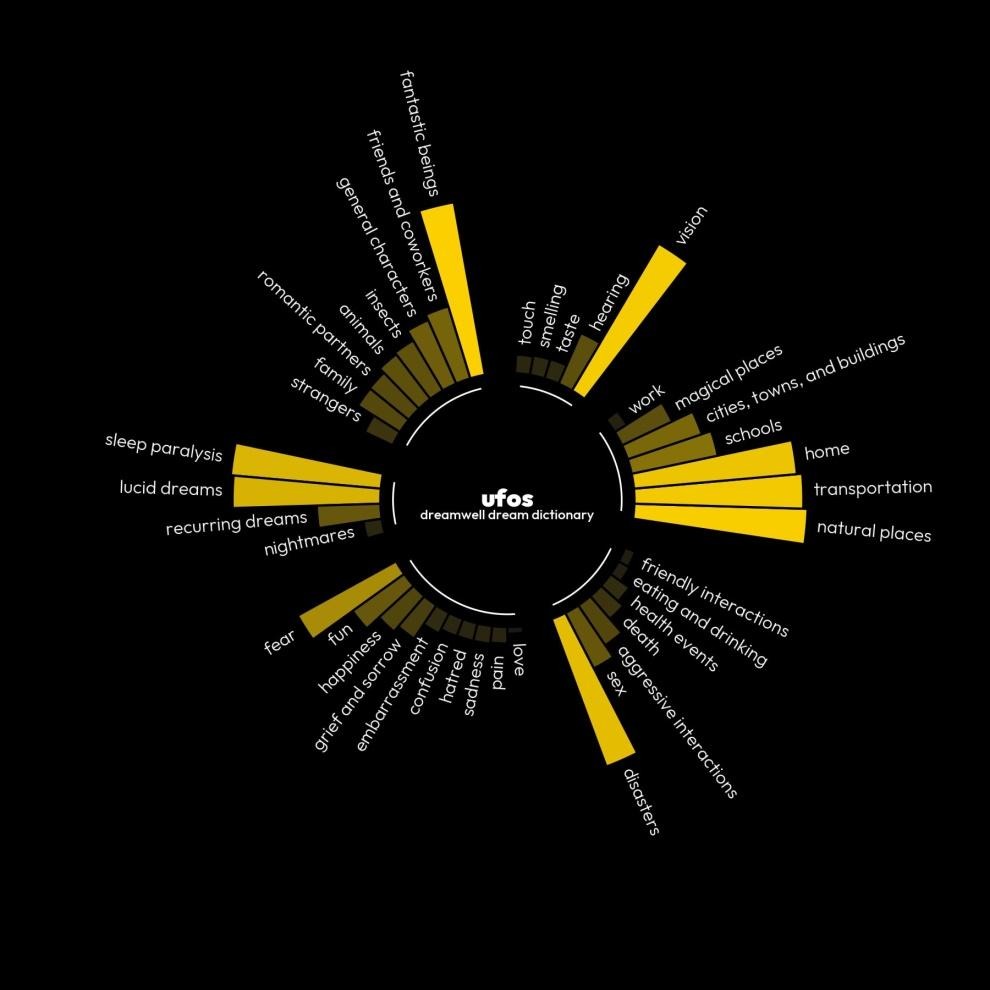
Note: This graphic summarizes an analysis of over 125k dreams available through the DreamWell Data-driven Dictionary, showing how topics in these dreams compare with the representative sample (https://dictionary.dreamwellbewell.com/dream-symbol/ufos).
Figure 2
Aliens in a representative sample of dreams
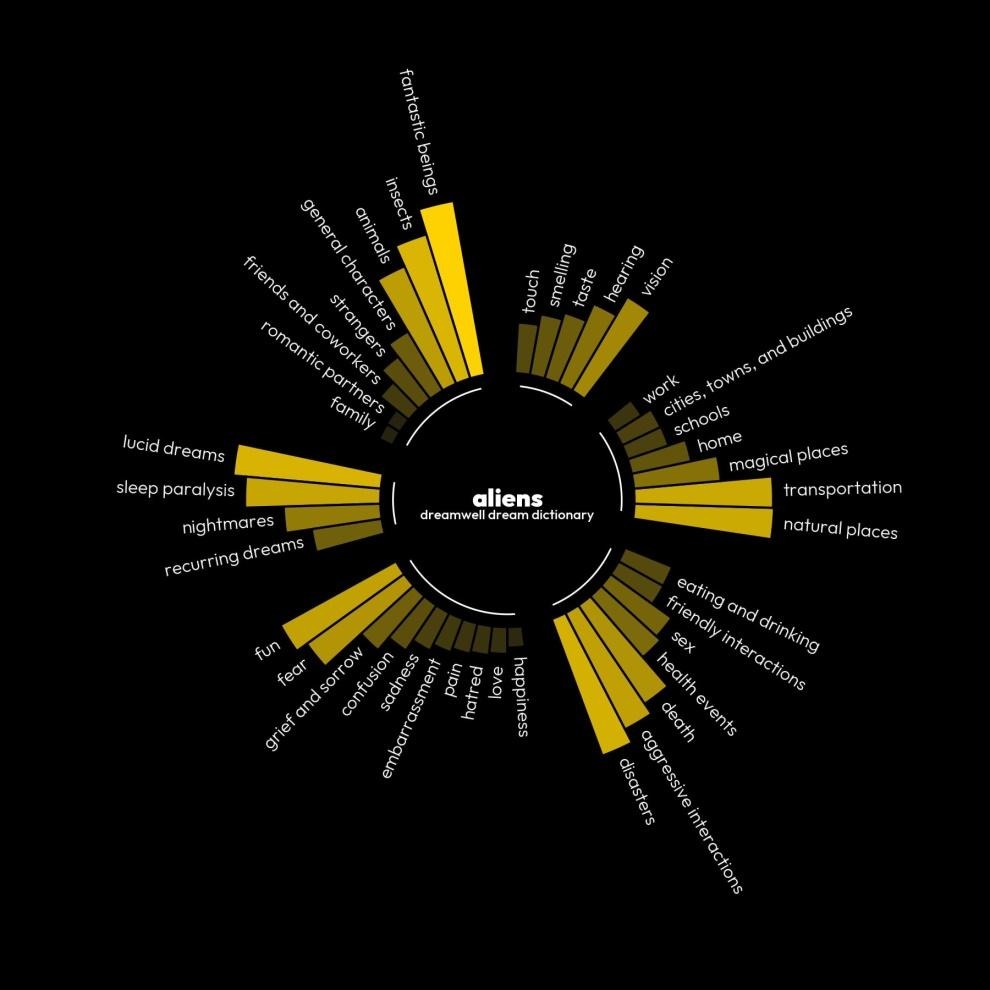
Note: This graphic summarizes an analysis of over 125k dreams available through the DreamWell Data-driven Dictionary, showing how topics in these dreams compare with the representative sample (https://dictionary.dreamwellbewell.com/dream-symbol/aliens).
Figure 3
Angels in a representative sample of dreams
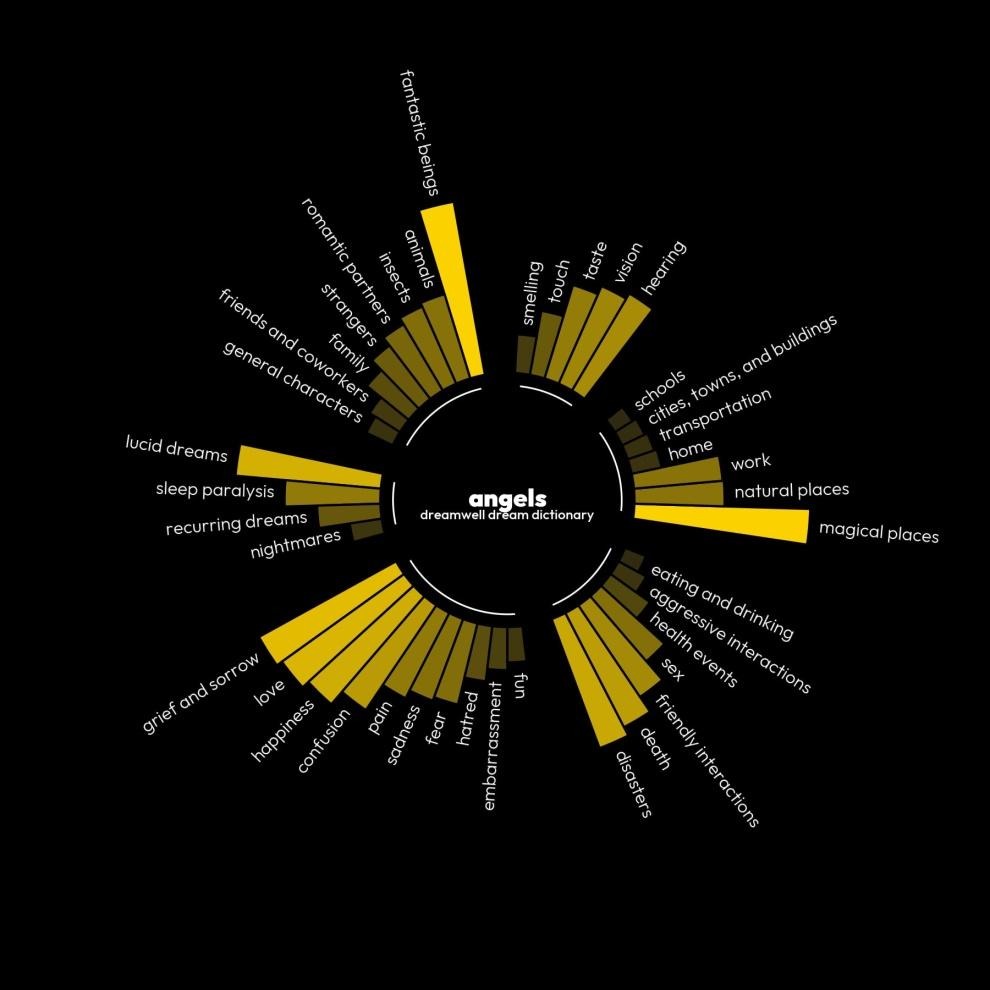
Note: This graphic summarizes an analysis of over 125k dreams available through the DreamWell Data-driven Dictionary, showing how topics in these dreams compare with the representative sample (https://dictionary.dreamwellbewell.com/dream-symbol/angels).
Figure 4
Ghosts in a representative sample of dreams
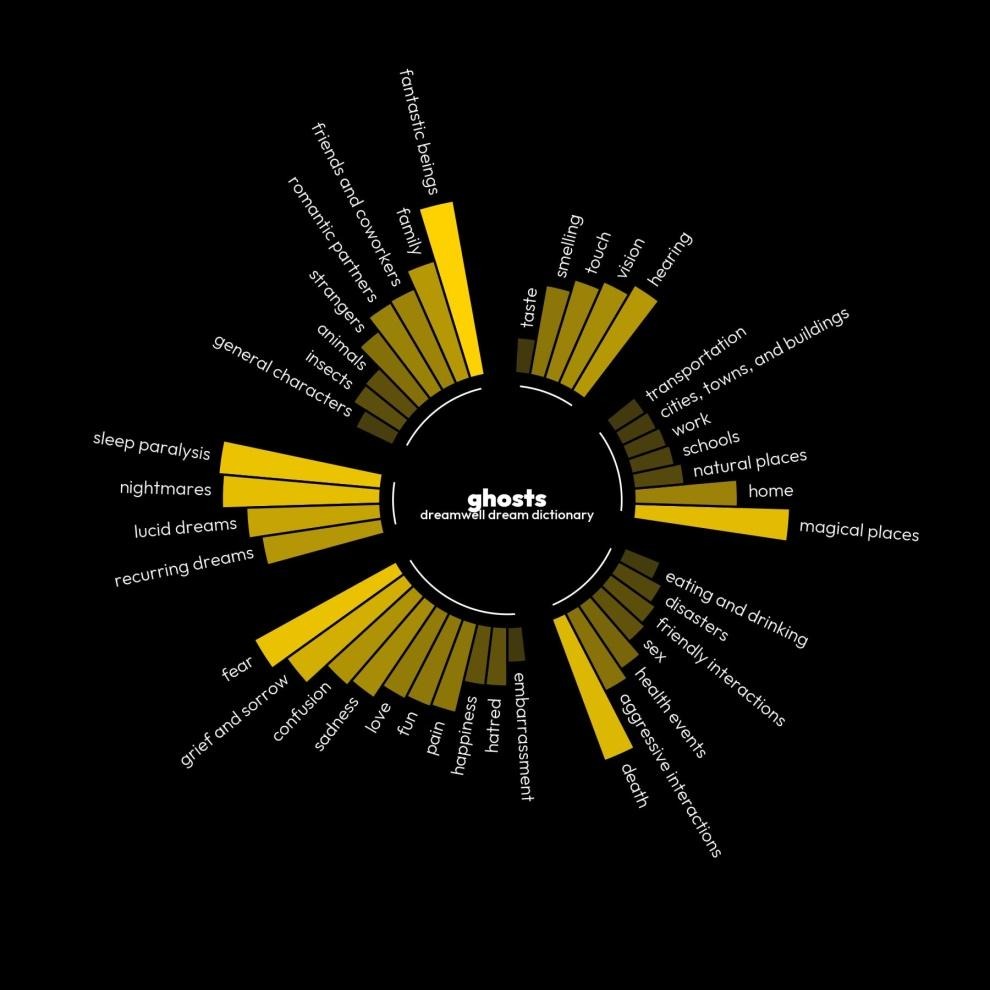
Note: This graphic summarizes an analysis of over 125k dreams available through the DreamWell Data-driven Dictionary, showing how topics in these dreams compare with the representative sample (https://dictionary.dreamwellbewell.com/dream-symbol/ghosts).
Figure 5
Spirits in a representative sample of dreams
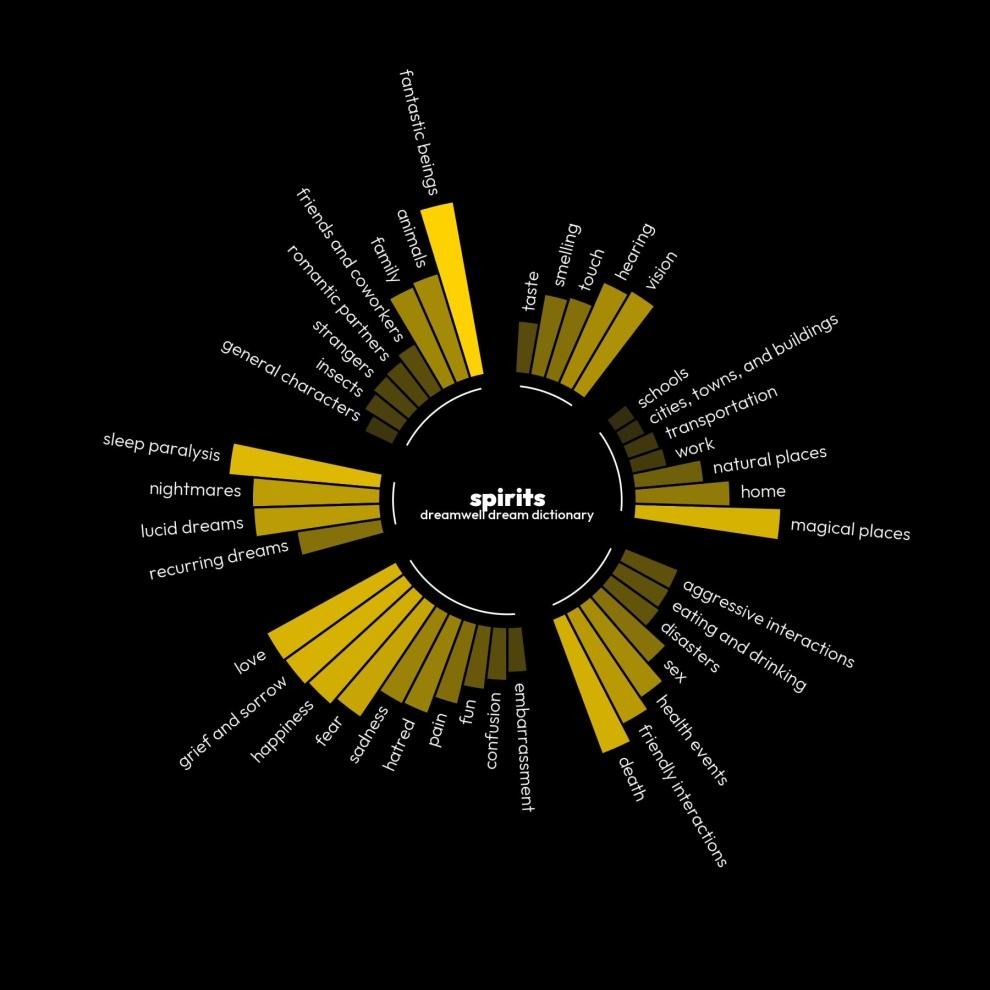
Note: This graphic summarizes an analysis of over 125k dreams available through the DreamWell Data-driven Dictionary, showing how topics in these dreams compare with the representative sample (https://dictionary.dreamwellbewell.com/dream-symbol/spirits).
Figure 5
Sleep paralysis in a representative sample of dreams
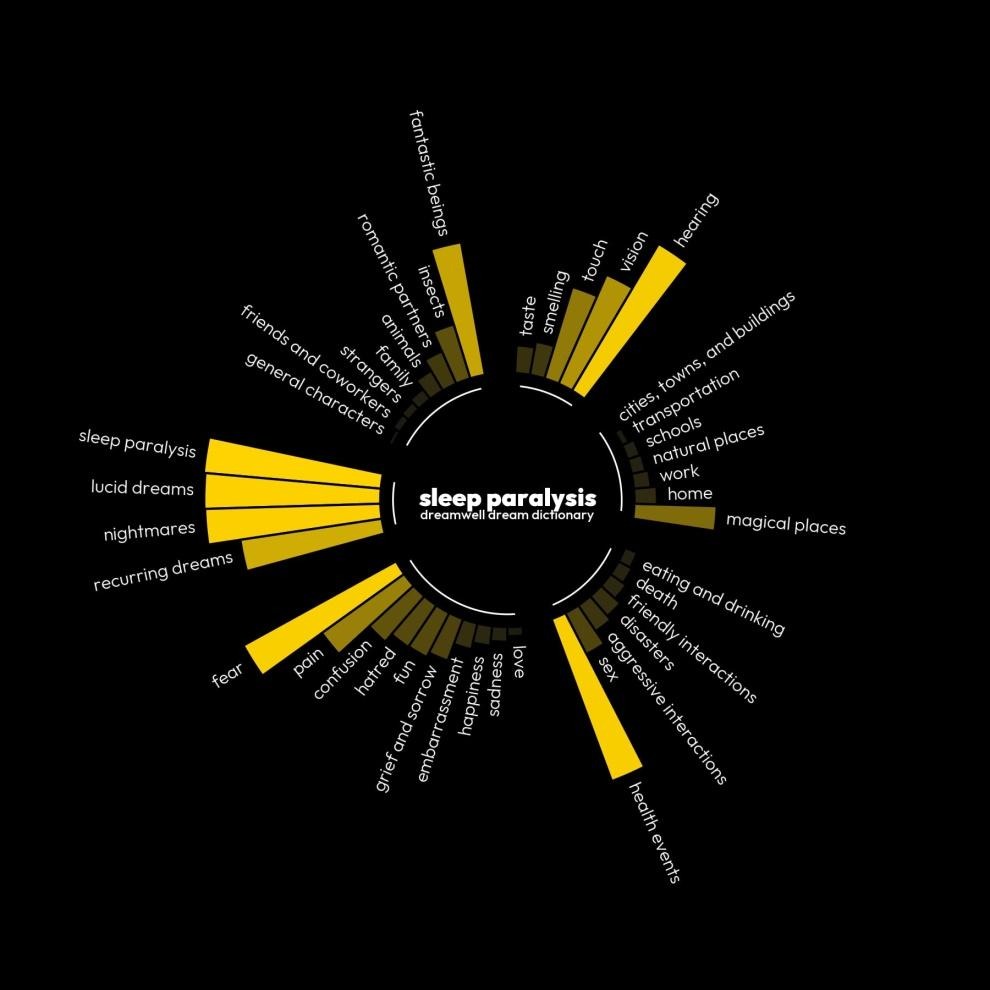
Note: This graphic summarizes an analysis of over 125k dreams available through the DreamWell Data-driven Dictionary, showing how topics in these dreams compare with the representative sample (https://dictionary.dreamwellbewell.com/dream-symbol/sleep-paralysis).
Figure 6
Lucid dreams in a representative sample of dreams
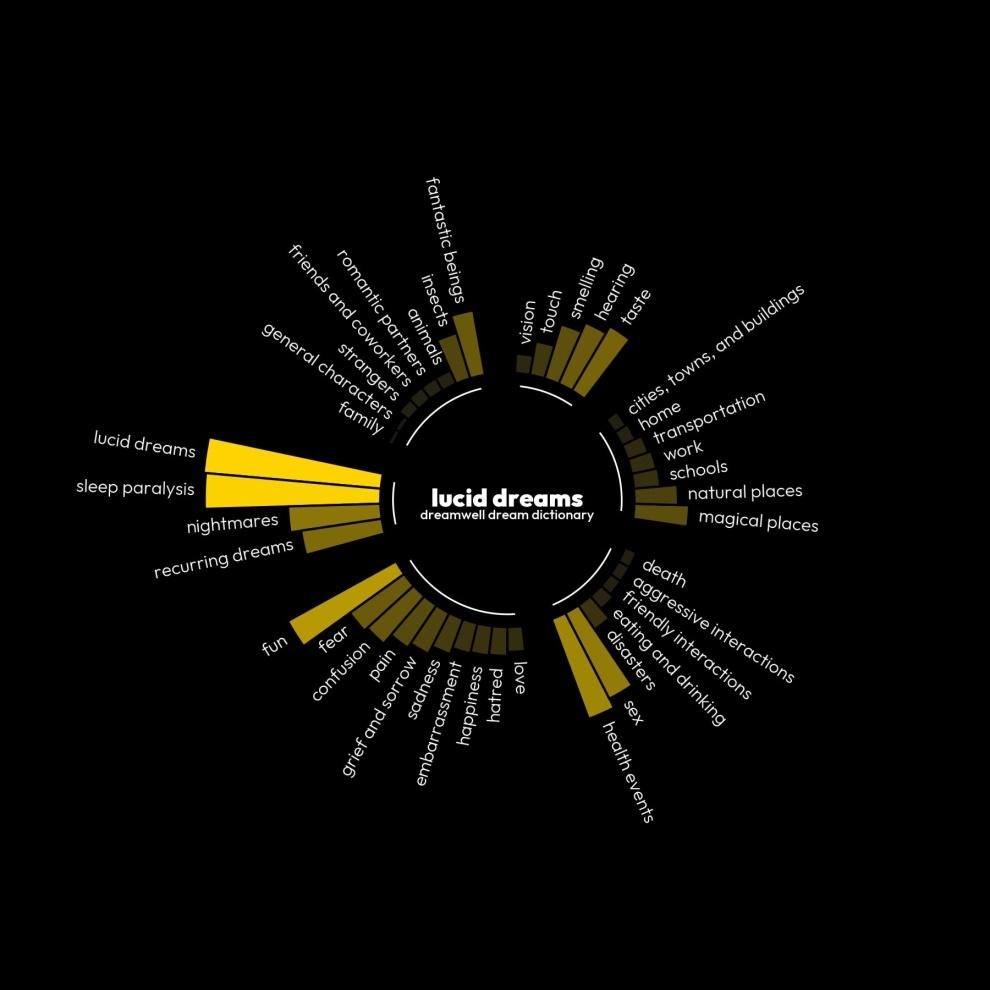
Note: This graphic summarizes an analysis of over 125k dreams available through the DreamWell Data-driven Dictionary, showing how topics in these dreams compare with the representative sample (https://dictionary.dreamwellbewell.com/dream-symbol/lucid-dream).
Figure 6
Screen capture of NORD reports
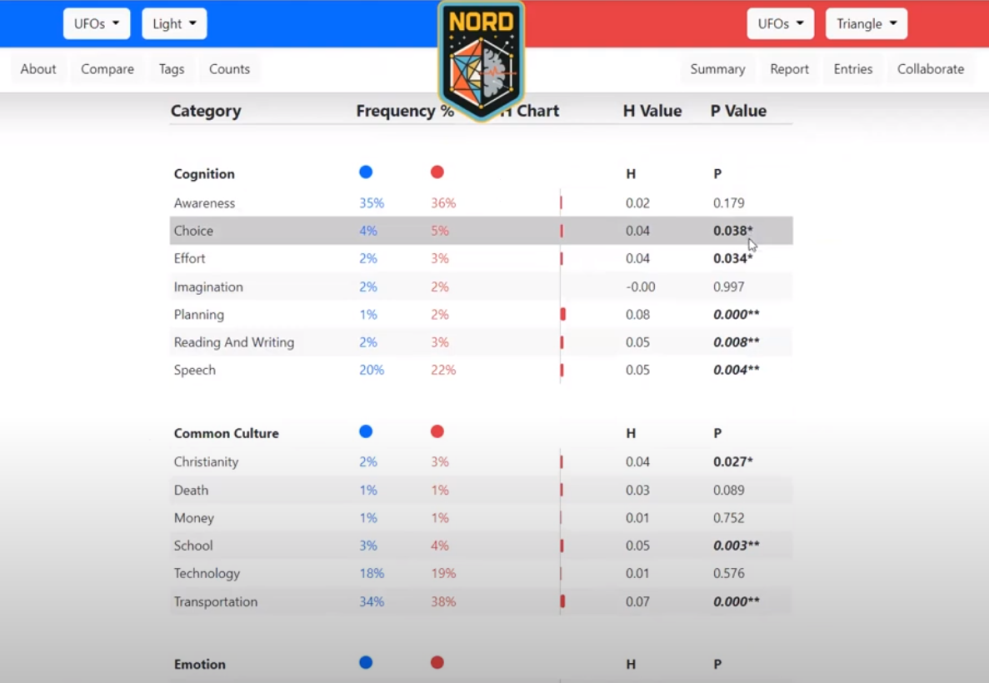
Note: This graphic is a screen capture of a video demonstration of NORD, the non-ordinary reality database (containing over 175k narrative). This report compared UFO sightings described as “light” with those described as “triangle” using standard dream content analysis methods to produce statistical statements. For example, we may conclude that words related to “choice” are statistically relevant to triangle UFO sightings when compared with light UFO sightings.
The NORD project was based on scalable cloud-based architecture to support real-time indexing, full-text search, and visualization features. The architecture has been archived pending research funding.
Figure 7
Analysis of sentiment and emotion in UAP and HICE reports
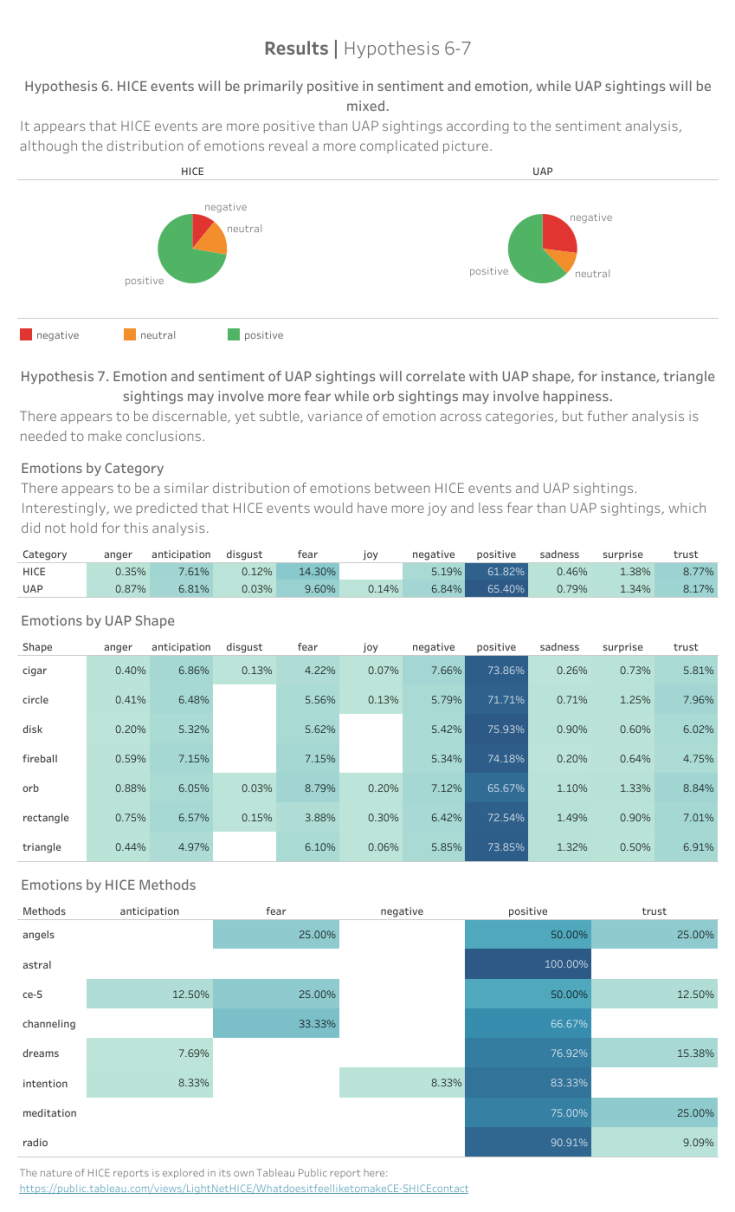
Note: This report compares the sentiment and emotions in HICE and UAP reports categorized by UAP shape or HICE method (https://public.tableau.com/app/profile/dseti/viz/UAPandHICEReports)
Links
D-SETI Youtube
https://www.youtube.com/@dseti
Video lectures and presentations on ET/NHI contact in dreams.
D-SETI Dreamwork
Online resources and personal hypnosis/dreamwork practice regarding ET/NHI contact in dreams, missing time, and NHI/UAP phenomena.
ETolemy
https://github.com/danielrekshan/etolemy
Open source UAP footage analysis and visualization tools.
UAP and HICE Reports Analysis
https://public.tableau.com/app/profile/dseti/viz/UAPandHICEReports
Comparison of 850 HICE reports with 10k UAP reports using NLP and content analysis of the report narrative.
Contact
Daniel Rekshan may be directly contacted at Daniel@dseti.org. Please feel free to reach out with questions or to a time to converse. He understands that the proposal will need several iterations and invites collaboration in refining the D-SETI Institute documents.
Please feel free to share these documents with interested parties.
Thank you for your consideration,
Daniel Rekshan