MISSING TIME FOUND
Don’t worry, it’s just a dream
A new and old hypothesis regarding ET/NHI and UFO/UAP associated missing time
Daniel Rekshan, MA, CHt
Copyright © 2023 Daniel Rekshan
All rights reserved.
ISBN: 9798858691945
Dear Reader,
Thank you for opening this book. The topics of UFOs, alien abductions, hypnosis, and dreams are not well understood in Western culture. Therefore, it is brave for you to even open up this book. Thank you for doing so. I hope that this book will inspire you to connect with your own dreams and consider your own potential experiences of ET/NHI contact in your life.
You are likely either skeptical about ET/NI contact or else a believer. If you are skeptical, you may find some of the dream-like tales of alien abduction or UFO sightings to be challenging to reconcile with your worldview. Likewise, if you are an experiencer or believer, then you may find that the central hypothesis of this book, which is that these experiences are dreams, to be challenging to integrate with your lived experience.
This book strives to reconcile both perspectives by presenting dreams as the primary precedent for missing time and ET/NHI contact, while also asserting that dreams are ultimately real. I believe that working with dreams of ET/NHI contact will inspire mathematical, technological, and social creativity that will bring humanity into a new golden age. Thank you for dreaming this new world together.
Daniel Rekshan
October 19, 2023
Books by Daniel Rekshan
Available on Amazon or D-SETI (https://dseti.org)
The D-SETI Quadrilogy
- Galethog the Grey’s Field Guild to Anomalous Geometry
- Missing Time Found
- Book of Galactic Light
- D-SETI Research Institute Proposal
Other Books by Daniel Rekshan
- The Alchemists’ Dream is Now Achieved
- Preface and Epilogue to the History of the World
- Prophecies for New Babylon
- On Realizing Divine Identity
- An Illustrated Guide to Practical Dreaming
Abbreviations
CE-5 – Close encounter of the 5th kind, synonymous with HICE
CETI – Communication with extraterrestrial intelligence
ET – Extraterrestrial
HICE – Human initiated contact experience
NHI – Nonhuman intelligence, synonymous with ET
SETI – Search for extraterrestrial intelligence
UAP – Unidentified anomalous phenomenon
UFO – Unidentified flying object, synonymous with UAP
Preface
Read this like a dream journal, not historical testimony
This book puts forward the hypothesis that extraterrestrial (ET) or nonhuman intelligence (NHI) contact experiences are dreamlike. Like many serious researchers, I observe the similarity between dreams and the strange tales of ETs and unidentified anomalous phenomena (UAP, formerly known as UFOs). Unlike many researchers, I say that their dreamlike nature makes these experiences more, not less, real. I personally believe that dreams are just as real as the physical waking world, but that they are subjective and require interpretation. The study of dreams requires you to study your own dreams because the contents of dreams are subjective and nondual.
As the book will reveal, our collective story of ET encounters and UFO abductions comes from the work of only around 10 hypnotists and 250 cases or so who published their theories and transcripts (see Table 1). Dr. Simon worked with the famous Hill case, which informed Budd Hopkins with Whitley Streiber, which in turn defined a generation of popular culture. Most of the 10 hypnotists believed that hypnosis could reveal historical facts about historical events (events happening in the shared physical world defined by the three dimensions of space and one dimension of time) through the enhancement of memory or the reduction of trauma or anxiety.
Nearly all of the published case studies of UAP-associated missing time involve the retelling of dreamlike experiences through several perspectives: the experiencer before hypnosis, the experiencer during hypnosis, and the hypnotist. Nearly all of the hypnotists report that their clients come to them with a dreamlike memory that feels strange. The hypnotist then tells the dreamer that their experience is knowable through enhanced memory or relaxing of the ego. The basic story is simple (see a similar story in Lynn & Kirsch, 1996):
- A dreamer considers a dreamlike memory, generally with the following qualities:
- Associated with a ET/NHI contact or UFO/UAP sighting
- Strange in the same way a dream is bizarre
- Inability to account for the passage of time
- An intuition that there is more to the dream like it is a screen memory
- An intuition that it is associated with ET/NHI
- Breadcrumb style evidence including the corroborating witnesses, physical evidence, film documentation, marks upon the body, etc.
- Dreamer encounters the notion that hypnosis can help recover or document the memory of missing time. In many cases, the hypnotist uses terms like regression and recovered memory to define their work.
- Dreamer meets with a hypnotist who suggests that their dreamlike experience is more than just a dream and may have clues to explain the evidence that something happened during the missing time.
- Dreamer and hypnotist share the dreamlike state of hypnosis to explore the memory. Generally, the session is recorded as a form of documentation.
- Dreamer and hypnotist discuss the experience immediately afterward. There may be a follow-up interview.
- Hypnotists write about their experiences, offering hypotheses about the world. Doubt, confusion, fanaticism, and a variety of other incoherent states of collective consciousness arise in response to the fantastic narratives of abduction that are presented as historic fact
Hypnosis typically involves induction of a trance state, then offering suggestions, which are thought to be effective in a similar way to placebos. In my view, it appears that the suggestions cause general confusion regarding missing time:
- Missing time episodes happen in a historic space time that is knowable through memory.
- The memory of the missing time experience is obscured by the trauma of the event, alien mind-control, or ontological shock.
- Hypnosis can mitigate these causes, thereby enabling the documentation of the neurologically-accessed memory (now psychologically liberated) of the missing time event.
- Hypnosis can lead to false memory syndrome, but avoidance of leading questions can simulate an objective perspective.
What if the hypnotists are wrong about the dreamlike nature of these missing time memories? What if these were actually dreams? What if dreams were much more than we ever imagined? What if the experiencers who first intrigued the hypnotist’s curiosity and speculation were actually right in their assessment that their missing time experiences were indeed dreamlike?
It would mean that we could understand and relate to the UAP/NHI phenomenon through the natural mechanism of dreams. It would mean that the whole ET narrative might not actually be so alien, foreign, or even modern. It would mean that you likely have had UAP/NHI-associated missing time experience and do not even know it, just like you ave had many forgotten dreams.
It took me nearly a decade to observe the similarities between dream, UFO, and abduction stories involving missing time. I knew that a majority of experiences happen during sleep and dream cycles. I knew that the ET contact experience is highly strange in the same ways that REM dreams are bizarre. I knew that sleep paralysis, out-of-body experience, and REM dreams are remarkably similar to the abduction phenomenon. But I did not observe the complete congruence of dreams and missing time until working with the people whose stories I present in this book.
The missing time experience is a dream that reveals this whole experience of life to be a dream. That is how the shadow people, spooky monsters in spaceships, or whatever they are, leave marks on the body and mind of these experiencers. They also reveal that we have no clue what dreams are and how powerful they can be.
It is important to note there are a few ethical principles of dreamwork that are relevant, which really encouraged me to be deeply open to the implications of these people’s stories.
- The dreamer is the sole authority regarding the significance of the dream, including its ontological significance.
- The study of dreams necessitates personal dreamwork.
- Working with dreams requires nondual awareness and participation.
- Dreams are multidimensional and may reveal new meaning upon each interaction.
Science understands that hypnosis may involve psi phenomenon, that it is relaxing and meaningful, but that it is not well understood and should not be used as evidence in most courts. There is general consensus that it involves relaxation and dreamlike states of consciousness. Therefore, I understand hypnosis to be a technique of inducing a dreamlike experience that responds to suggestions.
Dreams are psionic in nature and they do involve memory, so in a way, the ET hypnotists are partially correct. However, if they are dreams, then they need to be respected as dreams first and foremost. This involves requiring anyone who works with them to work with their dreams, which includes you. It requires everyone to understand that the dreamer is the one who gets to say if the ETs were physically real like a solid or a gas or if they were psychically present through any number of highly strange phenomena. It requires everyone who talks about these stories to know the difference between myth and logic.
The dreamlike stories of abduction and UFO sightings are hard for society to accept because our society has been so focused on logic. We think of everything in Cartesian planes, number lines, calendar time, proportions, and objective sciences. We want every fact to add up and for things to logically make sense. There are other ways of knowing than logic, which starts at irrational premises and unfold through reaching impasses. There is the mythic way of knowing, which is not made up because it is a truth that is spoken, not measured or captured. It requires you to listen to stories like when you were a kid and you knew that the magical beings on the TV screen were a story, but that did not change how excited or afraid you were.
The trouble with mythic ways of knowing in our society is that there are millennia of history involving the martyrdom of those who speak in mythic ways. Socrates, the father of Western Philosophy and written by Divine Plato, is one of the most famous examples and we will look at his life and death in this book to provide clues for how to relate to mythic ways of knowing.
Socrates talked about the limits of logic and the need for people to share their experiences through the mythic stories. We think of mythology as a curiosity cabinet of funny beliefs, but there may be more than can be cataloged by objective science. The mythic requires you to be present with the story in non-judgemental and non-rational ways, which is the definition of mindful presence. It invites your participation to experience.
When Socrates got to the limits of logic, he would often tell stories of his experiences of interactions with non-human intelligences in transcendent realms of consciousness. It appears that the UFO/UAP/ET/NHI experience has pushed our society to the limits of logic. I must follow the example of Socrates and present to you stories and mythology.
Please think of everything written in this book as mythic, not historical or objective. There are many contradictions between the experiences and my own hypotheses because reality is fundamentally irrational and that is okay because you are too. This book is a record of things said by earnest people who seem to me to be sane and trustworthy. I offer theory and interpretation from a credentialed and experienced perspective, but I can not tell you how any of this works or even how to make sense of it. I recommend you start a practice of mindfulness and work with your dreams.
This book is quite literally mythic. The etymology of mythic involves spoken word and nearly every chapter is derived from the transcription of recordings. This is the record of a series of dreamlike experiences, conversations, and academic inquiry. I present fascinating cases in a way that might feel objective, but they are not. For example, Dan Berg’s case is arguably the best-documented case of UAP-associated missing time with videos of him leaving and coming back from a missing time episode with concurrent video of a geosynchronous UAP sighting predicted in double-blind ways through automatic writing a year earlier. But the essence of his story is indistinguishable from dreams.
Mythic experience involves nondual participation, not objective investigation. After a series of fascinating regression sessions, we induced a deep trance and apparently remote-viewed his missing time encounter. He is not willing to say that what he saw in the session was what happened in the missing time event. But he is willing to share his story with the understanding that the hypnosis sessions were meaningful experiences but might not be memories at all. It is more important to him that you know that CE-5 (human initiated contact experience) is real and that you can make contact in ways beyond imagination that can change your life for the better.
As you read this book, please respect the experiencer by holding several simple principles in mind. Many of my collaborators expressed their desire for me to communicate and stress several ideas. We need to establish a safe context in which to share their dreamlike experiences. Before continuing, please consider and acknowledge the following items:
- The experiencer is the sole authority regarding the significance of their experience.
- They get to say if it was real, psychic, imaginal, spiritual, or whatever.
- We get to hear the story if we want, but we do not have to shift our worldview.
- The experience and its memory are multidimensional like a dream.
- The understanding and interpretation of the experience might change with time.
- It is okay to say the experience felt real and physical, then change your mind, or visa versa.
- The study of the experience requires you to work with your own experience through meditation, dreamwork, discussion, etc, therefore you will do this work today in whatever way is meaningful to you.
- Any logical conclusion based upon the mythic experiences is subject to change, which is okay even though the mind yearns for eternal truths.
- Facts, accurate history, and science in this field is sparse and subject to highly strange phenomenon, so please take personal responsibility for discernment and check any fact before assuming it is true.
- Assume a conversational level of truth in this book, not a rigorous level of truth as in a forensic investigation.
- Assume the experiencers and I are earnest. We are not deliberately lying, rather we are relating our experience the best we can, but we are not perfect.
- Assume people are bad at memory, but good with intuition, and that is okay.
- Remember that the world is made up of experiences and not facts, therefore you have to work with your own dreams in order to study dreams.
Introduction
This book presents a new and old hypothesis regarding the missing time phenomenon associated with unidentified anomalous phenomena (UAP), also known as unidentified flying objects (UFOs) and their mysterious occupants. Writing, or reading, about this topic is challenging because of several reasons. First, the topics are strange and have been ridiculed for nearly a century, although there is growing interest in academic, media, and political communities. Second, our language and theories are inadequate to accurately describe the phenomenon. For example, the appropriate terms have shifted from UFO to UAP and ET to NHI because of shifting theories about the phenomenon. Third, we each have our own personal experience that uniquely influences our personal understandings of the phenomenon, which may impact the very nature of ET/NHI contact for us. For example, it is possible to trace specific descriptions of UFOs or ETs back to popular publications such as Whitley Strieber’s Communion, the Betty and Barney Hill case, and even science-fiction depictions of aliens. While skeptics point to the influence of science fiction on alien abduction narratives as evidence for its unreality, the hypotheses presented in this book suggest that the influence of science fiction or fantasy on ET/NHI contact narratives is evidence for their dreamlike reality.
Key terms
There are several terms central to this book that should be defined at the start. All of these terms and topics are controversial, taboo, or problematic. While it is hard to fully define any one of these topics, most readers will understand what a UFO is, even though it is both unidentified and undefined. My choice of terms is based on popular usages at the time of writing and my personal biases. As the title of this book suggests, encounters with the occupants of UFOs or UAPs may not be lost to consciousness and therefore the UAP may actually be identified as a known object, which is the vehicle for the UAP occupants. Further, the hypothesis of this book implies that these encounters are actually normal for healthy cultures that engage in natural shamanic dreaming practices and therefore are not anomalous at all.
Any term applied to UFO/UAPs, ET/NHIs, and missing time must be understood as conventional and incomplete, which can be made complete only through your holistic inquiry into the phenomenon. The inquiry must engage your whole being inclusive of waking, dreaming, and sleeping states and therefore will involve both rational and irrational modes of meaning making. As I have cautioned in the preface, please use discernment when reading or thinking about these topics. I will briefly define the key terms in the introduction, then will provide more elaborate discussion throughout the chapters of this book.
Missing time
Missing time is the term for a phenomenon associated with ET/NHI contact and UFO/UAP sighting. It typically involves a gap in memory and an intuition that ET/NHI contact occurred during that time. Missing time may involve memories of dreamlike or strange events, often called screen memories because some researchers suggest they replace or screen the memory of the actual event. The term was popularized by Budd Hopkins’s book Missing Time (1981), which presented the hypothesis that invasive alien abductions were a primary cause of missing time because either the aliens directly controlled the memory of the experiencer or else the experiencer unconsciously repressed the memory due to its traumatic nature.
In this book, I will present the argument that unremembered dreaming is a natural precedent for missing time, which may or may not imply alien abduction. Missing time experiencers may remember their missing time events in the same way that they may remember their dreams. However, memory and dreams have a complicated relationship, which will be a theme of this book.
UAP/UFOs
Unidentified anomalous phenomenon (UAP) is a replacement term for the more familiar term unidentified flying object (UFO). Both terms appear to be euphemisms for technological craft controlled by non-human intelligences (NHI) that are often hypothesized to be extraterrestrial (ET). The term UAP was popularized during the recent dialog that arose after the 2017 New York Times article about secret UAP programs in the Pentagon. UAPs are characterized by the five observables, as put forward by Lue Elizondo, which are characterized by impossible physics like trans-medium travel or instantaneous movement (Sheaffer, 2019). Vallee and Davis (2004) have characterized UAP encounters with the term high strangeness, which expands on the impossible physics of the 5 observables with experiences like time/space dilation, paranormal events, and telepathy.
The shamanic dreaming hypothesis put forward by this book observes the phenomenological similarity of the highly strange aspects of UAPs and the highly bizarre qualities of REM dreaming. Just as the highly bizarre characteristics of night dreams, like impossible physics and fantastic characters, help us realize that we are dreaming, the highly strange characteristics of UAPs and their fantastic occupants might suggest that waking life is dreamlike.
ET/NHI
Non-human intelligence (NHI) is a term related to extraterrestrial (ET). Both terms refer to the entities or intelligences associated with UAPs who are encountered in the missing time episode. The shift from ET to NHI is well documented in Dr. Edgard Mitchell’s Foundation for Research into Extraterrestrial and Extraordinary Experiences (FREE) survey (Hernandez et al., 2018), which surveyed more than 3,000 experiencers of ET/NHI contact associated with UAP, all of whom asserted that they had never been diagnosed with mental illness and that they could consciously remember the encounter (not as a dream or through hypnosis). The researchers found that the respondents encountered many different types of beings, such as humans from the future or entities from other dimensions, and therefore shifted their language from ET to NHI.
The shamanic dreaming hypothesis implies that NHIs are real entities that are perceived by the experiencer through dreamlike faculties, which may be controlled by the NHI and influenced by the experiencer’s subconscious. Just as all the fantastic characters in a dream are simply aspects of the dreamer’s mind, so too may the various NHIs and experiencers of missing time discover that they are aspects of one consciousness. In the shamanic dreaming hypothesis, we must consider the possibility that waking life is like a dream and the fantastic beings encountered in the missing time episode invite us to wake up to the dreamlike nature of our life.
ET/NHI contact and alien abduction
ET/NHI contact and alien abduction are terms related to the missing time episode. Missing time is associated with alien abduction because of books like The Interrupted Journey by Fuller (1966) that told the story of Betty and Barney Hill and Missing Time by Budd Hopkins that presented the alien abduction hypothesis as an explanation for missing time. Alien abduction is a specific type of ET/NHI contact phenomena that often involves paralysis, movement against one’s will, and medical procedures. ET/NHI contact involves a variety of experiences. Only some ET/NHI contact events or alien abductions involve missing time, as demonstrated by the FREE survey, thousands of sane people have direct and conscious memories of ET/NHI contact. The FREE survey also showed that twice as many experiencers report ET/NHI contact with no abduction themes as those with abduction themes.
It is important to note that the researcher or hypnotist appears to play an active role in the distinction between alien abduction or ET/NHI contact. It has been noted that hypnotists can induce false memories in hypnotees and it has been asserted that influential researchers like Hopkins, Jacobs, or Mack consciously or unconsciously induce false memories based upon their conscious and unconscious worldviews. Some regression hypnosis proponents acknowledge the tendency toward false memory and assert that hypnosis, when done properly, can elicit veridical memories.
The shamanic dreaming hypothesis suggests that ET/NHI contact event is essentially a shamanic dream and requires shamanic intervention to mediate personal or collective fortune related to the event. Further, the shamanic dreaming hypothesis suggests that the focus on recovering memory and categorizing its contents is a culturally-specific notion. Just as waking up from a nightmare reveals the entire nightmare and its monsters to be a dream, so too does the recollection of missing time reveal all the phases of human experience to be something like a dream.
Experiencer, contactee, and abductee
Experiencer is a term similar to abductee or contactee and is used to signify the person involved in the NHI/UAP encounter and the subject of the missing time episode. It is intended to be a neutral term, unlike abductee that implies a sense of victimization or contactee that implies a sense of special selection. The term was recently used by the FREE survey and has been in common use since at least the 1990s, most notably by Dr. Mack (1996).
The shamanic dreaming hypothesis implies that everyone is an experiencer of NHI contact because everyone dreams. Just as many people think they do not dream or do not remember their dreams, so too many people do not think they have NHI contact or remember it. If unremembered shamanic dreaming is the most natural precedent for missing time, then we must consider that everyone who dreams may have had NHI contact but only those who actively remember their dreams have the tendency to remember their NHI contact experience. For those who do not habitually remember their dreams, the NHI contact experience may be understood as missing time.
Recovered memory
Recovered memory is a term that describes the narrative accounts about the contents of the missing time episode. While NHI contact may be directly and consciously recalled, as evidenced by the FREE survey, not all experiencers remember their contact and it is this gap of memory that we call missing time. Just like dreams, we may spontaneously recall the events or else use psycho-spiritual practices like hypnosis to encourage the recovery of the memory. However, the nature and validity of recovered memories is controversial. Anyone who engages in hypnosis should be aware of the controversies regarding recovered memory as evidence for sexual abuse that arose in the 1990s (Patihis et al., 2014). Many researchers and law courts no longer accept hypnotically recovered memories as evidence and recommend that forensic investigation substantiate any claims made regarding the recovered memory. Science has shown that the repression of traumatic events does not occur as originally imagined by the psychoanalysts like Freud, rather traumatic events are well remembered (Otgaar et al., 2022). Further, science has demonstrated that if a therapist suggests repressed memories occur, a client is many times more likely to report forgotten sexual abuse (Otgaar et al., 2022).
In the case of ET/NHI contact and alien abduction, the investigations often involve mysterious marks upon the body or witness testimony of UAPs, both of which will be explored in the case studies section of this book. While past life or alien abduction researchers may occasionally find that hypnosis produces veridical testimony, which may be substantiated through experiment or investigation, they find that hypnosis produces fantastic narratives that shift over time and respond to suggestion (Mills and Tucker, 2014). However, most scientists have not seriously studied dreams, otherwise they would have identified the contents of the hypnotic trance to be more like dreams than memories.
The shamanic dreaming hypothesis implies that hypnosis is a valid means of knowledge regarding the missing time episode only when considered to be like a dream, which occasionally brings forward veridical information but more often involves multiple layers of meaning that are irreducible to the waking memories. If the shamanic dreaming hypothesis is accurate, then we must consider the fantastic and dreamlike characteristics of the so-called recovered memories of missing time to be meaningful and beneficial in the same ways as dreams.
Regression hypnosis
Regression hypnosis is a term that refers to the use of hypnosis to recover memories regarding the missing time event. In the 1990s controversies, regression hypnosis was used by therapists to substantiate claims of sexual abuse that were later demonstrated to be false. Following the controversies, a number of scientists and researchers proved that hypnosis can produce false memories based upon the suggestion of the hypnotist (Otgaar et al., 2022). These studies have been used as justification to ignore hypnotic testimony regarding the missing time event, asserting that the hypnotist consciously or unconsciously implants false memories of alien abduction into their fantasy-prone clients. However, experiencers continue to seek the assistance of hypnotists and the public is fascinated by their stories, even though science is clear that hypnosis produces fantastic narratives and not recovered memories. The continued interest in missing time hypnosis, or its various derivatives like Mack’s relaxation techniques (1996) or Cannon’s quantum healing technique (1998), in the presence of definitive scientific studies that show hypnosis produces false and fantastic memories, demonstrates that something other than memory recovery is the point of the hypnotic trance.
The shamanic dreaming hypothesis implies that hypnosis is a shamanic journey and that the hypnotist is a shaman. The purpose of shamanic dreamwork is the benefit of the individual and the community through multiple layers and phases of elaboration, which may or may not involve memory. Modern western culture, from which regression hypnosis arose, is unique among Earth’s cultures in that it does not attribute reality to shamanic states of consciousness. The shamanic dreaming hypothesis invites us to consider that hypnosis is a natural way of working with our extraordinary dreams for the benefit of the individual and the community.
Shamanic dreaming
Shamanic dreaming is a term to describe a natural, indigenous, and nearly universal understanding of dreams and reality, but is actively rejected by modern Western culture as primitive. The universal aspects of shamanism have been explored by Western scholarship through the popular, yet controversial, work of Michael Harner (1980) and then later bolstered by cross-cultural anthropological studies. The controversies surrounding shamanism are associated with claims regarding colonization or appropriation that suggest the Western researcher extracts value from indigenous cultures like the exploitative extraction of resources. The controversies imply that Western culture is devoid of shamanic power and needs to exploitatively extract shamanic power from native cultures through the appropriation of artifacts and practices. However, it must be remembered that only the dominant worldview of some aspects of Western culture rejects shamanism. I personally avoid issues of appropriation by first exploring the shamanic aspects of my own genetic and cultural lineage, particularly through a) the practice of Enochian Magick derived from the work of the 16th century English magus John Dee, b) the study and practice of Platonism within the Western Liberal Arts tradition, and c) practice of dream incubation as exemplified by the Asclepian cults of the Greco-Roman world.
The shamanic dreaming hypothesis implies that the very nature of our reality is dreamlike and that our collective fortunes may be mediated through shamanic or dreaming practices. The shamanic dreaming hypothesis suggests that missing time and ET/NHI encounters are natural and may be a domain of mediation or negotiation of collective fortune. Further, the hypothesis suggests that each human is capable of navigating the missing time episode and negotiating with the associated entities using practices that are both culturally specific and universal. Rather than seeing missing time as a domain of victimization by alien entities, the shamanic dreaming hypothesis sees missing time as a symptom of the loss of shamanic power. Just as we may increase our capacity to remember and influence our dreams through rituals and practice, so too may we increase our capacity to remember and influence our ET/NHI encounters.
Monophasic and polyphasic
Monophasic and polyphasic are terms used to describe characteristics of cultures related to their worldviews and attribution of reality (Laughlin and Rock, 2014). These terms provide language to describe a cultural bias that you likely have encountered in modern Western culture. Both terms refer to the various phases of consciousness such as waking, sleeping, dreaming, shamanic states, and so on. Western and materialist cultures are monophasic because they attribute reality to only the waking phase of consciousness, while most other cultures are polyphasic because they attribute reality to multiple phases of consciousness. Westerners often imagine polyphasic people to be primitive people who need to be civilized through the progress of science and rationality over mythic ways of thinking. However, the notion of scientific progress over myth or magic is a relatively new invention that is correlated with the Industrial Revolution. Given that the history of mathematics and science is intimately intertwined with mythic and magical ways of thinking, it is clear that the notion of the civilizing force of scientific progress is simply a modern myth. Polyphasic people are just as intelligent and sophisticated as monophasic Westerners, however their sophistication involves multiple dimensions of meaning and experiences (the multiple phases of consciousness) that Westerners assume to be unreal.
It is important to note that most shamanic dreaming cultures emphasize the need for interpretation. While these cultures attribute reality to dreams, they would not assume that their nightly experiences are real in the same way that waking phase experiences are real. They understand that there are a variety of dreams, like everyday dreams or healing dreams, and that dreams require interpretation. The interpretation of dreams may be performed by anyone and everyone or may be performed by a specialized shaman depending on the dream.
The shamanic dreaming hypothesis of missing time invites us to move back to a more natural polyphasic perspective from the monophasic perspective associated with colonial industry. The lived reality of the ET/NHI encounter and the mystery of missing time demonstrate that reality is much greater than simply the waking phase of consciousness. In this way, regression hypnosis is actually a shamanic journey that reintegrates the experiencer with their polyphasic self. Therefore, the purpose of so-called missing time regression is not the extraction of veridical memories of waking phase events but rather the reintegration with the mythical, magical, and fantastic elements of the experiencer’s world.
Misattribution hypothesis
The misattribution hypothesis is a term that describes a common scientific explanation of ET/NHI encounters and alien abduction. Most researchers do not doubt that the experiencer of missing time or ET/NHI contact authentically and truthfully share their lived experience. While some skeptical researchers assert that ET/NHI contact stories are hoaxes, most researchers assume that the experiencers are telling the truth as they understand it. McNally and Clancy (2005) exemplify the skeptical perspective by asserting that the alien abduction hypothesis is clearly unreal and that the phenomenon is only one of personal belief. These researchers observed that sleep paralysis shares many characteristics with alien abduction and conclude that all alien abduction experiencers simply misattribute their sleep paralysis dreams to reality. Another recent researcher has demonstrated that lucid dreamers can emulate ET/NHI contact in their dreams to such a degree that other researchers can not distinguish between the dream narratives and the alien encounter narratives, then conclude that all alien abduction narratives may be simply misidentified dreams and therefore are unreal (Raguda, 2021).
The shamanic dreaming hypothesis accepts the observations of skeptical researchers that the ET/NHI contact experience and the hypnotically recovered memories of missing time are dreamlike in nature. It seems that the experiencers of contact, their hypnotists, and researchers all observed that the experiences are dreamlike. Believers say that their experience felt too real to be dreams, often observing that there is physical evidence like body marks or UAP documentation. Skeptics say that the experiences are too dreamlike to be real, often observing that the narratives are clearly derived from subconscious material like the archetypes of sleep paralysis or science fiction imagery. The shamanic dreaming hypothesis says that both ET/NHI contact and hypnosis are dreamlike, therefore are real but require interpretation. Further, the hypothesis suggests ways to interpret the experiences for the benefit of the individual and community. While the shamanic dreaming hypothesis may not directly involve universal claims about the existence of aliens or flying saucers in waking-phase consciousness, it does make the universal claim that each person is capable of interpreting their own experiences for their own benefit and the benefit of their community.
The shamanic dreaming hypothesis of missing time
This book presents the shamanic dreaming hypothesis of missing time. The hypothesis observes that the primary precedent for missing time is unremembered dreaming and that the primary precedent for regression hypnosis is shamanic dreamwork. The hypothesis attributes reality to dreaming and waking phase events and narratives. The hypothesis implies that every missing time narrative may have both imagined and conventionally real details, which requires the active interpretation of the experiencer. The imagined and dreamlike qualities of missing time narratives are not reasons to ignore the narratives, rather they become potent sources of meaning and transformation for the individual experiencers and their communities.
The shamanic dreaming hypothesis focuses more on how we know about the missing time episode and its contents than about what happens in the episode. It directly applies the ethics and epistemology of dreamwork to missing time narratives and their derivation from hypnosis. Rather than question if the narratives are real or not, the shamanic dreaming hypothesis assumes that they are real (like shamanic dreaming cultures assume dreams are real), but then invites discussion on the nature of the reality through ritual storytelling and interpretation. The hypothesis assumes that the contents of the missing time episode are culturally specific in the same way that the depictions of supernatural beings like angels or fairies are culturally specific.
The focus on the dreamlike nature of missing time events does not imply that they are illusory or unreal, rather the shamanic dreaming hypothesis attributes transformative and supernatural power to the missing time episode through the mechanisms of anomalous dream phenomena like visitation, telepathy, apportation, stigmata, bilocation, and so on. The shamanic dreaming hypothesis suggests that the entities and events of missing time are very real, but they interact with the physical-waking phase of reality through what we typically call supernatural. Like gods, angels, and nature spirits, the missing time entities appear through personal and transpersonal archetypes.
There are many precursors to the expression of the shamanic dreaming hypothesis in this book. While there are many rich and complex systems of shamanic dreaming, this book is particularly focused on the transition from monophasic to polyphasic perspectives and therefore is directly influenced by researchers and theorists who shifted from materialistic views to more expansive views. Carl Jung is a primary inspiration, particularly in his description of UFO events as archetypal and transpersonal (1978). Additionally, Jung pioneered the use of dreamwork instead of hypnosis within the therapeutic context, mirroring the shift from regression hypnosis to hypnotically-assisted shamanic dreamwork (Harpur, 1994). Jaques Vallee is a respected early researcher of the UFO phenomenon who started his research from a materialist perspective exemplified by the extraterrestrial hypothesis, then shifted his perspective to include psycho-spiritual dimensions, suggesting that encounters with UFOs and their occupants are mediated by the collective unconscious and other archetypes in his book Dimensions. John Mack provides the academic and professional precedent for working with experiencers through hypnosis for nondual purposes such as catharsis or co-participatory research. Mack’s first book Abduction focused on the use of hypnosis to explore the contents of the missing time event, while his second book Passport to the Cosmos used language like “powerful reliving” and “relaxation sessions” instead of hypnosis to explore the transformative spiritual aspects of the missing time episode.
There has been significant controversy regarding recovered memory and the ethics of hypnosis. The shamanic dreaming hypothesis resolves these controversies by identifying regression hypnosis as dreamwork, not as memory recovery. While dreams may trigger sudden recollection or knowledge of distant events, they are primarily imaginal experiences that require interpretation along multiple dimensions of meaning. The hypothesis suggests that dreamwork-like regression hypnosis is natural and universal, although it recommends shifting the language used to describe the dreamwork from its focus on regression and recovery or memory to the language of dreams.
The journey to find missing time
Now that we have established a clear set of terms, we can approach the discussion of the essential journey involved with the shamanic dreaming hypothesis of missing time, recovered memory, and ET/NHI contact. The basic premise is deceptively simple: it’s all a dream. If the shamanic dreaming hypothesis is accurate, then the discussion and testing of the hypothesis will be like going on a journey and arriving back at home.
The point of this book is not to convince you that aliens exist or that you can know about them through hypnosis, although both statements are probably true. The point of this book is to guide you from the monophasic perspective that dreams are unreal, through the strange and mysterious realms of missing time and ET/NHI contact, and back to the more natural and polyphasic perspective that dreams are real and that you are capable of working with them for your own benefit or the benefit of the community.
We started our journey with short definitions of interrelated key terms. As you may have already discovered, these terms are inappropriate for the phenomena they describe. We are dealing with something else besides psychic extraterrestrials who drive strange spacecraft, even though we are working with wild stories about these fantastic beings. Ultimately, the journey is very simple and involves only you. If the shamanic dreaming hypothesis is accurate, then we can see waking life like a dream and we must understand that each of us is capable of interpreting that dream for our collective benefit.
Just as nightmarish and fantastic experiences in dreams reveal that we are dreaming, so too do the ET/NHIs of the missing time experience reveal that life is like a dream. Just as we communicate with beings in our dreams through dream telepathy, so too do we have the experience of mind-to-mind communication with the ET/NHIs. Telepathy in nocturnal dreams is possible because all the characters arise in your dreaming mind. The shamanic dreaming hypothesis suggests that telepathy between human and non-human intelligences in the waking and dreaming phases of consciousness is possible because we are all in one dreaming mind together, which some might call the universe and others might call the mind of god.
The point of this book is to inspire you to personally and collectively work with your dreams and whatever dreamlike experiences you have of ET/NHI contact or missing time. It is to remind you that scientific, technological, political, and cultural progress unfolds through creative interaction with dreams and the characters in our dreams. A majority of ET/NHI contact events involve beneficial communications for the experiencer or community such as warnings of catastrophe, miraculous healings, ecological awareness, and so on.
If the shamanic dreaming hypothesis is accurate, then the missing time experience and our interactions with ET/NHIs must be understood as invitations to mediate collective fortune. Each event may be seen as a negotiation with technologically or culturally creative forces that may change the direction of human history, just like Socrates’s interaction with his daemon influenced Western philosophy or Descartes’s series of three dreams inspired by scientific method. Rather than seeing yourself as a victim or potential victim of alien abduction, the shamanic dreaming hypothesis invites you to see yourself as a co-creator of the experience and as someone who is capable of navigating the highly strange interactions with ET/NHIs for our collective benefit, just like you are the creator of your own nocturnal dreams and capable of navigating them.
The journey to find missing time may be expressed using the terms monophasic and polyphasic, which refer to the attribution of reality to one or many phases of consciousness. Anyone associated with modern Western cultures may have a monophasic bias, which denies the reality of dreams. While the polyphasic perspective, which attributes reality to all phases of consciousness including shamanic and dreaming states, is both natural and nearly universal, most Westerners are unaware that the polyphasic perspective is valid, available to them, and part of their cultural heritage. The journey to find missing time is simply a journey from the limited and unnatural monophasic perspective to the more natural polyphasic perspective. You can go on this journey right now by simply reflecting on how your own dreams or expanded states of consciousness have influenced you.
A brief history of missing time
The history of missing time and alien abduction is complicated and unclear. On the one hand, it is clear that the UFO phenomenon arose in cultural awareness in the 1940s with the Roswell crash and the alien abduction phenomenon arose in the 1960s with the Betty and Barney Hill case. On the other hand, proponents of the ancient aliens theory suggest that the ancient gods and angels of mythology may have been ETs. To complicate matters further, it has been noted that the descriptions of ETs and UFOs in hypnotically recovered memories of missing time have documented precedents in popular science fiction (Clark and Loftus, 1996). There are tales from every major religion of entity visitation in dreams or dreamlike states. The shamanic dreaming hypothesis suggests that something real happens in the missing time event, but that events are seen through a screen of personal imagery.
The specific focus of this book is on NHI/UAP-associated missing time and the so-called recovery of its memory through hypnosis. The phenomenon that we are discussing has several distinctive characteristics that have been noted by researchers such as Hopkins, Mack, and Cannon. The ET/NHI-associated missing time episode may be described as a journey from ordinary space-time, which is generally assumed to be physical/waking reality, that is initiated by extraordinary forces like aliens, ETs, or other supernatural entities. The experiencer is taken to another space in which procedures such as medical examination or communication happen such as telepathic warning of ecological shifts. There are common themes involving hybridization, mathematical or technical innovations, victimization such as abduction, and spiritual revelations. The return is typically abrupt and not well remembered with the experiencer discovering that they are back in physical-waking spacetime. The experiencers often return with the sense that no time has passed, then discover that hours have passed with no ability to account for the gap. Some experiencers discover physical evidence like strange marks upon the body, impossible movement of objects or bodies, miraculous healings, or UAP documentation including film or concurrent witnesses.
It is important to realize that we only know about the missing time experiencers who reported their experiences to researchers. These experiencers had to have noticed that time was missing, recollected enough details to suspect that NHIs or UAPs were involved, and intuited that the event and the recovery of its memories may be a source of significant meaning. The experiencer must have felt so moved by the experience that they sought for the aid of a hypnotist to recover the memory, then brave enough to share their stories. There is typically no material benefit for the experiencer to share their stories, which are often poorly received by the public because of the taboo nature of ET/NHI contact.
The practice of hypnosis is based upon the rapport between the hypnotist and the hypnotee. It is more of an art than a science that may be comparable to improvisational jazz. It has been noted that hypnotists may implant false memories or communicate unconscious suggestions during the trance. However, modern researchers have difficulty defining hypnosis or explaining how it works. Most proponents and critics of regression hypnosis assert that the purpose of hypnosis is the recovery of repressed memories. In contrast, the shamanic dreaming hypothesis suggests that the purpose of hypnosis is the same as shamanic dreaming, namely the mediation of personal and collective fortune through the ritualistic retelling of the dreamlike experience and its interpretation. In this way, it is only natural that the hypnotist, as well as the imagination of the hypnotee, consciously and unconsciously influences the contents of the hypnotic trance. Our history of missing time focuses on hypnotically relieved or imagined interactions with supernatural entities that are congruent with the modern ET/NHI contact phenomenon.
The history and field of missing time regression hypnosis is relatively small. It arose in popularity in the 1960s with the publication of the Betty and Barney Hill case. Publications about missing time regressions increased in popularity through Budd Hopkins’s work in the 1980s inspired by his books Missing Time and Intruders. The 1990s and early 2000s involved controversies about memories recovered through hypnosis. Despite scientific studies that suggest hypnosis produces fantastic and imaginative narratives, the topic of missing time and its recovered memories through hypnosis remains popular. Dozens of books have been published on the subjects, including scholarly research from respected institutions such as Harvard’s John Mack and Susan Clancy. The FREE Survey, which is the largest quantitative study to date on experiencers of ET/NHI contact, specifically rejected testimony derived from hypnosis because of its complications, which demonstrates the prevalence of regression hypnosis. Millions of people read ET/NHI-related content derived from hypnotic testimony such as Elena Dananna’s Gift from the Stars in the 2010s or Whitley Streiber’s Communion in the 1990s. Training systems like Dolores Cannon’s Quantum Healing Hypnosis Technique have trained thousands of practitioners, which have an explicit focus on the regression hypnosis to recover memories of past lives and missing time. Many schools of hypnosis practice regression hypnosis at the same time as disclaiming that hypnotically recovered memories are not a form of legal evidence.
Early hypnotists
Suggestion appears to be an operative and definitive principle of hypnosis. The basic idea is that the hypnotist guides the hypnotee into a relaxed or altered state, often called the hypnotic trance. Subjects in trance are thought to be more susceptible to suggestions, which the hypnotist uses to align subconscious activities to conscious goals like the shift of a habit, ignorance of pain, or recovery of memory. Science has clearly demonstrated that suggestion works through its continued use of placebos in clinical trials, which are sugar pills that have no physical effect but trick the patient into thinking they received a drug. Some placebo trials suggest miraculous healing may occur just through the power of belief, validating the common understanding of suggestion hypnosis.
Most trace the history of hypnosis back to Mesmer and his animal magnetism. Popular culture imagines hypnotists as something like sorcerers capable of forcing their subjects to their wills through psychological tricks or personal charisma. Hypnotists after Mesmer like Baird in the 18th century focused on hypnotic suggestions to assist with surgery or to bolster healing. Some New Thought authors used hypnosis for positive affirmations. Both Freud and Jung used hypnosis in their psychoanalytic practices, with Jung leaving it behind for dreamwork.
However, our modern view of hypnosis is confused and may be incomplete. In 2003, the American Psychological Association (APA) defined hypnosis as a technical practice to be performed by a qualified practitioner like a medical doctor or psychiatrist for clinical or research purposes (Green et al., 2003). In 2014, the APA redefined hypnosis to be a process that involves relaxation and suggestions that may be used for a variety of purposes including psycho-spiritual purposes (Elkins et al., 2015). There has been debate about whether hypnosis is a generalized process of suggestion or else specifically requires the use of the word “hypnosis”. Influential hypnotists like Erikson and Mack admit that hypnosis is highly personal and even nondual, which suggests that it is not naturally suited to science in the same way as pharmaceuticals or medical procedures. Most modern theories of hypnosis rely on the science of placebo to explain how it works, even though the mechanisms of placebo are not well understood.
In the shamanic dreaming hypnosis, we see that hypnosis is a generalized shamanic dreaming ritual in which the hypnotist serves as a shaman to help control a trance that involves a dream for a specific purpose. A characteristic of shamans within polyphasic dreaming cultures is the capacity to control and interpret a dream state for the benefit of the individual or community (Laughlin and Rock, 2014). Science has consistently shown that hypnosis produces altered states similar to dreams with narrative content as fantastic and imaginative as dreams. Deidre Barrett (1997) in her dissertation study on hypnotic dreams demonstrated that hypnosis suggestions may induce dreamlike experiences. While there are many varieties of dreams, some dreams precipitate miraculous healings, communicate nonlocal knowledge, and mediate relationships with celestial or supernatural entities.
The shamanic dreaming hypothesis observes that the history of hypnosis may focus on a special case of natural shamanic dreaming practices that involves the generation of a dreamlike trance for specific purposes by a specialized practitioner. The earliest record in Western history may be the dream incubation rites of Asclepius, the god of dreams and medicine, from the ancient Greek world. Supplicants would visit Asclepian temples to have healing dreams that were guided and interpreted by priests. Interestingly, mythology describes Asclepius as a shape-shifting reptilian entity who now lives in the sky and may bring healing or knowledge, which is a description that applies to many ET/NHI encounters described in the FREE survey. Neoplatonic theurgy of late antiquity may also be a precedent for hypnosis because it involved pairs of practitioners that used rituals to enter trance states to communicate with daemonic or divine entities.
The clearest early precedent for ET/NHI hypnosis is the 16th century English scholar and magus John Dee. Dee performed a series of angelic communication rituals with psychics like Edward Kelley, in which Dee would question angels through Kelley much like a missing time hypnotist would question the hypnotee. Similar to like missing time narratives, the contents of Dee’s rituals were fantastic and imaginative, with clear references to known magical and angelic texts of the day. However, they produced a system of language that Dee called celestial or angelical (often called Enochian in modern times) that embedded highly complex mathematics that are said to produce miracles through the intervention of the angelic beings. It must be noted that many of the descriptions of angels and supernatural beings are highly similar to the variety of creatures described in ET/NHI contact literature like small blue dwarves, feathered humanoids, and beautiful angels. The shamanic dreaming hypothesis puts forward John Dee as the primary modern precedent for missing time hypnosis, not Mesmer, because of his focus on celestial communication and his practice outside of clinical or research goals.
Betty and Barney Hill
The most famous case of missing time regression is the Betty and Barney Hill case. Betty and Barney Hill were driving through New England one night in 1961, saw a UFO, experienced missing time, then suffered from physical and psychological issues. The issues caused them to seek the help of Dr. Benjamin Simon who suggested hypnosis. The case was later published by John Fuller in his 1966 book The Interrupted Journey, then adapted for film in 1975. The case directly or indirectly influenced nearly all of the missing time hypnotists including Budd Hopkins and Dolores Cannon.
According to conventional theories of NHI contact and hypnosis, the case represents an early account of alien abduction and one of the first uses of hypnosis to recover memory. At the time, Dr. Simon was exploring the use of hypnosis and potent concoctions of drugs he called “truth serums” to make docile World War II veterans suffering from PTSD who overwhelmed his hospitals. He used a highly directive and aggressive style of hypnosis to establish forceful control of his clients. Modern hypnotherapy benefits from the recovered memory controversies of the 1990s that brought awareness that the hypnotist may unconsciously implant false memories or influence the recovery of memory. It is no wonder that the recovered accounts read like a nightmare from a man engaged in medically treating war veterans, such as the presence of military men and medical experiments. While the Hills asserted that their hypnotically induced narrative accounts of their missing time episode were recovered memories, Dr. Simon insisted that they were something like a shared dream.
The shamanic dreaming hypothesis affirms both the Hill’s perspective that their memories are real and Dr. Simon’s perspective that the experience was a shared dream. Shamanic dreaming cultures acknowledge that dreams are real. Western scholarship has observed anomalous dream phenomena like miraculous healing, stigmata, and even apportation in which objects from dreams appear in waking life (Krippner, 1994). In this way, the missing time episode may be a real interaction with real entities that has real consequences, as the Hills asserted. At the same time, the missing time episode may be reintegrated into waking phase consciousness as if it were a dream, as Dr. Simon asserted.
Budd Hopkins
Budd Hopkins may arguably be the most influential researcher into alien abduction using hypnotic regression because of his writing and direct influence on storytellers and researchers. The modern artist turned abduction researcher published two books including Missing Time and several articles in the 1980s and 90s, as well as facilitated experiencer groups and connections between experiencers and hypnotists. His books published dozens of case studies, drawings of craft and ETs, and several photographs of body marks associated with missing time. John Mack, the influential Harvard psychiatrist, dedicated his book Abduction to Hopkins. David Jacobs, the Temple University history professor, published scholarly research was directly influenced by Hopkins. While Jacobs focused on the negative and invasive aspects of missing time narratives, Mack explored greater psycho-spiritual implications of the narratives.
Hopkin’s influence may be measured by the popularity of Whitley Streiber’s abduction stories. Whitley Streiber wrote that interaction with Hopkins led to the discovery and publication of his missing time narratives in the best-selling book Communion. The book published several major abduction tropes such as body probing and medically focused ETs. The cover art of Communion, which features a gray alien face, is commonly cited by many modern experiencers as creating an uncanny feeling that inspired deeper investigation into their own missing time events. Thousands of people wrote personal letters to Streiber to describe their own similar experiences, which have been collected into the Archive of the Impossible at Rice University.
Hopkins did not perform hypnosis for his research subject, rather his role was to convince people he suspected were abductees to undergo regression hypnosis typically with Dr. Aphrodite Clamar. Clamar was a clinical psychologist who used hypnosis in her practice, but was not interested in UFOs or abductions before Hopkins worked with her. Hopkins was directly inspired by the Betty and Barney Hill case and naively believed that hypnosis could effectively recover memories. Clamar assumed that hypnotic regression could bring forward a reliving of probably traumatic events associated with the missing time. Although Clamar admitted that hypnosis alone can not substantiate claims of alien abduction in her afterward to Missing Time, Hopkins published notes about the increasing popularity of regression hypnosis in forensic investigation.
Hopkins’s work must be reconsidered in the context of the 1990s controversies regarding hypnotic regression and subsequent research that suggests that narratives derived from hypnotic trance are more imaginal than veridical. Hopkins, like many abduction researchers, see the similar patterns that emerged from hypnosis to be evidence for alien abduction. However, it appears that dream accounts of abduction do not differ in content or themes that those that arise from authentic regression hypnosis (Raguda et al., 2021). Therefore, the patterns observed across many different abduction cases may be explained the same way as similar dreams, fiction, myth, or cultural stories. Jaques Vallee, in his book Dimensions, has found precedent for the archetypes of alien abduction stories within fairy folklore, which also involves impossible physics, fantastic beings, supernatural lights, missing time, and strange marks upon the body or ground.
Critics of regression hypnosis often suggest that the testimonies derived from hypnosis are invalid means of knowledge (Lynn et al., 2020). They might say that Hopkins’s assumption that the missing time episode was a traumatic interaction with aliens may taint the hypnotic testimony because his unconscious bias implanted false memories in the hypnotee. Some skeptics go so far as to say that this sort of research is unethical and dangerous because it fosters the belief in alien abduction or other fantastic tales. However, if the shamanic dreaming hypothesis is accurate, we may see that the imaginative nature of hypnosis and the influence of the hypnotist or researcher on the hypnotee are natural, universal, and perhaps necessary to resolve the psychological tension introduced by the missing time event.
The shamanic dreaming hypothesis suggests that the entire process from the missing time episode to its reliving in regression hypnosis is essentially dreamwork. The only ethical issue regards the interpretation of regression hypnosis as memory recovery. Rather than seeing regression hypnosis as a tool for forensic investigation through memory enhancement, the shamanic dreaming hypothesis sees regression hypnosis as a shared dream regarding the missing time episode that responds to the intentions and suggestions of both the hypnotist and hypnotee. Just like past life regressions may resolve present life psychological tensions, the dramatic reliving of the missing time episode may resolve similar tensions for the ET/NHI experiencer. In this way, the role of the researcher or hypnotist is more like a shaman or priest than an investigator.
John Mack
John Mack was one of the most credentialed and prestigious researchers of missing time and its exploration through hypnosis. Mack was a Pulizer-prizing winning author, Harvard psychiatry professor, prolific researcher, and author of two books on the subject. His controversial work with abductees was investigated by Harvard and was found to be academically sound. Mack’s respectable credentials provided deeply needed legitimacy to the strange field of abduction research.
Mack’s work provided several major contributions to missing time research. First, his clinical work established that alien abduction and missing time are not symptoms of psychopathy and can not be explained through conventional models of psychopathy. Second, he provided sound ways to work with and study experiencers, particularly through his reinterpretation of regression hypnosis techniques as powerful relivings within conscious relaxation sessions. Mack understood the sessions to be nondual, admitting that they were imaginal experiences co-created by the hypnotist and hypnotee. Third, Mack’s investigations revealed themes involving spiritual transformation and ecological sensibilities, rather than only the invasive abduction narratives previously described by Hopkins and other researchers. Finally, Mack’s work established theoretic lenses through which to view the phenomenon that included cross-cultural awareness.
The shamanic dreaming hypothesis relies on the foundation of Mack’s work. His interpretation of the hypnotic regression as a nondual and imaginal experience is congruent with shamanic dreaming. His focus on the spiritually transformative aspects of the missing time phenomenon over the establishment of their physical reality provides an example for how to conduct research in support of the shamanic dreaming hypothesis. Finally, his description of the spiritual themes of missing time episodes, particularly through his book Passport to the Cosmos, may be used to establish a clear and direct connection between the abduction phenomenon and shamanic dreaming.
Clancy and McNally
Harvard University has produced two diametrically opposed perspectives regarding abduction and missing time. On the one hand, John Mack conducted influential research into the topic from a non-skeptical perspective. He established that alien abduction is not a symptom of psychopathy and pioneered paths to study the spiritually transformative aspects of the experience, while shifting his focus away from establishing the physical reality of the phenomenon (although he admitted it may be physical at some level). On the other hand, Harvard researchers Clancy and McNally, performed skeptical studies that demonstrated hypnosis to produce false memories. Their research assumed that alien abduction and missing time narratives are clearly unreal and false memories, putting forward the hypothesis that most such events are misidentified sleep paralysis.
It is clear that their research responds to Mack’s work and may be seen as an attempt to distance Harvard University from Mack’s strange claims. McNally and Clancy performed studies that showed that hypnosis produces false memories and that experiencers were more likely to be classified with schizotypy than non-experiencers. Schizotypy is an inconsistently defined psychological category that is sometimes referred to as a precursor to schizophrenia. Their explanation of missing time is simple: abductees are schizotypal people who experienced sleep-paralysis, of which they were unaware, so they mistakenly attributed reality to the dream. They suggested that the experiencer lacked concrete memories of the dream, which they later filled in according to the unconscious suggestions of hypnotists who believe in the alien abduction narrative.
Clancy (2005) admitted that most experiencers rejected her hypotheses as out of touch with their lived experience. It is easy to be offended by their classification of experiencers as schizotypal or their blanket explanation of misattributed sleep paralysis because the terms sound clinical and may seem as if they are part of a clinical diagnosis of psychopathy. While Clancy’s writings made fun of the strange behavior of her survey respondents, that is those who believe they were abducted by aliens, her research did not associate alien abduction belief with psychosis or psychopathy.
Clancy and McNally’s research made similar conclusions to Mack in several respects. First, as noted, they did not identify a causal relationship between psychopathy and belief in alien abduction. Clancy and McNally assumed that the belief was something like a delusions similar to belief in the physical reality of angels. Second, all researchers observed qualities of openness, imagination, and intuition among abductees. Mack casually described the qualities as open and intuitive, while Clancy scientifically described the qualities in terms of fantasy-proneness and absorption.
Finally, the researchers attributed spiritual qualities to the abduction experience or its impact. Clancy and McNally explained that the tendency to hold the false belief or memory of alien abduction may be motivated by spiritual yearnings unmet by modern society, while they expressed their own belief that any memory of alien abduction is simply fantasy and unreal. Mack did not explain the phenomenon, rather he simply observed the tendency toward transformative spiritual growth in his clients. Mack also participated through the nondual qualities of his sessions that dissolved the boundary between hypnotist and hypnotee because of the transpersonal foundation of hypnotic trance.
The shamanic dreaming hypothesis accepts the conclusions of Clancy and McNally regarding false memory in hypnosis, fantasy-proneness, and the association with schizotypy because these conclusions were derived from peer-reviewed science. However, the shamanic dreaming hypothesis rejects the assumption that the experiences are unreal because they are fantastic or reported by people who are imaginative, intuitive, and open. The hypothesis suggests that the ET/NHI contact experience is like a dream, which is forgotten or remembered in the same way that REM dreams are forgotten or remembered because they are a special type of dreaming (just as waking experience may be a special type of dreaming and not a shared physical reality). In this way, it is natural and obvious that imaginative and fantasy prone people would experience and remember their ET/NHI contact more than people who do not value imagination and fantasy.
Dolores Cannon
The impact of Dolores Cannon’s work on contemporary missing time regression hypnosis and its derivatives can not be overstated. Cannon wrote many books on the subject, drawing dozens or hundreds of case studies. Her training system, the Quantum Healing Hypnosis Technique (QHHT), has produced thousands of basic level practitioners and hundreds of advanced practitioners, as well as inspiring several other hypnosis or healing training systems. Her book, Custodians: Beyond Abductions, presented stories about the ET/NHIs and why they are interacting with humanity, not just the fact that these mysterious missing time episodes happen. While academia was debating about false memories and fascinated by the victimization accounts of abductees, Cannon pioneered an effective system to explore a holistic vision of the ET/NHIs and their realms.
While Cannon’s hypnosis and healing system is clearly popular, it lacks the scholarly sophistication of Mack’s system or the scientific rigor associated with the Clancy studies. However, she practically applied her training in hypnotherapy through collaborations with MUFON, the mutual UFO network, and other clients. Her method involves inviting the hypnotee into a deep state of trance that she called the somnambulistic state, which is a word that literally means sleep-walking. The term was used by Dr. Simon in his Betty and Barney Hill case study, but is no longer used in hypnosis outside of QHHT. Once in deep trance, the hypnotee is invited to engage in free-form imagination guided by an intention, which may be to remember a missing time event, past life, or another motivation. Channeling is common in QHHT, during which the hypnotee will speak for parts of themselves, their higher self (a term roughly synonymous with the soul), or the telepathic entities discovered within the missing time regression.
Her system was developed under the cultural assumptions about regression hypnosis that were common in the 1980s and 1990s, namely the assumption that the regression hypnosis primarily deals with veridical narratives and not fantastic or dreamlike experiences. Her missing time work was directly informed by her work with past life regression, through which she wrote the contents for her book Conversations with Nostradamus that chronicled her verbal conversations with the 15th century prophet channeled through the voice of her entranced clients. Her work does not neatly fit into academic categories. While the academics point to the spiritual and transformative aspects of missing time and regression hypnosis, she developed a rich system to experience and apply those aspects for the purposes of healing and wholeness in the client’s lives.
Scholarly and scientific research has largely ignored her system, which is strange given the magnitude of her contribution to the field. While her work lacks the academic sophistication, it is not different in kind from the work of researchers like Budd Hopkins or David Jacob, although she was actually trained in hypnotherapy. Her work likely was ignored because of a combination of her practical sensibilities and her refusal to stop at the limits of physicality such as with evidence or abduction. Her work actively incorporates spiritual aspects and was inspired by telepathic communications that she attributed to the NHIs. In other words, her work was too far out in the domain of spiritual experience for mainstream academia to accept.
The shamanic dreaming hypothesis is directly informed from my own experience with QHHT and the derivative Beyond Quantum Healing (BQH) modality. There are several characteristics of quantum healing (QHHT and its derivatives) that align particularly well with the shamanic dreaming hypothesis. First, the goal of quantum healing is not the recovery of memory or production of veridical testimony, rather the goal is the holistic healing and actualization of the client that is directed by the client’s own intention. Even though quantum healing has used the terminology of regression hypnosis, its practical application is clearly spiritual and dreamlike rather than forensic and investigative. Second, the session itself is very dreamlike and may involve direct telepathic interactions with NHI entities, as described by the session participants. Third, quantum healing attributes reality and power to the entities encountered in trance, understanding that interactions with those entities through trance may mediate the well-being and fortune of the client. Finally, the system involves interpretation of the session through conversations between the hypnotist and hypnotee, as well as through sharing of personal testimony within the greater quantum healing community.
Quantum healing appears to be more like shamanic dreamwork or spiritual counseling than clinical or research focused hypnosis because its practitioners engage in the control and interpretation of the dreamlike trance, while honoring the reality of the trance to mediate individual and collective fortune. However, the language of regression hypnosis and recovered memory is clearly inappropriate to the system and must be seen as a cultural legacy. There is general confusion about how the trance is real and what level of truth the regressions have. For example, Elena Danaan in her Gift from the Stars wrote that hypnosis cannot lie, which she used to substantiate her fantastic stories of abduction by evil gray ETs and her salvation by nordic ETs that were recovered through a quantum healing session. Danaan has amassed a social media following of hundreds of thousands of people by interpreting the missing time and ET/NHI contact narratives of other people based upon telepathic messages she received through an alleged alien communication implant. If ET/NHI contact is dreamlike, then her direct interpretation of other’s narratives is problematic because it violates dreamwork ethics.
Danaan’s popularity despite her problematic claims reveals that more nuanced language is necessary to discuss claims based upon hypnotic testimony. The shamanic dreaming hypothesis suggests that the ethics and epistemologies of dreamwork apply to hypnosis. In this way, regression hypnosis must be seen as a dreamlike experience that requires interpretation. While some dreams may trigger the recovery of physical memories, most dreams are assumed to be experienced through the lens of personality and the individual subconscious. Dreams do involve transpersonal qualities like telepathy, precognition, or initiation into local and nonlocal knowledge systems, but they can not be the sole foundation of claims regarding physical-waking phase experience.
The International Association of the Study of Dreams (IASD, 2018) recommends two ethical principles that may be directly applied to hypnotic trance as dreamwork. First, the principle of assignment of authority states that the dreamer is the final authority regarding the significance of the dream. In the case of ET/NHI regression hypnosis, the principle is violated when another person interprets the contents of the experiencer’s trance, such as through the authoritative categorization of the NHI entities as malevolent or benevolent. This principle is honored when one respectfully listens to another person’s testimony, asks what they think, and offers interpretations in only tentative and suggestive language.
Second, the principle of respect of the dream states that dreams are multidimensional sources of meaning. In the case of ET/NHI regression hypnosis, the principle is violated when hypnotic testimony is used to substantiate a single and definitive worldview or statement without tentative language, such as through inappropriate attribution of physical-waking reality to dreamlike reality. An example of this violation may be the interpretation of sleep-paralysis encounters with NHIs as physical encounters with extraterrestrial bodies when there is no evidence for the physical encounter beyond the felt sense of reality. The principle is honored by sharing testimony through description of experience, then tentatively sharing interpretations.
Contemporary hypnotherapy
The field of contemporary hypnotherapy in service of missing time presents a paradox that the shamanic dreaming hypothesis strives to resolve. On the one hand, science is clear that regression hypnosis does not directly recover veridical memories, rather it engenders fantastic and imaginative experiences that are indistinguishable from science fiction. On the other hand, experiencers continue to seek out assistance with and resolution for their extraordinary contact experiences and the public clearly enjoys the presentation of their strange stories. If the sole purpose of regression hypnosis is the recovery of true memories, then the science that arose from the 1990s recovered memory controversies should be sufficient to stop the popular practice and the prevalent testimony of recovered memories such as past lives or alien abduction. However, experiencers do continue to seek out regression hypnotists, therefore the function of regression hypnosis must be something other than the recovery of memory.
While scholarly publications involving regression hypnosis have dramatically decreased since the 1990s recovered memory controversies, the practice continues to this day. There are several notable therapists who provide regression hypnosis such as Barbara Lamb or Mary Rodwell. Additionally, hypnotherapy systems like QHHT clearly offer regression hypnosis even if they include the disclaimer that the sessions are for relaxation purposes only. Both my training in Beyond Quantum Healing and Depth Hypnosis included a focus on educating the hypnotee about false memory. Both hypnosis modalities align with hypnotic testimony like spiritual testimony and model their practices after religious ministries, in which the ET/NHIs may be analogous to angels or demons in mainstream Christianity. The spiritual treatment of hypnotic testimony as religious testimony falls in line with findings from Clancy and McNally’s research on false memory and abduction. Experiencers share their testimony in communities in person and online, with hundreds or thousands of missing time regression discussed or shared per year.
In my personal experience, I observe that the concept of regression hypnosis is helpful to establish a rapport with my clients. Most of my work begins with a lengthy consultation about the missing time and hypnosis. I explain that regression hypnosis has been shown to produce false memories, that it does not constitute proof or historic testimony, and that undergoing hypnosis will likely undermine the credibility of their testimony. Finally, I take time to explain my hypothesis that hypnosis is misidentified shamanic dreamwork, suggesting that the sessions will be a shamanic dreamwork journey and not regression hypnosis. Most of my clients are not focused on the recovery of true memories of historic events. Many clients are relieved when they learn that their missing time episodes may be caused by the same mechanisms that cause us to forget our nocturnal dreams, rather than caused by the repression of trauma or alien mind-control. My clients choose to work with me because they have deep intuitions that the missing time episode is meaningful and that its exploration through shamanic dreaming practices or regression hypnosis will be transformative. Most clients understand that the integration of their missing time episodes constitutes a life-transforming event, therefore we often speak about the sessions like a rite of passage.
The shamanic dreaming hypothesis suggests that regression hypnosis is simply misattributed shamanic dreamwork. While dreams may involve the recovery of repressed memory, an ethical principle of dreamwork is the respect of the dream, which asserts that dreams are multidimensional sources of meaning that can not be reduced to a single dimension. In other words, memory is simply one of the many components of shamanic dreaming. The shamanic dreaming hypothesis presents a new model for how and why missing time and its recovery occurs, which may occasionally be derived from repressed trauma or alien mind-control, but is primarily caused by the same mechanism as unremembered dreaming. Therefore, the shamanic dreaming hypothesis emphatically recommends shifting the language we use to talk about missing time from its focus on memory and trauma to dreams.
It is important to note that everyone is a qualified and capable shamanic dreamer, even if these words seem foreign to you. A principle of shamanic dreaming cultures is that everyone may serve as shaman for themselves or others. A specialized shamanic practitioner is only necessary in rare or challenging cases. It is easy for one to learn to remember and interpret most of their dreams, but one may require assistance if the dream is particularly strange, exotic, or triggering. Western mainstream culture has actively denied the reality and power of dreams, therefore many Westerners are unfamiliar with even basic literacy in dreaming. Consequently, many people are unprepared to work with their own potent dreams or dreamlike experiences like NHI contact, so they work with hypnotists or other practitioners. You can start now by simply paying attention to your dreams.
Thesis
Dream shamanism is the primary precedent for ET/NHI and UFO/UAP associated missing time
This chapter presents the hypothesis that ET/NHI contact, missing time, and its recovery through regression hypnosis are best understood through the framework of shamanic dreaming and not historic memory. A basic understanding of dreaming, shamanism, ET/NHI contact, and hypnosis is necessary to understand the relevance and significance of the hypothesis, which will be presented through this chapter. Once we have a solid foundation regarding the phenomenon of ET/NHI contact, dreams, and hypnosis, the obvious connections between these topics should come into focus.
The paradox of monophasic perspectives on ET/NHI contact
The shamanic dreaming hypothesis resolves a paradox in abduction research regarding the dreamlike nature of the experiences and the attribution of reality or unreality to dreams. Abductees report clearly dreamlike experiences that some scientists claim are identical to sleep paralysis reports (McNally and Clancy, 2005). These reports are often associated with supporting evidence like physical marks upon the body or corroborated witnessing of UAPs, which suggests that even if the experiences are dreamlike, they must have some level of physical-waking reality (Mack, 1995). On the one hand, the dreamlike experiences feel so real that some experiencers and researchers assert they are not dreams. On the other hand, the experiences are so dreamlike that some experiencers and researchers assert they must be unreal. Some researchers and theorists like Vallee or Jung suggest that they are both real and dreamlike events.
The paradoxes involving the reality of dreams arise only when dreams are assumed to be unreal. It is clear that the lived experience of dreams is real, as well as the authenticity of many ET/NHI contact experiencers, so the attribution of reality and unreality must mean something other than if the experiences occurred. When we say that dreams are unreal, we are not denying their lived experience, rather we are saying that they are fantasies that are not relevant to our waking-phase experience. This worldview expresses the monophasic bias, which attributes reality and meaning to only the waking phase of consciousness. In contrast, a polyphasic perspective attributes reality and meaning to multiple phases of consciousness such as sleeping, dreaming, or trance. Western, educated, industrialized, rich, and democratic cultures are unique in that they are monophasic (Henrich et al., 2010). Over 90% of Earth’s cultures are polyphasic and may be characterized as shamanic dreaming cultures (Laughlin and Rock, 2014). The monophasic bias appears to correlate with the rise of empire, colonization, and the industrial revolution.
The monophasic bias is clear when we look at the number of researchers dedicated to dream studies, of which there are perhaps dozens or hundreds. This number is staggeringly small given several observations. First, everyone dreams and spends nearly one third of their lives in dreams. Second, dreams have inspired significant technological, political, and cultural innovations like Western philosophy, the scientific method, and quantum physics. Third, dreams are documented to produce miraculous healing, creative solutions to problems, and effective warnings about individual and collective misfortune. Fourth, nearly every other culture on Earth attributes reality and meaning to dreaming besides Western materialistic culture.
In the rest of this chapter, we will examine scientific and scholarly perspectives about dreams and the dreamlike aspects of ET/NHI contact and regression hypnosis. The shamanic dreaming hypothesis represents a third option between the reality and unreality of missing time, therefore resolving the paradoxes that arise from the attribution of reality or unreality to missing time. The shamanic dreaming hypothesis agrees with skeptical researchers in their observation that missing time and regression hypnosis are dreamlike, but disagree with their conclusions that the experiences are meaningless and unreal fantasies. The shamanic dreaming hypothesis agrees with credulous researchers in their attribution of reality to missing time and regression hypnosis, but disagrees with their conclusions that these experiences are necessarily real in the same way as veridical memories or historic testimony.
What are dreams?
While nearly everyone has the experience of dreaming, even if one does not remember their dreams, there is no universal definition or theory of dreaming. There are many different types of dreams, including typical nocturnal dreams, exotic dream states like sleep paralysis, and even day dreams. In 2001, a group of dream researchers formed a committee to provide a definition of dreaming that would guide research (Pagel et al., 2001). They recommended that any definition of dreaming address three dimensions. First, the working group defined the wake/sleep continuum, suggesting that a dream may occur at any phase of consciousness including the waking phase, in between wake and sleep, and sleep. Second, they defined the recall continuum, indicating that a dream may be recalled in various ways including partial recall or through behavior effects. Third, they defined the content axis, suggesting that dreams may have a variety of content such as simple awareness of dreaming, typical dream narratives, dreamlike thoughts, and hallucinatory thoughts. The working group’s recommendations clearly indicate that dreams may happen at any time or phase of consciousness and that they are experiences that must be, in part, described from subjective and mental perspectives.
There are many types of dreams. Along the wake/sleep continuum, there are dreams that arise from hypnagogia (the state between waking and sleeping), rapid eye movement (REM) sleep, or non-REM (NREM) sleep, naps, day dreams, and trance or altered states. These types of dreams vary in their content and the dreamer’s awareness of them and ability to recall them. Along the content axis, there are mundane, existential, transcendental, anxiety, nightmare, and exotic or anomalous dreams such as precognitive or healing dreams (Busink and Kuiken, 1996). These types of dreams vary in their content and impact on the dreamer.
There are many theories about dreams. Researchers recently listed 11 different theories that may explain lucid dreaming (Zink and Pietrowsky, 2015). These theories include the prominent continuity hypothesis, which suggests that dreams are continuous with waking life. Other theories suggest that dreams help us solve problems, simulate future events to train the mind/body, or serve as a domain of psychological healing. These various theories explain different aspects of dreaming, but none provide a singular explanation of the phenomenon. Just like it may be impossible to create a single theory of life, it may be impossible to create a single theory of dreaming.
Krippner establishes precedent for reality in dreams
Krippner, a respected dream and parapsychology researcher, suggested that dream enigmas like exotic dreams direct Western science to inquiry about shamanic dreaming cultures. Krippner directed the Maimonides dream telepathy studies that demonstrated that dream telepathy is a real and measurable phenomenon, which was recently validated through meta-analyses (Storm and Rock, 2015). Krippner (1996) listed several different types of dream enigmas that point researchers towards dream shamanism and may serve as dream precedents for ET/NHI contact. These enigmas include shared dreaming, precognitive dreaming, and dream apports, which is the physical manifestation of an object from the dream.
Krippner and Faith (2001) performed a cross-cultural study of 1,666 dreams from 6 countries to identify the prevalence of exotic dreams, which are roughly equivalent to big dreams. They found prevalence rates varied between 5 and 13% depending on population sample, with around 8% of dreams on average classified as exotic. While Clancy and McNally’s work supports the notion that ET/NHI are dream experiences, Krippner’s work establishes the precedent for how they may be both dreams and real, with real impact on physical/waking reality.
While dream enigmas may be ignored as anomalous, especially in Western culture with the monophasic bias, they indicate that our understanding of dreams and reality is not complete without accounting for how they may occur. Telepathy studies often have statistically significant results that are slightly more than chance, which means that there is definitely a telepathic phenomenon but that it is not clear or direct. Even though the studies have not demonstrated telepathy to be like a mental telephone, they show that a phenomenon is occurring that is not explainable through materialist theories of consciousness. It is conceivable that some people or entities have highly developed telepathic skills and may use them at will, which Easterners have described as siddhis or supernatural powers that arise from meditation. One can easily model ET/NHI contact phenomenon including abduction using the precedents of anomalous dreaming that Krippner documented, especially when one considers the dream apport phenomenon.
Shamanic dreaming
The shamanic dreaming hypothesis is not concerned with many of the mundane theories of dreaming such as might explain the typical dream theme of showing up for class naked or teeth falling out. In shamanic language, these types of dreams would be classified as “little” dreams. In contrast, “big” dreams are powerful dreams that may be transformative to the individual dreamer or their communities. Precognitive dreams, for example, would be classified as big dreams because they communicate warnings about the future that involve the fortune or misfortune of the dreamer.
While exotic dreams may seem strange from a Western materialist perspective, these dreams are typically understood as real and meaningful in indigenous and shamanic cultures. It has been noted (Goulet, 1993) that when researchers who study these cultures suspend their disbelief, they too have exotic and big dreams. In general, anthropologists (Guzy, 2021; Laughlin and Rock, 2014) understand that shamanic dreaming is knowledge and worldview transmission from non-human sources such as the environment, ancestors, spirits, or other entities, which has a transformative effect on the individual dreamer and community. Cross cultural studies performed by Harner and Laughlin and Rock identified major characteristics of shamanic dreaming cultures including the attribution of reality to dreams, the acknowledgement of real spiritual entities that inform dreaming, and the function of shamanic dreaming as the mediation of fortune or well-being for the individual or community.
The experiences of calling or vocation, initiation, journey, relationship with entities, and ritual are central to shamanic dreaming cultures (Harner, 1980 and 2010). These cultures imagine the world to consist of the physical/waking world, often called the middle world, which represents the limit of materialist worldviews. Above and below the middle world are spiritual realms. The upper world consists of spiritual entities like angels or other celestial beings, while the underworld consists of animal spirits, ancestors, or nature spirits. Dreams are seen journeys through these various worlds or interactions with the various spiritual entities.
In these cultures, shamanic dreams are understood to be powerful dreams crafted by the entities for the purpose of the calling and initiation of shaman, along with the facilitation of their shamanic world. The role of the shaman is the mediation of powerful relationships between the human and non-human world, typically for the benefit of individuals and communities. The experience of calling or vocation is characterized as an ordeal that is confusing, challenging, or even life-threatening. The resolution of the ordeal is seen as a rite of passage into practice as a shaman. The ordeal may involve life-threatening crises through which the shaman learns the art of healing, which is often described in terms of dismemberment and integration or ritual death.
In this light, the alien abduction phenomenon may be seen as an aborted or incomplete shamanic initiation. Both skeptical and credulous researchers have observed that alien abduction and ET/NHI contact ultimately leads to spiritual transformation and ecological sensitivity, which may be understood as a side-effect of shamanic initiation. The alien abduction experience clearly involves themes of calling, journey, dismemberment, and initiation into other knowledge systems. Shamanic initiations involve the spiritual calling through dreams, but also connection with a living human tradition. The symptoms of shamanic calling may be observed by an elder shaman, who then mentors and supports the uninitiated through the process. Western mainstream culture has rejected shamanic worldviews and dreams as meaningless and unreal through the active persecution of shamanic traditions that would have made sense of alien abductions as shamanic calling.
There are several characteristics of shamanic dreaming that relate to modern ET/NHI contact through the common themes of missing time narratives. While some missing time episodes involve only a gap in the awareness of the continuous passing of time, others episodes involve the memory of clearly fantastic or impossible events that are often called screen memories. A stereotypical example of a screen memory is a large owl that appears in the bedroom, which later is discovered to stand in for the memory of an ET with large eyes. The use of animals in screen memories relates to shamanic dreaming through the typical shamanic skill of animal embodiment, which is a sort of spiritual merger with or control of animals.
Another common phenomenon involves being in the same place, but empty of all people or activity, which has been called the oz factor (Jordan, 1999). Experiencers and researchers attribute various levels of control to the ET/NHIs involved, for example, some suggest that screen memories are the mind’s natural defense mechanism like the repression of trauma, while others suggest that the ET/NHIs create the imaginal experience through telepathy or mind-control. This experience is directly related to the phenomenon of false awakening, in which the dreamer thinks they are awake and can not distinguish the dream from waking reality. The oz factor experience relates to dream shamanism through the typical shamanic skill of control of dreams, which involves the generation and direction of dream states by the shaman.
The role of dream interpretation is central to shamanic dreaming cultures. Dreams require interpretation to discover their meaning or mediate the fortune associated with the dream. While some dreams may be interpreted simply through the dream sharing process, others require the interpretation by a specialized shaman. The shamanic world is seen as a complex system of power and energy relationships between beings. Some dreams arise from powerful spirits, which require the interpretation of a powerful shaman. The shaman typically performs the interpretation through either merging with a helping spirit or else going on a shamanic journey into the spirit world. The contemporary practice of hypnosis clearly involves dreamlike journeys to the ET/NHI worlds through regression hypnosis. Many regression hypnosis sessions involve direct telepathic communication with the ET/NHIs, which may be seen as a shamanic merger with a helpful spirit.
The shamanic dreaming hypothesis suggests that the shamanic worldview may be an accurate depiction of reality that has been rejected by Western mainstream culture. It appears that the West has repressed the lived experience of connection with the spirit world and our natural shamanic tendencies. Anyone who has worked with recurrent nightmares understands that the psyche only tolerates repression for so long and that the subconscious mind will amplify the nightmare until the conscious mind integrates it. The nightmarish aspects of alien abduction may simply be a function of the repression of shamanism in mainstream Western culture. The hypothesis may be tested through the education of experiencers about the monophasic bias and about the natural shamanic aspects of human culture. In this way, experiencers may then understand their nightmarish experiences as both a real and as a dreamlike calling to initiation as a mediator or even ambassador between the human and non-human worlds.
Dreamlike aspects of ET/NHI contact
ET/NHI contact and alien abductions are clearly dreamlike and have been frequently associated with dreams by both skeptical and credulous researchers. The bulk of UFO sightings happen at night and the bulk of ET/NHI contact happens around sleep and in the bedroom. Experiencers often think of their ET/NHI experiences as dreams, even when there is physical evidence like marks upon the body. Hopkins, Mack, and Cannon have noted the tendency of experiencers to think of their experiences as dreams. These hypnotists worked to convince their clients that the experiences must have been more than a dream because they are clearly real experiences with real effects in physical/waking reality. Alternatively, some researchers worked to convince experiencers that their experiences are not real because they are dreamlike, for example, Dr. Simon believed Betty and Barney Hill experienced something like a shared dream. The shamanic dreaming hypothesis suggests that experiences may be real and dreams, therefore the categorization of ET/NHI contact as either real or unreal misses the point.
The notion that alien abductions are misidentified sleep paralysis, out of body, or other exotic dream phenomena is the basis for the majority of studies that arise from a mainstream and skeptical perspective. Most notably, Harvard researchers Clancy and McNally have performed studies that identify false memories within abduction narratives and their phenomenological congruence with sleep paralysis. Recently, Raguda et al (2021) conducted surveys that suggest similarity between REM dreams, out of body experiences, and alien abduction.
While the overlap between ET/NHI contact and dreams is obvious, it is important to note that ET/NHI contact happens outside of states typically associated with nocturnal dreams. For example, ET/NHI contact happens while driving, walking, or other activities throughout the day. The FREE survey collected over 3,000 testimonies of ET/NHI contact that occurred outside of dreams and were consciously remembered without the assistance of hypnosis. However, it is also important to note that dream researchers acknowledge that dreams may happen throughout the day such as through day dreams or visions. The distinction between waking and dreaming may be a continuum rather than binary. The shamanic dreaming hypothesis suggests that ET/NHI contact in waking phase consciousness demonstrates that waking phase consciousness is essentially dreamlike.
Unremembered REM dreaming as precedent for missing time
The only natural precedent for missing time is unremembered dreaming, particularly REM (rapid eye movement) dreams. There are several reasons for this claim:
- Experiencers and their hypnotist often think of missing time like a dream see (see Mack, 1994 and Fuller, 1966).
- Other missing time hypotheses are based on myths about memory (see Otgaar et al., 2022) and hypnosis (see Lynn et al., 2020).
- Missing time is often associated with sleep paralysis, a known dream phenomenon (see Clancy, 2005 or Gackenbach, 1989).
- Missing time narratives and dreams both involve characteristic themes of impossible physics, fantastic characters, ecological warnings (see Guzy 2021 and Schredl et al., 2004 for dreams; see Mack, 1998, and Hernandez et al., 2014 for ET/NHI contact).
- Alien abductees and frequent dream recallers both are characterized by fantasy-proneness, absorption, and intuition (see Lynn and Kirsch, 1996 for abduction; see Nemeth, 2023 for dreams).
- REM dreams are highly bizarre (see Colace, 2023) in the same way that ET/NHI contact is highly strange (see Vallee & Davis, 2004).
Other missing time hypotheses
Most hypotheses about missing time assume that it must involve historic memory. They begin with the assumption that there are only three dimensions of space and one dimension of time. Real events happen in spacetime that involve physical bodies, which are encoded into memory like a camera records video. In this view, objective reality is experienced through physical sensations. Subjective reality is experienced through thoughts, dreams, and feelings. Mainstream Western culture assumes that objective reality is meaningful and real, while subjective reality is actually unreal and only personally meaningful. Dreams are thought to be a by-product of physical processes and are probably meaningless. In this view, missing time is envisioned like a corrupted video file in which a period of time is deleted or replaced by an outside force.
Typical explanations of missing time include trauma repression or alien mind-control. These hypotheses rely upon common myths about how memory works and assumptions about historical time. They assume that memory is like a video file, which can be used to retrieve true data about real events in the past. The trauma repression hypothesis suggests that the subconscious mind chooses to erase the parts of the video file it does not like. The alien mind-control hypothesis suggests that other entities can delete or replace data in the video file of memory. However, it is possibles that memory does not act like a video recording.
The trauma repression hypothesis suggests that the missing time episode must have been so traumatic that the experiencer repressed the memory, which may be recovered through regression hypnosis. However, science has shown that trauma repression is a myth that arises from psychoanalysts like Freud and that regression hypnosis produces recovered memories that may be demonstrably false (Otgaar et al., 2022). The psychoanalysts were very influential in the development of psychology as a field of study, but some of their theories have proven to be incomplete or false. They imagined that the mind would forget particularly traumatic events that are abhorrent to the ego or conscious mind by placing the memory deep in the unconscious mind. In the 1990s, therapists used hypnosis to allegedly recover memories of sexual or satanic abuse that lead to conviction of innocent people, which gave rise to the memory war controversies (Patihis et al., 2014).
The alien mind-control hypothesis suggests that the ET/NHIs use hypnotic suggestion or technology to erase memories or replace them with screen memories, which may be reversed or recovered through regression hypnosis. However, the alien mind-control hypothesis must account for how hypnotists are able to counteract the alien technology given the level of technical mastery of an interstellar race and why some people are immune to the mind-control. In any case, the belief that hypnosis can make one do something they do not want to do is a common myth (Lynn et al, 2020). The major precedent for mind-control is aggressive and abusive conditioning that one would expect to express through other symptoms. Alien abductees exhibit some degree of psychological tension and diversion from norms, but are acknowledged by most researchers to not exhibit symptoms of psychopathology that one would expect with abusive conditioning.
Fantasy proneness links dreaming and missing time
A psychological trait called fantasy proneness directly links dreaming and the missing time phenomenon. Fantasy proneness is a personality trait associated with a tendency toward imagination and fantasy (Lynn and Kirsch, 1996). Skeptical researchers of alien abduction such as Clancy, observe that abductees are not generally psychopathic, but use the trait to explain how some sane people can believe they were abducted. Clancy and similar researchers assume that the missing time narratives are unreal and assert that the ET/NHI contact arose from misidentified sleep paralysis for people who are prone to overactive imaginations.
In her research into false memory and abduction narratives, Clancy (2005) presented a profile of abductees based around fantasy proneness as a trait, which she described as a schizotypal personality. Schizotypy is associated with schizophrenia, but does not characterize mental illness. Rather, schizotypy describes a set of traits involving fantasy-proneness and openness to odd beliefs. This and similar hypotheses seek to identify unique traits and characteristics of experiencers. The association of abduction narratives and fantasy-proneness requires more research to verify.
Interestingly, dream researchers posit very similar traits as influential in dream recall (Nemeth, 2023). Everyone dreams multiple times a night, but only some dreams are encoded in memory and then retrieved through reflection or sharing. People who recall their dreams more frequently seem to be fantasy-prone, imaginative, and open just like abductees are thought to be. If ET/NHI contact is dreamlike, then one would expect that those who remember their abductions, or are even aware of their encounters through missing time, would exhibit the same traits as those who remember their dreams. Therefore, the association of fantasy-proneness with frequent dream-recallers and abductees may demonstrate how missing time is dreamlike.
Dreams are highly bizarre like missing time is highly strange
Both dreams and missing time narratives express highly bizarre and strange events. Dream researchers use the term bizarre to describe the strange aspects of dream content like events that are impossible in waking consciousness. UAP researchers use the term high strangeness to describe the bizarre aspects of UAP encounters like synchronicity, telepathy, and other weird events.
Bizarreness in dreams often measures the difference between the dream experience and waking phase events (Colace, 2003). Bizarre dream events may be described as odd, improbable, or inconsistent with physical/waking reality. They may involve fantastic creatures like aliens or monsters. Different sleep phases are correlated with different levels of dream bizarreness, suggesting that REM may be a significant factor. Dream bizarreness is also correlated with waking creativity.
UAP researchers Jaques Vallee and Eric Davis (2004) characterized UAP encounters as both physical and psychic events as high strangeness, which is a popular term in UFOlogy that refers to the absurd and improbable events often included in UAP or ET/NHI contact narratives. The researchers described UAP encounters in very similar terms as dream researchers describe bizarreness. For example, UAP encounters often include impossible physics, telepathic or psionic events, fantastic beings, and absurd or improbable events.
If dream bizarreness is most associated with REM dreams, then one would expect that ET/NHI contact and abduction narratives may involve the same brain areas or faculties of consciousness as REM dreaming. Recent research demonstrated that lucid dreams may emulate alien abduction and UAP encounter narrative, which suggests that REM dreams and missing time narratives are highly similar (Raguda et a., 2021).
Ethical implications of dreaming precedent of missing time
The shamanic dreaming hypothesis suggests that unremembered dreaming is the primary precedent for missing time. It suggests that the ET/NHI or UAP encounter is dreamlike in itself, while the encoding and retrieval of its memory happens through the same mechanisms of dream recall. This claim is supported by the association of fantasy-proneness with both abduction narratives and frequent dream recall. The claim is further supported by the similar occurrence of improbable events involving fantastic characters and themes like ecological warning in both abduction and dream narratives. The shamanic dreaming hypothesis suggests that regression hypnosis is more like dreaming than memory retrieval. Therefore, the ethics and epistemologies of dreamwork are most applicable to missing time hypnosis.
The International Association of the Study of Dreams (IASD, 2018) published ethical guidelines for dreamwork and two of its principles are directly relevant to missing time and regression hypnosis. First, the guidelines state that the dreamer is the final authority regarding the interpretation or significance of the dream. Second, they state that a dream is a multidimensional source of meaning, which may be interpreted many different ways.
The association of dreams with missing time suggests that missing time narratives must be interpreted like a dream, not like historic testimony or veridical memory. Dreams may involve memory of historic events, but they are not memories in themselves, rather they are fantastic and imaginal experiences that unfold through personal and transpersonal levels of consciousness. Therefore, the significance of missing time narratives derived from regression hypnosis is not derived from their value as historic testimony, rather their meaning is derived from their fantastic and imaginal qualities.
If missing time is dreamlike, then one would expect that missing time narratives may benefit the experiencer and their community in the same way as dreams. It is important to note that nightmares are a typical dream theme that often lead to psychological healing or insight, suggesting that the nightmarish aspects of abduction experiences may have some unknown function in the collective unconscious. There are many ways dreams impact society, including personal healing, problem solving, ecological communication, and inspirations of technical or scientific creativity.
The notion that regression hypnosis must produce veridical memories to be meaningful may be a harmful limitation. Experiencers are often warned about the power of regression hypnosis to implant false memories in ways that may corrupt research efforts. However, the shamanic dreaming hypothesis suggests that the missing time experience may be worked with like a dream and therefore imagination and fantasy are essential. Dreams, imagination, and fantasy are not problematic so long as we do not expect them to be exactly like physical/waking reality. The shamanic dreaming hypothesis does not reject the possibility that memories may be recovered through regression hypnosis, rather it suggests that the recovery of memory through regression hypnosis happens in the same way that memories may be recovered through dreams.
Fantastic qualities of ET/NHI demonstrate that life is a dream
One of the most challenging implications of the dreamlike nature of missing time involves the nature of physical/waking reality. While missing time episodes are clearly dreamlike, they may happen during waking hours and be supported by physical evidence like marks upon the body or UAP documentation. The highly strange characteristics of UAP or ET/NHI encounters during the waking phase demonstrates that life in general is like a dream. Just as impossible events in nocturnal dreams invite the dreamer to become aware that they are dreaming, so too do the impossible events of missing time and NHI contact invite the experiencer to become aware that life is like a dream.
Methods
The shamanic dreaming hypothesis arises directly from my academic study of psychology, practice of hypnosis and dreamwork, and my personal experience of ET/NHI contact through dreams. My scholarly inquiry arises from an integral perspective, which strives to integrate multiple perspectives including cross-cultural and personal perspectives. Like John Mack, I must emphasize the nondual aspects of my inquiry and the experiences. The experience of missing time and regression hypnosis transcend the duality of subject and object, blending the personal and transpersonal realms. In other words, my clients are co-researchers and I, as the primary researcher, am also a co-experiencer. We had dreamlike experiences together that must be interpreted like dreams, even though they involve waking-phase events that may be substantiated through physical documentation of UAP or body marks.
My missing time dreamwork with clients is only possible because I am an experiencer myself and have a vocation to perform the work. Dreamwork and hypnosis require authentic participation of the practitioner to establish an effective rapport with the client. One can not simply read a script like a doctor may prescribe medicine. The shamanic dreaming hypothesis suggests that the most appropriate model for the regression hypnotist is a shaman or priest because it involves spiritual experience and belief. Consequently, this book arose from my personal journey that was guided by dreams and intuition more than scholarly methods.
The purpose of this book is the presentation of the shamanic dreaming hypnosis in a scholarly manner for the educated lay-person. It is intended as a direct response to the cultural impact of Budd Hopkins’s Missing Time. I am personally inspired by the notion that missing time events may be worked with like a dream for the mediation of collective fortune. I personally believe that working with missing time like a dream will directly lead to scientific, technological, and cultural creativity that will directly benefit our society and the earth.
I have experienced NHI contact throughout my life in both waking and dreaming experiences. When I grew up in the 1990s, the only prevalent explanation of the strange phenomenon I experienced was alien abduction, which was disempowering. In retrospect, I now understand my experiences through the lens of dream shamanism, which is empowering. I avoided acknowledging and exploring these potent dreamlike experiences for years out of the fear that they were alien abduction. The active rejection of my dreams produced a sense of tension and anxiety that were only relieved by integrating the experiences through a variety of shamanic and dream practices, including conventional missing time regression hypnosis. While I rarely make historic claims or objective conclusions about my ET/NHI contact, my journey with hypnosis has released the suffering related to the tension and anxiety of pushing away the shamanic reality of my ET/NHI experiences.
I wrote this book because I want other people to know that there are more options than alien abduction. Clancy, the false memory researcher, wrote that many abductees simply believe that they have been abducted by aliens based upon inference and not direct memory. The experiencers observe evidence for missing time, hold an intuition that something meaningful happened, and are trying to make sense of a strange collection of physical evidence like mysterious body marks. The experiencer encounters abduction narratives in the media or a well-meaning researcher or hypnotist suggests regression hypnosis for abductions, then the experiencer assumes the identity of a victimized abductee. This book is testimony that the shamanic dreaming worldview is more empowering than conventional abduction narratives.
Method precedents
There are several different types of precedents for this book. There is no single methodology that I followed in writing this book. Rather, I was guided by intuition to my dreamwork practice and to work with my own missing time experiences. According to the shamanic dreaming hypothesis, this book is the record of my spiritual practice and the case studies it presents must be interpreted like dream testimony.
Books like Missing Time by Hopkins, Abduction by Mack, or Custodians by Cannon present theories and case studies about missing time, which directly inspired my own theories and practice. These books present the work of individual researchers or hypnotists who theorize based on their inquiry into the cases they present. The theories and cases seem to reflect the personality and worldview of the hypnotists. For example, Hopkins typically focused on invasion and negative abductions while Cannon’s focus extended to positive contact experiences. These books must be understood as primarily theoretical and anecdotal because their sample size is too small to make universal conclusions. While any theory they present must be validated through rigorous study, these books are immensely influential in the popular conception of missing time and hypnosis.
Second, the practices of hypnosis, dreamwork, and shamanism inform how I worked with my clients and interpret our sessions. While these fields are often seen as taboo and relatively small, they do have professional associations and academic literature. I am certified in Depth Hypnosis, which is derived from transpersonal psychology, core shamanism, and Buddhist traditions. I am also certified in Beyond Quantum Healing, which is understood as a spiritual or energy modality that is derived from the Quantum Healing traditions established by Dolores Cannon. I personally align with shamanic models of hypnosis and therefore educate my clients that the session does not directly produce or enhance historic memory and must be understood like a spiritual experience or a dream.
Third, research studies regarding missing time, hypnosis, and dreams provide methodological precedents. I look to the International Association of the Study of Dreams for ethical guidelines regarding my dreamwork practice. I look to the false memory research arising from the memory wars controversies of the 1990s to inform my interpretation of hypnotic sessions, understanding that regression hypnosis produces a dreamlike experience and not historic memory.
Regression hypnosis, memory controversy, and dreams as a way of knowledge
Any inquiry into missing time and regression hypnosis must reference the memory war controversies of the 1990s (Patihis et al., 2014), during which innocent people were convicted of crimes on the basis of false memory allegedly recovered by therapists and hypnotists. Psychoanalysis involves the theory that the unconscious mind represses the memory of traumatic events, thereby causing the symptoms of psychopathy that are addressed through psychoanalysis. Well-meaning therapists may suggest that a traumatic event happened in their clients life that may be repressed and forgotten. The therapists then use hypnosis or other similar techniques to recover the memory. While hypnosis has occasionally been shown to recover memory, hypnosis has consistently been demonstrated to respond to suggestions and to produce dreamlike experience.
In considering the false memory controversies, it may be helpful to explore what hypnosis is, what it is not, and common themes about hypnosis. The stereotypical image of a hypnosis involves a mysterious process with an authoritative or charismatic figure who actively controls the hypnotee, possibly against their will, by placing the hypnotee into a trance that makes the hypnotee susceptible to any suggestion. However, this image involves many common myths and misconceptions of hypnosis (Lynn et al., 2020). In practice, the hypnotee is a full and willing participant in the experience. The hypnotic trance is an altered state of consciousness that involves relaxation and imaginal or dreamlike content. The hypnotee is susceptible to suggestions, meaning that the contents of the trance experience and some of its aftereffects may be suggested by the hypnotist, which is best explained by the placebo effect.
The most prevalent misconception about hypnosis and missing time is that hypnosis may recover memories. Otgaar et al. (2022) recently surveyed the science related to recovered memory. This subject is particularly important because hypnotic testimony has been used to convict innocent people during the Memory Wars controversies. Some therapists believed that hypnosis could recover true memories that were forgotten because of repression of trauma, which is a notion derived from psychoanalytic models of the mind. This lead to the wide-spread recovery of sexual abuse memories and legal accusations. However, science has shown that hypnosis can implant false memories and that traumatic events are mostly well-remembered, demonstrating that amnesia through repression is simply a myth. A recent survey of therapists show that most still believe in this model and may recommend hypnosis as a means of recovering memories of trauma or abuse (Otgaar et al, 2022). Most law courts require forensic investigation or other evidence than hypnotically recovered memories.
Another misconception people hold is their expectations about the trance. Popular portrayals of regression hypnosis presents a trance like going to sleep, perhaps through some mysterious mechanism like a swaying watch or calming voice of the hypnotist. In these portrayals, the hypnotee is completely at the will of the hypnotist and their recovered memory, without the ability to refuse hypnotic suggestion or even understand that they are not in the memory. At the end of these portrayals, the hypnotee discovers what they relieved through reviewing the recordings of trance.
In practice, most people experience trance like a relaxing day dream. They maintain awareness of the situation through the trance and they feel like they are imagining the situation. Many different types of experiences can arise in trance, from memory retrieval to telepathic communication, but they all derive from the hypnotee’s intention for the session and the hypnotist’s suggestion to achieve that intention. The shamanic dreaming hypothesis observes that trance is primarily and universally dreamlike, while only occasionally involves memory or psychic phenomenon. Therefore, hypnosis appears to be a dream state that responds to intention. Some dreamers are naturally lucid dreamers, while others have little awareness or control of the dream, and therefore the quality of consciousness within the trance may be predicted by the quality of consciousness within dreams. Another implication of the shamanic dreaming hypothesis is that if no historic memory of the missing time episode is within the hypnotee, the dreamlike nature of the hypnotic trance will provide a dreamlike narrative of that time. Discernment and interpretation of dreams are central processes to shamanism, but appear lacking in the unquestioned belief or skepticism regarding regression hypnosis for missing time.
The final misconception about hypnosis that must be addressed is its history. The typical history of missing time and regression hypnosis goes something like this. In the 1700s, Franz Mesmer invented the practice of animal magnetism. The mainstream conception of hypnosis suggests that he was a bit of a showman or fraud because his notions about animal magnetism were not scientific. This view admits that Mesmerism might work, but only through the known mechanisms of placebo and positive affirmation. After Mesmer, according to this view, some doctors and psychologists experimented with hypnotism such as an alternative to anesthesia or as a means to explore repression within psychoanalysis. While it never became clear how hypnosis worked, it clearly did in some cases, and experimentation continued until the 1960s when Dr. Simon experimented on war veterans with a powerful combination of “truth serum” drugs and authoritative hypnosis to control PTSD in his hospital that was overrun by traumatized World War II soldiers. Dr. Simon’s hypnosis of Betty and Barney Hill allegedly recovered the memory of alien abduction and inspired several generations of hypnotists and abductees to use hypnosis in the exploration of missing time.
The common history of hypnosis assumes that its use is either clinical or research, but not spiritual or psychic. The definitions of hypnosis put forward by the American Psychological Association (APA) demonstrate this preconception. In 2003, they defined hypnosis as a clinical or research practice that is recommended to be performed by trained professionals like psychiatrists or clinical hypnotherapists (Green et al., 2003). In 2014, they expanded the definition to include other purposes like psycho-spiritual development or enrichment and released the implication that hypnosis should be performed by clinical professionals (Elkins et al., 2015). The shamanic dreaming hypothesis suggests that hypnosis is primarily a dreamlike experience that may be used for all the purposes of dreaming, such as spiritual growth or psychological healing. Further, the shamanic dreaming hypothesis suggests that anyone is qualified to perform hypnosis because everyone expresses the shamanic principle. This view sees the difference between a lay, professional, or clinical practitioner as a difference in degree of training or specialization, not innate capacity or authority.
It is difficult to define hypnosis or come to a consensus regarding its definition. The APA definitions of hypnosis are acceptable to the degree that they are vague. Some definitions suggest that hypnosis is a technical procedure that must use the term “hypnosis”, otherwise the process would be considered guided meditation, relaxation, or some other process. However, in practice, the description of hypnosis from hypnotists using the word hypnosis are extremely varied from clinical applications like smoking cessation to spiritual applications like past life recall. The shamanic dreaming hypothesis suggests that hypnosis is a special type of shamanic ritual, which is both natural and universal, although it has been actively forgotten in Western mainstream cultures.
Hypnosis, in the shamanic dreaming hypothesis, involves two perspectives of consciousness that may be embodied by a single person in self-hypnosis or two people in the conventional practice. In this view, hypnosis is the intentional process of relaxing into a dreamstate that responds to the suggestion of the hypnotist. A characteristic feature is the absorption of the hypnotee into the unconscious or fantastic qualities of the trance experience, counterbalanced by the conscious focus of the hypnotist on the narration of the trance. The session proceeds through suggestions from the hypnotist for the elaboration of the trance through question and answer. The trance itself is like a dream, with all of the capabilities and limitations of dreams. The hypnotic process typically involves several phases: induction of trance, trance experience, and the interpretation of the trance.
There are two major precedents in Western history for the shamanic dreaming hypothesis that illustrate the cultural heritage of hypnosis extends far beyond Mesmer. The earliest precedent was the dream incubation and healing practices associated with the cult of Asclepius, the ancient Greek of dreams and medicine. Supplicants to the god who needed healing would travel to a local temple of Asclepius to have a dream that would be interpreted by the Asclepian priest. While there has been debate about the relevance of Asclepian dream incubation to hypnosis (Hovec, 1975), the debate arises from the limited and tautological definition of hypnosis as the induction of a suggestible trance using the terminology of hypnosis. The shamanic dreaming hypothesis holds that the Asclepian cult is the primary ancient Western precedent for hypnosis. Interestingly, Asclepius was described as a shape-shifting reptilian humanoid that lives in the sky and brings miraculous healing, which is highly congruent with some modern missing time and ET/NHI contact narratives.
The second precedent involves Dr. John Dee, the 16th century scholar and magus who was influential in the establishment of the British Empire. Dee’s work serves as a clear and direct precedent for ET/NHI-related hypnosis, although I am unaware of any of his work that directly deals with missing time or memory. Dee worked with sensitive psychics by placing them in a trance, then offered suggestions and questioned them. The psychics would see celestial or angelic figures who transmitted a mathematically and linguistically complex system of communication that some people now call Enochian Magic. His communications are similar to trance narratives in their mixture of highly bizarre or strange content, fantastic beings, ecological warnings, and inspiration of technical creativity.
Both precedents have been actively erased from history, which demonstrates the monophasic bias of mainstream Western cultures. Emperor Constaintine was responsible for the 314 AD Edict of Milan that offered religious tolerance to the empire and adopted Christianity as the state religion, yet in 324 AD, Containtine uncharacteristically ordered the destruction of the temple of Asclepius (Graf, 2014). Similarly, Dee was erased from history through active attempts to discredit him as a demon worshiper or fraud, such as the biased biography by Causabon. While both precedents have been immensely influential in their time, it is only since the late 20th century that modern scholarship has explored them.
The interpretation of Plato may be a gauge for the Western monophasic bias. Plato is regarded as a father of Western philosophy and rational discourse. He wrote a series of plays that presented the dialogues of Socrates, his teacher. These focused on the nature of logic, mathematics, science, and spirituality. There is significant evidence, including the words of Plato himself, that both philosophers were mystics and had transrational interactions with NHIs through trance states. However, modern Western philosophy has often treated the Socratic myths and testimony of NHI contact as silly and out-dated fables or allegories for the rational and logical mind. If a system of thought posits that the Socratic myths are mere allegories for the rational mind, then it exhibits the monophasic bias because it rejects those dreamlike narratives of NHI contact as unreal.
A personal reflection on the reality of missing time and regression hypnosis
While I have practiced hypnosis since around 2014, I focused on ET/NHI contact and missing time in 2020. After saying a heartfelt prayer to be of service to others through my vocation as a hypnotist with this explicit focus, I was directly guided to work with Dan Berg through a series of synchronicities. While I will discuss his case in depth later, I will note that his case involves concurrent documentation of a UAP during his missing time episode the Atacama desert that involves video footage of him leaving and returning to the group he was with. His case presents an order of magnitude more documentation of ET/NHI and UFO/UAP associated missing time than any other case. The video footage represents objective documentation of the missing time episode, Dan’s state before and after the episode, experience of concurrent witnesses, prediction of the episode through prior telepathic communication between NHIs and members of his group, and presentation of UAP (although the footage requires further analysis for claims of exotic origin).
It is easy to think about missing time and regression hypnosis like science fiction or fantasy. Even though I was fascinated by it and acknowledged the real possibility of ET/NHI contact, the recognition occurred in my mental experience and was not deeply embodied. It is easy to look up at the many stars in the night sky and know that we are not alone. It is much harder to accept the possibility that some beings out there traveled to our spacetime here on Earth and interacted with Dan Berg in fantastic, yet documented, ways.
Given the relevance and importance of psychic events in Dan’s case, such as the use of telepathy for communication with NHIs and the prediction of the episode, I came to the conclusion that Dan may have had real interaction with time-traveling psychic entities. My intuition suggested that regression hypnosis to a missing time episode created by time-traveling psychics may actually be a contemporaneous telepathic conversation with those entities.
While the actual sessions turned out to be something else, I prepared for the sessions as if they would bring about telepathic communication. Similarly, I realized that the notions of regression hypnosis, even those focused on alien abduction missing time, are insufficient for the phenomenon of ET/NHI contact as demonstrated through Dan’s documented case. The shamanic dreaming hypothesis directly arose from my work with Dan and other clients.
Practice of regression hypnosis
The case studies presented in this book arise from my private practice of hypnosis and dreamwork. My practice is based on my certifications in Depth Hypnosis and Beyond Quantum Healing. It is informed by my training in core shamanism, dreamwork, and other psycho-spiritual modalities, as well as my education in Integral Psychology and the Western Liberal Arts. All of my work is offered according to the recommendations of my certification training and I take the additional step of educating my clients about my hypothesis that hypnosis is misidentified shamanic dreamwork.
In line with both hypnosis certifications, I think and speak about my practice like spiritual counseling and not clinical hypnotherapy. My practice is relatively simple and follows the same pattern for all of my offerings. Clients connect with me either through word of mouth or because they have encountered my content online. We set up a consultation, in which we discuss their intention for hypnosis and their experiences. I take time in the consultation to educate my clients about the limitations of regression hypnosis and my theories that hypnosis is misattributed shamanic dreamwork. I go through my terms of service that explain my practice is psycho-spiritual and not clinical. I often tell my clients that working with a hypnotist will make their testimony regarding their missing time episode less credible to mainstream audiences. I invite my clients to understand hypnosis like a dream experience that can serve as a rite of passage. I can not promise the recovery of memory, but I can promise that we will have an experience together that responds to their intention through dreamlike means.
During the consultation, I explain that I work by donation, telling them the market rate of my sessions, and instructing them that I will perform the session and then provide a link to the donation form when I send the recordings, in which they can write whatever they like. Contrary to some business advice, I have offered lengthy consultations with no donation expectation and allow for self-selected sliding scale donations because of the spiritual nature of my work. A model for my practice is the ancient Greek cult of Asclepius, in which supplicants incubated and interpreted dreams for healing with dedicated priests, for which they were expected to offer a gift of gratitude after the fact.
After the consultation, we establish a plan for a single 90 minute session, a series of three sessions based on Depth Hypnosis, or a 3-5 hour session based on Beyond Quantum Healing. All my sessions follow the same pattern, the only difference is the length and cadence of the sessions. We begin with a conversation about the client and their experience in order to build rapport between us and to guide the session. Next, we explore hypnosis together by going through a guided relaxation process, then use the imagination to explore an inner world based upon the suggestion of being in a place in nature where they feel safe and at peace. We methodically explore this imaginal world through the variety of inner senses like vision or awareness of energy so that we learn how the client imagines and perceives their inner world.
The first hypnosis experience is designed to make the client feel comfortable, at peace, and in control of their situation, while providing them enough information to understand what hypnosis is and is not. While the consultation can provide education and mental information about hypnosis, it can only be fully understood through experience. It is common for my clients to intellectually understand that hypnosis feels like an imaginative and relaxing day dream, but still hold contrary expectations until they have the experience.
Once we gain familiarity with each other and the process, I invite my clients to relate with an image of guidance and protection, which we understand like a helpful dream character. Some people feel like they are imagining the character, others feel as if the character exists outside of themselves and communicates through telepathic means like channeling. The shamanic dreaming hypothesis understands that all characters within hypnosis are real with the power to transform the client’s life or to provide knowledge, but that all events in the trance require discernment and interpretation in order to make meaning in the client’s life.
After building rapport with the hypnosis process and connecting with inner guidance, we approach the intention, which was established in the consultation. My recommendation for intention is to focus on personal transformation that has individual and collective benefit. For example, missing time is often associated with anxiety and inner tension that prevents the experiencer from thinking about certain things or approaching similar situations. Rather than focus on the recovery of historic memories about missing time, I invite my clients to focus on the resolution of tension or anxiety within themselves. It seems to me that most missing time experiencers hold an intuition about the reality of their experience that is opposed to a mental conception of how the world works. John Mack called the incongruence of experience and expectation ontological shock. I frequently offer the suggestion that the hypnosis session is a rite of passage that resolves the ontological shock associated with their experience.
Personally, I am not as concerned about objective or historic research as I am about the resolution of anxiety and tension. Once the tension is relieved, the client has much more energy and capacity to focus on their own life and vocation. Many experiencers are psycho-spiritually gifted such as in mediumship, remote viewing, or energy work, but the tension associated with missing time obstructs the activation of their gifts. My own personal experience with missing time informs my professional stance that it is harmful to exclusively focus on objective memory.
Many research organizations actively warn people away from looking into their missing time experiences because they may be traumatic or away from working with hypnotists because they may lead to false memories. However, these warnings are based upon the assumption that hypnosis is primarily focused on memory and that missing time is caused by trauma repression. The shamanic dreaming hypothesis suggests that hypnosis is primarily focused on dreams and observes that the only natural and scientifically valid precedent for missing time is unremembered dreaming, not trauma repression. Further, research regarding nightmares suggests that working with them leads to insight and empathy, which has been shown to reduce the symptoms of psychosis (Voss et al., 2018). Therefore, working with the nightmarish content of missing time narratives through hypnosis may actually be natural and beneficial.
The trance session may respond to the intention in a variety of ways. Regardless of the way, the session must be understood as an imaginal and dreamlike experience that requires interpretation to make any claims. The most common way the session responds is through the presentation of what appears to be physical and historic memories associated with the missing time event. The client revisits the memories before the episode, then follow a coherent narrative through the missing time experience that often surprises both of us. The session often involves contemporaneous interactions with characters from the missing time episode, which appears like channeling. The most direct interpretation of the interactions is that the ET/NHI entities are telepathically connected to the client, such that the client may be directly communicating with the entity during the session or else may be expressing unconscious impressions from a telepathic communion that occurred in the missing time episode. A more conventional interpretation of the ET/NHI interactions in the hypnotic trance is that the client is engaged in a gestalt-like process where different aspects or archetypes of the unconscious are expressed through the various dream characters of the trance.
It is an ethical principle of dreamwork to respect the dreamer as the final authority regarding the significance of their dreams, including the ontological significance, which means that only the client can say what type of communication occurred. I personally believe that the model of dream telepathy is most appropriate. In this model, it is understood that dreams provide nonlocal means of knowledge and telepathic connections between entities, but that the communications are always expressed through the language of the personal subconscious. I often use the metaphor that the nonlocal telepathic connection is like a sculpture, the contents of the personal unconscious are like a blanket covering the sculpture, and our awareness of the communications are simply one perspective of the situation. In this way, I assume that any trance communication involves both personal and transpersonal aspects that may be impossible to objectively distinguish, therefore I invite all my clients to understand their trance like a dream.
After the session, we engage in a debrief or interpretation process. We discuss the contents of the trance, how it relates to the intention, and anything that may have come up during the session. I offer observations of my own experience, feelings, and imaginations during the experience as a source of data for my clients. Some trances feel as if we are dealing with physical memories, while others feel as if they are more dreamlike. I strive to communicate my own personal experience, rather than my interpretation of their experience, as a way to respect their authority as the dreamer.
Working together establishes a relationship. Sometimes, the relationship lasts only that session, while other times, the relationship is ongoing. I like to check in with my clients to see how their integration process is going and invite them to reach out if they have questions or insights. A number of my clients continue working with me for a variety of reasons, primarily to continue dreamwork on other experiences. My vocation is focused on psycho-spiritual and shamanic support of experiencers rather than the one-time clinical or research application of hypnosis for memory enhancement. In this way, this entire book is a side effect of my spiritual practice rather than the product of an explicit research effort. While many of the cases presented in this book involve objective documentation of missing time or UAPs, the explicit focus of this book is on the dreamlike aspects of missing time and hypnosis.
The case studies in this book are derived from transcriptions of the hypnosis experience and interviews I conducted after the sessions. After conducting dozens of missing time sessions, including undergoing my own regression for a missing time episode I experienced in 2002, I realized that I would write this book in direct response to the trauma-repression model of hypnotic regression for missing time. I realized that the model put forward by researchers such as Budd Hopkins or David Jacobs made the assumption that hypnosis can deal with objective memory because it may relax the repression of traumatic memories associated with missing time. I held the intuition that the explicit focus on objective memories is the direct cause of the nightmarish contents that arose from the sessions and serves as the foundation for claims of alien abduction narratives.
In contrast, researchers like John Mack or Dolores Cannon acknowledged the nondual aspects of hypnosis and documented rich spiritual transformation associated with missing time and its exploration through hypnosis. In this view, the hypnotist and hypnotee are co-researchers engaged in a participatory process that yields transpersonal data that stands outside of the subject-object duality. Therefore, I conducted lengthy interviews with my clients about their missing time and hypnosis experiences that I present in the case studies chapter of this book.
Ethics and epistemology of dreamwork
My hypnosis work relies on the foundation of the ethics and epistemology of dreamwork. Both my hypnosis certifications recommended ordination and spiritual counseling as the most appropriate model for the practitioner-client relationship, not mental health or clinical hypnotherapy. They recommended that the hypnotic trance be treated like a religious practice. For example, they recommended treating ET/NHIs like Christians treat angels and demons or to treat the missing time narratives like Christians treat spiritual visions of heaven. I agree with their recommendations and have procured ordination through the Universal Life Church, which is commonly used to provide legal ordination for wedding officiants.
The tendency of hypnotism to mask itself as a religious practice is similar to the tendency of psychics to disclaim that their work is “for entertainment or relaxation purposes only”, which is a phrase that some hypnotists include in their terms of service. I personally find such statements to be duplicitous when the practitioner offers services that use the language of regression hypnosis and recovered memories. On the one hand, the practitioner’s language implies that hypnosis yields historic memory, thus aligning with the research or clinical applications of hypnosis. On the other hand, their terms of service disclaim that hypnosis is a spiritual or psychic process that is only valid for entertainment or relaxation.
The shamanic dreaming hypothesis clearly defines hypnosis as a dreamwork process, while providing a framework to receive the benefit of the sessions. The practice of dreamwork is clearly psycho-spiritual and is one of the oldest documented spiritual and religious practices of humanity. According to Western culture’s monophasic bias, dreamwork is as meaningful as the psychics who offer readings for entertainment purposes only. However, research into shamanic dreaming cultures demonstrates that most cultures honor dreams as real and impactful in human life. Therefore, the shamanic dreaming hypothesis honors the psycho-spiritual aspects of hypnosis, while acknowledging the reality and importance of dreams in general.
The shamanic dreaming hypothesis suggests that the most appropriate model for hypnotic practice is the ethics and epistemology of dreamwork. The International Association of the Study of Dreams (IASD) is the only professional association for dreams. They published ethical guidelines for dreamwork. The guidelines include the principle of assignment of authority, which asserts that the dreamer is the final authority regarding the significance of the dream. Another principle is the respect of the dreamer, which asserts that the dreamer has the right to share or not share their dream with others. Yet another principle is the respect of the dream, which asserts that the dream is a multidimensional source of meaning that can not be reduced to a single interpretation. The IASD suggests that dreamworkers are educated in contemporary scientific theories about sleep and dream, along with cross-cultural perspectives about dreaming. Finally, dreamworkers should be engaged in their own personal practice of dreamwork both individually and with other practitioners.
The major implication of these ethical guidelines on the field of regression hypnosis involves the principle of assignment of authority. If hypnosis produces dreamlike narratives, then the hypnotee is the authority regarding their significance. It is unethical for the hypnotist or objective researchers to make conclusions about the trance session for the experiencer. In this way, a hypnotist might educate their client about false memory in hypnosis or its dreamlike nature, but it is up to the client to determine if their session involved false or veridical memory. In this way, the shamanic dreaming hypothesis refrains from making objective or historic conclusions about the trance session and missing time experience.
Dream telepathy and SETI
While the framework of shamanic dreaming implies methods like shamanic journeying and dreaming interpretation, my inquiry into missing time relies on dream telepathy as a model and method. Dream telepathy is nonlocal mind-to-mind communication of knowledge, feelings, imagery, or other data through dream states. The shamanic dreaming hypothesis predicts that findings related to dream telepathy in general will apply to ET/NHI contact episodes. For example, researchers have found that people who are fantasy-prone tend to remember their dreams more and report more alien abduction narratives than less fantasy-prone people (Nemeth, 2023). Some studies suggest that geomagnetic activity impacts dream telepathy, therefore we may expect that geomagnetic activity may influence ET/NHI contact and missing time events (Persinger and Krippner, 1989).
The study of dream telepathy involves the sending and receiving of images through dreams (Storm and Laughlin, 2015). It seems that complex images are difficult to send and that it is easier to send qualities of imagery because the dreaming mind frequently uses metaphors and associations (see Sherwood and Roe, 2003). These studies have indicated that most people can send and receive simple images through their dreams. However, dream telepathy that is directly useful to the waking mind, such as complex linguistic communications, is undocumented in Western science.
My inquiry into dream telepathy is theoretical and qualitative. I look to the practice of shamanic dreaming and interpretation to be the most effective model for working with ET/NHI contact and not quantitative studies from a materialist or skeptical scientific point of view. Both Cannon and Mack did not limit themselves to quantitative science and they both produced inspiring systems that resolved the negative aspects of missing time through spiritual transformation. In contrast, Clancy and McNally did limit themselves to skeptical materialism and they came to the same conclusions that missing time narratives resolve into spiritual transformation, but they did so through a research process that offended their intended participants and categorized experiencers as schizotypal, which is a personality type associated with fantasy and related with schizophrenia but is not pathological in itself. Therefore, I choose to conduct qualitative and nondual research that respects my participants as co-researchers.
Dream telepathy serves as a concept to relate the shamanic dreaming hypothesis to existing dream studies and SETI (search for extraterrestrial intelligence) research. The shamanic dreaming hypothesis posits that missing time is primarily a shared dream experience between the ET/NHI and experiencer. There may be many layers of the shared dreams, with the first layer as the waking phase intuition of missing time, the second layer as the screen memory, the third layer as the recovered memory, and so on. The ET/NHI controls some parts of the shared dream, while the experiencer controls others, which explains how science fiction imagery is influential in the contents of missing time narratives.
The shamanic dreaming hypothesis resolves the paradoxes associated with the dreamlike nature of ET/NHI contact and hypnosis. On the one hand, these experiences are dreamlike and therefore are often seen as unreal. On the other hand, these experiences are felt as much more real than nocturnal dreams and therefore are often seen not as dreams. Western scholarship has documented anomalous dream phenomena like shared dreaming, apports, and miraculous healing, which may provide a mechanism for dreams to manifest in physical/waking reality (Krippner, 1994). While precedents like exotic dreams have been documented (Krippner and Faith, 2001), dream researchers have not yet formulated a theory about how these phenomena arise and have pointed to shamanic dreaming as a possible source of meaning. Shamanic dreaming provides a framework for understanding how dreams may be both dreams and real.
When we seek to understand missing time and ET/NHI contact, our minds use concepts and words. Typically, we assume that the encounters happened in physical-waking reality and were recorded in memory that has been tampered with or repressed. The metaphor of recording a play may be helpful. The stage is space-time, the events on stage represent waking phase consciousness understood as the real world, and a video camera recording is memory. We assume that all real events happen on the stage and that the events may be recorded using the video camera. The mainstream Western worldview only acknowledges the events of the play on stage as real and has very little awareness that actors prepare off-stage, the director secretly coordinates the production, and technical staff support the whole event. Shamanic dreaming cultures acknowledge the reality of the entire situation, not just the events on the stage. Some perspectives may go so far as to acknowledge that the play on the stage (standing in for waking reality) is a figment of your imagination and that you are the source and cause of all waking world events, just like you are the source of your own dreams.
If you wanted to change the plot of the play, you could talk with the actors or director. The ET/NHI contact event is sometimes like encountering people off stage. While the off-stage encounters are clearly real, they are not enacted on the stage or recorded in the camera. Rather, their reality impacts the play indirectly through support staff, actors, or director. Shamanic dreaming cultures understand that dreams are like an intermission from the play of waking life. Shamans develop their understanding and capacity to journey in the other phases of reality. In the play metaphor, the nocturnal dreams would be the intermission. Shamans build relationships with the support staff and play director in order to influence or interpret the events of the play for the benefit of the audience. In contrast, those in monophasic Western culture only use the intermission to run to the bathroom or get a quick snack, then hurry back to their seats because they are so enraptured with the play that they do not care about anything else.
Shamanic dreaming provides a strong cultural precedent for the reality of potent dream characters like ET/NHIs with the capacities to control dream experiences, including the dream of waking life, that require interpretation for the benefit of the dreamer or community. Dream telepathy provides a scientific mechanism for how shamanic dreaming may be real in both physical and psychological domains. In other words, missing time may be explained in terms of shamanic dreaming, which in turn may be explained or modeled using dream telepathy. There are many examples of supernatural beings visiting people in dreams, often leading to mathematical, technological, or cultural creativity such as Socrates’s daemon, Dee’s angels, or Ramanujan’s deities (Abraham, 2017). However, these examples are typically understood within the monophasic bias that assumes that the dreams were unreal or perhaps problem solving simulations, but definitely derived solely from the dreamer’s personal consciousness.
Science has not yet connected the dots that dream telepathy and anomalous dream phenomena present, even though Krippner observed that these dots pointed towards dream shamanism in the 1990s. It appears that direct and nonlocal communication may happen through dream telepathy, which means that communications are not limited by the speed of light. While Western scientific studies simply demonstrate the phenomenon exists, they have not demonstrated clear or direct communication for most dreamers. However, Western culture actively rejects dreams as unreal, which may explain why Western study participants demonstrate the capacity, but not mastery, of dream telepathy.
Shamanic cultures that honor dreams may demonstrate mastery of dream telepathy such as the Aboriginals of Australia or the Bon-influence Tibetan Buddhists. Such systems incorporate the ability of a dream teacher to enter and control the dreams of their students. These systems provide precedent for the transmission of knowledge systems through dreams and on-going relationships with dream characters that are understood to be real. Western science hypothesizes that these communications happen through entanglement and are nonlocal, meaning that they may occur in an instant across vast distances. Using the metaphor of a play, dream telepathy is like a conversation that happens off-stage that influences the direction of the play.
If dreams may involve real beings who can communicate with the dreamer across time and space, then would we not expect to see communication from such beings in our dreams? It is conceivable that the culture of an entire planet somewhere in space, or even Earth in our past or future, may develop along the lines of dream shamanism. Modern Western culture has developed along only the line of physical or mechanistic technology. Shamanic dreaming cultures on Earth demonstrate that it is possible to develop technology along psycho-spiritual lines. Given the number of planets and the vastness of time, it is likely that at least one culture has developed mastery of dream telepathy.
Some skeptics will ask, if there are ETs, then why haven’t we seen them? The answer is simple: we have seen them. The skeptics express the monophasic bias when they expect that ET/NHI encounters are real only when they happen in physical/waking domains. However, thousands of people have reported dreamlike encounters with ET/NHI in waking phase reality through the FREE survey. Dream studies reveal that 6.5% of people have had a dream of an ET/NHI or UFO/UAP (Schredl et al., 2004). All major spiritual systems acknowledge that dreams are a domain of interaction with supernatural beings who may impact daily life or assist in the accomplishment of spiritual goals (Mota-Rolim et al., 2020). Therefore, the shamanic dreaming hypothesis posits that ET/NHI contact primarily happens through dreams and that our psycho-spiritual history is full of ET/NHI contact narratives. The hypothesis posits that Western science has rejected the evidence for ET/NHI contact because it rejected dreams from its reality.
There is only one peer-reviewed paper in Western scholarship that addresses the topic of dream telepathy and ET/NHI contact (Ibison, & Hathaway, 2011). The paper was published in a journal that is associated with controversy. However, its authors acknowledged suggestions from Kit Green and Harold Puthoff, who are scientists associated with the intelligence community that have allegedly studied the phenomenon in semi-official capacities. The paper offered a model of dream telepathy based upon quantum entanglement that suggests the possibility of nonlocal communication. The authors suggested that dream telepathy could be operationalized like remote viewing was used by the intelligence community for spy purposes such as through Project Stargate. Finally, the paper considered the question of authentication of signals, which addresses the question of who sends the dream signal. The authors suggested that the presentation of advanced mathematics or at least math beyond the capability of the dreamer would provide one means to authenticate the signal as ET/NHI. In this view, the intersection of dreams, supernatural entities, and mathematical creativity throughout history may be reinterpreted as evidence for the on-going interaction of humanity and ET/NHI through dreams.
My inquiry into missing time relies upon the theoretical possibility of dream telepathy, its precedents in shamanic and spiritual contexts, and the expectation that advanced mathematics authenticates the dream as telepathic and involving ET/NHIs. In practice, dream telepathy must be understood as a possibility in missing time and regression hypnosis. In other words, the contents of the missing time event and their integration into consciousness may happen directly through dream telepathy. Given the prevalence of false awakening in normal dreaming, as well as the popularity of the simulation hypothesis of dreaming, it is reasonable to expect that missing time and ET/NHI contact may involve various levels of reality and illusion. Therefore, the missing time event must be understood as real, but requiring interpretation especially when discerning its significance in waking phase physical reality. Many of the ideas presented in this book arise from my experimentation with ET/NHI dream telepathy. When I realized that dreams may be a nonlocal means of communication with ET/NHIs, I used the practice of dream incubation to intend to have a dream with ET/NHIs. The dreams directly inspired my inquiry and provided direct instruction about the potency of ET/NHI dream shamans.
The shamanic dreaming hypothesis suggests that dream telepathy is a more effective instrument for the search for extraterrestrial intelligence (SETI) than radio astronomy for two reasons. First, dream telepathy is nonlocal in space and time, making possible instantaneous communications. Radio communications happen at the speed of light, which means that a simple greeting and response with the closest interstellar neighbors about 4 light years away would take 8 years. Dream telepathy may happen outside of time all together, which may allow for anomalous dream phenomena like precognition, in which one dreams future events, or retrocausation, in which one may perform actions in the perceived present that have effects in the perceived past. If humanity makes contact with ET/NHI civilizations in the future, then we may have already been in contact with those civilizations throughout our linear history, which may account for our myths of celestial beings.
Second, dream telepathy is universal and intuitive, making direct mind-to-mind communications possible, although these communications would require interpretation just like any other dream. Dream SETI may use anyone as the communication instrument because dream shamanism is a universal principle on Earth (Laughlin and Rock, 2014). While the shaman is a specific cultural role like a priest, shamanic dreaming cultures typically empower everybody to relate with their dreams in shamanic ways. Each person may perform the role of a shaman for themselves or community members. One may consult a shaman for specific dreams or reasons such as their experience, relationships, power, or energy. About 6.5% of people dream of ETs, which makes ETs and UFOs a common dream theme (Schredl et al, 2004). Additionally, the majority of people who try to dream of ETs end up having a dream of ETs that may be indistinguishable from abduction and UAP narratives (Raguda et al., 2021). In contrast, radio SETI is conducted by experts using institutionally funded telescopes, which is very removed from everyday life. If humanity makes contact with ET/NHI civilizations using dream telepathy, then everybody and anybody would be the ambassadors of our civilization and may directly mediate humanity’s relationship with the interstellar civilization, as opposed to the scientific or political elite.
Scientific studies show that dream telepathy is real (Storm and Laughlin, 2015). You can send and receive images using dream telepathy, although it is difficult to distinguish the message from your dream. An ethical principle of dreamwork is to personally practice dreamwork during dreamwork research. I learned about dream telepathy and personally explored its application for SETI, which I will describe in the case studies section. This book’s contents, outline, and hypothesis are deeply connected with my dreams. In particular, a tall gray ET has presented in my dreams and directly inspired my hypothesis regarding dream shamanism, geometric SETI, body marks, and missing time. It claims responsibility for a 2002 missing time event I shared with my twin brother, a visitation as a child (remembered as the Eastery Bunny) that is corroborated by my family, and the highly geometric body mark that hints at a geometric language common to some UAPs, body marks, and crop-circles.
My work with dream telepathy is not rigorous science. While I have documented my inquiry in a variety of ways and am engaged in academic study, I have not sought to objectively prove anything. Many of my contact experiences would be described as fantasies and Clancy may suggest they derive from a schizotypal personality. I have no physical evidence to support historic claims. I have no memories of physical abduction, although I have intuitions that physical abduction occurred. While I have seen UAP respond to my thoughts, I do not claim they were ETs in flying saucers. I can authentically say that a tall gray ET appears in my dreams, talks to me through psychic channeling sessions, and claims responsibility for UAP events and body marks. However, I can not say that tall gray ETs exist in the way humans on Earth exist. The ET in my dreams says that I might as well imagine it is from Zeta Reticuli because its reality is as different from ours as waking is from dreaming.
If you want to test the shamanic dreaming hypothesis, it is better to use your own dreams than only read scientific studies. While I have read enough scholarly resources to convince me that dream telepathy is real and may be the primary domain of ET/NHI contact, my own personal dreams provided the path and ground of my inquiry. My deepest hope in writing this book is to inspire you to dream and to work with your own dreams. I hope that you read enough science to convince yourself that dream telepathy with ET/NHI is possible, then to use your dreams like SETI scientists use radio telescopes.
Geometry as communication with ET/NHI
The search for extraterrestrial intelligence (SETI) necessarily involves communication with extraterrestrial intelligence (CETI). Most SETI theorists suggest that mathematics is a universal language and may be used to encode and decode messages (Lemarchand and Lomberg, 2011). Famous CETI messages include the Voyager plaque that used pictograms and the Arecibo message that also used pictograms and binary code (Atri et al., 2011). My dreams involving ET/NHIs directly inspired my hypothesis that Euclidean Constructive Geometry may be the universal mathematical language of interstellar communication because it is directly intuited. Rather than being an abstract medium of encoded message, geometry is an intuitive, imaginative, and embodied experience that is both highly subjective and objective.
My inquiry into ET/NHI dream telepathy is expressed through two behaviors. First, I pay attention to my dreams and record them. Second, I take action on my dreams according to my intuition so long as the action is non-harmful and somewhat reasonable. I frequently use meditation and imagination to give permission and invitation to ET/NHIs for the purpose of communication and collaboration for the benefit of humanity and all beings. I occasionally document my imaginal experiences and permission-giving as a form of consent to the ET/NHIs. For example, I gave them permission to use the body mark phenomenon and I discovered a small mark on the summer solstice. The mark was highly geometric, yet remained a mystery until they visited in dreams on the next winter solstice to inspire my geometric practice and my own geometric analysis of the mark.
The geometry presented in the case studies chapter is simple and obvious in retrospect. Some people may say that I had unconsciously analyzed the UAPs and body marks based on my education that included years of geometry. They may say that I simply consolidated the subconscious process into the image of a tall gray ET from Zeta Reticuli. Both it and I would agree, although the fantastic and imaginary nature of this attribution does not diminish its claims to an ontological status outside of my personal psyche. I am the first researcher to apply Euclidean Constructive Geometry to UAP sightings such as the famous Phoenix Lights and I say that the ET/NHIs in my dreams directly inspired my research in transpersonal ways. At some level, it is impossible for me to discern the ontological status of the ET/NHI in my dreams. I have no memory of physical or waking encounters with a tall gray ET body, but it claims I have or will, although it also claims its true nature does not reside in a body.
My inquiry into geometry as communication with extraterrestrial intelligence was guided by my dreams of ET/NHIs. I did not deduce that Euclidean geometry was an appropriate method, then took rational action to establish this hypothesis. Rather, my dreams marked my body in strange ways that were retroactively explained by subsequent dreams. If I were asked about the hypothesis that ET/NHIs might use geometry to communicate, I may have agreed just like a majority of people believe in the possibility of ET life. However, I would not have taken the steps to identify and interpret geometry in anomalous body marks or UAP documentation. While geometry appears to be highly rational and deductive, it actually involves imagination and intuition as well.
The case of the Phoenix Lights exemplifies the strangeness associated with the obvious presentation of geometry with the relatively slow human response of discerning that geometry. In 1997, Tom King filmed one of the most famous UAP sightings in history. While there has been debate about whether he filmed illumination flares or UAPs, his footage has been seen by millions of people and has been analyzed by many experts. The footage is about nine minutes long and presents around 7 orbs that maintain perfect geometric formation over the duration of the footage. During the filming, Tom exclaimed, “There’s geometry in there!” His co-witness, Steven Blonder, also intuited meaning in the geometric formation and wrote the book Oracle of the Phoenix inspired by the sacred geometric qualities of the UAPs. However, no one performed geometric analysis based on Euclidean Constructive Geometry until my dreams guided me to do so. I demonstrated that the Phoenix Lights exhibit highly geometric patterns that involve themes that express intentional intelligence, which are the same themes I demonstrate to be present in body marks associated with ET/NHIs.
How is it possible that no one until me published geometric analysis or constructions of the Phoenix Lights, even though experts combed over the footage and news channels to this day still use the footage? There are three main reasons in my opinion. The first involves education, the second involves the intuitive and embodied nature of geometry, and the third involves the implications of the geometry. If the Phoenix Lights presented intentional and intelligent communication through geometry, then its analysis would demonstrate that intentional and intelligent beings use UAPs for communication.
First, modern Western education presents arithmetical geometry and not purely Euclidean geometry, which means that most people think that geometry is simply a translation of algebraic ideas. The original practice of geometry derives from ancient Greek philosophy, involving drawing, intuition, dialog, and spiritual recollection. Plato’s Meno provides an important example for the practice of geometry. The dialog focused on the limits of deductive reason and the necessity of a trans- or pre- rational intuition that Socrates called recollection. The doctrine of recollection suggests that geometric intuition is actually the soul’s recollection or remembrance of the world of forms, which is conceived of as the domain of psycho-spiritual archetypes or the underlying patterns of reality. However, the spiritual dimension of geometric practice was abstracted by the integration of algebra with geometry in the wake of Rene Descrates and the enlightenment.
Descartes introduced the use of a grid-based spatial system in geometry that we now call the Cartesian Coordinate System. The impact of the system is subtle and pervasive. Prior to the Cartesian coordinate system, mathematics focused on magnitude and proportion, but not necessarily number. How you think about the Pythagorean theorem, which famously states that “a-squared plus b-squared equals c-squared” where c is the hypotenuse of a right triangle with a and b as the other sides, may illuminate the impact of Descartes. Mathematical education in the twentieth century focused more on the formula a2 + b2 = c2 than on the geometric proof. On the one hand, the problem of squaring a magnitude may be solved through arithmetic by multiplying the number by itself. On the other hand, the problem may be solved through geometry by constructing a square upon the given magnitude using a ruler and compass. The fact that you likely think of squaring a magnitude by multiplying the number by itself demonstrates the impact of the Cartesian coordinate system.
The geometric solution to squaring a magnitude traditionally involved drawing or constructing the figures and going through step-by-step proof in a social context. Researchers have found that geometric reasoning is embodied, imaginative, and intuitive (Nathan et al., 2021). Educators have found that they can establish a situation in which geometric intuition may occur, but the intuition happens individually for the student through the process of embodied imagination (Fujita et al., 2004). In this way, it is unlike memorizing times tables. Traditionally, geometric constructions and proofs were conducted in a group that would question or affirm the demonstrations. Geometric proofs are considered valid if each step is obviously true or else based upon earlier proofs, which are ultimately based upon postulates that are a series of obvious statements about geometry that are unprovable due to their fundamental nature. The proofs are conducted in a group because intuition may be wrong (see Anderson, 2011), even though it conveys a feeling of certainty. In this way, geometric proofs must be understood primarily as a transpersonal ritual that defines and sustains consensus reality.
Arithmetic makes practical statements about magnitudes using the language of numbers. The truth that 2-squared is 4 may be abstractly validated through memorization of times tables. In practice, arithmetic reasoning only deals with a single dimension of meaning. Arithmetic simply deals with the fact that 2 times 2 is 4, but not how or why. In contrast, geometry requires imagining the mathematical processes in space and time through the reliance on the simple tools of the ruler and compass. Every single mathematical idea in geometry is expressed and derived from the embodied action of drawing with a ruler and compass. In this way, geometric reasoning involves many more dimensions of meaning than arithmetic reasoning. Arithmetic says what is, while geometry imagines how and why things are.
A reason why no one has demonstrated a Euclidean construction of the Phoenix Lights is because of the lack of pure geometry in mathematical education. In order to perform geometry, one must be initiated into a geometric system such as Euclidean geometry. Geometric intuition presents as an obvious certainty, but may be wrong, which is why geometric reasoning requires dialog between multiple people and perspectives. Geometry may present as self-evident truths, but it is actually a transpersonal ritual akin to contemplation and prayer. I was initiated into the Euclidean cult of geometry at St. John’s College, which is a traditional liberal arts college. Geometric reasoning involves multiple dimensions of meaning, not just abstract numbers, and includes spiritual dimensions. Most people have never read Euclid, which may be why the researchers never thought to apply Euclidean Constructive Geometry to the obvious geometry in Tom King’s Phoenix Lights footage.
The second reason Euclidean geometry has not been the focus of SETI efforts and has not been applied to UAP footage may be described in terms of cultural bias, worldviews, and assumptions. One of the primary characteristics of intuitions, which is the foundation upon which deductive reasoning operates, is that intuition conveys a sense of certainty but may be inaccurate. Unless one actively engages in cross-cultural comparisons or talking with others about their intuitions, one may inadvertently adopt biases and assumptions as universal truths. Social scientists have recently explored how impactful these biases are regarding universal assumptions. The researchers observed that Western, educated, industrialized, rich, and democratic societies, which they acronymized as WEIRD, are relatively rare when considering humanity’s full history (Henrich et al., 2010). Even though WEIRD culture dominates the modern world, it has only been for the last 300-500 years. These researchers strongly cautioned social scientists to perform cross-cultural studies, not just small-sample size studies on undergraduates or Westerners, in order to make universal assumptions. They pointed out that geometric perception, to some degree, is culturally specific using the example of the perception of divergent or convergent lines as indicators of linear perspective, which does not happen with jungle cultures who do not consistently see over long distances.
There are some SETI researchers who have put forward beautiful geometry as a potential universal language (Lemarchand and Lomberg, 2011). These theorists were inspired by the physicist David Bohm, who put forward dream-inspired notions that the universe holds an implicit order that may be apprehended through concepts of wholeness. The theorists observed that most SETI efforts have focused on the encoding or decoding of messages in radio waves. The encoding of messages for SETI may be problematic because it involves several levels of abstraction including the construction of a linguistic or mathematical message and its encoding within a medium such as radio waves. The ET/NHIs would need to identify that a signal includes encoded messages, then decipher the coding system.
While most SETI researchers suggest that the abstractions of number and symbol represent a universal language through which to communicate with ET/NHIs, these other researchers suggest that beautiful geometry is most appropriate. Geometric messages in themselves do not require multiple levels of abstraction because they only relate with magnitude and proportion. On the one hand, encoded mathematical messages rely upon the application of the Cartesian Coordinate System through the application of a number line, which seems natural to Western educated individuals but is not a universal mathematical tool. On the other hand, geometric messages do not rely upon additional mathematical tools and are the most pure expression of mathematics humanity has encountered. In encoded messaging, the message is communicated through the medium. In geometric messaging, the message is the medium.
Geometric messaging may involve more dimensions of meaning than encoded messages. The alternative SETI researchers suggested that there may be an aesthetic and spiritual dimension to geometric communication, most identifiably through the golden ratio. Both spiritual and beautiful experiences directly happen for the experiencer, rather than abstractly like encoded messages. The truth of the experience happens for and with the experiencer, rather than by experts in the external world. Appreciation of geometry is both a science and an art, which has been frequently associated with spiritual visitations of celestial entities through dreams or dreamlike experiences. Precedents for the association of entity visitation associated with geometry include Pythagoras, Socrates, Iamblichus, Dee, Descartes, and Jung. While geometric proofs and mathematics in general may feel impersonal and objective, the history of mathematics is intertwined with the history of mysticism.
Euclidean Constructive Geometry describes a mathematical world with the simple tools of the ruler and compass, as defined by Euclid’s postulates (Beeson, 2012). Geometric figures and proofs are constructed or drawn using only the ruler and compass or their equivalence in the imagination. In a SETI message, geometric figures would need to be encoded directly into a transmission medium. Geometry directly works with magnitude and proportion, which are fundamental characteristics of phenomena, and therefore avoids the abstraction of numbers. The message could consist in pulsation of radio waves like traditional SETI message, but also in more obvious media like crop-circles, UAP formations and pulsations, or anomalous body marks often associated with alien abduction.
In order to decipher a geometric message, one could imagine a Euclidean construction and deduce many mathematical facts about the message. If there is demonstrable congruence between the construction and the message, then we know that the geometric message has been received because we know that we are dealing with a mathematical object. There are many ways to construct geometric figures and proof mathematical truths, therefore there are many dimensions of meaning to geometric messages, like appreciating a work of art or music. Encoding symbols and language within a geometric message typically requires tools like the Cartesian coordinate system, pictograms, number systems, and binary code. Geometric messages may be felt directly without any level of preparation, although it is helpful to be initiated into a geometric tradition, such as by reading Euclid and Plato.
The shamanic dreaming hypothesis is more concerned with the spiritual and aesthetic dimensions of meaning than in abstract codes, although my analysis of UAPs and body marks points to a binary or byte-like coding system. Euclidean constructive geometry relates all elements of the geometric message to a dot, line, and circle that may be drawn with a point, ruler, and compass. The circle that is imagined in the geometry construction may be understood as a mandala, which is the archetypal circle and has artistic and spiritual significance across many cultures. The famous psychoanalyst Carl Jung meditated on various mandalas and communicated with entities through his active imagination practice, whose reality he placed outside of himself. While the entities were experienced through imagination, Jung believed that they had a reality of their own outside of his personal mind. Interestingly, Jung hypothesized that UFO sightings were an archetypal and transpersonal experience that served as mandalas for the modern age. Euclidean geometry and its associated mysticism, particularly through Socrates and Platonists like Iamblichus and John Dee, provide historic precedents for the association of mathematics and transpersonal entity encounters. A SETI message deciphered using constructive analysis may describe a mandala that could focus the imagination upon the entity who sent it and enact a mind-to-mind communication through the mathematical object.
The third and final reason why constructive geometry has not been used in SETI messages or the analysis of UAP documentation may be the ontological shock of immediate mind-to-mind connection with the sender of the message through the transpersonal aspects of the geometric figure. Ontological shock is a term used to describe the psychospiritual crisis associated with the shift of worldview caused by experience such things as UAPs or ET/NHIs (Mack, 1998). When I received my anomalous body mark, I saw it as an utter mystery that seemed important, but I could not make sense of it. Its obvious geometric nature clearly suggested intentional intelligence, but I had no idea of who or why until entities visited me in dreams and suggested ruler and compass geometry. The body mark and its interpretation were part of a much larger dream interaction that spans my entire life. Many of my dreams may be classified as simulation dreams that seem to be preparing me for more interaction between humanity and ET/NHIs. Like Jung, I personally believe my experience was assisted by entities whose reality exists outside of my personal imagination even though I see my dreams through the lens of my personal imagination. It seems that many of the experiencers associated with the geometric case studies are open to the possibility that the intelligence behind the UAP or body mark is ET/NHI and not an unreal figment of their imaginations.
Interestingly, the only peer reviewed paper about dream telepathy as a SETI instrument recommends the use of geometry to authenticate dream messages (Ibison & Hathaway, 2011). The authors observed that dream telepathy may be real and nonlocal, therefore suggesting its use instead of radio telescopes. The challenge with dream telepathy is that it is difficult to discern the specific message and if the source of the dream is within the personal unconscious mind or beyond. The authors suggested three test cases for authenticated ET/NHI dream telepathy. The most powerful test is if the dream could provide the location of a crashed UFO or some other undeniable physical evidence of ET/NHI technology. The second most powerful test is if the dream telepathy could provide mathematical or technical insight beyond the capability of humanity. The final and least powerful test is if the dream telepathy could provide mathematical or technical insights beyond the understanding of the dreamer.
Just like dreamwork, constructive geometry is multidimensional and requires personal participation. You must have dreams and draw geometry in order to understand the implications of dream telepathy with ET/NHI as discussed in this book. I recommend keeping a dream journal and practicing dream incubation, which is the process of guiding your own dreams through establishing an intention. You can ask your dreams how to work with them and they will show you. For geometry, I recommend reading Euclid’s Elements and drawing basic geometric constructions for the regular polygons and division of magnitudes in proportions like the golden ratio using only the ruler and compass. When you draw the geometry, pay attention to your waking life and your dreams. Learn about how other people have used geometry and dreams to communicate with the celestial realms like Socrates, Iamblicus, Dee, and so on. Work with UAP data, body marks, crop-circles or whatever else inspires you in order to explore ET/NHI communication through geometry.
My own geometric practice is personal just like yours will be. Even though it is personal, there are transpersonal elements of geometry. When a simple Euclidean construction matches a potential SETI signal like crop-circle or UAP formation, the intentional intelligence of the message is objectively demonstrated. Tests of geometric certainty are transpersonal rituals and typically involve multiple people to share the same mental space and observe the same mental objects to come to a consensus about the nature of reality. I offer my documentation of my inquiry through this book as a starting place for your own inquiry, which you can begin by drawing any of the figures in this book or else just playing with the ruler and compass. I look to the work of Mark Carlotto and Planetary SETI as an excellent example of scientific inquiry into geometric CETI messages (see Crater, 2007).
Geometric SETI in support of the shamanic dreaming hypothesis focuses on anomalous geometry associated with ET/NHI visitation, dreams, and UAPs. I work with data only from experiencers who intuit that the anomalous geometry is significant and may involve ET/NHIs, dreams, or UAPs. One phenomena I focus on is anomalous body marks that have been called abduction marks by former researchers who used them as physical proof for alien abduction. These may be geometric figures composed of what appear to be small puncture wounds, scoop marks, or burns. The experiencer has usually debunked prosaic hypotheses and hold intuitions of meaning because they had experiences of ET/NHI or UFO/UAP contact through either dreaming or waking experience. In some cases, particularly the Red Grid Mark Phenomenon (RGMP), the experiencers have no memory of the cause but have an intuition that something anomalous occurred and are simply open to the notion that intelligent entities communicate through the mark. Another source of data is video or photographic record of UAPs derived from human initiated contact experience (HICE) events. HICE uses meditation and intention to invite ET/NHI contact typically through the appearance of UAPs or other manifestations. I focus on the pulsation of light from UAPs over time or the formation of multiple UAPs in space.
My geometric analysis process is fairly simple and involves only a few steps. First, I document my hypotheses. Typically, my hypothesis is that the geometry is a signal for ET/NHI communication. I test the validity of my hypothesis through a simple Euclidean construction that is congruent with the physical documentation that expresses specific characteristics. The characteristics are derived from SETI theorists such as Lemchard, Lomberg, and Carlotto. Specifically the characteristics are symmetry, whole number ratio, presence of physical constants, golden ratio, and aesthetics. I also look for signs that demonstrate the original geometry was designed by an intelligence that was aware of the environment or the mind of the message recipients. If the geometric figure was placed in proportion with natural landmarks, body marks, or stars, then we know that the mark-maker was aware of their environment as they made the mark. If the geometric figure is in proportion to humanity such as having a perceivable duration in time like matching video frame rates or having a size that we can see, then we know that the mark-maker has an effective theory of our mind. In particular, I may document specific hypotheses such as how or if a message is encoded. The documentation of hypotheses usually occurs through email communication with the experiencer or else in my journals.
My next step is the construction of geometric figures. While it is possible to match Euclidean geometry to most shapes using highly complex construction methods, I strive to make extremely simple constructs that are based on only a few basic techniques and are simple enough to write as geometric instructions that could be performed by beginning geometers. The techniques include drawing a point, line, circle, regular polygons like hexagons, bisection of a line, and golden section of a line. My first step involves preparing the data for printing, either through graphing the UAP pulsations or manipulating the photograph to highlight the geometry (using simple transforms like shifting contrast or cropping). Once printed, I try to build a geometric construction on top of the image, typically beginning by drawing a vesica pisces, which is composed of two overlapping circles of the same radius drawn from each other’s center. Once I establish my basic understanding of the geometry, I draw the geometric figure on another sheet of paper and record the construction instructions. After constructing the geometric figure, I test its congruence with the original footage or data by overlaying the construction on top of the original data and visually confirming the congruence. Finally, I document my inquiry and reflections, typically through an email or video communication to the experiencer.
My inquiry has yielded demonstrations of geometry within HICE-associated UAP documentation and ET/NHI-dream related body marks. My analysis demonstrates similar themes across HICE footage, anomalous body marks, and ET/NHI contact, suggesting that these various phenomena involve similar intelligences. The demonstrations were clear and undeniable to my eyes, but you must test for yourself. Specifically, my inquiry focuses on the only publicly available documentation of UAPs with missing time through Dan Berg’s case and its connection to the Phoenix Lights and the 2022 Monroe Institute UAP. My analysis suggests that there is a geometric language expressed through these various phenomena by ET/NHIs, although this hypothesis is only validated and not proven through my inquiry presented in this book. I believe that this geometry is directly meaningful through aesthetic and spiritual dimensions, but also may encode specific and symbolic messages. The most that I can say is that these geometries suggest intentional intelligence. More research is necessary to even say if these messages derive from ET/NHIs, from covert or anomalous human activity, or from another source.
Lucid dreaming and HICE
Human initiated contact experience is an ET/NHI contact event that was initiated by humans through tools like meditation, intention setting, and SETI-style messaging. The phenomenon was popularized by the Latin American ET contact network Rahma and by the CE-5 movement led by Dr. Steven Greer. Both methods involve meditation, connecting with universal consciousness, ritualized expression of intention for contact, and observation or documentation of the phenomenal world for manifestations of ET/NHI such as through entity visitations, telepathic messages, or UAP sightings. Many of my geometric case studies involve experiencers who have explored HICE. HICE relates to the shamanic dreaming hypothesis through its similarity to lucid dream incubation practices.
A major premise of the shamanic dreaming hypothesis is that there is an analogy between waking and dreaming. As one awakes from a dream to another order of reality, so too may one wake up from life into an experience of another reality. Spiritual and philosophical traditions often suggest that death will be like waking up from the dream of life. Experiences like near death (NDE), out of body (OBE), or ET/NHI contact often involve higher orders of reality that the experiencers describe as more real than waking life. In this way, the shamanic dreaming hypothesis observes that life in general is dreamlike. The ET/NHI contact experience is particularly dreamlike because it involves fantastic beings and impossible events just like REM dreaming.
Lucid dream incubation practices involve the expression of intent within the dream for the purpose of influencing the dream content. Dreamers may intend to do anything they wish, such as fly, meet a famous person, or solve a problem. The majority of lucid dreamers can accomplish their intentions a majority of time that they remember to attempt their intent for the lucid dream (Stumbrys et al., 2014). If waking life is dreamlike and if the ET/NHIs are expressions of a higher order reality, then the major precedent for HICE is lucid intent dream incubation. The fact that one can summon fantastic beings like ET/NHIs and impossible events such as UAP sightings from waking consciousness demonstrates that waking phase consciousness is at least occasionally like REM dreaming. It may be the case that waking life is a dream or simulation and that events like HICE demonstrate its dreamlike nature. Interestingly, dream researcher Raguda et al. (2021) recently demonstrated that lucid dreamers could emulate alien abduction, ET/NHI contact, and UAP sightings using lucid dreams and out of body experiences. According to the researchers, the dream narratives were indistinguishable from authentically reported ET/NHI contact narratives.
HICE narratives support the shamanic dreaming hypothesis because they are clear demonstrations, at least to the experiencers, the dreamlike nature of waking phase consciousness through the undeniable experience of fantastic beings, impossible physics, or the other dreamlike characteristics of ET/NHI contact. Unlike more materialist models of HICE, the shamanic dreaming hypothesis does not posit that the physical reality of ET/NHIs or their UAPs is the primary mode of their reality. Rather, the shamanic dreaming hypothesis suggests that there is a more fundamental reality than waking life from which the ET/NHIs emerged and to which they go after their manifestation. Just as all dream characters in a nocturnal dream resolve into the single dreamer upon waking, so too may all the various ET/NHI characters and HICE experiencers may resolve into a single dreamer upon waking up from this dream of life.
A standard definition of lucid dreaming is not yet established. In general, the term lucid dreaming applies to a dream in which one is aware that they are dreaming. While it is possible to control a lucid dream, the dream often responds in unconscious or transpersonal ways that are out of control for the ego or personal awareness. There are many different applications of lucid dreaming such as problem solving, exploration, entertainment, research, and so on. The field of lucid dreaming emerged in Western academia in the 1980s through the work of LaBerge and Worsely, although LaBerge (2014) has acknowledged that Tibetan Buddhism has a millennium-old tradition of lucid dreaming that is arguably as academic as the Western dream studies. These dream researchers demonstrated that one can consciously control their eye movements while in a dream state, proving that lucid dreaming is real.
While there are many methods to achieve lucid dreams, it is most successful to do what works for you. Each dreamer is unique and the final authority regarding the significance of their own dreams. Researchers have shown that applying lucid dream techniques are helpful, but there is no one technique that is proven to work for everyone (Stumbrys et al., 2012). I invite my clients to do whatever works for them and to apply mindfulness in both waking and dreaming, after the method of Raguda et al. (2021).
The shamanic dreaming hypothesis uses lucid dreams as a metaphor for life and also an instrument of research. Just as becoming lucid in a dream may enable you to control the dream to make contact with ET/NHIs, so too may you use mindful intention to make contact with ET/NHIs in waking, thereby demonstrating that life is like a dream. Raguda et al. (2021) offer a model for using lucid dreams as an instrument of research. They invited their participants to enter a lucid dream or out of body experience and intend to have ET/NHI contact or a UAP sighting, which a majority of participants did. The UAP-focused HICE event would be like becoming lucid in a dream, but within waking phase consciousness. HICE typically begins with meditation, then the ritualized expression of intent for contact. Just like lucid dreams, HICE events are in part out of the experiencer’s control. There is a sort of logic in dreams, just as there are natural laws like gravity in waking life.
If HICE and lucid dreaming are analogous, then the same authentication tests for ET/NHI sources of dream telepathy messages should apply to HICE. Geometric signals associated with HICE events may authenticate the ET/NHI source of the signal. If the geometry is beyond the capability of the experiencer and communicates mathematical or technical truths beyond the capability of humanity, then we may be certain that the source was another intelligence. However, the intelligence may be the collective unconscious, transpersonal phenomena, or many other sources. While novel geometry derived from HICE events prove their source is intentional, intelligent, and empathic, the geometry in itself does not prove ET/NHI involvement.
Although I can not say that my dreams are true in the way that historical facts are true, they are consistent and their themes are clear. An intelligence that presents as a tall gray ET claims responsibility for anomalous geometric body marks and has worked with me in a series of dreams that guided and inspired this book. This character, as well as many others, have instructed me on the nature of dream and ET/NHI contact. Through intuition and dream, the tall gray claimed that the body mark and related geometric intuitions were offered as validation of its claims of its reality outside of personal dream imagination. The shamanic dreaming hypothesis suggests that everyone may have dreams involving teaching entities, while some people dream about ETs, others about nature spirits or ancestors.
Case Studies
The majority of the contents of this book and the shamanic dreaming hypothesis of missing time is derived from my own personal experience or hypnosis-based dreamwork practice with others. The first three chapters of this book introduced the topic, detailed the shamanic dreaming hypothesis, and described my research methods. This chapter presents case studies in three distinct, yet interrelated domains: regression hypnosis, body marks, and UAP documentation.
The case studies are intended to support the shamanic dreaming hypothesis, but not in the typical way that alien abduction narratives support their hypotheses. I make no ontological claims about alien visitors from off-world, rather I present these cases as documentation of experience and inquiry. The case studies should demonstrate that both missing time and its hypnotic regression are dreamlike, while also demonstrating that there is some level of reality that is best understood through the framework of dream shamanism.
The point of these case studies is not to prove that alien abduction or ET/NHI contact happened in the missing time event. Rather, it is to demonstrate that the missing time event is dreamlike and not direct historic testimony. Dream sharing is a natural and universal aspect of shamanic dreaming cultures, therefore is the primary model and precedent for the presentation of testimony through these case studies. While I have looked to academic literature as a model to structure this book and its case studies, it must be emphasized that dream sharing is non-academic and dream testimonies are not historical. Therefore, these case studies must be interpreted like dreams or dream journals and not as evidence for physical or historic hypotheses regarding missing time or ET/NHI contact.
Comparison with alien abduction narratives
Alien abduction researchers have used regression hypnosis, body marks, and testimony about UAPs to support their hypothesis that missing time is caused by ET invasion into our normal space, kidnapping of the physical body, and procedures performed by the ETs on the helpless abductee. While the shamanic dreaming hypothesis does not reject the alien abduction hypothesis completely, it suggests that alien abduction is only one of many types of ET/NHI contact that lead to missing time. The FREE survey indicated that only around 10% of ET/NHI contact has the negativity typically associated with alien abduction.
The alien abduction narrative is supported by several phenomena. First, the abductees express strong conviction and intuition that abduction occurred, although it has been noted that anxiety related to the unknown is reduced after regression hypnosis. Some researchers hypothesize (Lynn and Kirsch, 1996) that false memories are adopted in hypnosis to reduce stress related to the mysterious event. In my own practice, I invite my clients to think of the missing time event and its hypnosis as if they were dreams and therefore multidimensional sources of meaning. We use dreamwork to find meaning, insight, transformation, and healing through the experience but we do not typically use dreamwork to establish veridical claims of ET/NHI contact.
Body marks also support the alien abduction narratives. Researchers such as Hopkins, Jacobs, and Mack have all pointed to mysterious body marks that appeared in association with missing time events. The abduction researchers assume that since the mark is physical, the cause must be physical, and therefore the abduction narrative explored through hypnosis is valid. However, these marks are typically understood as the artifact of medical procedures, which researcher Vallee (1988) questions with the logic: why would people who could travel through space to perform vast medical experiments be such poor doctors? Vallee, in his criticism of materialist UFOlogy and abduction research, presented strong precedents for abduction and body marks within fairy lore before the modern notions of ETs or UFOs. Additionally, stigmata is a famous example of the body responding to mental or spiritual events, which may explain many of the odd body marks associated with alien abduction.
I will present my own body mark case that is connected with several other people who have highly similar marks, which are associated with highly similar dream characters, namely tall gray ETs. Further, I will demonstrate that geometric themes in the body marks are highly similar to geometry derived from UAP footage such as the Phoenix Lights. I will offer my personal testimony as an experiencer and my perspective as a researcher that body marks must be seen primarily as signifiers of intense shamanic dream experiences, acting through the same mechanisms of stigmata, and not as physical evidence for abduction narratives without other supporting evidence.
Alien abduction researchers have used sightings of UAPs to support their claims that physical alien abduction causes missing time. They gather corroborating witness statements or photographic evidence of physical side-effects of the craft like landing circles burnt on the ground. While the presence of UAPs supports the claim that something meaningful happened during the missing time event, it does not directly support the alien abduction narrative. Many of the UAP sightings are assumed to be craft, but appear like distant lights that move in strange ways. The corroborating witnesses or documentation of the craft indicate an anomalous phenomenon has occurred, but they do not typically provide detailed corroboration of the craft’s structure or mechanisms. While the abductee may describe physical technology after they enter the liminal space of the missing time event, the documentation and witnesses lack consistency with each other and the experiencer report. My inquiry includes analysis of UAP documentation that is concurrent with missing time, particularly through the case of Dan Berg in the Atacama desert and Dr. Kitei with the Phoenix Lights. These cases are the only public cases that I know of that involve documentation of a UAP at the same time as a missing time event. Neither case is presented as an abduction narrative. Geometric analysis of both cases express similar themes.
Many Western scientists cite Occham’s razor as a meaningful scientific principle, which asserts the simplest hypothesis is usually the right one. However, simplicity is often a subjective or culturally specific notion. The missing time experience is a perfect example of the culturally specific notions of simplicity or complexity. On the one hand, materialist perspectives explain missing time through amnesia caused by either trauma repression or alien mind-control, which was perpetrated by physical ETs who flew physical craft from other planets to perform physical procedures on the abductee. The alien abduction narrative does not explain the high strangeness associated with the events, such as the body marks or psychic phenomenon. Given the high level of technology necessary for ETs to travel to Earth, it seems highly unlikely that they are mediocre doctors or hypnotists. If they can block memory or control experience, why would we expect that the hypnotic science of the 1960s would be able to reverse the effects of the encounter?
On the other hand, the shamanic dreaming hypothesis observes natural precedents for the reality of dreams and their capacity to occasionally express in physical reality through such phenomena as stigmata or apportation. The dreaming hypothesis explains both missing time and high strangeness through the similarity of missing time with unremembered REM dreaming. Western mainstream culture has preferred the alien abduction narrative because it is biased against dreams in general and therefore considers dreams to be a complex or unreal explanation. Which narrative is more simple?
Regression hypnosis case studies
My inquiry into missing time and my hypnosis practice is derived primarily from shamanic dreamwork, not clinical or research techniques. While focus on historic facts is important for Western culture, it is not essential for dreamwork. Many researchers and organizations about alien abduction have cautioned experiencers about working with their experiences in hypnosis because of the tendency for hypnosis to produce fantastic narratives that are understood as false memories. The shamanic dreaming hypothesis suggests that this well-intentioned caution is actually harmful. Hypnosis yields narratives that are meaningful in the same way as dreams and reduces anxiety related to the missing time event. Hypnosis is only problematic when its narratives are understood as memory and used to substantiate claims involving historical facts. However, if the claims that UAPs move through space and time are accurate, then we must deduce the missing time experience happened outside of the linear flow of history. Therefore, memory of a missing time event can not be thought of like a video recording of a historic event.
I look to the ethics and epistemology of dreamwork to inform my hypnosis practice, rather than the very young field of clinical hypnotherapy because shamanic dreamwork is a traditional and universal method of working with supernatural experiences such as entity visitation. In this way, I am not interested in documenting facts and I do not present hypnosis narratives like memories. Rather, I am more interested in accomplishing the intentions of my clients, which may include the resolution of anxiety regarding the missing time event or integrating whatever memory or intuition is present in their unconscious mind. If I have a choice between supporting healing and self-actualization or recovering an alleged memory, I always choose healing and integration over memory recovery. When I speak with clients, I assume that most of their ET/NHI narratives are real in the same way as dreams, but I respect their discernment when they say something real in the same way as physical objects in waking phase.
The ethical dreamwork principle of respect of the dream states that dreams are multidimensional sources of meaning. Typically, this principle applies to dream interpretation or dreamwork. Dreamwork does provide interpretation about dreams, but it is not like establishing historic facts. There are multiple layers to dream significance and even our recollection of the dream shifts over time. In this way, it is unreasonable to expect that missing time narratives derived from hypnosis involve only a single system of meaning and may be understood only after one reflection or interpretation. Dreamwork is not a forensic investigation that gets all the facts down on paper to make judicial conclusions. Dreamwork is a collaborative journey between the dreamers, the dream characters, the dream, and the dreamworker.
Consequently, statements made about the missing time experience and hypnosis must be understood as descriptions of phenomena or documentation of experience and not as historic claims. For example, my own missing time from 2002 did not directly involve perception of a tall gray ET, but my missing time regression did. I do not make the claim that a tall gray ET abducted me in 2002, rather I claim that my brother and I shared a strange experience in 2002 that is best described as missing time and that my regression involved imagery of a tall gray ET. Further, I do claim that this ET has been presented in many forms through dreams and intuitions, but I make no claims that it flew from Zeta Reticuli in a flying saucer. In this way, all the case studies presented in this book must be understood as documentation of experience and inquiry and not as claims for specific facts.
The shamanic dreaming hypothesis suggests that the expectation that hypnosis provides true memories and veridical testimony is an unethical and unscientific expectation. The missing time experience and its regression are dreamlike, therefore we should treat them like dreams and not as historic facts. Both experiencers of missing time and high dream recall have higher scores of fantasy-proneness and absorption. Rather than see their fantasy-proneness as a symptom of pathology or problematic for our ways of knowing, researchers should honor their capacities as dreamers and not impose inappropriate expectations on dreams and dreamwork. Missing time hypnosis is clearly a source of meaning and transformation with the documented benefit of reducing anxiety related to the missing time event. The only reason why it is not performed more is because researchers have imposed the expectation that it yields objective memories.
Each case study presented in this book is derived from hypnotic dreamwork that is not exclusively focused on historic testimony. An ethical principle of dreamwork is the assignment of authority, which states that the dream is the final authority regarding the significance of the dreams. I educate my clients that hypnosis produces a dreamlike state of consciousness and primarily deals with imaginal experience, although this sometimes may lead to memories or veridical testimonies. I work with their material like they are dreams, which one can do with the events of waking life in general, and I do not focus on the distinction of waking or dreaming. In this way, the case studies are derived from both hypnotic sessions and interviews with the experiencer that invites their own reflections about the ontological significance of their missing time and its regression.
Dan B
Dan Berg’s case is central to the shamanic dreaming hypothesis and my inquiry into missing time presented in this book. In the fall of 2020, like many people, I found myself reconsidering life. While I earned my MA in psychology and got certified in hypnotherapy in 2014, I had focused my professional life mostly on art and web development. My full time work involved freelance web development for tech start-ups, which I was finding less and less fulfilling. I had an offer to become Chief Technical Officer of a promising startup, and I needed to contemplate my next steps, and so my family and I watched The Secret, which is a popular presentation of manifestation and the law of attraction. When I considered what I would do if the tech startup were successful and the stock options fully vested, I realized that I would leave web development all together in order to serve ET/NHI contact experiencers as a hypnotist.
I allowed myself to feel the vocation as deeply as possible, then I said a heartfelt prayer to be of service to others in alignment with my vocation and in particular as a hypnotist focused on missing time. As soon as I concluded the prayer, a thought popped into my head “google CE-5 Revelstoke and follow what’s there”. CE-5 is a term popularized by Dr. Steven Greer for human initiated contact experience (HICE), in which a human initiates ET/NHI contact typically through meditation and intention. While the thought seemed like a natural thing to do, it felt like it came from elsewhere, as if it entered my consciousness through the side of my head like hearing as opposed to within the center of my being like personal thoughts.
Upon searching for “CE-5 Revelstoke”, I found an interesting news story about a local car dealership manager named Dan Berg who engaged in CE-5 a few years ago. The news story was about anomalous circles in river ice that appeared the same night Dan tried his first CE-5 experience. I contacted Dan and he informed me that many people contacted him because of the article and he invited me to the dealership to have an in person conversation. During our conversation, he discovered that I was a hypnotist and interested in missing time, while I discovered that he has one of the most documented cases of missing time in recorded history. He knew that one day a hypnotist would cross his path and felt certain that I was that hypnotist. We engaged in nearly weekly sessions for a couple of months and eventually accomplished a session that most alien abduction researchers would classify as a recovered memory regression hypnosis session.
Meeting Dan had a tremendous impact on my life and practice. Dan’s missing time case is clearly documented and special. After the ice circle story, Dan was invited by Rob Freeman to travel with him to film HICE/CE-5 events. Rob Freeman was a UFO as a child and has dedicated his life filming UFOs through advanced video equipment, particularly in HICE contexts. Within HICE circles, there is an understanding that some people facilitate UAP sightings more than normal. Dr. Burkes, a leader in the HICE movement, describes these people as prime contactees (2022). Rather than relate equally to all people in all ways, it appears that ET/NHIs relate with people according to their sensitivities, capacities, destiny, and desires. While everyone likely experiences supernatural events at least once in their lives, prime contactees are magnets for such experiences and may be imagined as living UFO hotspots like the famous Skinwalker Ranch. In addition to being a great guy dedicated to CE-5, Dan Berg appears to be one of these prime contactees. The presence of a prime contactee on a film crew may increase the chances of catching a UAP on film.
Dan’s missing time experience happened during a CE-5 event in the Atacama desert several years before. As Dan explained, the event was put on by contactee Ricardo Gonzoles and has connection to the Rahma group, which is the Latin American HICE network. The Rahma group uses automatic writing and other forms of ESP to receive messages from ET/NHIs, particularly instructions for “preprogrammed” UAP sightings. A year before the Atacama experience, several people in the Rahma network received messages that provided the instructions, date, and time of the sighting in the Atacama desert. Hundreds of people gathered to witness the UAP, including Rob Freeman and his crew, Ricardo Gonzoles, and investigative journalist Paula Harris. While filming the sky, Dan Berg felt supernaturally compelled to leave the camera equipment and go off into the desert. He remembers seeing several trees light up in sequence, following the compulsion to go to the end of the trees, and then coming back to the group as if no time had passed, but with the group clearly distressed about his absence. Rob Freeman has published footage of Dan leaving and coming back to the group, his initial thoughts about the experience, as well as documentation of the telepathic messages the Rahma group received that suggested a camera man would have a direct contact experience. During Dan’s absence, Rob’s cameras recorded a regularly pulsating light in a geostationary that appeared to a UAP.
There is no other case in the history of missing time that involves this level of concurrent documentation. Typically, we have to rely upon the experiencer’s testimony for details about time, place, and feeling. In contrast, the time, place, and duration of Dan’s missing time is recorded. We do not have to rely on his retelling and recollection of the experience to understand how he was feeling or what he was thinking, we simply need to watch the publicly available videos of his departure to and return from the missing time experience, as well as his immediate reflections on the experience. The experience itself was not unexpected and the fact that it happened at all validates the telepathic messages received by the Rahma group. We do not need to hypothesize who sent the messages and who facilitated the missing time experience because the Rahma group can tell us specific details about the ET/NHIs they work with.
The case leaves minimal room for skepticism. Something clearly happened to Dan in the Atacama desert that he can not remember. Dan is an authentic person and is happy to discuss his experience, but refuses to make claims that he can not substantiate from his memory or experience. He will discuss what he remembers about the experience, but will not claim that he went on a spaceship or talked with ET beings. For some reason, Dan is able to navigate the ontological shock of undoubtedly knowing he has a missing time experience at the same time as having immense uncertainty about the specific details of the missing time experience because he can not remember them.
Dan and I worked together for around 9 sessions. We explored hypnosis, dreams, UAP sightings, remote viewing, and other psi phenomena. Right before the last session, Dan asked me to do him a favor that was contrary to my beliefs about hypnosis. He asked me to put him deeply into trance, to recall the missing time event, and to make it so he did not remember it afterwards. He promised that he would watch the recording and trust that what came up was the truth of the experience. It was contrary to my beliefs because I feel that hypnosis should empower personal consciousness, not disempower it. However, because of our growing friendship and his explicit request, I said that I would try even though I was uncertain of my ability.
During the final session, Dan narrated the missing time experience. He perceived a technological space with extraterrestrial beings who examined a person that Dan felt was himself. The session itself was not like relieving a memory, rather it was more like a remote viewing experience. The session communicated very little details about the beings and craft. The encounter, as described in the session, appeared to involve telepathic communication between Dan and the beings. The beings appeared to examine Dan, who passed their tests. The beings indicated that Dan has specific qualities that enabled him to help them in their mission. Dan has several qualities that may be helpful such as an innate remote viewing capacity, his authenticity, and his desire for ET/NHI contact. The session ended and Dan said he remembered everything and would watch the recording.
Several weeks passed and I discovered through a social visit that Dan did not remember the session, nor had he watched the recording. I was surprised to find out that my suggestions had worked because it was the first and only time that I offered suggestions for hypnotic amnesia. Dan did not remember the contents of the session or the fact that we produced a narrative about his missing time experience seemed to have slipped from his awareness. While I have described the contents of the session to him multiple times, he has not yet fully watched the session.
Session
In September 2021, I wrote him several lists of observations and conclusions about his sessions through email. Rather than interpret session again or paraphrase my findings, I will directly quote from that email for the rest of this section until my personal reflections. While I normally would not offer my personal conclusions, Dan had asked for them and I shared them as both his personal friend and hypnotist. Please note that I hypothesize that ET/NHI hypnosis is dreamwork, therefore it is unreasonable and even unethical to assume that only one interpretation is valid. Therefore, please understand that these conclusions are presented here as documentation of my inquiry and not as historic claims. Here are my conclusions quoted from that email:
- your ET contact was real and purposeful
- they are peaceful and respect your free will and have positive intentions
- they are requesting your help by sharing your story
- they request your help because you, for whatever reasons, actually and truly can help them (the implication is with your remote-viewing-like skills)
- that next steps are further sessions to make contact using those remote-viewing-like skills
I shared my personal understanding of his story through the following list of observations:
- You made face-to-face contact with 15-20 beings with ET faces
- They were in a room that had warm light
- You clearly saw, not remembered, e.g., remote viewed, the face of the tallest ET
- The ET locked eyes with you
- You felt a sensation of observation and of passing a test
- You acknowledge that you’re on a list of people who can help these ET beings
- You can help them because of your unique capacities, which I believe are remote viewing, psychic/telepathic ability, and certain pathways in your nervous system and mind that allow you to deal with the intensity of face-to-face telepathic communion.
- There is a clear invitation for deeper and ongoing contact
- The unfolding of the story and your service isn’t on your timeline, but another
- The ongoing contact will involve your remote-viewing-like skills through session work and other means
- Your session footage will help prepare everyone who watches it for contact
This is a highlight of the regression (session quote):
We have some difficulty getting into the experience and I end up trying a variety of instructions. Eventually, I use a sort of catch-all phrasing to invite you to work with the beings to help you see what happened. You literally tell me you don’t remember, but you see it happening, like remote viewing:
I go back to that room. The room where everyone is, I’m the only one. They’re ET faces and they’re all different.
I feel a bit afraid, but not, just uneasy. Not saying I remember, but saying what is happening in my head right now.
[look around and describe]
It feels like there’s another human. I can’t see him, but I feel him and I sense it. It’s just a thought. But it came on strong. There was another person like me in the room, but I seem to be the only one. Nothing is clear. I guess my mind is on pause because everybody, they’re wavering a bit. But the tall one, it feels like he’s staring, looking at me. I don’t like the look of his face.
[why not?]
It’s just so different… I still don’t have the answer, but I feel like this is one big audition. I really believe it was an opportunity for me to be viewed, analyzed, or something. I feel like, actually right now, I’m getting a feeling of like in a movie, of a UFO movie, and a light comes down, and you see a light that scans the body, up and down, head to toes, I know it sounds silly. But still at this moment right now, I feel like it was like an exam. But I don’t know, I’m not getting any hard answers here.
The only thing that is preventing your memory is that you are a humble, yet very special, man (session quote)
At the end of the regression, I invite you to sense the feeling in the room. You resist and I invite deeper sleep. You continue:
This is coming stronger than anything else. I feel a huge sense of humble pride. Because I know that whatever I’m supposed to do, where I am supposed to go, I know that I am connected with these beings, accepted by these beings, that’s really exciting for me. Because I know that there’s more coming. I don’t know how long it’s going to be. It could be years, it could be weeks, I have no ideas. But I have this overwhelming sense of pride, and it’s not false pride, that the beings that I so desperately want to have a relationship with, to give messages with, I’d like to serve in some way, and I know that I’m on a list, for lack of a better term, of people capable of helping them. It makes me even still, even now, feel really proud, like I’ve passed a test, I feel really proud.
I need to assemble people. The more people that I can get together with. This is the message I’m getting right now. CE-5 changed my life in 20 seconds. I said it before, if everybody felt the way I feel, the world would change in a day. So there will come a day where I will dedicate myself full time to CE-5. My destiny is to assemble people, to teach them what I’ve learned.
Something really happened, and I don’t feel like I have any true, real memories. I want to be able to like watch on TV everything that happened to me.
It can’t be on my time, it has to be on someone else’s time. I can’t give up, I have to keep doing this.
Your session footage is AMAZING and you should be PROUD. I have reviewed much of our session footage. You are very certain of your ET contact. I was afraid that perhaps I was leading you on or that my memory misrepresented the situation. There is no doubt that you had face to face ET contact. You literally describe their faces, the feelings of the connections, and so on. The session footage is beautiful and tells an incredible story. You are raw and candid and human in your presence. At some level, the footage may always embarrass you in the way that listening to your own voice feels weird. Eventually, that might wear off, it has for me. I understand what I’m asking, which is for you to share your stories openly with the world. I believe it is worth it and that it will lead to contact.
Reflections
Dan Berg’s case has been particularly impactful in my own life and inquiry for several reasons. The level and quality of Rob Freeman’s documentation and Dan Berg’s participation in multiple highly documented human initiated UAP events lend credence and validity to Dan’s story. While it is easy to deny or ignore another person’s alien abduction story that happened in their dreams, it is harder to deny the reality that something happened to Dan Berg that was the result of human initiated contact with ET/NHIs and their UAPs.
My work and training focused on dreams and psycho-spiritual experiences. I have explored and practiced different types of practices like mindfulness, energy work, core shamanism, out of body experience, psychic reading, channeling, past life regression, and mediumship. I am interested in extraordinary and anomalous experiences and I believe that there is some level of reality in all these experiences. While I believe that something meaningful and real happens through all these experiences, primarily because they are dreamlike and dreams are meaningful, I do not necessarily believe in them at their face value or the popular understanding about how they work. Just like dreams may be described like a story or in neuroscience terms, so too may all these anomalous experiences be described like a dream or in more scientific terms. I prefer to explore the dreamlike experiences and have discovered that they are more than just making it up. Something real and meaningful happens through psi phenomena even if we can not scientifically explain it. Most of these various practices involve mindfulness, ritual expression of intention, and observation of experience through imagination or intuition.
One of the primary characteristics of dream shamanism is the ability to distinguish between different types of dreams. Most people experience what we consider common night dreams like dreaming about work, romantic desires, or childhood anxieties. However, some dreams involve precognitive content or entity visitation. It is usually possible to find cues and signs about which type of dream occurred, generally through the feeling or contents of the dream. One of the most important distinctions is between personal and transpersonal dreams, which relate the primary domain of experience. Personal dreams relate to the personal unconscious, while transpersonal dreams relate to another entity, collective unconscious, or community in general.
In the same way, psi phenomena express through imaginative intuition and may be personally or transpersonally significant. Psychic training often involves refining the capacity to distinguish between personal or transpersonal imaginations. Rather than instill a new capacity into the person, psychic training uncovers and refines already existing capacities through education and building trust with those capacities. Precognitive dreams are a primary example because they might feel like normal dreams until the predicted event, at which point one can go back and identify any signifiers of precognition. The signs are different for everyone, some might have a feeling while others might have a specific dream character.
When I met Dan Berg, every single mode of psychic intuition I had trained indicated to me that Dan was authentic and had ET/NHI contact. Judging his story to be authentic was easy to do because he did not make wild claims about being an ET contactee and openly shared his bewilderment about the experiences. The videos are not particularly flattering to Dan and he is not particularly interested in sharing that story. However, Dan does testify to the transformative power of CE-5 in his own life and loves to share the experience of sky watching. When he speaks about CE-5, you can feel his convictions about the experience. Even though Dan has clearly received messages from ET/NHI beings, as documented through Rob Freeman’s footage, he does not speak like a contactee. Rather, Dan speaks like a good guy who has had varied life experiences and is trying to make sense of his experience just like anyone else would.
The impact Dan had on my life came through my psychic perceptions of him. While he was clearly authentic in his story, there was something else arising in the psychic field around him. He held the imprint of ET/NHI contact in his field. Whatever you want to call it, I could sense their presence in his aura like I might sense lingering perfume or second-hand smoke. I had similar impressions throughout my life with various people, but Dan’s undeniable documentation helped me isolate and identify those impressions as derived from ET/NHI contact. Dan’s work with me served as a Rosetta Stone that helped me learn to discern and translate my own imaginative and intuitive impressions.
Dan’s authentic bewilderment about his experience combined with the lingering imprint of ET/NHI contact in his field deeply shifted my own relationship to the subject of missing time and regression hypnosis. The possibility of ET/NHI contact and its integration through hypnosis was no longer distant like on television or controversial books. Rather, I found myself immediately in the exact position I prayed for and was guided to only days earlier. Not only was I working with a missing time experiencer, I was working with the most documented case of missing time that I have ever encountered, which has already touched the lives of the hundreds of people who were with Dan during the CE-5 experience in the Atacama desert.
I found myself to be in a position no other regression hypnotist has been in before. Most hypnotists and researchers must trust the testimony of the experiencer about the facts of the missing time event, which they often substantiate through documentation of witness accounts or anomalous physical marks. Most cases require trust in the experiencer’s intuition that missing time occurred and their recollection of the time before and after the event. While all well-meaning hypnotists attempt to avoid leading questions or implanting false memories, they must establish a range of possible hypotheses beforehand, even if they do not share it with their clients. Typically, one pole of the range of possibilities involves unreal fantasy or hoaxing, with the other pole involves physically real ET/NHI contact.
In Dan’s case, it would be unreasonable to assume that the missing time was hoaxed or an unreal fantasy because of the clear video documentation of his departure to and return from the missing time episode, as well as the concurrent documentation of a UAP. It would also be unreasonable to assume that the episode did not involve entities because of the social context out of which the experience arose. At the very least, Dan’s case represents clear and direct documentation of interaction with entities who have the capacities to a) coordinate a UAP sighting years in advance, b) communicate instructions through the automatic writing process of physically isolated individuals, c) directly inspire Dan to leave his camera equipment, d) directly control Dan’s experience of the world through telepathic messaging and his visual perception of trees lighting up, and e) offer consistent names and impressions through the Rahma group, Rob’s camera equipment, Dan’s memory and sessions, and my own psychic perceptions.
Not only did Dan have documentation of his missing time event, a UAP associated with the event, and recorded witness testimony about his event, Dan invited me to sky watch and see UAPs. Many people say that extraordinary claims require extraordinary evidence. As an aside, the shamanic dreaming hypothesis invites reconsideration of what extraordinary means because it suggests that dreamlike encounters with celestial beings are not actually extraordinary. In any case, Rob Freeman’s footage is certainly extraordinary because it is recorded on multiple high quality cameras. Dan’s capacity to attract UAPs in the CE-5 experience is extraordinary. On a cold Canadian night, Dan came over to visit my family, we walked a labyrinth I had drawn in the snow, and we expressed our heartfelt intention to make ET/NHI contact.
With Dan, I saw lights in the sky that were clearly UAP, although I would actually call them something other than unidentified. My entire family is relatively open to new ideas and concepts, in part because I spend months talking about ET/NHIs and UAPs. We all have had supernatural experiences, which prepared us for seeing UAPs upon request. The phenomena were subtle, like three lights moving in formation for 5 seconds or a light trail across the sky that looked like a meteor but moved just slow enough to discern its trail was geometric. While the lights in the sky were interesting and exciting, my wife and I separately experienced psychic phenomena that convinced us the main domain of contact is psycho-spiritual. At the end of the night, Dan was a little embarrassed and disappointed that more dramatic UAPs did not show up, but it did not matter to us because we could discern the significance of what did appear.
Footage from CE-5 is often similarly disappointing. The UAP may be simply a blinking light or something that looks like a satellite. You often have to watch the footage carefully and learn about conventional space objects in order to discern for yourself that you are seeing a UAP. Many skeptics suggest that the lack of clear photographs of UAPs suggest they do not exist. However, I have personally demonstrated coherent geometric patterning in a UAP that Dan saw at the Monroe Institute in 2022 that was filmed by Rob Freeman. The director of MUFON Canada categorized it as UAP. The sighting was described in the culmination of the book UFO of God by Chris Bledsoe, which was introduced by former CIA official Jim Semivan and the famous psychic spy director Col. John Alexander.
The footage itself is simply a blinking light and is not very interesting, but the fact that it appeared during a CE-5 and expresses coherent geometry is very interesting. While there is likely no higher credentialed UAP footage in the world outside of the videos disclosed by the Pentagon starting in 2017, the footage has been viewed by only a few thousand people. After discovering and demonstrating coherent geometry within the pulsation of light and its thematic relevance to other UAP footage, I informed everyone connected with the sighting and researchers I felt could interpret the message. However, I am the only researcher that I know of who is even looking into the pulsation of light in this UAP as a potential SETI signal. In my view, it is extraordinary that conventional researchers and media ignore the possibility of ET/NHI communication. HICE demonstrates that some ET/NHIs or UAPs have the capacity to monitor and take action on human thoughts through something like telepathy.
Common HICE anecdotes suggest that some UAPs may appear different to some people, indicating that their phenomenal appearance may be personal communication. If waking life is a shared dream, then the various manifestations of UAPs demonstrate that each dreamer is perceiving the dream through their own personal lenses, which may be influenced by the ET/NHIs. In this way, the CE-5/HICE footage such as from Dan’s encounters may be understood as a purposeful communication and not as merely a recording of a physical event. Several blinking pixels in video footage is not sensational, but the fact that it is recorded within the context of HICE and psi phenomenon means that it is a communication open to anyone who views the footage.
Dan’s case, for me, has been problematic and paradoxical for several reasons. On the one hand, his case is the most documented missing time case. Rob Freeman filmed his departure, return, and reflections of the missing time event, as well as a UAP during the event and witness testimony after the event. Dan and I recorded over 9 hypnotic sessions and their debriefs. It would be easy to conclude that ET/NHI contact did in fact happen, which is my conclusion. However, on the other hand, Dan has resisted viewing his final session recording and will not share the typical ET/NHI contact narrative. While Dan has had many highly strange experiences, he resists sharing his story, like other experiencers have in the past, through books, TV, or media interviews. Dan feels an obligation and vocation to share CE-5 and his experience, but he does so in a deeply authentic way that is often bewildered by the high strangeness of the events and he makes no claims. To my knowledge, he has only agreed to share his story publicly through Rob Freeman’s footage and his permission for me to write on his story because of his personal friendship with Rob and me.
The entire experience was confusing to me. I said a prayer to be of service as a missing time hypnotist and was magically guided to the most compelling missing time case I have ever encountered. After talking with Dan, I became convinced that ET/NHI contact did occur and was the direct cause for his Atacama missing time. His story has an undeniable public destiny because it was filmed in a public context with hundreds of dedicated HICE experiencers. Our sessions, I believe, saw one aspect of the missing time episodes and revealed that Dan could be of service to both ET/NHIs and humanity through his capacities related to remote viewing and other psi-sensitivities. In my view, Dan has accomplished a goal of CE-5/HICE, which is the face to face and mind to mind communication with ET/NHI beings. It is clear from the session that they selected Dan to be something like an ambassador or communicator between their civilization and ours.
However, Dan continues to manage a Ford dealership in Canada, has not watched the session, and does not actively practice ET/NHI telepathy. His destiny, in his own words, is to share his story with the world and facilitate ET/NHI contact in this world. After our final session, I ended up moving away from Revelstoke. My family believes we ended up in Revelstoke just for me to work with Dan. We came back the next summer to hold a CE-5 retreat at Sale Mountain with Dan, which brought more contact experiences but did not move Dan to review his session transcripts or integrate the conclusions of ET/NHI contact. Once again, we saw lights in the sky, had anomalous radio chatter, and many of the participants reported psychic messages.
During the Sale Mountain retreat, I was deeply considering how best I can help Dan integrate his experience and calling to work with CE-5 and ET/NHI contact. My hope was that something would happen that inspired him to watch the session or to share his story. Something did happen, but it happened to me and involved my story and not Dan’s. One morning at the campsite, I found myself to be alone, so I sat down to meditate and had a powerful imaginal experience that I almost forgot completely. After about 15 minutes, my family came back and told me that they saw a tic-tac UAP move across the sky. They had called for me from a hundred or so feet away, but I did not hear them and wondered why. As I wondered, I remembered the contents of my meditation.
In the meditation, I felt that a spirit or entity came to me. While I did not physically or even psychically see the entity, it’s presence was undeniable like the presence of ET/NHIs in Dan’s field. The spirit identified itself as John Dee, the 16th century magus who engaged in angelic communication for the British crown, and explained to me that my story with Dan was a sort of resonance with his story and Edward Kelley. As described in the introductory chapter, Dee practiced an early form of hypnotism to communicate with celestial beings through a psychic who would channel or interact with the various entities in trance. The spirit instructed me to explore the connection to inform my work with missing time and ET/NHI contact.
While it may sound incredible and fantastic, I deeply felt the spirit encounter and it deeply influenced my life. Just as I could not doubt that Dan Berg had ET/NHI contact because of the psychic information I clearly perceived in his field, so too I could not doubt something happened with me. Its reality was emphasized by the fact that three other people saw a UAP move across the sky at the same time as I was absorbed in a fantastic trance. My inquiry into Dee eventually became The Book of Galactic Light, which is the transcription of a visionary ritual I performed for the purpose of celestial communication using techniques derived from John Dee’s work. However, it is important to note that I make no claims about the physical reality of Dan’s ET/NHI contact or about the spirit/UAP visitation that inspired my Dee inquiry. Both events involved a heightened state of absorption and imagination that would indicate the events were dreamlike in nature.
At times, I have deeply wanted Dan to share his story in a public way. While there is obvious benefit for me as his hypnotist, I believe that it would help Dan integrate and actualize his destiny regarding ET/NHI contact and CE-5. As long as I have known him, Dan has testified to the transformative and beneficial power of ET/NHI contact through CE-5. He reluctantly shares his story when it would be encouraging for another person. The fact that his missing time episode is documented in such a public manner tells me that the ET/NHIs and Dan, at some level, want his story to be public. While we have had many conversations about sharing his story, we always come back to a single point. He still does not know how to tell his story.
It may be easy to jump to the conclusion that Dan does not know how to tell his story because he has not watched the recording of his session, but this is not the main reason. Primarily, Dan is resistant to sharing testimony from regression hypnosis and not from direct memory. At one level, his response seems egoic to me because he does not want to be perceived as one of those people who believes they have been abducted by aliens but are actually schizotypal, as Clancy described in her book on false memory. At another level, I believe Dan intuits that our social understanding of ET/NHI contact and regression hypnosis is insufficient to receive or integrate his testimony.
Dan has publically shared his story several times, although from a casual perspective that makes no historic claims beyond what was recorded by Rob Freeman or directly recalled through memory. He does share his experience working with me and testifies to the reduction of anxiety and tension regarding his missing time experience. However, he would not say that ET/NHIs visited him in a technological room and telepathically communicated with him, even though he might say that these were the themes of his hypnotic session. He shares his bewilderment and his journey, not his claim to be an experiencer or his theories about ET/NHI contact in this world. It is ironic that the most documented case of missing time, involving more than a dozen hours of hypnosis, has yielded practically no historical claims regarding the contents of the missing time episode or about the ET/NHIs involved.
When I started working with Dan, I realized that I had a personal responsibility to Dan and the hundreds of people who were with him during the CE-5 event. I knew that interaction with a hypnotist might discredit his testimony, but I also knew that it could be immensely transformative for everyone involved. My approach was based upon my Depth Hypnosis training and I modeled the hypnosis as shamanic journeys involving shamanic entities, which are assumed to be real at a transpersonal level but are perceived through personal imagination. Like John Mack, I observed that hypnosis is essentially nondual in nature, meaning that my participation in the session was equally as important as the client. I realized that I could not avoid leading questions, even if I were to use perfect language, because most communication is non-verbal. Consequently, I produced hours of audio journal reflections about my experience as a way to document my own contribution to the sessions. Dan and I spent a lot of time discussing the intention for the session, shifting the intention from recall of historic memory regarding the missing time event to something like the resolution of tensions derived from the event.
I now see that Dan’s inability to publically share his story in a meaningful way is a failing of our culture and not Dan’s courage or memory. I say that his recovery of missing time is sufficient as it is and that he does not need to remember more about it. Rather, I say that Western culture needs to shift its views about what is possible in this world. We need to accept the possibility that there are ET/NHIs, that they have the capacity to travel through space and time, and that they are powerful psychics with the capacity to control dreamscapes and to telepathically communicate. There are overwhelming precedents for such beings as these in every major religion and shamanic culture is based upon the acknowledgment of their reality. It is only modern Western culture that rejects the testimony of experiencers because they are slightly deeper dreamers than the average person. Western culture needs to recognize that regression hypnosis involving psychic time-travelers is more like concurrent telepathic communion than memory in order to make sense of Dan’s story or missing time stories in general.
The reinterpretation of dreams through the application of imagination can yield transformation, healing, and insight. We do not expect that dreams yield historic claims or veridical testimony. Even if we experience shared dreaming or dreams from transpersonal realms, we expect that the narratives are fantastic, personal, and shifting. We may even shift our daily experience by imagining different resolutions to recurrent nightmares. If missing time and its regression hypnosis is dreamlike, then we must actively reject the notion that historic claims may be derived through hypnotic testimony and accept the notion that the hypnotic testimony will be both fantastic and transformative.
Rather than convince Dan to share his story and our regressions like other researcher who uses hypnosis may have, I am writing this book to change Western culture so that his authentic bewilderment and inquiry into his missing time is sufficient testimony for ET/NHI contact, in and of itself. As strange as it may be to say about this highly documented case of nearly an hour of missing time, I am offering my testimony and Dan’s as support for the notion that alien abduction narratives and missing time are fantastic tales that may be understood as false memories if you apply the framework of historic memory to them.
What happened to Dan in the Atacama desert? You discovered that dreams are real.
Sandra
Another well-documented case of missing time and regression hypnosis is Sandra. My wife and Sandra met through the serendipitous decision of my wife to attend a social function, during which time Sandra mentioned that she was contemplating regression hypnosis for missing time. Sandra is a kind Canadian with grown children who works with special needs children. At the time, Sandra engaged in the disclosure community, which is a community of people who believe that ET/NHIs are real, that the government has actively covered-up the fact, and who want the truth to come to light. Members of the disclosure community offer their personal testimonies and research to the community. The community dynamics are similar to some Christian denominations, in which Christians share their testimonies about the reality of angels and demons while they await the return of Christ. Sandra publicly shared the recording of her session with the community via Robert Earl White’s Youtube channel, as well as several interviews about her experiences.
The role of regression hypnosis in the community must be understood as a religious sacrament and not as historical memory retrieval, although there is much confusion about memory and hypnosis. Many hypnosis training systems, such as Depth Hypnosis or Beyond Quantum Healing in which I was trained, recommend performing work as a spiritual counseling activity and to procure legal ordination. These systems also recommend educating clients about false memories and hypnosis, which I do. In general, I educate my clients about my perspectives but use conventional language regarding memory to deepen our rapport. Even though steps are taken to explicitly define hypnosis outside of memory and historic testimony, it is often treated as if it were memory and historic testimony by the experiencers and community. For example, both Sandra and Robert noted the dreamlike qualities of the session by observing the third-person perspective and distant emotions and even contrasted the hypnosis session with naturally occurring first-person memories, but then used words like “remember” or “reexperience” to describe the session.
When Sandra and I met, she was preparing to share her testimony about strange dreams and wanted to deepen her understanding of the dreams. She had been exploring ET/NHI contact narratives that brought up memories of strange dreams involving ETs that she connected with medically-documented symptoms of pregnancy. She connected these with the common narrative about alien abduction for the purpose of hybridization, which has been described by most researchers since Budd Hopkins. Jacques Vallee, in his book Dimensions, has pointed out that hybridization narratives have a long history in fairy lore. The basic premise is that aliens abduct people to take their genetic materials in order to produce alien-human hybrids. The purpose of the project varies. Some suggest the aliens are future humans who need current human genetics to replenish their depleted genetic lines, such as Michael Master’s book Identified Flying Objects (2019). Others suggest that aliens are producing hybrids to infiltrate society, such as Hopkins’s Intruders. Yet others suggest that the aliens are custodians of the Earth and produce hybrids like we might with garden plants or livestock, such as Cannon’s Custodians.
While the notion that aliens perform abductions for the purpose of hybridization may seem far-fetched or fantastic, the medical anomalies that substantiate these claims are not far-fetched. These anomalies include marks upon the body that appear like puncture wounds or bruises. I have personally heard cases of anomalous scarring of the reproductive organs and even the disappearance of organs, although documentation of these cases is beyond the scope of my inquiry. In Sandra’s case, she experienced the anomalous leaking of milk ducts and a hormone profile that indicated she had been pregnant years after her last baby was born. It was only around the time she started to engage with the disclosure community that she connected her anomalous medical history with strange dreams of alien visitation.
The intuition or memory of an anomalous event is what often spurs experiencers on to explore the notion of missing time. In addition to the anomalous medical event, Sandra had dreamlike memories of ET visitation. She described them as people who came from the closet and moved towards her, but would stand through the bed as if they were slightly out of phase with physical reality. This detail stood out in her mind and kept her thinking about how and why she held such memories. The anomalous detail that inspires inquiry may be thought of like a hanging thread in the tapestry of normality. It is easy to ignore a single hanging thread and one can tuck it away so that the tapestry does not unravel. But when there is time to explore, one could take apart the entire fabric simply by pulling on the thread. When Sandra worked with me, she was ready to pull the thread.
Sandra and I happened to attend the same social event, so we took the opportunity to have an in-person consultation. We went over her history, talked about what hypnosis is and is not, and made a plan of action. The hypnosis happened online in a single session that was recorded. She shared the recording with Robert Earl White, who conducted an interview with her about the session. She also recorded a case studies interview with me about her experience and understanding of the session. Sandra has continued to have ET/NHI experiences and has become a friend of my family.
Session
Sandra’s intention was to find out what happened to her and to bring as much healing, insight, and transformation to the situation as possible. The intention for a session is one of the most important aspects of hypnosis because it represents the agreement between the hypnotist and client. Once the intention is established, the client feels empowered to relax and follow the suggestions of the hypnotist because they trust the hypnotist to provide guidance in alignment with the intention. The intention needs to be within the realm of possibility. Many experiencers have the intention to remember their missing time events, which may or may not be possible. Sandra had strange memories of ET/NHI contact, documentation of medical anomalies, and intuitions that something happened. She wanted to understand and make sense of what happened to her. As with all my clients, I invited her to frame her intention for healing and insight, not just memory.
The process of establishing false memories through hypnosis is understood. Lynn and Kirtsch (1996) suggested that missing time experiencers seek out hypnotists who have a perspective that they want to integrate. For example, some experiencers may seek out an alien abduction researcher because they already believe that they were abducted and want external confirmation that they were abducted. The researchers suggested that the session appears to be effective because the client’s anxiety reduces, but the researchers point out that the reduction of anxiety may be caused by the fact that the client is no longer questioning what happened. In Sandra’s case, they might suggest that she sought out missing time hypnosis because she was inspired by tales from other abductees and wanted to consolidate her intuitions and dreams into concrete memories.
However, at the time that Sandra worked with me, I was already documenting my skepticism regarding regression hypnosis. While I admitted that regression hypnosis was meaningful and may bring forward veridical memories, I was exploring the notion that hypnosis was more like dreams than memories. In this way, I invited all of my clients to establish an intention beyond the integration of memory to include healing, insight, or transformation. Consequently, in my session with Sandra, I focused more on bringing healing and insight to the dreamlike experience that arose than on gathering definitive details about her events. Unlike historic memory, Sandra explored her experience through direct intuition, third-person perspectives, and interactions with imaginal guidance.
My basic strategy for every hypnosis session is simple. I invite the client through a conscious relaxation process that establishes a sense of safety, connection to guidance, and empowerment to go deep into the trance experience. After relaxation, I invite the client to imagine a place in nature where they feel safe and at peace. We methodically explore the imagination of nature through the various senses so that we can understand how the client experiences trance in a neutral or positive space before approaching their intention. I invite the client to encounter inner guidance through the imaginal presentation of a guide like an angel, animal, or some other meaningful figure. Whenever the session gets stuck or challenging, we invite perspectives from the guide to help move the session forward.
Sandra’s session began with relaxation, but immediately jumped into what appeared to be a memory of abduction. When I invited her to imagine a place in nature, she described being on a cold spaceship that produced a metallic taste in her mouth. I invited her to pause the experience and to connect with guidance, who she called “Guide”. After connecting with guidance, we established ourselves through methodically exploring her sensations within the trance imagination. The method is simple, it involves questioning what the client is experiencing in sight, sound, taste, and so on, then providing a range of possibilities. For example, I asked if what she saw was light or dark. She said it was dark, then described angled walls. To avoid leading questions, I try to ask questions that invite the elaboration of details using the words already used to describe the scene. In this case, I asked of what the angled walls were made.
Sandra and I continued in this way to explore what appeared to be a memory or imagination of typical alien abduction. She described a technological spaceship populated by typical gray aliens. She found herself powerless on a medical table and victim of strange medical procedures. She described seeing the grays take away a fetus, presumably to be used in the hybridization program or their scientific research. She connected with the intuition that she has been abducted many times, beginning when she was 17 years old.
While she presented many details that may be useful in investigative research into her case, we focused more on healing and insight than on investigation. After the scenes were established, I invited her to connect with intuition and guidance about the situation. She was guided to forgive the entities who abducted her and to send healing light back to herself. There was an obvious release of emotion and movement towards healing in the experience. After forgiving the entities and integrating her sense of victimization, she connected with an image of herself catching grasshoppers as a child and not understanding the harm she caused them. She realized that the aliens did not understand humans in the same way that she did not understand the grasshoppers.
Further, she connected with the intuition that the aliens conducted their research through the permission of the government. There is a notion that aliens made deals with the military industrial complex to abduct citizens in exchange for technology. Sandra’s intuition informed her that if she were to have explicitly said “no” to the aliens, she would have revoked the permission given by the government on her behalf, and would not have been abducted. However, she was frozen and bewildered by the experiences and simply let them happen.
After going through the regression experience, forgiving the grays, and then integrating the empowering intuition regarding consent, Sandra explored more recent ET/NHI contact experiences. She had recently had feelings that the aliens were coming back for her and watching her. At the end of her session, we connected with guidance and intuition about those recent events. She realized that her feeling of being watched was from Pleiadian ET/NHIs, not her abductors, who are connected to her soul through feelings of family and love. She wished that she had not been afraid of them in the recent experiences and invited deeper connection with them in her life.
Reflections
Sandra was interviewed twice about her experiences and hypnosis session, once by me for the case study and once by Robert Earl White as part of his presentation of her session to his community. Her comments focused on the journey of gaining insight and healing, with special consideration for the notion that consent is required for the abduction to occur. Both interviews explored the relevance of a third-person perspective of the session experience. There was some consideration to the nature of regression hypnosis and both interviews discussed the synthesis of conventional regression hypnosis with healing.
At the time, I had been practicing hypnosis under the brand name Cosmic Dream Sanctuary, which was an iteration of the Cosmic Dream Hypnosis brand. The brand name always reflected my intuition that dreams and hypnosis are deeply related, but the shift from hypnosis to sanctuary represented a shift in my thinking regarding the role of hypnosis. I realized that hypnosis is primarily a psycho-spiritual experience best modeled as a religious sacrament like prayer or confession and not as clinical or research memory augmentation.
Sandra’s case was particularly interesting to me because her intention for the session and its reception by the community were influenced by the conventional notion that hypnosis may recover lost memories. I offered regression hypnosis in line with my Depth Hypnosis training, which recommends educating clients about false memories and setting the session within the context of psycho-spiritual healing and transformation. The claim I might offer at that time would be that hypnosis could bring forward memories of missing time in the same way that dreams or visions may bring forward memories, but that the point of hypnosis may be something like healing or transformation at the level of spirit or soul.
While I had not yet completely formulated the shamanic dreaming hypothesis of missing time and regression hypnosis, I had intuited that most ET/NHI contact events and all regression hypnosis are essentially dreamlike. In this way, I had already begun to think of my client’s memories and regressions as dreams and not as real or physical events. Dan Berg’s case taught me to think of regression to ET/NHI contact as an event in the present, not as access to memories, which is why I encouraged the intention for healing over recovery of memory. I did not doubt my clients’ memories, but I thought of them as stepping stones to the worldview that everything is a dream.
The term spiritual bypass describes the tendency to ignore challenging personal issues through spiritual practices. For example, one might continually sign up for meditation retreats instead of feeling anger about childhood abuse. In my case, my focus on dreams rather than physical events was a spiritual bypass. Alien abduction is terrifying, disempowering, and difficult to integrate. Working with abductees is challenging and it is easier to think about aliens as figments of imagination rather than physical beings with the capacity to kidnap humans. My strategy is to treat memories and intuitions about abduction as if they were dreams, just like I interpret recurrent patterns in waking life as if they are dreams. It is possible to treat all experience like dreams because all personal experience is mediated by consciousness, as demonstrated by the experience of projection or misapprehension of reality.
Sandra’s case shook me out of my spiritual bypass. While the treatment of her abduction intuitions as if they were dreams was effective for her intention, it did not honor the reality of her abduction experiences. She really did have nightmarish encounters with entities that impacted her physical body. My personal intuition told me to interpret much of her sessions as if they were physical memories and not as imaginary reinterpretations of events or fantasy. I am not an investigator or researcher into historic claims, therefore I can not make historic claims about her experience. Rather, I can and do make the claim that her session felt to me like accessing physical memory. There are cases, such as my own missing time episode, where the physical body is in trance like in sleep paralysis and the events unfold in a dream space controlled by the ET/NHI. My intuition emphatically suggested to me that her experience involved her physical body, not just her consciousness, which caused me to rethink my strategy of spiritual bypass.
While my intuition and her statements indicated to me that her session and memories were essentially about physical events, her session involved dreamlike characteristics. The most notable characteristic was its frequent third-person perspective. It was unlike first-person memory because she frequently saw herself from a perspective outside of her body. Interestingly, this third-person perspective is highly similar to Dan Berg’s final session, in which he viewed himself from a floating out of body perspective.
Another dreamlike characteristic of the session was the presence of guidance and intuition. We worked with a spirit guide during the session who facilitated healing and insight regarding the experience. During the session, Sandra confirmed that she gained insight into the ET/NHIs and their motives directly through intuition and not perceptions. Finally, the session itself had dramatic events like a dream such as the extraction and presentation of the hybrid fetus, which involved descriptions of technological procedures.
The shamanic dreaming hypothesis supports the notion that physical/waking memories may be accessed, integrated, or healed through the dreamlike experience of hypnosis. Further, it suggests that the imaginary and dreamlike aspects of hypnosis are meaningful in and of themselves without reference to physical/waking events. While the shamanic dreaming hypothesis focuses on the level of dream or spirit, it affirms the physical reality of ET/NHI contact and the capacity for hypnosis to facilitate the integration of physical memories. While the shamanic dreaming hypothesis affirms capacity for hypnosis to recover physical memories, it would recommend that any memory, dream, or hypnosis narrative go through a process of discernment and interpretation. Finally, the shamanic dreaming hypothesis affirms the reality of experiences that are dreamlike or nightmarish such as those thought of as strange dreams like Sandra thought of her alien visitation experiences.
Wren
Most of the cases I present in this book feel like they were orchestrated for the benefit of myself as well as my clients and readers. Wren’s case felt as if it were a gift for this book, both as encouragement of the shamanic dreaming hypnosis and as a personal teaching. Wren’s session focused on a conventional missing time episode from a clear, defined, and unique perspective. We got in touch after he saw my interview on Aeon Bytes, a podcast dedicated to gnostic themes, about The Book of Galactic Light and the angelic communication work of John Dee. Wren lives in the American south and engages in energetic and magical practices. His session was particularly clear because he has highly developed imaginal faculties that he used to explore his missing time episode and the entities associated with it.
False memory researchers associate ET/NHI contact and regression hypnosis with fantasy proneness and imagination (see Clancy, 2005). Skeptical researchers suggest that missing time and its integration into consciousness are caused by overactive imaginations, which they imply are unreal. However, if the shamanic dreaming hypothesis is accurate, then imagination may be essential to ET/NHI contact and the remembrance of missing time. The imaginative qualities of experiencers and their testimonies may actually indicate the validity of the experience. Imagination is a skill that may be developed and practiced, but one which Westerners typically avoid because of its association with unreality and childhood.
The elaboration of intuition through imagination is essential to regression hypnosis. Much of the work of a session involves providing suggestions that it is okay to use the imagination and asking non-leading questions to elaborate the contents of the imagination. For example, I may offer the suggestion to imagine you are in a place in nature, then I will ask if it is light or dark, cold or warm, and so on. Each person is unique in their ability to imagine, some people visualize their experience, while other people simply just know what is going on in their imagination. One of the reasons that imagination is so important is because it is how the unconscious mind communicates with the conscious mind, which is a process exemplified by dreaming.
Another reason why imagination is relevant to missing time regression is that physical or historic memory may not be involved with the missing time event. Some people assume that missing time happens because the events are so traumatic that they are repressed or else the aliens use hypnosis or other technology to wipe memories of the contact event. Some hypotheses regarding NHIs and UAPs involve interdimensional and time-traveling beings, which might suggest that missing time happens because the events in the episode may have happened outside of our local spacetime and therefore may not be encoded in physical memory. If there are no physical memories of the event, then the only way to gain insight into the event would be through intuition and imagination. In shamanic dreaming cultures, dreams and imaginations are valid sources of knowledge or insight. In his book Abduction, John Mack wrote that he questioned indigenous experiencers the reality of UAP asking if it were real or made up, to which they replied it made no difference.
While imagination is typically associated with unreality and fantasy, there are rules and logic to the imagination. Lucid dream research may illuminate the realities of imagination. A naive perspective of lucid dreaming suggests that when you become lucid in a dream, you can control what happens in that dream. Research has shown that only a percentage of people who become aware they are dreaming can remember their intention for lucid control and, in turn, only a percentage of those people actually accomplish their intent (Stumbrys et al., 2014). Just like dreaming, imagination presents a world that may be explored through inner senses. Just like dreaming, the contents of imagination may be surprising, frightening, or insightful.
Wren’s life involves frequent practice with imagination through his ritual magical work. Magic is a very misunderstood subject in mainstream Western culture. While it is portrayed as a set of mysterious tools or practices through which the magician enacts his will upon the world, it involves meditation and imagination in practice. Western magic is an expression of universal shamanic dreaming principles because it uses dream states like imagination for the purpose of mediating individual or collective fortune through interacting with entities that are presumed to be real in some way.
If the shamanic dreaming hypothesis is accurate, then we might expect that those people who are practiced and skilled with imagination would have greater coherence or awareness of their missing time episodes. Working with the imagination for insight requires several skills such as the ability to focus on the imagination and discernment to identify personal and transpersonal elements. Dreams and imagination communicate meaning through association, metaphor, and other indirect methods, therefore we may expect people who practice skills like dream interpretation will have more coherent understandings of their missing time episodes and their hypnosis. For example, abduction narratives typically involve imagery of penetration by technological instruments at the hands of aliens. UFO researcher Jacques Vallee (1988) rightly questioned how aliens who can travel across space and time are such bad doctors that they leave scars and traumatic memories. It may actually be the case that most missing time events happen outside of physical/historic/waking phase reality and therefore missing time narratives may be dreamlike symbols for real, yet non-physical, events. In this way, the medical technology of alien abductions may actually be a dream metaphor for some other real process that occurs outside of our local space-time.
The assertion that missing time narratives such as alien abduction are dreamlike does not imply unreality. The assertion implies that transpersonal and real events in the missing time episode are experienced through personal imagery. Just as dreams may involve a wide variety of experiences, including shared dreaming and apports, which are objects from dreams that appear in physical reality, so too the missing time experience may involve a wide variety of phenomena. The mysterious phenomenon of dream apports provides a precedent for the capacity of dream images to physically manifest into our local space-time. In this way, the alien abduction experience may be informed by the personal imagination and subconscious mind, yet still manifest in physical reality. In this view, the transpersonal reality of alien abduction may involve something like the interpenetration of energy or spirit, while its personal reality may be expressed through the culturally-specific lens of imagined medical technologies that are physically manifested in the waking phase through the same mechanisms as dream apports.
Wren’s missing time, hypnotic regression, and reflections illuminate the importance of imagination and personal practice. His session was remarkably coherent, with a high degree of self-awareness. The session provided a multi-layered narrative about his missing time and tools for engaging the entities associated with his missing time. While his session involved imagination and magical creatures, he did not attribute reality in inappropriate ways, rather he appropriately applied discernment and interpretation to his experiences.
Session
Wren’s session focused on a missing time episode he experienced as a teenager that involves the oz factor. The oz factor is a term coined by UFOlogist Jenny Randles to describe an experience related to UFOs that is similar to false awakening in dreaming (Jordan, 1999). Experiencers of the oz factor find themselves in a reality that is very similar to the waking phase, but one that is empty of people or with slightly different details. Wren was attending a regional band and orchestra event at a large school when he found himself isolated in a completely empty building. When he finally found people, he was missing about an hour and a half of time. While the memory itself is anomalous, he did not explore it until he heard my interview and decided to reach out to explore. Interestingly, his intention was as much about supporting my work through sharing his story as it was about his own experience. He wanted to make sure that I knew people were interested in this topic and had experiences, so he reached out to work with me., for which I am grateful.
The session itself was relatively straightforward and involved several phases. In the first phase, we connected with his inner guidance in the form of Apollo and his ritual space in the form of an imagined cabin. The inner guidance led us through a series of experiences mostly focused on energy and feeling, which felt significant but lacked narrative content. Next, he encountered another known guide in the form of a fairy creature who took him back to the school. Once connected to the memory of the school, he explored his experience in multiple layers like different pages of the same book or nested Russian dolls. He tracked the event in the physical, energetic, and astral domains.
On the physical level back at the band event, he simply stopped walking and went into trance for the duration of the experience. His consciousness shifted to a more energetic or dream experience. He fell down a well into a cavern that held insectoid creatures who worked upon his body. At the same time, the experience included a projection into a UFO above the school that was perceived as technological and physical, but understood to be astral. Wren affirmed that what happened to him was abduction, but at an energetic level and involving entities who have distinct physical and energy bodies.
His missing time event may be thought of like the meeting of two distinct realities through an intermediary space. One reality was his physical/waking reality, in which he stood in trance for an hour and a half during a band event. The other reality involved the insectoid entities who reside in a denser level of reality than ours, but have the capacity to manifest and take action in our reality. The insectoids performed their work deep within a cavern in the Earth, which produced an astral projection above Wren’s physical body that was imagined and experienced as a technological UFO. Various levels of Wren’s consciousness went to the various levels of the experience. His waking consciousness seemed to shift from the physical reality of the band event to the empty dreamlike version of the band event, known as the oz factor.
After describing the various levels of reality involved with his missing time event, the session engaged inner guidance to explain the situation to us. Apollo and Wren’s fairy guide provided some contextualization of his missing time episode, but they eventually brought in an insectoid consciousness that Wren called a mantid, which is a common designation of insectoid entities in both abduction and DMT literature (Luke, 2011). The mantid explained that it was something like a doctor acting on behalf of the Earth, but commissioned by entities or collectives who know how to relate with them.
It abducted Wren to perform an energetic or astral surgery on him that would help Wren activate potentials of his ancestral lineage associated with fairy spirits. It explained the process of commissioning mantids to perform work, which involves imaginally relating to the mantid consciousness through rocks placed in the shape of the mantid body. It suggested that mind-to-mind communication was sufficient, but that human consciousness required the aid of the mantid doll. During the session, we asked the mantid to help shift the original oz factor memory to something more appropriate, which it agreed to do.
I interviewed Wren a week or so after the session. Wren reported that his memory of the missing time episode was shifting and felt squishy. I asked him to share his understanding of the session, his original memory, and his memory now. I used transcripts of the interview checked against the session to outline the events of his session. He demonstrated a sophisticated awareness of the session events and their impact on the various levels of himself, including memory, energy, and psychology.
Reflections
Wren’s session, for me, was a gift from the universe. It felt like the coordinators of synchronicity set up our meeting to help me on my journey and the formulation of my hypotheses. It was immensely helpful for me to see Wren resolve his original memory into the two different scenarios because it clearly demonstrated the dreamlike nature of ET/NHI contact and missing time. The oz factor experience is very similar to false awakening, a dream in which you think you are awake but are revealed to be dreams through bizarre events. Wren’s experience of energetic and astral abduction presented multiple levels of dreamlike experiences. Just like dreams, Wren’s experience was multidimensional because it involved the multiple perspectives of his memory of being alone in a school during, his body memory of standing in trance, and his imaginal perception of the mantids in a cavern who project an astral UAP in order to conduct the abduction.
Wren’s experience was primarily derived from imaginative and intuitive experiences that are essentially dreams. If you try to reduce Wren’s experience from imaginal stories to physical details, all you would get is a story about a band kid zoning out when he was supposed to follow a schedule but did not. He offered no mysterious mark upon the body, co-witnessed UFO, or other substantiating evidence. However, he also offered no claim for ET/NHI contact in missing time or any of the other extraordinary claims that skeptics focus on. Rather, he shared a story with me and invited me into his imagination that he has cultivated through years of magical practice. Mainstream dialog about missing time, ET/NHI contact, or even astrology often assumes that experiencers make extraordinary claims that they can not support without extraordinary evidence. Skeptics assume that missing time experiencers claim aliens abducted them and then wiped their memories just as they assume that astrologers claim the stars have direct influence on our lives. However, if you actually listen to the claims made by experiencers or astrologers, you would find that their claims are often limited to their personal experience and invite you to share their observations or bewilderment.
The multiple dimensions of Wren’s experience invite interpretation at the appropriate level. It is inappropriate to make claims about physical-waking reality based on imaginal experience. For example, Wren interacted with an imaginal being he called Apollo in his imagination, but did not claim the ancient Greek god personally guided him in the physical world. The deity provided spiritual healing, insight, and transformation but did not present as a physical body, rather it presented through an imaginal body with the dreamlike experience. Similarly, Wren interacted with mantid beings at several different levels, first through their projection as a technological UAP and then as insectoids within the cavern. Wren said that these various projections were necessary for us to even perceive the mantids because their existence within our physical-waking reality might be perceived as an assemblage of strange events. Wren invited me to share his imaginal space to gain insight into his experience, but also to encourage my inquiry, but certainly not as a way to make historic claims about ET/NHI interactions.
I interact with different entities through the imagination of my clients. I feel their various levels of reality through various means. For example, I often feel chills or goosebumps during particularly potent sessions or I may cry as a client experiences spiritual healing. Sometimes my dreams inform sessions, as if the entities or the client visited me in dreams the night before. Synchronicity, meaningful coincidences, and omens are a common way that I find confirmation or guidance about my client sessions. My experience in general senses into and responds to my client’s imaginal world through my observation of the call and response of hypnotic suggestion. I am often surprised by my client’s responses. Speaking with entities through my clients, even if they may be simply imagining the entity’s responses, feels very real because their speech patterns change.
The mantids have interacted with me through a variety of ways beyond this one session through my own imaginative, intuitive, and dreamlike experiences. Right around the time of Wren’s session, I engaged in an art practice focused on my personal interactions with gray aliens. I painted stones shaped like alien heads with big eyes and little noses and mouths, then placed them around in liminal spaces like under old tree stumps or in out of the way wall cracks, but never out in the open. Wren’s mantids instructed us to use stones placed in the shape of a mantid to communicate with them, which I looked for as I placed my alien head stones. On one walk, I discovered a stone that looked like a natural version of my alien heads, but rather than painted, the eyes were indented into the stone through some ancient geological process. As I discovered the stone, I intuited a message from my own mantid connection that the stone was a gift from them to demonstrate their capacity to coordinate events and communicate across vast distances of time.
While this event with the stone might seem trivial, the potency of ET/NHI communication is personally undeniable. I understand that my testimony is insufficient evidence to convince you that mantids telepathically spoke with me through the totem of a stone that looked like a gray alien. I understand that such claims demonstrate that I am fantasy prone, yet I also understand that my accurate attribution of these experiences to imagination demonstrates that my fantasy-proneness is not pathological or even inappropriate to life. Such fantasies are no different than those involving Jesus Christ or angels.
I recognized the frequency of the mantid through my memory of another telepathic experience. As I was waking up one morning, I found my consciousness to be held within the powerful presence of a spiritual being who told me that it was assisting telepathic communion with me as a way to build a communication channel. It presented as a mantid and it taught me how to communicate with it. The interaction was very brief, but was immensely powerful and took days to process. The interaction is real and potent in the same way that dream visitations are real and potent. Even though we often consider dreams to be fantastic and unreal, their impact can be felt throughout the day and a potent dream may influence one’s entire life.
The shamanic dreaming hypothesis uses the metaphor of dreaming to explain ET/NHI contact phenomena like the oz factor. The hypothesis suggests that these events as consciously experienced at the time or reexperienced through hypnosis are like shared dreams. While some aspects are fantastic or imaginative, the shamanic dreaming hypothesis does not attribute unreality to any aspect of the experience. Rather, it attributes reality and meaning to each level of experience that is appropriate to it.
In the metaphor of shared dreaming, the ET/NHIs may be understood as powerful shamans who have the capacity to generate and control shared dreams. At the same time, the experiencer also controls the dream through the contribution of their own unconscious material such as Wren’s memory of the school. Unlike most other hypotheses, the shamanic dreaming hypothesis does not see the experiencer as a victim of alien mind-control. Rather, the hypothesis understands the ET/NHI contact experience to arise like music from the multiple instruments in an orchestra.
Francis
Francis’s case is one of the most impactful on my inquiry for several reasons. First, Francis embodies the principle of nonduality that is key to the shamanic dreaming hypothesis. Many people question if ET/NHI contact experiences are real or made up. Nonduality suggests that these experiences can be both or neither and that the categorization of experiences may not be as important as imagined. Second, Francis’s experience reminded me of my own 2002 missing time experience that I had experienced with my twin brother but had forgotten about until speaking with Francis. A common notion about missing time is that you forget about it until something reminds you and then you might receive more and more insight through dreams, visions, and memories. Third, Francis has avoided hypnosis and it took them over a year before approaching a trance session, during which they sat up and we avoided language involving relaxation. We approached our work together like dreamwork or spiritual counseling rather than hypnosis until our two hour session that explored their sighting of the famous Hudson Valley UFO.
Francis and I met online in a social media group for alien abduction support and discussion. After choosing to pursue my vocation of supporting ET/NHI experiencers through hypnosis, I joined many online groups and I focused on alien abduction. While I had intellectually acknowledged that abduction was only a subset of ET/NHI contact, I had not yet emotionally accepted the possibility. When I was a kid trying to make sense of my own experiences in the 80s and 90s, the only popular models I encountered were scary media about alien abduction like the X-Files, Communion by Whitley Streiber, or the variety of cheap TV shows that ridiculed or sensationalized alien abduction accounts. Although Cannon published Custodians in 1998 and Mack published Passport to the Cosmos in 1999, which are books that discuss the psycho-spiritual dimensions of abduction, I did not encounter these books or related notions until a decade and a half later.
Working with ET/NHI contact and hypnosis is a little like going into a dark basement or through a dark wood. The darkness is unnerving and mysterious. You can intellectually acknowledge that no monsters exist, but you still might run up the stairs or back into the light, driven by irrational fear. This fear kept me in the dark for many years because I was afraid to look at my own experience. Like many of Clancy’s research subjects, I experienced a number of highly strange phenomena like missing time and believed I may have been abducted by ETs, even though I held no conscious or physical memories of abduction events. I compared my experience with the lists that abduction researchers publish and realized that I had many of the signs.
There has been little research about abduction and ET/NHI contact. The only peer-reviewed statistical survey of experiencers is the FREE survey, which compiled data from over 3,000 experiencers. The data revealed a much different picture of ET/NHI contact than typical abduction narratives, although it did include abductions. For example, typical abductors like grays or Reptilians account for a minority of ET types, with human-looking are the most prevalent. Only about 10% of experiences are negative, indicating that abduction is the exception and not the rule of ET/NHI contact. A majority of experiencers understand that their negative experiences have led to psycho-spiritual development, which is in line with Clancy and McNally’s finding that belief in alien abduction experiences constitutes a sort of spiritually transformative worldview.
In abductee groups, there appears to be two types of people. First, there are those who hold the abductee identity, claiming either direct memory or deep conviction that they are victims of alien abduction. This group typically relates to the research of Budd Hopkins and David Jacobs, who used hypnotic testimony to substantiate claims that ETs kidnap humans using advanced technology in order to perform bizarre medical procedures or mind games. When the abductee identity is adopted, it is tightly held because it makes sense of impactful and mysterious ET/NHI contact experience and because the identity requires active defense from ridicule or misunderstanding from the general population. This group seems to assert that the ET/NHIs are physical entities from other planets who have advanced technology, as if they were humans from the future who have perfected space travel. They typically have good reason to identify as abductees such as their conscious memory of abduction and anomalous medical issues. This group actively rejects the notion that some alien abductions are misattributed sleep paralysis experiences, tending to assert that their memories are either repressed due to the traumatic nature of the abduction or directly controlled by their abductors.
The second group of people in abductee groups do not hold the abductee identity as deeply as the first, but are exploring these notions in order to make sense of their own experiences. This group typically relates to the research of John Mack or Dolores Cannon, who accepted the reality of abduction but also explored the spiritual implications of such experiences. They would fall into the category of people who may believe they were abducted by aliens, but not actually remember all of the abductions. This group of people would be indistinguishable from Clancy’s research subject that she interviewed for her study on alien abduction and false memory. This group of people require an additional element beyond their personal experience to make claims regarding alien abduction. The additional element typically comes from the social testimony of other experiencers or abduction narratives put forward by researcher-hypnotists. They have a set of memories and intuitions that are truly abduction-like because they deal with topics like missing time, ET/NHIs, and other dimensions but only shift into the abduction narrative when a third party suggests that alien abduction is the most appropriate model.
At the time of meeting, both Francis and myself were exploring the notion of alien abduction as the most appropriate model for our experiences, while also discovering the work of John Mack. Francis reached out to me because they knew I offered hypnosis services and because I was open to other explanations than physical abduction. Although we initially connected through the hypnosis consultation, we did not do a conventional regression hypnosis session until nearly two years of working together. Francis did not like the relaxation suggestions typical of hypnosis and did not want to undergo typical hypnosis, although they did want to gain insight into their experiences. We applied the model of Depth Hypnosis, particularly in its emphasis on mindful listening, to our work. Most of our time was spent in conversation, often about books, their job at the library, dreams, and contemplations about alien encounters and John Mack. I appreciate Francis’s literary and imaginal world because it feels familiar to me to live with books so much that you are dreaming about them.
Like all the cases in this book, Francis’s case significantly shaped my inquiry and conclusions. Their case reminded me of my own missing time episode that I had totally forgotten about until Francis described their own similar episode. We had similar potential screen memories, which are memories constructed by the unconscious mind that stand in for other less palatable memories. A typical example of a screen memory is a large owl that stands in for a gray alien with large owl-like eyes. Francis and I both had memories of driving outside a major city, then moving into a strange liminal space, and finally concluding with the appearance of a strange dog. The description may sound trivial, but the lived experience is so significant that it has inspired our inquiry decades later.
The memory is accompanied by the intuition that something strange must have happened that needs explanation or remembrance, which is not explained though conventional means and might be explained by alien abduction. My missing time episode was shared by my twin brother, who was living in a city the name of which Francis has spontaneously adopted. Memory is often state-specific, which means that you only remember certain events when something triggers a similar state as that memory such as a smell or remembering someone’s name in the place you met them. My missing time episode was so strange that I would rarely encounter the same state of mind as when the event happened. While my brother and I agree that something like missing time or alien abduction happened, we had not spoken about it until Francis’s story triggered my recollection.
In addition to triggering my missing time memory, Francis influenced my inquiry in several other ways. First, our discussion on the nature of hypnosis and the works of John Mack were immensely helpful. Second, they offered helpful advice about the editing of The Book of Galactic Light. Third, their observation of the time and number code 3:13 helped me identify several UAP sightings essential to my geometric SETI hypothesis, such as the Phoenix Lights (March 13th as 3/13) and the Celestial Phenomenon over Nuremberg (4/14). Finally, their contemplation of their gender catalyzed my understanding of nonduality, which is essential to the embodiment of the shamanic dreaming hypothesis. Nonduality generally refers to the subject-object duality, suggesting that reality is neither subjective or objective. John Mack wrote that his research and practice was nondual because of its transpersonal nature, meaning that much of his inquiry into alien abduction involved levels of consciousness beyond the personal ego.
The egoic mind wants to categorize experiences and draw definitive conclusions. For me, I wanted to discern whether my experiences were truly alien abduction, fantasies, or something else. In other words, was the strange dog just a dog or was it an alien? How could we know how deep the alien mind-control screen memory goes? What if the alien stands in for something else? The egoic mind wants to know what is going on and that it is in control because it wants to make sure it’s safe, maximizing pleasure, and minimizing pain. Our model of the world, or worldview, defines our strategy for being in this world. Changes or threats to our worldview challenge our safety in this world and are often repressed until a paradigm shift occurs. Thomas Kuhn described the process of paradigm shift in scientific revolutions, but something similar happens in the personal consciousness. John Mack called the reaction to worldview threatening experiences ontological shock, suggesting that ET/NHI contact experiences provoke ontological shock. This shock may be repressed or ignored, such as forgetting the missing time for two decades, or it may be resolved through some sort of psychological process. The process may be thought of as a rite of passage or journey from an old world, in which ET/NHIs cannot exist, to a new world, in which ET/NHIs do exist and interact with you.
Psychoanalysis might say that repression uses up valuable energy and ultimately creates crises in life until the initial wound or shock is resolved. Regression hypnosis clearly offers resolution to the ontological shock of missing time, even if it may yield false memories. False memory researchers have suggested that alien abduction regression hypnosis reduces anxiety because it provides a meaningful narrative about an experience (Lynn and Kirsch, 1996). They have also found that these narratives encourage spiritual development. John Mack might say that the regression hypnosis session, which he called a powerful reliving, provides an experience of catharsis and psychological journey or ritual that is sufficient to resolve the ontological shock. The practice of regression hypnosis for missing time would not be problematic if people were less concerned about whether or not the narratives are true, real, or historical. The focus on truth, reality, and veridicality is dualistic and it may help reduce anxiety about the world. Much of the abduction research in the 20th century focused on the question of whether the experiences were dreams or real.
However, the question whether abduction is a dream or real is dualistic. The shamanic dreaming hypothesis suggests that the experiences are both dreams and real. Much like the quantum uncertainty principle, you can know that your experience is real, but you might not be able to know exactly how it is real. If the shamanic dreaming hypothesis is accurate, then the resolution of ontological shock may involve coming to terms with the possibility that ET/NHIs are real, that you might never know their true reality, and you are personally out of control of the contact phenomenon. Psychological and spiritual healing involves more than just thinking about things, the healing must happen at all levels including the body. In order to resolve the ontological shock of missing time, you might need to embody nondual perspectives. Francis’s contemplation of their gender nonduality helped me to embody the perspective that my ET/NHI experiences and related imaginal experiences such as regression hypnosis are fundamentally nondual, both regarding the subject-object and the dream-reality dualities.
Session
Francis had several experiences they wanted to gain insight on, including the potential screen memory of the strange dog. They also wanted insight about their sighting of the Hudson Valley UFO, which was a boomerang-shaped craft seen by thousands of people in the early 1980s and investigated by famous researcher J. Allen Hynek. Francis also experiences entity visitation at night, which at the time they had interpreted both as possible abductions and as something less sinister. Above all, Francis wanted dialogue about these topics in a way that felt safe and supportive in which they could explore the possibilities without needing to make conclusions.
There is a duality within the field of regression hypnosis in service to missing time and ET/NHI contact. On the one hand, there are researchers like Hopkins and Jacobs who assert a negative view of abduction that essentially describes humans as unwilling victims of interstellar kidnapping and poorly performed medical procedures. On the other hand, there are researchers like Mack and Cannon who assert a positive or neutral view of ET/NHI contact that describe humans in spiritual terms that are empowering to the experiencer. The term abductee describes victims on one side of the duality, while the term contactee describes people selected by ET/NHIs to be the subject of contact and carry forward messages to humanity, and the term experiencer describes people in along the spectrum of ET/NHI contact in a nondualistic way. Francis was inquiring about if they were on this spectrum and where along it they would be.
The typical language and procedure of hypnosis did not work for Francis for personal reasons. They did not appreciate the standard suggestions of relaxation and were hesitant to experience trance. During our consultation, we decided to periodically have sessions based on the practice of Depth Hypnosis but without the actual hypnosis. Much of hypnosis involves the establishment of rapport, mindful listening, and asking non-leading questions pointed to healing or insight. There is an entire field of conversational hypnosis, inspired by Milton Erikson, that simply uses conversational language to achieve the goals of hypnosis. We met frequently for around a year about every month or so, then have shifted to a few times a year, mostly in our conversational style. We have recorded one session that we consider to be conventional hypnosis.
We gained insight into Francis’s nocturnal visitors through conversation about their childhood experiences in church. Every so often, Francis has been visited by entities who may be described as spirits or astral forms. While the experiences happen around sleep and dreams, they happen in what appears to be the physical apartment Francis lives in and not a dream space. They visitors engage in energetic interaction with Francis, who frequently described it in erotic terms because of the depth and intensity of the feelings. Francis gained insight into how the entities visit when they remembered an experience of “standing up in church” in spirit during a particularly potent part of the service.
Francis described the process of standing up with the spirit in the same way that one might describe an out of body experience or astral projection. This connection helped us understand that their visitors may be energy or astral beings. The identification of their plane of existence helped make sense of the erotic aspect of their experiences. Francis realized that the visitors may not be directly interested in human sexuality, but that they interpreted the interpenetration of energy and astral forms as erotic because that was their primary precedent for such intermingling of energy.
We gained insight into the strange dog screen memory through conversation and not hypnosis. At one point, I asked Francis to just imagine what happened. I offered suggestions that imagination is a valid means of insight and that we did not need to make a judgment about the veracity of their imaginations. In hypnosis, I frequently use the suggestion that making things up is okay because our imagination is the primary mode we experience intuition. I suggest that the process of interpretation and discernment can happen after the imagination or session is complete because constant judgment hinders the flow of intuition and trance. Francis stepped through their memories, then imagined that they were part of a mass abduction. They imagined themselves on an immense cylindrical craft with many other people and cars likewise abducted into the craft. Most people were frozen and in trance, but Francis was aware of their surroundings. They imagined that the experience served as a test that revealed Francis’s spiritual or energetic sensitivities to be more active than the average human, therefore enabling them to stand up out of the abduction trance. Whether or not this imagination is physically true misses the point of the experience.
We gained insight into the Hudson Valley sighting through a conventional regression hypnosis session after more than a year of conversational sessions. The session itself was both climatic and anticlimactic depending on your perspective. If you hold a perspective that hypnosis should yield more historical details than memory, then the session would be anticlimactic because it presented contradictory and indistinct details about the event (much like typical memory). If you hold a perspective that hypnosis should yield healing, insight, or transformation through imagination, which is the premise of the shamanic dreaming hypothesis, then the session is climactic because it provided the insight that the ET/NHIs within the UAP had visited Francis before.
They described the event as a mass sighting event by ET/NHIs who were examining the human population over a large area. They flew over Francis and gave a wave, much like an acquaintance who is a bus driver might wave to you even if you are not at a bus stop. This insight inspired deep spiritual inquiry and transformation for Francis, which is in line with both Clancy’s and Mack’s findings about abduction and hypnosis, namely that they involve spiritual development.
Reflections
I deeply appreciate Francis’s work with me because it trained me in patience and how to be in a nondual relationship with a client like Mack recommended for research. While I wanted to get to the facts about many of Francis’s experiences because of their similarity to my own, we never arrived at a definitive set of historical details or understanding. We know that something meaningful happened and that there is some memory or intuition about the events, but we can not say for certain what happened or its specific significance. While the incompleteness of our work together may seem problematic, it falls in line with our focus on nondual process. Just as Francis realized that they did not need to be either male or female to make other people comfortable, so too we realized that we do not need the experiences of regression hypnosis to be true or false to make other people comfortable.
Neither Francis or myself make claims that aliens abducted them, even though we explored the notion through imagination and hypnosis. Our experience and inquiry together stands outside of the duality of true-false, objective-subjective, or real-imagined. While it is comfortable for one aspect of the egoic mind to categorize all experiences, such dualistic categorizations may not be relevant or meaningful to the discussion of ET/NHI contact or hypnosis-as-dreamwork. The focus on dualistic categories may be a culturally-specific lens that is derived from the Enlightenment through the philosophic works of Descartes or Kant, which means the focus may be unnatural and destructive in the same ways as the Industrial Revolution that emerged out of the same period. While it may feel natural for modern Westerners to demand categorization of experience and testimony into duality like self-other or fantasy-reality, these demands may be unfair and unnatural. Francis’s brave example reclaims the right to be who they are and experience what they experience without justification to cultural norms.
While it would be difficult to reduce Francis’s experiences into verifiable historical details, there are a number of aspects of their case that have guided my inquiry into missing time, ET/NHIs, and UAPs. Their story is related to my story in a way of shared experience. It is like we are expats of the same country finding each other in a foreign country or like cousins who share memories of long-dead grandparents. Their screen memory of the strange dog literally triggered my own memory of missing time because of its similarity to my experience. This book would not exist without my consultation with Francis.
Francis also works with the time code 3:13, which they observe whenever it is 3:13 and contemplate synchronicities during that time. I imagined that the focus on 3:13 was imprinted on Francis through some ET/NHI contact experience. My son was born at 4:14pm, which both Francis and I considered meaningful in context of 3:13. When I was first exploring geometry associated with UAPs, I realized that the Phoenix Lights were filmed on March 13th (3/13), which encouraged me to treat them as if they were as meaningful to me as Francis might. Similarly, the connection with 4:14 made me consider the Celestial Phenomenon over Nuremberg to be equally as meaningful, which was a medieval woodcut that described a UAP sighting on April 14th (4/14). Francis’s UAP experiences began with the Hudson Valley UFO, which was described in the press as a boomerang-shaped formation of lights. Francis said that they reminded them of the Lubbock’s Lights, which were photographed as a boomerang of lights in geometric proportions similar to the Celestial Phenomenon over Nuremberg.
There is clearly a wider phenomenon occurring that is related to geometrically positioned boomerangs of UAPs that often are associated with meaningful numeric codes like 3:13. Tom King, as discussed in the Phoenix Lights case study, has identified videos from around the world that express similar characteristics, which I have geometrically demonstrated. If these phenomena are real, which the shamanic dreaming hypothesis posits, then Western culture will need to go on a journey to understand. The journey will involve a period of time where we learn how to discern and interpret the significance of ET/NHI phenomenon in such a way that we will need to embody nondual perspectives.
Clancy, in her research into alien abduction from a skeptical Western perspective, noted that most of her potential research subjects rejected working with her because they knew she did not believe that and categorized their experiences as misattributed sleep paralysis. While she came to the conclusion that alien abduction narratives are in some way related to spiritual development, she offended and alienated the experiencer community. John Mack also considered sleep paralysis like Clancy and physical alien abduction narratives like Budd Hopkins, but emphasized a nondual perspective and therefore created space in his inquiry for directly relating with his research subjects in an open and explorative way. Rather than arrive at a conclusion like Clancy or Hopkins, Mack provided well-researched descriptions of the phenomenon that are clearly characteristic of spiritual and shamanic experiences.
The shamanic dreaming hypothesis suggests that the work of a researcher is less about establishing and testing categorical claims of reality and more about a journey of inquiry that involves the research subjects as co-researchers. Western science has a tendency to pretend that there is an objective world out there that is the source of categorical and objective knowledge. However, the quantum uncertainty principle demonstrates that the world and our knowledge of it is neither subjective nor objective. Rather, we are participating in the world and our inquiry into its nature changes the world. In this way, the shamanic dreaming hypothesis posits that our system of knowledge needs to include subjective interpretation as well as objective categorization. Whether we like it or not, research into ET/NHI contact may never achieve the status of Newtonian physics or forensic investigations. Francis’s example demonstrates that it may not be the experiencer’s responsibility to make objective researchers feel comfortable, rather it is the researcher’s responsibility to learn how to be holistically engaged in and be comfortable with nondual inquiry that may never lead to objective or historic conclusions.
Daniel
I had always been interested in missing time and alien abduction. As a kid, I read all the books I could and devoured all the information I could from the nascent internet. There was not much serious material available, which was mostly themed around the scary aspects of alien abduction. While contactees, who are people that claim peaceful contact with ET/NHIs, have published their messages since the 1950s, not much of their message reached me in rural Michigan in the 1990s. Some of my interest came from my natural curiosity, but some came from family stories. My mother would watch for UFOs, my aunt told stories about seeing alien beings leave a landed UFO in a corn field, and my father talked about seeing a UFO fly straight up to our house and then zip away.
As a kid, I wondered if I was abducted. I had strange dreams and was an odd child. I identified with many items on the lists of symptoms that researchers associated with alien abduction. TV programs about abduction scared me and I knew in my heart that something like abduction was possible and happened to me. However, I found no physical evidence or concrete memory that would substantiate the claim. Like many of Clancy’s research subjects, I believed that I may be abducted by aliens but could not claim to be an abductee. A fascination with UFOs and aliens was unsustainable for me back then, I needed to have at least some semblance of being socially acceptable and so I set aside my interest for other focuses like philosophy and art.
After undergraduate, I pursued my interest in psycho-spiritual topics like dreams, shamanism, and psychology. I earned a master’s degree in East-West Psychology and my Depth Hypnosis certification. I took time to explore my passion again, but from a different angle. My psychology education opened my mind to many different paths of inquiry, including the Terrapsychological Inquiry Methodology put forward by my graduate school advisor, Craig Chalquist (see Chalquist, 2007). The basic premise is that the Earth is a psyche that may be interacted with for the purpose of integral and holistic research. Dr. Chalquist frequently provided examples of inquiry that included deep inquiry into topics through imaginal dialogue with places, for example one might inquire about the social history of a place through research about its landscape, folklore, or even one’s personal dreams in that place.
I conducted an informal inquiry into the topic of ET/NHI contact in the American Southwest and Ancestral Puebloan sacred sites. I researched their history, visited the sites, and had dreams inviting ET/NHI contact. I balanced this cross-cultural research with inquiry into the life of Dr. John Dee through the lens of ET/NHI contact, visiting his home in England and significant places in Eastern Europe. My inquiry into Dee and ET/NHI contact culminated in The Book of Galactic Light.
When covid slowed life in 2020, I reconsidered my career and vocation. At the time, I had been professionally working as a web developer while pursuing art on the side. I realized that I deeply cared about ET/NHI contact and I believed that hypnosis is a viable means of knowledge regarding the contact experience. When I allowed myself to set aside my fear of abduction, ridicule, or shifting worldviews, I realized that I had passionately but unconsciously pursued education, training, and experiences that set me up for a vocation focused on missing time regression hypnosis. I said a prayer to be of service in this way, then was guided to work with Dan Berg and the rest of my recent practice.
Experiencers often question if they are making up their experiences or if they are real. I spent several decades of my life wondering if anything really happened to me or if I was just scared of the 1990s alien abduction media like the X-Files. When I realized that my spiritual vocation focused ET/NHI contact and missing time, I realized that something really did happen to me, even if it was not typically abduction. When I tracked my behavior over my life, I could see that there was some hidden thing that subtly shifted my decisions, like an undiscovered planet might influence the orbit of known planets. I concluded that this hidden thing must be something like ET/NHI contact or alien abduction, even if I could not claim concrete memories or come to objective conclusions.
Session
I have explored two experiences using regression hypnosis. The first experience focused on an experience that I deduced happened, of which I had no recollection. My life-long interest in alien abduction made me realize that some potent event, whether or not it abduction per se, must have happened. The second experience focused on a typical experience of missing time that I recollected only after working with Francis and their potential screen memory of the strange dog. Neither regression provided concrete historical details or new memories.
Both regressions provided an imaginal narrative of the missing time, along with dialog with myself in trance speaking on behalf of an ET/NHI character. The NHI characters feel real to me that are at least as real as spiritual entities like Christian angels or Buddhist deities or archetypal entities like dream figures or those encountered in Jungian active imagination. I strive to only make claims about my imaginal experiences as if they are primarily dreamlike and not historical, therefore my discussion of these characters makes no ontological claim beyond my own experience. Any direct reference to the characters is simply a shorthand way to refer to personal imaginations, intuitions, or dreams and not to record physical or historical entities as such. While I am claiming that these characters are only as real as dreams, which is not the same as physical or waking reality, I testify that they are real relationships as potent and meaningful as human relationships. For example, I attributed co-authorship of The Book of Galactic Light to “Celestial Beings”. Both of the characters associated with these two regressions directly contributed to that book.
The first regression session was a recorded self-hypnosis session. I recorded then listened to what is now my standard hypnotic induction for regressions. It involves conscious relaxation of the body, establishment of safe spiritual space, connection with inner resources and guidance, and definition of intention using guided imagery. I focused on a potential alien abduction screen memory that I recalled from dreams after searching my memory for the mysterious event in my life that would account for my fascination with alien abduction and the fear I felt in my body and soul when I contemplated it. Regression hypnosis, as presented in my Depth Hypnosis training, mindfully works with the feelings associated with the session intention, then suggests that the client goes back to when they first experienced that feeling, and finally works with guidance to heal or resolve that issue. I contemplated the feeling of fear that I felt when I contemplated alien abduction, which is the same fear that I felt when I practiced psychic-mediumship and shamanism.
It is important to note that dreams change in the retelling of them. Dream stories are not static records of what happened. Rather, science has observed that the memory of dreams may change over time or reflection (Beaulieu-Prévost and Zadra, 2015) and that dream interpretation may shift historic memories (Mazzoni et al, 1999). While the waking mind that keeps a linear account of history might find this to be a problem, the ethics of dreamwork may suggest it is natural. The ethical principle respect of the dream, as defined by the IASD, suggests that dreams are multidimensional and should not be limited to a single definition or interpretation. The changing nature of dream memory is only a problem if we assume that dreams have to be like waking/physical reality. However, the precognitive quality of dreams suggests that dreams are not limited to linear time in the way that we assume physical reality is limited to progressing forward in linear time. My retelling of the dream will shift in each telling. I have publicly and privately recorded my dreams and sessions, which I use to verify the consistency of my memory and stories.
When I bridged myself from the feeling of fear in the body to the source experience, I recalled a potent dream involving a reptilian figure. Like Wren, I had a two-layered experience. I first recalled the dream, then I explored an imaginal situation that responded to my suggestions to go to the source experience of the memory. I imagine that the dream of the reptilian, who nightmarishly ate me alive, to be a screen memory of an abduction event. In the dream, I was on the beach in front of my childhood home, it is night and the sky is beautiful, but I am roasting over a fire, and the whole situation is held by a reptilian whose scales are like jewels and whose eyes hypnotize me. I awoke from that dream in existential agony as if I had physically felt the pain of the flames and dismemberment.
In the regression, I found myself looking out through the eyes of that reptilian. I could see an entire situation in my mind’s eye. I could also relate with the intelligence of the reptilian as if it were a fragment of my own imagination, which of course it was at some level. As soon as a question arose in my mind about the scenario, the reptilian would answer through direct communication often described as telepathy or channeling, although it feels most like communication with dream characters to me. After listening to my recorded regression induction, I recorded myself asking and answering questions to myself as if I were both the hypnotist and client. I spoke from multiple additional perspectives like myself at the time of the dream and the reptilian from the past and present. It continues to present to me through as a shamanic guide and as the priest of Ascelpius in The Book of Galactic Light.
The scenario expressed abduction, starseed, and milabs themes. Starseed is a concept related to alien abduction through the hybridization narratives, which was popularized through quantum healing and the works of Dolores Cannon, although there are many early precedents. The term starseed implies a human being with an ET/NHI soul. The topic of past lives is beyond the scope of this book, but it relates to missing time through the practice of regression hypnosis. Researchers have shown that past life regressions do lead to substantiating information, but also involve fantasy (Mills and Tucker, 2014). Both alien abduction and past life regressions seem to have some benefit like reduction of anxiety, involve fantasies, sometimes lead to historic verification, and get confused for memory.
Milabs is a term that refers to events like alien abduction that involve covert military or government personnel. As the reptilian explained to me, I was looking through his eyes because of our psychic connection that occurred on the night of the dream. We were in a covert military base deep underneath the KI Sawyer Air Force Base outside of my hometown. The covert base was there because of the detachment of nuclear bombers the base serviced, which were ready to fly over the arctic circle to bomb Russia. The reptilian served with the covert military underneath the public-facing US military through a sort of exchange program. It provided psionic services as part of membership into the Draconian empire, which its people were associated with like Australia might be an ally with the USA. Its job was to scan the astral and dream worlds and report anything of significance much in the same way a radar scans the sky.
It occasionally would do other projects for itself, the Empire, or covert humans, such as assist in the re-abduction programs. As the reptilian explained, it was the member of one faction of many ETs. The covert humans were interested in the activities and technologies of the other factions, so they would monitor their activities and re-abduct people who had ET/NHI contact. The reptilian explained that my physical/spiritual body has ET elements, such as from the Pleiades along my mother’s line or Alpha Centuarian like the reptilian along my father’s line. The reptilian said that my dream of being eaten alive was actually a psychic re-abduction. It was interested in me because of the UFO that my father saw when I was a teenager. The reptilian said that the UFO was Pleiadean and it was checking up on my family in the way a shepard might check up on a lineage of sheep. The reptilian said that its psychic perception of my then-future Bodhisattva vow inspired it to leave the service of the Empire to enter an interstellar spiritual community that has expressed itself through the priesthood of Asclepius. Asclepius is the ancient Greek god of healing and dreams, who is literally a shape-shifting reptilian humanoid who lives in the sky. It said that we had the same soul like in the same way that a past life and the current life incarnation might share a soul.
My imaginal connection to this ET/NHI dream character is significant in my life. I understand that the character is both imagined and real. Which part is real and which is imagined may be impossible to discern. I can simply testify that the dream character feels real in the way of a person, but imagined in the way of an engaging story. I think of the character like a spirit guide or personal angel. In this way, I am sharing my personal world with you and not making historic claims. I understand that claims that there is an interstellar reptilian empire that has made deals with covert elements of the military sound fantastic or even insane. Such claims would require significant evidence. The only claim that I make is that my story here is a retelling of a dream and imagination that is meaningful to me and the writing of this book. The hypothesis I am presenting is that imagination is meaningful, which I invite you to test through your own experience of imagining what ET/NHI contact might be like for you.
My second session was conducted by a transpersonal hypnotherapist who publicly shares their worldview, inquiry, and perspectives about ET/NHI contact and hypnosis. Much like my own practice, they offered regression hypnosis services in the context of psycho-spiritual inquiry and development and not as a forensic tool. My intention was to explore the 2002 missing time event that I shared with my brother, the memory of which was triggered by Francis’s case after nearly two decades of not remembering it. I needed to do the session as a way of understanding what my clients go through with me.
My missing time event happened in 2002 when my brother and I were on a road trip from Michigan to California to see the Redwood trees. We passed through Minneapolis and stopped at a diner that had the style of a 50s dinner but with psychedelic art. We then drove onto the freeway, then the next thing we remember was driving through an endless construction zone. I remembered moving in and out of coherent consciousness as construction light strobed. It felt like moving through thick and warm syrup, as if time and space were stretched. It felt much like falling asleep when you want to stay awake or when your head and eyes feel unnaturally heavy and slow. Then we passed through a barrier, like popping a bubble, and we were back in normal space. My brother remembers a strange dog at the barrier who was also a witch, a “dog-witch” as my brother said, although I do not remember seeing it, although I remember his description. We pulled into a rest area to regroup and decided to keep driving as far as possible. As we drove, we tried to figure out what happened. We concluded that we must have been drugged with LSD that was planted on the payphone we used in the psychedelic dinner. Even though both of us have experience with psychedelics, neither of us questioned how improbable the explanation was and we never discussed it until Francis reminded me of the experience.
The hypnosis session was mostly an interaction with an imaginal ET/NHI character that presents as a tall gray ET. This character has spoken through me in the session and other trance channeling experiences. It has also visited me in dreams and communication through dreamlike telepathy, although I acknowledge that some of these materials derived from my personal imagination. It claims that it is the light being who visited me as a child, which I experienced through an Easter Bunny screen memory. It also claims responsibility for the anomalous body mark I discover on the summer solstice of 2022, which it says substantiates its claims that it has and will physically visit.
It explained the missing time event to me. It said that the episode was primarily a psychic experience like a shared dream sustained by its imagination, not our personal imagination, much like the shared dreams in the movie Inception. It said that its ET collective telepathically controlled our bodies, ensuring that we safely drove, in order to bring our consciousnesses into the shared psychic space. They used nighttime driving because the brain state is very close to trance. When I asked about how they accomplished the feat of controlling our bodies in the car and our minds in the shared dream space, it said in the same way that dream shamans control shared dreams or accomplish animal embodiment. My brother and I were like animals that its consciousness embodied in order to keep us driving while taking our consciousnesses to another location outside of our local spacetime.
The ET/NHI was very communicative in the session. I served as a channel or relay for its consciousness to be questioned on my behalf by the hypnotist. On the one hand, it felt as if I made up the whole thing. On the other hand, its responses felt real, they surprised me, and I came out of the trance feeling similar to coming down from psychedelics. The character has claimed responsibility for several childhood visitations and more recent experiences with UAPs, psychic dreams, and strange animal encounters. It told me through omen and intuition that it was training and guiding me in ET/NHI dream shamanism. I must testify to the fact that this book would not exist had I not had a series of potent dreams involving this dream character and therefore I attribute reality to the character, at least at a transpersonal level.
I have asked that my brother participate in the research of this book by undergoing his own regression hypnosis from a hypnotist of his choosing and by being interviewed. Our interview corroborated my recollection of the events and documented his own experience. At times, he was clearly uncomfortable discussing at the screen memory. There always seems to be an element of existential angst or ontological shock associated with these memories, which is best to experience when one is naturally ready or called. While he was willing to explore the memory with me, he was clearly uncomfortable with the implications of the memories that ET/NHI being have the capacity to interact in such ways. Like we did for two decades, he would rather have the experience out of mind. Similarly, I experienced deep fear and anxiety when I approached the memories of the events. However, I forced myself through the uncomfortable feelings because I needed to undergo the same experience that I asked of my clients.
Interestingly, Francis’s case and their focus on the embodiment of nonduality helped me see that it is okay for people to not want to know or to explore the memories in their own time, which is another bridge between the case of Francis, myself, and my brother. There appears to be a line of development from Western mainstream perspectives of ET/NHI contact and the role of hypnosis to something else. At first, there is a rejection of hypnosis and ET/NHI testimonies, such as all the various skeptics. Then there is a belief in ET/NHI testimonies and regression hypnosis to serve memory as imagined as a video recording of a play that is life, such as researchers like Hopkins and Jacobs. After belief in hypnosis, there is a reaction to its fantastic nature and a disbelief in its primary function as memory enhancement, such as researchers like Clancy and McNally. Finally, there is a mystification or dreamification of the entire process that yields spiritual insight and transformation and has been noted by many researchers but particularly exemplified by Mack and Cannon. Similarly, Carl Jung shifted his practice from hypnosis to dreams because of the open nature of dreamwork (Harpur, 1994).
At some stage in the development of hypnosis, it would be interesting to compare my trance session with my brother, then to forensically investigate the situation. Researchers have conducted similar studies to explore the veracity of alien abduction accounts, past life memories, and, very controversially, allegations of sexual abuse derived from hypnotically induced memories. It is clear that hypnosis may lead to veridical data, but is primarily a fantastic and imaginal experience that resolves psychological tensions and anxieties in the same way that a play might offer the experience of catharsis. In other words, my dream interaction with the ET/NHI dream character is cathartic for me and reduces my ontological shock, but must not be understood as a historical or physical event. In this way, the forensic investigation of hypnotic testimony misses the point of hypnosis because it would be like investigating the historical accuracy of dreams, which we know have both historic and fantastic elements. Consequently, I know that any testimony that arises from my brother’s hypnotic regression is personally meaningful to him and may actually be contradictory to my own testimony, which would not diminish the significance of either experience. Further, I would say that each of our personal reactions to the experience are equally valid and deep. I am no longer hoping that he gets his regression hypnosis because I know that his experience is perfect as it is.
Reflections
My clients and vocation inspired me to do my sessions. An ethical principle of dreamwork is for the dreamworker to do their own work. One can not ethically research dreams at an objective level without first researching their own dreams at a subjective level. I needed to work with my own alien abduction experiences in order to relate with my clients. I needed to be able to look my clients in the eyes and tell them that I knew what they were going through. Quite literally, I would not have even remembered the fact that I had a missing time episode, even though it was part of my vocation, if I had not met Francis.
I experienced existential fear and anxiety related to the memories and regression. The feeling was similar to childhood fears of the dark, in which the mind was unable to distinguish between fantasy and physical-waking reality, thereby projecting nightmarish monsters into the dark. The fear is real, the mechanism by which it is experienced is real, and the consciousness interprets it as real, but the darkness monsters are ultimately a personal fantasy. While ET/NHIs have a level of reality and alien abduction narratives appear to be real, the fear and anxiety associated with them may resolve in a similar way to the fear of the dark. The only difference may be the domain of reality and imagination. Childhood fears may arise from the personal unconscious, while alien abduction fears may arise from the transpersonal or collective unconscious. Just as nightmares may trigger personal lucidity in dreams and insight into both the nature of reality and the personal consciousness, so too may the nightmare of alien abduction may trigger transpersonal lucidity and insight into the nature of reality and transpersonal consciousness.
The tall gray ET/NHI character explained to me that the sense of fear associated with these experiences helps protect consciousness from exploring these domains until it is ready. It suggested that the fear is like the bright coloring added to poisonous chemicals to warn people that the chemical is not water and requires special treatment. The gray has explained to me that it’s true nature is as different from humans or ETs as ETs are imagined to be different from humans. It inhabits the tall gray body with only one aspect of its consciousness, while it inhabits other aspects, like my human body, in different times and places because we both are expressions of the same source consciousness. Upon waking from a nightmare, the monster and the dream avatar both resolve into the same consciousness. In the same way, the gray and I, along with this entire realm, may resolve into the hyper-awake mind of a dreaming god.
While I primarily focus on the dreamlike nature of my missing time episodes and regression hypnosis, I must testify to the significance of these events in my life. I truly saw a light being come to my house, which telepathically worked with me to establish the perceived screen memory of the Easter Bunny. My father truly saw a UFO fly around and towards our house. My brother and I truly experienced something anomalous when driving and cannot account for how we drove from Minneapolis to the great plains and why our experience was so strange we attributed it to accidental dosing of LSD. I truly had a series of dreams with the tall gray that explained to me the nature of dream shamanism and provided direct experiences within dreams and waking that convinced me of at least its transpersonal reality like Jung was convinced of the reality of the figures in his active imaginations.
While I say that the gray and I are one in the universality of god and dreams, it may actually have a spaceship that can fly through space and time. Its society may actually have interacted with humanity through the abduction phenomenon as mediated through covert treaties with our government. It has cautioned me to not generalize about grays based on my experience with it because it says that some grays are not as empathic or altruistic as it is. It has claimed physical visitation in the past and recommends that I prepare for physical visitation in the future. It stated that my experience with anomalous geometric body marks substantiates its claims for physical interaction. These real interactions with the dream characters has convinced me that our fundamental reality is one of dreams and not dead matter, therefore when I claim that these interactions are dreamlike and fantastic, I attribute as much or more reality as the physical waking world.
Body Marks
The topic of anomalous body marks have been used to substantiate claims of physical abductions and medical procedures. These are typically called abduction marks and have been documented by Budd Hopkins and David Jacobs and have been acknowledged by other researchers like Mack and Clancy. These marks take a variety of forms such as scoop mark indentations, scratches, bruises, puncture wounds, and burns. The experiencer can not explain their cause in conventional ways and associates the mark with an intuition of meaning or missing time event. For example, an experiencer might dream of alien abduction, then discover a triangle of puncture wounds on their body. Sometimes, the experiencer finds the mark and simply intuits that it is associated with ET/NHI contact.
Many researchers say that physical marks prove that aliens physically performed medical procedures on their abduction victims. While I would not doubt the direct testimony of an experiencer if they claimed physical memory of the marking, most experiences do not have a physical memory of the marking. Rather, they have fleeting and dreamlike intuitions of ET/NHI contact when they discover their physical marks, then deduce a physical event occurred. Like Jacques Vallee, I wonder why and how such advanced beings as interstellar aliens can be such poor medical doctors that they leave marks and traumatize their victims. Like Vallee, I posit that these marks are real and derive from real encounters, but in the way of stigmata or psycho-somatic reactions to nonphysical encounters. During the time I was formulating my hypotheses, my PhD advisor Dr. Sean Esbjorn-Hargens, related a story from prominent dream author about a bike accident dream and the physical road rash it caused. Following Dr. Esjorn-Hargens’s advice, I hypothesize that the mechanism of body marks is like dream stigmata unless otherwise indicated by the experiencer testimony.
Body mark research is relatively uncomfortable because it intimately deals with the physical body and the alien abduction hypothesis implies that humans are disempowered victims. When confronted with an anomalous geometric body mark associated with alien abduction nightmares, one has to confront the possibility that a physical ET used advanced technology to physically abduct their victim to mark their body for mysterious purposes. While this is just one of many hypotheses, it is the most popular and obvious explanation for such marks if one accepts ET/NHI contact. Most researchers are unaware of the wide variety and richness of anomalous dream phenomena and therefore never consider that dreams may actually cause physical marks.
My inquiry into body marks was guided by dreams and intuitions. I knew the topic was important and started looking into it online. I became connected with a social media group dedicated to the Red Grid Mark Phenomenon (RGMP), which is a stereotypical mark composed of a grid of red dots that appear to be burnt into the skin and is associated with ET/NHI and abduction dreams. I realized that if there were mark-makers, they must be intelligent, intentional, and sensitive to dream telepathy. Therefore, in the spring of 2022, I recorded an invitation to the mark-makers to give me the RGMP and gave permission to directly work with me and my body.
On the summer solstice of 2022, I discovered an anomalous body mark that initially appeared to me like the RGMP, but I quickly discerned it as a line of dots composed of puncture wounds. I now call this type of mark DIAL for “dots in a line”. As I discovered the mark, I recalled a potent lucid dream that I remembered intentionally forgetting in that morning. I knew the mark was geometric communication, but could not discern its meaning. I ignored the mark until a series of ET/NHI contact dreams that began on the winter solstice of 2022. The ET/NHIs established a firm rapport with me through dreams that they used to guide my learning of ruler and compass geometry, along with its application to crop-circles, body marks, and UAP documentation. I recorded my initial geometric inquiry and discoveries through the video series The Universal Language and open-source published my analysis tools for UAPs as ETolemy.
Interestingly, I discovered another DIAL body mark on my leg after writing the last paragraph. I discovered my first mark the day after I thought I finished a draft of this book. I concluded my written draft about my missing time regression with the tall gray last night, had a dream of being in a large building interacting with someone, then wrote the draft introduction for the body mark section, and finally discovered the mark. This marking occurred on the anniversary of the missing time regression, suggesting to me that it is confirmation of the tall gray’s capacity for communication.
The application of constructive geometry to anomalous body marks may demonstrate their intentional and intelligent nature, although geometry alone does not prove who made the mark and why. Sometimes, the body marks are caused by physical accidents like sitting on a shower drain or bench or by insect bites like equilateral triangles composed of bed bug bites. However, my inquiry focuses only on marks that are associated with an intuition of meaning or ET/NHI contact. All of the marks that I have analyzed have been either sent directly to me or encountered in public social media posts from experiencers who are seeking to find answers and meaning. In my experience, some ET/NHIs frequently communicate through meaningful coincidence rather than technological spacecraft because their true nature is consciousness and not physical matter. It is the intuition of meaning and its impact in the experiencer’s life that authenticates ET/NHI communication through anomalous geometry and body marks, not a forensic investigation from a skeptical materialist perspective.
My inquiry into geometric communication through body marks focuses on the construction of geometric figures that are congruent with the body mark. I try to identify meaningful geometric themes like symmetry, bisection, golden ratio, physical constants, and encoded messages. My dreams instructed me to study the geometric language of crop-circles, which I apply in my analyses. crop-circle geometry typically can be reduced to a single magnitude, which is the radius of the main circle. The placement and size of every element relates back to that circle through simple techniques, which become obvious when constructing the figure using the ruler and compass. The placement and size of the crop-circle itself often references natural features in the land. Similarly, proportions within anomalous body marks often relate back to a single circle or magnitude and the whole figure relates to natural features of the body like moles or birthmarks in geometric proportion. If I can build a geometric figure using simple techniques that is congruent with the body mark, then I can conclude that the mark is both a physical object and a mathematical object. When I apprehend the mathematical object, I receive a mind-to-mind communication from the mark-maker through the medium of the anomalous geometry.
RGMP
The Red Grid Mark Phenomenon (RGMP) is an anomalous body mark phenomenon sometimes associated with strange dreams involving entities like aliens or spirits. The RGMP appears as a geometric grid of red dots on the skin. The mark is highly geometric and stereotypical, which suggests that one cause of the mark is intelligent and intentional. The mark itself is not painful and simply appears, often overnight but also in the day. The dots themselves look similar to suction wounds caused by pushing or pulling the skin through a grid or mesh, like sitting on a bench or wearing a backpack with the grid pattern. However, hundreds of experiencers have reported their marks to ExperientialDreaming.com’s research or to the RGMP Experiencers and Researchers social media group, including dozens that have been examined by medical doctors who could not identify a conventional cause. Therefore, the mark appears to be one of the most prevalent and obvious candidates for geometric communication with ET/NHI.
I started working with RGMP experiencers in 2020 when I came across the social media group. I was impressed by the coherence of the geometry and the general sense of calm amongst the experiencers when compared with abduction mark experiencers. On the one hand, the mark clearly demonstrates intentional intelligence at some level either in its design and application, even if it came from sitting on a grid wire bench or something like that. The mark is both unexplained and associated with strange dreams and implications of alien abduction. On the other hand, the experiencers generally appear calmer than people who claim their marks are from alien abduction. While they seem to be curious and sometimes concerned about the markings, they rarely discuss negative feelings of victimization like I have observed with the less coherent body mark phenomenon of scoop marks, triangle dots, or glyph marks that are often associated with abduction. The marking itself is mysterious, but the experiencers’ reaction to it is also mysterious.
There is a clear association of strange dreams with the RGMP. Researchers at ExperientialDreaming.com have documented several hundred cases and observed the connection between RGMP and dreams. The RGMP Experiencers and Researchers Facebook group conducted a survey with around 130 responses and around 55% explicitly reported strange dreams, while around 10% considered alien abduction or ET/NHI contact to be a cause. Around 30% of respondents attributed their marks to supernatural causes like aliens abduction, interdimensional beings, or dreams. Around 40% of respondents have seen a UFO. Around 85% reported dreams, dreamlike experiences, or entity encounters immediately around the time of the marking. 8% reported missing time and 2% reported ET abduction.
There are several typical characteristics of the RGMP that suggest the mark making process is similar to darkroom photography using stencils. In this metaphor, the skin is the photographic paper that is exposed to light through a stencil instead of a film negative. The mark appears to be a subcutaneous burn or bruise in a geometric pattern. The mark typically does not hurt and disappears as it heals. Most people discover their marks after the fact, but several have filmed their appearance.
The abstract pattern of the RGMP, which can be described using ruler and compass geometry, is imagined to be like a stencil placed between photographic paper and the light projector. The geometric pattern is typically based upon a hexagonal, square, or rectangular grid. The marks may be dots at the grid points or else diamonds that represent the space in between the grid points and lines. The size of the dots or diamonds appears to be in whole number ratio to the size of the grids, for example, a dot might be 1/4th the radius of the circle used to construct the grid. A minority of the marks involve a circular design, but still involve a regular grid pattern aligned to the circumference of the circle.
It appears the mark may be composed by multiple exposures of light through the stencil that involves the technological manipulation of the stencil. There are marks that appear to be multiple exposures of the same stencil, but slightly overlapping as if the marked person or the mark-maker moved between exposures. Some designs appear to be multiple applications of a same smaller stencil that is used to compose the larger figure, like using a quarter of a circle four times to make the whole mark. The multiple application of smaller templates characteristic can be discerned by drawing lines between the dots of a figure and observing that the grids are similar in proportion but slightly out of alignment.
The edge of the mark appears to be defined by the presence or absence of a dot, which supports the light application hypothesis. The dot might be light or dark, but not cut in half. In other words, the edge of the mark made of dots would never involve half dots or semicircles. While the intensity or darkness of each dot varies, they appear to have a regular distribution pattern such that the darkest dots are toward the center and the lighter dots may be towards the edge. However, there appears to be variation to this pattern such that some edges are composed of dark dots. The diffusion pattern may be caused by the natural diffusion of light coming from a single light source. The edge of the mark is lighter than the center because of natural diffusion, while it might be dark because of a multiple exposure that has, in part, been covered up as if an opaque material was placed between the skin and light source to cover up specific dots or elements of the stencil design.
The mark appears to involve at least two types of intelligence. First, the abstract design or stencil requires a designer who knows ruler and compass geometry or its equivalent. Second, its application through a technical process involving multiple steps requires a dexterous technician who can intelligently place the mark in meaningful proportions to the body and respond to surprising movements of the marked person. A third type of intelligence may be necessary to explain the strange dreams associated with the marks, which often involve entities like ETs or spirits.
Any hypothesis would need to explain all these characteristics. Some hypotheses like forgotten marks from man-made objects, such as the circular pattern of a shower drain or a hexagonal grid of a bench, do not explain the composition of marks from smaller stencils. Physically-oriented hypotheses do not account for the intuition of meaning and strange dreams associated with the marks. Extraordinary or spiritual hypotheses like alien abduction, ET contact, or spirit visitation may or may not account for the variety of other testimonies, such the fact that experiencers inconsistently report ETs, extradimensional beings, and spiritual entities as causes for their marks.
I work with the RGMP in two ways. First, I offer dreamwork and hypnosis services to experiencers. Some people report missing time, alien abduction, or ET contact in association with the mark, while other people deduce that something must have happened that is unremembered. I have used regression hypnosis with clients to gain insight about their experiences, set within the context of the shamanic dreaming hypothesis. These sessions typically involve imaginal communication with the entities responsible for the mark, such as ETs in UAP craft or spiritual entities from a higher dimension. In my experience, the sessions have been superficially inconsistent, for example one client interacted with spirit beings while another interacted with ETs. The shamanic dreaming hypothesis implies that the superficial inconsistency is resolved when the session is understood as the perception of transpersonal reality through the lens of personal imagination. Rather than say the sessions are false because they are inconsistent, we might say that they reveal that the true cause of the marks is something like spirits and ETs.
Second, I perform in-depth analysis using constructive geometry. I produce a drawing using only the ruler and compass that is congruent with the body mark, then I document my observations about its geometric properties and themes. I hypothesize that the marks are geometric communication that may be directly intuited like geometric proofs are intuited. Learning to construct the mark with only the ruler and compass does two things. First, it constructs a mathematical object in the mind that requires accurate perception and intuition. Second, it relates all the characteristics of the mark to a fundamental or archetypal circle that may be used as a mandala, which are circular patterns traditionally associated with spiritual experience and entity communications such as in Tibetan Buddhism or Jungian active imagination.
The RGMP may provide empirical data for the shamanic dreaming hypothesis. It is associated with strange dreams or ET/NHI contact experiences that have a discernible impact on the body. While the shamanic dreaming hypothesis attributes reality to all dreams, it acknowledges that reality may be defined through multiple spectrums such that things may be real, imagined, transpersonal, and non-physical all at the same time. The physicality and geometric coherence of the RGMP may represent a specific orientation within the matrix of reality in which the dream and waking phases meet or blend together. Just like any other dream, dreams about ETs and spirits may be derived from personal imagination, which Western mainstream culture considers unreal. Some dreams have transpersonal qualities like precognition or telepathy, which Western mainstream culture considers mysterious and real. The presence of the RGMP suggests that the associated dreams have transpersonal significance and therefore may be considered to reveal some level of information regarding consensus reality.
Shann
Shann experienced the RGMP in 2015, as documented in Figure 1 (in the appendix at the end of this book), and again around 2019. Her partner and children have experienced the mark as well. She and I connected during 2020 in the Red Grid Mark Experiencers and Researchers Facebook group. Her original mark was based on the hexagonal grid pattern, which makes her marking typical of the group. She experienced vivid dreams and a feeling of being drained of energy around the time of the marking. She wanted to gain insight about the mark, as well as connect with her path and spiritual guidance. We conducted two sessions based on Beyond Quantum Healing and an in-depth case study interview about her experience with me. The first session focused on the RGMP and the second focused on her connection with inner guidance.
Her first session was typical of missing time regression sessions, both in terms of the induction and the contents. We began with her dream of a tentacle that attached itself to her head. I suggested that we follow the image and go to the most relevant time and place to accomplish her intention regarding insight into the mark. She found herself on a medical slab within a technological craft that had clear walls. Several small gray ETs were performing procedures to her body. I suggested that we pause the experience and question the ETs. While we assume that memories are static and can not change, dreamwork is not static and can shift over time. Similar to Jungian active imagination, hypnotic dreamwork invites the client to have imaginal conversations with various characters of the dream.
The questioning of ETs within a trance state is an inappropriate tool for forensic investigation or establishing the historic testimony, although it could serve to inform such investigation or research. Rather, the imaginal questioning of ETs in trance is meaningful in the same way that dreams are meaningful, especially dreams that have been incubated to provide insight or messages from the unconscious. If hypnosis is defined as a clinical or research technique that enhances memory, then directly interacting with parts of the memory through imagination would be inappropriate. If hypnosis is defined in terms of dreamwork, then it would be very appropriate to question characters in the trance and even make up different happenings. Whether or not the trance conversation speaks for an external ET/NHI is a topic for the interpretation of the trance, just like interpreting the significance of a dream. It is important to note that an ethical principle of dreamwork is honoring the dreamer as the final authority regarding the significance of the dream. In the same way, it may be an ethical principle of hypnotic dreamwork that the client is the authority regarding the ontological significance of the trance, which relates to the type of reality attributed to the trance.
In any case, questioning characters within the trance communicates wisdom from the unconscious mind, which quantum healing hypnotists call the higher self and other people might call the soul or spirit. The unconscious mind speaks to the conscious mind through imagination, intuition, and non-rational modes of experience. The questioning of characters from the trance may directly communicate wisdom or insight from the higher self, including partially remembered details or dream experiences. Additionally, experiencers report that many ET/NHIs are highly telepathic and we know that dream telepathy is a real, albeit under-developed, faculty of humans. Therefore, the questioning of telepathic ET/NHIs through a trance dream may actually be a form of telepathy and real communication, even if the session’s intention is to recover lost memory of missing time.
We questioned the several small gray ETs, but they were unhelpful in the same way that automated telephone directories or programmed chatbots are unhelpful. After several attempts at communication, we called in guidance to help interpret the experience. A character that Shann recognized as her Arcturian guide provided the insight that we were seeking. According to her guide, the grays were conducting these marking procedures for purposes related to frequencies. The guide used an image of a seed to explain the situation, saying that the mark planted a specific frequency into our world. The guide told us that Shann and her family agreed to the experience before incarnation and that she was unable to shift the agreement between their souls and the mark-makers.
My experience with Shann was impactful for me for several reasons. First, it gave me insight regarding the various levels of the marking experience, such as her feeling of tiredness, the dream images of the tentacle, the trance memory of the craft and gray ETs, and the interpretation of the Arcturian guide. Second, her family’s experience helped keep my inquiry into missing time grounded in lived experiences and taught me to trust the discernment of my clients. It is easy to assume that dreamlike things are unreal or at least inconsequential. When I first formulated the hypothesis that hypnotic trance and missing time are dreamlike, part of me assumed that I could not say anything about the ontological status of the trance characters. For example, I might say that ETs are a common theme in both RGMP dreams and hypnosis, but that it was impossible to say anything about the actual entities. I would point out that some of my hypnosis sessions, like Marina’s, involved spirit entities and not ETs, which I took to mean that the angelic or ET presentation of the entities was unreal or imaginal. I thought that there might be a deeper reality that was covered over by fluxing imaginations of angels or ETs, which I assumed were unreal in comparison. However, personal communications with Shann’s family made me realize that the outward and more dreamlike appearance of the entities are just as real as the deeper reality.
They reminded me that I needed to honor my clients as the final authority regarding the significance of the trance, including the ontological significance. If they say that the ETs are real, then I must find a way to honor their interpretation, even if another client says that the angels who marked them are real. I must shift my worldview to accommodate those truths rather than attribute unreality to any image. The attribution of reality to potent dream characters has been a philosophic topic since around at least 300 AD when Neoplatonists like Iamblichus questioned and defended the reality of the appearance of Ascleipus in dream, who was the ancient Greek god of medicine and dreams. Interestingly, Maimonides, for whom the famous dream telepathy experiments were ultimately named, also contemplated the reality of the appearance and essence of angelic dream characters.
Some philosophers attributed reality to the image of the dreamed deity in itself, along with the essence or deeper reality of the dream image. Others attributed unreality to the appearance and reality to only the essence of the dream image. Shann’s family’s shared experience of the RGMP and their attribution of reality to the images of ETs that she experienced inspired me to find a way to honor the reality of all my client’s experiences and interpretations, which is expressed here as the shamanic dreaming hypothesis of missing time.
Marina
Marina received the RGMP in October of 2021, as documented in Figure 2 with analysis presented in Figure 3, when she underwent surgery for a brain tumor. She is a medical doctor who worked in plastic surgery and whose health was actively monitored by a team of medical professionals around the time of her marking. If the mark had a conventional explanation, one would expect that Marina or her doctors would have found it. Much like the doctors that other RMGP experiencers have consulted, her doctors determined that the mark was apparently non-harmful and therefore did not warrant immediate concern or investigation.
We connected on the Red Grid Mark Experiencers and Researchers Facebook group. Marina was on a quest to find answers and insights. We met online for a consultation, then had a session in the style of Beyond Quantum Healing. Her session was not recorded, but she has publicly reported to the group that our experience provided her insights. She described her marking experience as a spiritual experience, close to nirvana, in which the veil between this world and the spirit world was lifted.
In her experience and her report, Marina categorically denied that ETs or abductions were involved. As a researcher and hypnotist, I must accept her interpretation of the session, even if it contradicts my personal expectations or hypotheses. The question arose for me, how can the RGMP be caused by both spiritual entities and alien abduction? The rational mind says that either explanation is correct, neither explanation is correct, but certainly not both. An immediate hypothesis might be that both Shann and Marina were marked by similar entities, but that they perceived the entities through the lens of their personal imagination. However, that initial hypothesis attributes unreality to the dream image in direct contradiction to the experiencer’s own interpretation of their experience and therefore the ethics of dreamwork.
The shamanic dreaming hypothesis supports the notion of multiple systems of reality. The hypothesis suggests that consensus reality is more like a shared dream than the billiard-ball model of the universe that materialists imagine. In this way, there are multiple systems and levels of reality, all of which are real because they are experienced but none of which needs to be ultimately consistent because they resolve into the deeper reality of the universal dreaming mind. It is important to realize that the mark-makers may never directly enter our reality in the same way that one might never directly enter the dream of another person. Dream telepathy and sharing is definitely possible, but these phenomena emerge through layers of transpersonal and personal consciousness. In this way, the mark and the dreams or intuitions associated with it may actually be the physical and historic expression of entities from other layers of reality or phases of consciousness.
Arrow
In the spring of 2023, I was contacted by a RGMP experiencer via the Facebook group about analyzing their mark, shown in Figure 4. Although the mark itself is not associated with missing time, hypnosis, or alien abduction, I am presenting my analysis and interpretation of the mark as an example of geometric meaning-making outside of historical or forensic claims. It would be easy to assume that the RGMP involves missing time because it is a physical change that appears to be the result of an unremembered technological event. However, neither I nor the experiencer suggest that missing time, as depicted through mind-controling or traumatic aliens, is the cause of their mark.
Several researchers have presented physical body marks as evidence for physical alien abductions. Hopkins and Jacobs have documented body marks, while Mack and Clancy acknowledge their association with alien abduction beliefs. Most researchers have simply documented that geometric body marks happen in association with alien abduction intuitions, but no researcher until me has analyzed the marks using Euclidean constructive geometry. Much like the Phoenix Lights, which were clearly identified as anomalous geometry in the moment they were filmed by Tom King, the geometric properties have been used to substantiate extraordinary claims, but no one has bothered to look at or share an analysis from a geometric perspective. ET/NHI dream characters guided me to learn ruler and compass geometry and apply it to body marks and UAP documentation, thereby discovering a demonstrable geometric pattern that may prove the intelligence and intentionality of the mark-makers or UAP occupants.
The shamanic dreaming hypothesis is the only reason that I could hear the messages from my dreams and take action upon them. Dreamwork is a practice of finding meaning where there is no one right answer and no hidden truth to be uncovered because every single layer of the dream and its interpretation is meaningful. Dreams do not need to resolve into a set of meanings or interpretations, nor do they need to resolve into physical causes. Rather, dreams happen to us whether or not we want them to and they can shift our worldview in unexpected ways. Dreams express transpersonal truths through the personal imagination, therefore dreamwork provides practice for finding particular and universal meaning from the outward appearance of phenomenon. In other words, my dreams gave me practice at finding meaning without needing it to be rational or true, which is a necessary skill to look at geometric body marks and not assume that an abduction occurred, memory is impaired, or some other prosaic hypothesis.
My focus on geometric analysis and interpretation finds demonstrable meaning in the mark, from which conclusions can be made. The meaning typically involves mathematical and geometric themes, but also includes a sense of beauty. While the geometry alone can not substantiate the claim that aliens or other specific entities caused the mark, the demonstration of geometry may substantiate the claim that the mark was caused by intentional intelligence. The presence of geometric themes like the golden ratio or symmetry or the presence of novel mathematical insights, according to some SETI theorists, are sufficient to substantiate the claim that the geometry is communication.
This mark appears consistent with the general RGMP characteristics. There are several distinct characteristics of this mark that are immediately apparent:
- Arrow-like pattern composed of a band of approximately 20 dots forming the shaft and about 3 wide dots forming the head of the arrow.
- A two-dot pattern composed of a dot and a naturally occurring birthmark, which is pointed to by the lines composing the head of the arrow.
- The dots appear flattened and to be more like dashes.
My analysis process involves printing out versions of the images. I use photo editing software to edit contrast, desaturate, and adjust levels of the image in order to print it in black and white to draw upon. I am specifically looking for signs of geometric communication as put forward by some SETI researchers as signs of intelligent and intentional communication such as symmetry, golden ratio, and revelation of novel mathematical concepts.
The first analysis image, shown in Figure 5, involved highlighting the dots, drawing the grid lines, and applying the seed of life geometric figure to test the mark’s congruence with a hexagonal grid. The underlying grid pattern expressed through the straight lines may be seen in the various sets of parallel lines. The pattern is mostly regular, but appears to shift due to two movements: the movement of the surface of the skin over the various muscles and a subtle shifting movement that I imagine is caused by the subtle tilting of the template as light is applied. There appears to be two major applications of the template, demonstrated by the two different orientations of the dots (the head and shaft of the arrow). The circle in the top right of my analysis paper is the size of the basic circle used to construct the grid.
The second analysis image, Figure 6, explores the relationship of the two different grid systems (the head and shaft of the arrow), along with the formation I call a “two-dot DIAL”. The DIAL is a body mark phenomenon that I discovered on myself and at least 6 others that involves dots-in-a-line composed from a characteristic set of proportions. A late-teenager experiencer had dreams of tall gray ETs and discovered two DIALs, one of which was composed of a birthmark and an anomalous body mark, while the other mark expressed the same geometry as the Phoenix Lights. The two-dot DIAL is the most abstract and precise marking I have analyzed. While I may be reaching in this analysis because the RGMP dot is not clear in its size, the formation appears consistent with the two-dot DIAL pattern.
Further, there are two lines of strong dots that connect with the two-dot formation. While the head of the arrow points left and off-frame, it also points to the two-dot formation. The top line may be constructed from the golden ratio, while the bottom line may be constructed from bisection. Both lines appear congruent with the Phoenix Lights style placement of dots in reference to, but not exactly on, points of geometric coherence. However, the analysis is not precise and would require deeper geometry to be certain about the precision. To my eyes, this looks like an intelligent approximation of the pattern using the tools at hand: light and stencil-like templates based on ruler-and-compass constructive geometry.
The third analysis, shown in Figure 7, explores the size of the dots, grid, and a right triangle formed from the extension of the arrow head and end of the shaft. The shape of the dots is clearly regular, although it varies in intensity consistent with the imagined light-and-stencil application of the mark. I imagine that the mark-maker has one large hexagonal grid with dots and several opaque sheets to block off the light, which they used to form the shaft of the arrow. This hypothesis may explain how the dots vary in intensity, while the pattern as a whole has sharp edges like the end of the arrow shaft on the right.
The dots of the main pattern (arrow shaft) are oblong. Their width is based on a 1/8th ratio to the circle used to draw the hexagonal grid. I did not estimate their height, although I would expect it to reference the original circle or else the distance between the dots. The point of the arrow (darkest dot) seems to be the strongest example of the shape. The dots also reference the lines of the hexagonal grid, but appear to be slightly rotated from the grid lines. The grid lines also converge near the arrow head. The lines are not parallel, as one might expect from a geometric construction, but may be accounted for by titling or rotating the stencil as the light is applied.
There is a right triangle implied by the arrow head on the left and the shaft of the arrow on the right. My analysis is imprecise to a small degree because of the nature of drawing and the fuzzy size of some dots. However, it is remarkable that these geometric figures may be applied with a feeling of coherence. I measured the length of each triangle side using the radius of the circle used to construct the figure (distance between two dots and the radius used to construct seed of life pattern). The triangle base is nearly a perfect 11 and its hypotenuse is a nearly perfect 14, while the final side appears to be between 8.5 and 9. A right triangle calculator provides 8.66 as the measure.
A very interesting implication of the right triangle is the significance of the arrow shaft. The entire mark appears to divide the right triangle into two other right triangles, by connecting the brightest dot (second from bottom on right edge of arrow shaft) to the point of the arrow. This dot divides the line into segments that are in golden ratio, 5.35 and 8.65. Curiously, the hexagonal grid is not directly in line with the line that divides the larger right triangle (a line drawn from the dividing dot in the rightmost edge to the head of the arrow connects closer to the bottommost point of the arrow head and not its center).
It appears that the oblong dots point in lines parallel to the line that divides the larger right triangle into the two (head of arrow to strongest rightmost dot). One of the tests of intelligent and intentional communication is the revelation of new mathematical insights and creativity. I am unfamiliar with this specific right triangle and was very surprised to discover it and the golden ratio division of the hypotenuse. I would expect that a deeper inquiry into the angular difference between the hexagonal grid and the lines parallel to the oblong dots would reveal mathematical insights that are novel to both myself and the experiencer.
The overall impression I get from the mark is intelligence and intentional communication that has personal awareness of my own engagement with the analysis. I feel as if the mark-maker is aware of my previous analysis of the two-dot DIAL and is literally pointing to it. Further, it is instructing me in the construction of right triangles based on golden ratio. I make no special claims about myself or relationship with the experiencer because I hypothesize that the phenomena expresses awareness of all the consciousnesses that will be associated with the mark. These marks seem to have a personal and transpersonal quality, which may be an association with the collective unconscious that often mediates extraordinary coincidences.
My intuition of intelligence may be incorrect, I have ascribed personal meaning to impersonal events in the past and therefore caution every reader to apply their own discernment. However, because geometry is essentially imaginative, intuitive, and transpersonal, I must include my own impressions, thoughts, and feelings within my reports in order to present a holistic and integral perspective.
The overall impression I receive from the geometry of the RGMP is that of artistry expressed through technical limitation. They remind me of the street artists who use a variety of spray paint techniques to build a landscape in seconds. They understand their craft at a level of mastery. Even my crude analysis of the marks resolved quickly into geometric coherence. This level of coherence can occur with machine produced objects like shower drains or mesh clothing, but its complexity and association with intuition of meaning suggests other explanations.
DIAL
The DIAL (dots in a line) body mark is a phenomenon that I identified while writing this book. On the summer solstice of 2022, I discovered an anomalous geometric body mark on my body that I associated with an intuition of meaning and ET/NHI communication. I documented the mark but was unclear about how to find meaning in it until ET/NHI dream characters instructed me to apply ruler and compass geometry to crop-circles, the RGMP, UAP documentation, and my own body mark. After constructing a geometric figure that was congruent with my mark, I discovered several other experiencers with highly similar marks.
There are several characteristics typical of the DIAL mark. First, it is composed of dots mostly in a line, but also in triangles or other geometric figures. The size of the dots are proportional to each other, often in the golden ratio to each other or a whole number ratio to the line drawn through the dots. The dots typically are red, but not bloody, which most experiencers describe as puncture wounds. It is typically not painful, itchy, harmful, or problematic, although one experiencer, Paul, reported minor pain in the area but also attributed miraculous healing of his leg nerves to the mark. The marks are discernable over days and, in some cases, a few months after the mark. The healing process, in my case, reveals that the top layer of skin is missing or damaged because it appears like the edge of a peeled sunburn.
A majority of the experiencers associate the mark with dreams of ETs and intuitions of alien abduction. However, nearly none of the experiencers appear to strongly hold the abductee identity, rather they openly share their experiences and their hypotheses while acknowledging that their conclusions may or may not be accurate. The notable exception to this rule is Stan Romaneck’s presentation of his DIAL mark on ABC News as proof of alien abduction, although it appeared he was unaware of the other DIAL experiencers.
At least three other DIAL experiencers, in addition to me, reported dreams of tall gray ETs. My dreams of a tall gray ET were essential in the formation of the shamanic dreaming hypothesis. The dream ET claimed it was a dream shaman who initiated me into a local, yet interstellar, knowledge system for the benefit of my community. As a researcher and theorist, I must report interactions with this ET as if it were a dream character. My primary precedent for similar research is Carl Jung and his imaginal conversations with various wisdom figures that he recorded in his Red Book and other writings. I may report that it claims that it has physically visited me and that it is responsible for my body marks without making my own claim that I believe it.
The tall gray ET asserts that my geometric inquiry into my own body mark authenticates my dreams as ET/NHI telepathy. Its argument is simple and direct. It marked my body with geometry I did not understand and it provided novel geometric insight beyond my conscious capacity. The only peer-reviewed paper about dream telepathy with ETs uses geometry as a tool to authenticate the ET/NHI source of telepathy, which the gray ET claims is not by accident. Further, it claims that the timing of my marks substantiates its claims that it was responsible and not just any other ET/NHI.
There are a few meaningful coincidences that support its claim. The content book was initially outlined through a series of video presentations. The day after I completed the final one, or so I thought, I discovered my first DIAL mark (Figure 8), from which I felt compelled to present on the topic of anomalous body marks. I underwent a regression hypnosis session on August 15th, 2022 about the missing time event I shared with my brother, in which I encountered the tall gray ET. Within a week of the session, my hypnotist discovered their own geometric mark, the analysis of which helped establish my technique using golden ratio constructions. One year later, on August 15th, I wrote about the experience for the draft of this book, then discovered my second DIAL mark the next day (Figure 9).
The DIAL mark is significant because it expresses demonstrable geometric themes that are congruent with UAP geometries like the formation of the Phoenix Lights, while also are associated with particular ET/NHI characters. I understand the mark as confirmation that UAPs and ET/NHI contact phenomenon are essentially dreamlike. Both geometry and dreams are intuitive experiences that require personal interpretation, therefore they are inappropriate tools to directly substantiate historic or physical/waking claims of ET/NHI contact. However, they are appropriate tools to engage in inquiry and meaning-making regarding the experiences. If the geometric analysis of these body marks and similar UAP patterns lead either to novel mathematical insights or to discovery of encoded messages, then the subjective dream experiences associated with the marks may be demonstrated to have transpersonal, not just personal, significance.
Daniel
I discovered my first dots-in-a-line (DIAL) body mark on June 20, 2022. I was in the sauna and looked down at my leg and experienced several things at once. First, I identified the mark as a Red Grid Mark Phenomenon (RGMP), which I had been studying for months previously. The RGMP is a grid of red dots that appear to be like sun burns, which appear in mysterious ways but are sometimes associated with dreams. I realized that the RGMP mark-makers, whoever they are, enjoy creativity and humor. One experiencer reported two Pythagorean Decads (bowling pin triangles) on his butt cheeks, which made me laugh so much that it shifted my suspicions of nefarious abduction or milab-style experiences. I recorded myself on video giving explicit permission to the mark-makers, provided intentions of nonharm and highest good, then took no further action until my marking.
My own mark was clearly not a RGMP because there was no grid, it was much smaller, and the dots appear to have punctured the skin. I realized all these things in a second and became intrigued by the nature of the dots. This intuition of meaning inspired me to photograph and video the mark. At the time, I knew that I would understand the geometry of the mark, but I had no idea how to even begin a geometric analysis.
Second, I recalled a dream experience from the morning. I remembered that I had another dream in a series of lucid dreams. The lucid dreams were the strangest that I ever experienced. The contents were nearly empty of visual data and it felt like being in a luminous darkness. I imagined that being in the womb with several people in the same room is a similar experience. The only content I remember is traveling through long gray hallwalls with many doors. I was clearly aware that the content was a construction used by my mind to bridge the experience of deep dreaming with waking phase consciousness.
As I was walking through the hallways, I remember generating the intention to forget the dream. Most of the time, I intend to remember my dreams. But as I was coming back to waking consciousness, I knew that I intended to forget the dream and I was aware with every aspect of my mind that the choice was good and right. I was to forget the deeper dream, but recorded my memory of the hallway.
Third, images of an experience moved through my consciousness. Just like in dreams, my awareness extended into the imagery and into several different but interrelated perspectives. The scene was simple: my body was lying on a table like in a tattoo parlor, my dreaming body was standing above my physical body, and a guide (who felt like a version of me) held my hands and guided the marking. The marking felt like a cat scratch and involved the application of the device we were holding, which had a needle-like quality. The imagery of the scene is indistinct, like a watercolor painting dropped into a dish of water.
The experience of being marked the first time was exhilarating for me. It was like seeing a UFO for the first time. It felt like a gift because there was a strong intuition of meaning and purpose behind the mark. It was not just for novelty or to provide confirmation of my own experience. When I was a teenager learning about alien abductions, I had looked several times for such marks, never found them, and concluded I must not have been an abductee. Several strands of intention and purpose aligned to produce it. The intuition included an understanding that this may be one of the only physically documented events I would ever experience.
Like many experiencers who do not know how to move forward or to integrate their experiences, I forget about the mark. It was too much like bed bugs to offer as evidence. I have been very aware that body marks have been used as proof for abduction. I knew my mark was not abduction, but I was not sure what it was. So I kept quiet and focused on other things until my dreams guided the geometric interpretation of the mark.
Six months to the day, on the Winter Solstice of 2022, similar dream characters came to me in a dream that had a similar quality of luminous darkness. They told me that they observed my recent work with Enochian Magic, in which I explored De Heptarchia Mystica by John Dee and produced the Dee Code video series. They said in the telepathy of dreams, “we see that you are working to make things better in society and the world, you seek to create change in your world for the benefit of others and according to the principles of nonharm. We create the world and shape realities. If you would choose to work with us, you may create the change that you yearn for.”
I had not really understood what they asked, but I said yes in my heart. I had imagined that I would be supported as an Enochian Mage or something fantastic like that. During that next day, I was browsing Youtube and fell in love with Zen sand garden geometry videos where circles are drawn in sand by small rakes. I started playing with ruler and compass geometry with the notion that I may use the winter holidays to produce a series of ASMR sacred geometry videos.
The next night, the dream characters came back. They said, “thank you for doing exactly what we told you. It is not often that you listen to us so clearly, usually you add a flourish of creative interpretation that is workable but not what we ask. Please follow our direct instructions, as you have today, until this process is complete.” In the dream, I knew they talked about geometry. Their dream instructions indicated to me that they speak in waking experience through intuition and coincidence.
Through a series of geometric dreams and intuitions, they instructed me on ruler and compass geometry and its application to anomalous geometric objects like crop-circles, body marks, and UAP formations and pulsations. On the second of January, I realized that my own body mark yearned for geometric analysis. I found my photos and printed them out. It was hard to actually see what was happening. There are three perfect dots to the left and three that are sort of smudged. There is a sort of training of the eye that happens as one learns geometry and my eyes were very untrained. It felt like learning to walk. I eventually discerned that the entire mark was composed of regular dots when I compared the photos of its healing and saw that all the dots exhibited clear puncture boundaries, even when the redness under the dots were blurred together, see Figure 11.
My geometric inquiry is focused on discerning signs of intelligent and intentional communication. I am not looking for pictographic puzzles or binary code like many SETI researchers do. I assume that the message will be tuned to the consciousness who receives it. It should be obvious and apparent, even if it requires training of the eye to see. My crop-circle analysis showed me that the geometries are simple and require only a few technical methods to produce complex designs. All marks in the figure should relate back to an initial circle or unit, from which all the proportions of the mark may be described.
My heart pounded as I produced my first analysis of my body mark. I tested the distance between dots, observing two major distances. I observed two distinct sizes of dots. I observed that the size of the dots had reference to the distance between the dots. Those were all the observations I needed in order to produce instructions for constructing my DIAL body mark using the ruler and compass.
The production of geometric construction from a single drawn magnitude (the first circle used to draw the figure) and simple techniques along with a congruence test may prove that we are dealing with mathematical objects and not just physical artifacts. Congruence testing involves placing the constructed geometry over the image of the mark and observing if things line up or not. I produced the construction, overlaid it on my photos, and had my “eureka” moment. Figure 12 shows the construction aligned to the photograph of the mark.
I experienced an incredible sense of relief, joy, and accomplishment. I realized that I had proof, or at least something objectively demonstrable, that my body mark is not just bed bugs or a funny indention. The presence of geometry like this means that whoever made it understands geometry and the workings of my mind. It took me a few more days to realize how deep the communication and empathy ran. On my other leg, I have a tattoo composed of three dots set in sacred geometric proportion. The three circles represent Christ, time, and Satan and are surrounded by the infinity symbol. The geometry of the DIAL references the geometry of my mark. The themes of clarity and obscuration are mirrored in the mark itself. The mark-maker observed and responded to my tattoo.
I was finally able to talk about my body mark in a deeper way with people. Ever since the mark, it was a sort of mystery that showed up in my thoughts and feelings, but remained below the surface. It is like having a wound in the mouth that you keep tonguing in an unconscious way. The geometry is objectively demonstrable and allows for direct comparison with other similar marks, like bedbugs who sometimes bite in sacred triangles. I immediately looked for and found other similar marks, which I described in the Universal Language video series and will describe in the next few case studies.
After analyzing dozens of similar marks and UAP formations, I revisited my constructions of the mark. While my initial geometric construction of the mark is accurate, I believe that was naïve or crude. I got the message, but did not fully understand the language of the mark. I was like a baby repeating words, but now I understand that the words go together to form meaning. I am perhaps like a toddler now and can communicate through this language, but generally only through the assistance of more mature minds. I reconstructed the geometry using my new insights, see Figure 13.
While geometry is objective, it is also imaginative and creative. It is not like doing arithmetic or algebra. There are many solutions and some may be elegant, while others may be crude. There are different ways of looking at the same figure. My dream friends want me to use a specific geometry based upon the vesica pisces, which is derived from the intersection of two circles. The figure is the emblem of the Book of Galactic Light and I imagine that my analysis will somehow refer to the Book of Galactic Light like encrypted text refers to a cipher key.
Even as I write this, they are telling me that there is no encoded or hidden meaning within the mark and that the medium is the message. They remind me that the Book of Galactic Light is not a physical text, but is written in light on the heart. They tell me that these marks, crop-circles, and UAP flashes are the words of the Book. They tell me that my role is that of a scribe and that the application of the vesica pisces to those figures creates the words, like how raw sounds become meaning through the structures of language and grammar.
The geometry of my first mark is both simple and elegant. It is the smallest and least clear expression of the DIAL phenomenon that I have analyzed, except for the “two-dot DIAL” that seems to be an abstract version of the mark. The mark is clearly composed of skin punctures that created redness beneath. The redness of the right side makes it difficult to discern the actual size of the dots, but photos of the skin puncture marks during the healing process reveal the size of the dots.
The formation is composed of 8 dots in a line with 2 distinct sizes. The two different sizes are in golden ratio with each other. The size of the larger dot is clearly proportional to the length of the entire line. The DIAL may be read like “big, big, big, small, gap, big, small, small, small”. The pattern appears to involve principles of symmetry, proportion, and aesthetics. The gap between the two phrases is in golden ratio to the length of each phrase and, in turn, the length of the whole line.
Interestingly, the clue in my analysis came from a hidden dot in the DIAL, which is the small dot in the first phrase of the large three dots. It lacked the characteristic redness of the other marks and appeared as a tiny scoop mark or puncture. I had to move around the skin to truly observe its presence, although it is obvious to my eyes now that I know what to look for. I have analyzed another DIAL composed solely of the scoop/puncture marks without redness.
Another interesting feature of my most recent analysis is the clear “8” shape. After placing it within the now standard vesica pisces (with bisection and golden section of the radii), I allowed myself some creativity in construction because the dream guides instructed me through intuition to be as creative as I wish in the construction methods. They tell me that it is both a science and an art. I tried to make the most beautiful and elegant construction for the DIAL, which resulted in the Figure 8. The center of the 8 is the mysterious small dot. Coincidentally, its presence also references both my tattoo’s infinity symbol and the number of dots in the DIAL.
Paul Vidal
The day after I analyzed my own DIAL body mark, I sought for other examples of the mark. I immediately found a Reddit post about a body mark that expressed similar geometry, see Figure 14. Interestingly, I had been in a slow conversation with the experiencer about hypnosis and dreamwork, but had not connected the conversation with the experiencer until after performing the analysis. The experiencer describes their story on Reddit. Their story includes dreamlike encounters with tall grays, intuitions regarding hybridization, and several other body marks. They also participated in CE-5 or HICE-like experiences, which may also be a common factor of the DIAL marking.
This marking is the clearest I have analyzed and exhibits obvious geometric qualities. The experiencer wrote:
Shortly after all this I moved across the country for a bit, and after a few quiet months the experiences amped up again. In the span of a week I had about 5 experiences. During one I saw a silhouette which was very clearly a gray lurking by my bed. The next day I felt some soreness in my leg and thought I’d pulled a muscle / had gotten a charlie-horse in my sleep, but I would always remember when that happened. Then later that day I noticed a perfectly spaced, straight line of what appeared to be needle marks on my leg. I was stunned – but even then, I was still in denial to an extent. The more I thought about it though, it made no sense. I’m very familiar with the type of pain that comes with intramuscular injection, and there was zero mistaking it in this case. This was the dead of winter in 2021. There was 3+ feet of snow outside, and not a single bug in my house. No spiders, bed bugs, nothing. And these looked nothing like bug bites. Or a healing scratch. I know in my gut that these are something else. As if to seal the deal, the very next day I woke up partially paralyzed, and saw a small gray glide around my bed and out of my room. Almost like it was doing a post-op checkup.
I performed a geometric analysis of the mark, shown in Figure 15, then overlaid it on the image as a congruence test, shown in Figure 16. The fact that I can overlay the construction on the mark suggests that the mark itself is a geometric object that is intentional and intelligent, even if I do not fully understand the geometry. The congruence is not perfect in the image because of the angles of photography and imperfections of my images over-laying skills, but is clearly close enough to demonstrate that we are dealing with geometry and not accidental markings.
These are the steps for construction:
- Establish unity circle by drawing arbitrary radius
- Cut radius into 8ths, this is the radius of the dots
- Draw dots 1 and 2 at center and edge of unity circle
- Extend line by the golden ratio from square built on unity radius
- Extend again by golden ratio extension, place 3rd dot
- Place 4th and 5th dot at middle and edge of unity circle
- Use a circle, the radius is the unity + phi to intersect main line
- Place 6th and 7th dots displace from main line by 1/8th unity radius
- Place 8th and final dot on main line 1/4th unity radius
The mark demonstrates two characteristics that seemed idiosyncratic at the time, but later I discovered to be characteristic of the DIAL phenomenon. The three rightmost dots are displaced from and not centered on the places of geometric coherence. Two dots are drawn as if they are sitting on the line and the last dot is drawn one dot beyond the final construction circle. This sort of placement is absolutely precise in this mark and appears in other marks and UAP formations. I hypothesize that it is characteristic of NHI geometry and conveys specific meaning, like how tonal inflection of words may indicate a statement or a question. A similar displacement of dots is exhibited in Stan Romanek’s DIAL.
I reanalyzed the mark based upon the vesica pisces, see Figure 17. One of the curious aspects of my analysis is that I can build constructions based upon a left-to-right reading of the DIALs like shown above and based upon the vesica pisces constructed from the circle with a diameter defined by the leftmost point and rightmost point on the line. I suspect there are several other ways of looking at the figures.
The geometry of this mark feels like a language to me. It feels like looking at words in a sentence. Allowing myself to speculate, it appears that a syllable is composed of 3 dots, the placement of which is shown in the smallest vesica pisces in the analysis image. A word may be composed of 5 dots, the placement of which is the intersection of a diameter and the circumference of the circle, the center of the circle, and the bisection or golden section of its radii. The letters in this language would then be the dots and placement of the dot relative to the point of intersection, see Figure 28. From these configurations, we could then construct a matrix of possible letters based on:
- Ordinal placement of dot in the line (1st, 2nd, 3rd, etc)
- Placement on golden section or bisection of radii
- Placement of dot relative to intersection point (left, top, right, bottom)
- Size of dot relative to radii
This is identical to the geometry associated with the Phoenix Lights. This DIAL’s experiencer saw a tall gray ET in a dreamlike experience that arose from a human initiated contact invitation. The mark is associated with healing and does not appear harmful. If I were to connect those dots right now, I would have to include hypotheses that put forward the reality of ET/NHI entities and their UFO/UAP craft. However, I must put forward the notion that these ET/NHI encounters are dreamlike, which raises questions of their ontological status or implications. The furthest claims I can consider at the moment involve the hypotheses of dream-related stigmata-like mechanisms.
Stan Romanek
The most famous example of the DIAL body mark is presented in Extraordinary: the Stan Romanek story. Stan is an experiencer who documented hundreds of encounters. However, he was convicted of criminal charges, although the documentary suggests that he was framed. I bring this up first and foremost as a disclaimer for anyone looking into the story. For me, the geometry is clear and he is clearly a DIAL experiencer, regardless of his criminal status. It should be obvious to anyone reading this that I firmly believe in the DIAL experience as an anomalous means of NHI communication, otherwise I would not associate my claims with such a challenging story to work with.
The documentary is the best place to get more information about his story, but I will summarize the events related to the DIAL. Stan hurt his knee to such an extent that he needed surgery to fix it and he required a brace to walk before the surgery. An encounter happened, from which he awoke without the brace, but with five dots along his knee. He was able to walk normally and found his brace melted outside of his house (melting medical devices is associated with ET/NHI influences for him). He went back to the doctors to confirm that he was healed.
Stan discussed the DIAL marking with ABC News in an interview that explored his physical evidence. Just like the Phoenix Lights, the experiencers and the media both acknowledge the geometric qualities of the marks but no one, until my dreams told me to, performed Euclidean constructive analysis of the marks. The congruence of the Phoenix Lights geometry with Stan’s markings suggest that either this geometry is associated with real NHI encounters or else there is an elaborate hoax involving the Phoenix Lights, Stan, and at least 6 other DIAL experiencers including myself. Interestingly, Chris Bledsoe’s recreation of his famous 2007 encounter expressed similar geometry, see Figure 32.
The ABC news interviewer suggested that the DIAL is self-inflicted. While this may be a possibility in an isolated case, it seems highly unlikely that at least 6 other people would self-inflict with such geometric precision. It took me 6 months and intervention from dream characters to identify the geometry. Even though I have identified its characteristics, I still seek a definitive understanding of its mathematical significance.
However, people require a hypothesis and a mechanism to understand or even comprehend such anomalous markings. In the past, people have used similar markings, although much less geometric, as physical evidence for alien abduction phenomena. Rather than put forward the ET hypothesis, I look to the precedents of anomalous healings and body marks in religious phenomena like angel visitation or stigmata.
I hypothesize that these body marks are the result of dream encounters with real entities, albeit in the dream world. Next, I point to the traditional and shamanic understanding that dreams are real and involve the spirit world. Finally, I point to stigmata and other dream anomalies, documented by Krippner, to include precognition, entity encounters, miraculous healing, and apportation. Given these precedents, we do not need to hypothesize ET or alien abduction to study the phenomenon. Vallee (1988) has pointed out sufficient precedent in fairy lore for both the body marks and the fantastic journey elements. However, the testimonial narratives of the experiencers regarding ET/NHI encounters need to be accounted for in any hypothesis and should be respected.
Stan’s DIAL is very characteristic of the phenomenon, see Figure 18. It includes the puncture wound appearance, the association with ET/NHI dreamlike experiences, the intuition of meaning, and also miraculous healing like Paul. The geometric figure may be constructed from the vesica pisces using the standard bisection and golden section of the initial circle’s diameter. The size of the dots appear proportional to the length of the line. An additional feature of DIAL is that some of the dots are placed in clear reference to points of geometric coherence, but not centered on them. For example, the central dot is placed to the right side of the center of the figure, but in proportion to the size of the dots.
The geometry of Stan’s DIAL feels like a declaration of the mark. It is almost stereotypical and lacks the feeling of nuance and creativity that I have come to associate with the mark and related UAP geometries. It feels as if the mark-makers knew Stan’s story would be highly public and documented, so they presented the mark in a stereotypical way. I suspect there are many other geometries within Stan’s story that would find corroboration in the stories of many other experiencers like the DIAL mark.
Two-dot DIAL
A Redditor posted in February 2023 about a few of their body markings including two DIALs and one scoop mark. The experiencer has a 2-dot DIAL body mark, presented in Figure 19 and analyzed in Figure 20, and a 6-dot DIAL mark, presented in Figure 21 and analyzed in Figure 22. When I came across this post, I had already worked with several DIALs and recognized it immediately. The image of the two dots served as a sort of confirmation for me that I truly discovered a pattern out there in the world involving ET/NHI communication through geometry. The mark is consistent with the other 6-dot mark and has an intuition of meaning associated with it (the experiencer posted it as meaningful). The 2-dot DIAL is the most abstract expression of DIAL possible because it requires 2 dots to create the line.
The 6-dot DIAL somehow inspired my discovery that the DIAL geometry is congruent with the Phoenix Lights geometry. They are the same language expressed through different mediums, like a spoken or printed poem. I do not remember how I moved from the DIAL analysis to the Phoenix Lights. I vaguely remember looking at my analysis and remembering looking at something before. It felt similar to trying to remember a place associated with a scent from childhood that is long forgotten when you first encounter that scent after many years. I knew that I had seen the geometry somewhere and must have recalled Dr. Lynne Kitei’s photographs (2010). I had previously researched concurrent documentation of missing time events. I have worked deeply with the only other case I know about involving visual documentation of a UAP at the same time as a missing time episode, which is Dan Berg’s Atacama desert experience.
The 2-dot DIAL is constructed using the vesica pisces, with the radius divided by the golden section on one side, then bisected and golden sectioned on the other side, to produce the placement and relative sizes of dots. The 6-dot DIAL expresses the stereotypical characteristics of the mark such as the positioning of the dots at points determined by the golden section, the size of the dots, and the strange displacement of the dots from the places of geometric coherence. This DIAL exhibits the placement of the leftmost dot at an angle determined by the size of the 2nd from left dot.
Angles in DIAL and similar geometry like the Phoenix Lights are very fascinating to me, but I do not understand it and feel a distinct lack of intuition regarding why or how it is meaningful. My intuition reminds me to study trigonometry, but finding the time has been difficult for me. However, I do not need to understand the specific meaning of the angles in order to produce constructive analysis of these figures. To my mind, producing an Euclidean construction using very simple methods and then overlaying it on the image proves that we are dealing with intentional mathematical objects and not physical artifacts or accidents.
UAPs
While UAPs are frequently described in geometric terms regarding their shape, formation, movement, or pulsation, I did not analyze UAPs using constructive geometry until my dreams and related intuitions guided me to do so. There were three different paths of inquiry that led me to geometric analysis of UAPs. First, Dan Berg’s missing time experience happened at the same time as Rob Freeman filmed a geosynchronous UAP that pulsated in the Atacama Desert, which I intuited could be graphed on a timeline and analyzed using ruler and compass geometry. Dan attended the UAP Consciousness Connection conference at the Monroe Institute in May 2022 with prominent experiencer Chris Bledsoe, other experiencers, and academics. They saw a UAP that was highly similar to the Atacama UAP, which expressed similar geometric themes as the DIAL body marks and the Phoenix Lights.
Second, the DIAL body mark somehow reminded me of Dr. Kitei’s photographs and the Phoenix Lights footage by Tom King. When simplified to geometric abstraction, the body marks and UAP geometry are indistinguishable. The only other documentation of UAPs concurrent with missing time than the Atacama UAP are the photos of the Phoenix Lights orbs by Dr. Lynne Kitei, which expressed similar geometric themes through spatial rather than temporal proportions. Interestingly, Chris Blesdoe directed a TV crew to recreate his sightings of orbs before his famous 2007 missing time episode, the animation of which expressed nearly identical geometric themes as Dr. Kitei’s photographs, although the researchers interviewed in the show asserted that they could find no similar cases of orbs. The geometric pattern has likely been expressed throughout history, as I have found examples in European art from the 1500s and in American Southwest petroglyphs.
Third, a synchronicity guided me to consider Jimmy Blanchette’s research and similar human initiated contact UAP footage. When I discerned geometric communication within the anomalous body marks, I wanted to find more examples of marks in association with human initiated contact experiences (HICE), so I posted on Kosta Makreas’s ET Let’s Talk Facebook group. Kosta approved my post and a post by Jimmy in the same minute, such that my feed showed my inquiry for examples of geometric communications and then Jimmy’s post saying that UAP footage reveals the geometric keys to the universe. Jimmy has become well-known within the HICE community for his research with radio communications. Rather than seek for messages from distant planets, Jimmy uses high-powered shortwave radio transmissions to send HICE invitations to ET/NHIs. He records UAP manifestations and anomalous radio behavior as potential responses from ET/NHIs during the time of his broadcasts. His UAP footage includes highly geometric formations of UAPs, as well as geometric pulsations when the UAP brightness is graphed on a timeline. Jimmy and I collaborated on a HICE radio message, which did not yield discernable UAP manifestations on film, but I consider to be a retroactive material cause of my body mark phenomenon and related ET/NHI dreams.
The HICE experience and lucid dreams are similar phenomena because they both use intention to cause similar experiences to arise. Both dreams and HICE experiences involve impossible physics, fantastic creatures, and ecological warnings. UAPs behave in ways that are beyond Newtonian physics such as instantaneous acceleration, phasing in and out of space, bilocation, and maneuvers impossible for known human technology. UAP sightings are often associated with telepathy, which may be described as the wordless communication between dream characters. Lucid dreaming involves the cultivation of mindfulness awareness and the discernment of one’s state of consciousness. When one holds an intention within lucid awareness in a dream, the dream experience directly responds to the intention, although it does so in unpredictable ways. HICE also involves the cultivation of awareness, discernment of state of consciousness, expression of an intention, and observation of direct experience. The shamanic dreaming hypothesis suggests that HICE provides direct experience that substantiates the claim that ET/NHI contact and waking life in general is dreamlike.
Atacama & Monroe UAPs
When I realized that I could use Euclidean constructive geometry to discern meaning from UAPs, I immediately wanted to analyze Dan Berg’s Atacama UAP footage. I imagined that it might contain messages or some characteristic that proved ET contact happened, although I now would say that proof of historical events is actually not relevant to interpreting some ET/NHI contact events. However, the footage of the Atacama UAP was not online, so I analyzed a similar case as proof of concept to request Rob Freeman for the footage.
In May, 2022, Dan Berg attended the UAP and Consciousness Connection conference held at the Monroe Institute. The event culminated in a CE-5/HICE sighting of a flashing UAP that was filmed by Rob Freeman and later confirmed as a UAP by David Palanik, director of MUFON Canada. The event was written up in the final chapter of Chris Bledsoe’s book The UFO of God. I analyzed about 5 minutes of the footage and produced a data visualization that demonstrated its geometric themes. I applied the analysis technique to dozens of other UAPs and published it as the open source code library ETolemy, depicted in Figure 23.
The Monroe UAP was geosynchronous and flashed, like the Atacama UAP. I graphed the UAP brightness on the y-axis and the frame number on the x-axis to produce a figure that I could construct with ruler and compass geometry, see Figure 24 and analyzed in Figure 25. While I have not yet produced geometric constructions for the intensity, I have produced a geometric construction for the intervals between the pulses, which expresses the golden ratio and symmetry. I have also shown, but not conclusively demonstrated, that the brightness of the intervals appear proportional and express the golden ratio. The interval pattern is constructed from the bisection and golden section of a magnitude, which may be the most abstract expression of the symmetry between rational and irrational proportions. Its pulsation pattern is repetitions of bright-dim-dim-medium-dim-dim-bright-dim-dim and so on.
Rob Freeman shared the Atacama footage with me after seeing the data visualization. The footage included only a few minutes of the Atacama UAP. The Atacama UAP was stationary like the Monroe UAP, moving only a few pixels in the frame over the entire video. It also exhibited a pulsation pattern of bright-dim-medium-dim-bright and so on, just like the Monroe UAP, although the Atacama’s dim pulsation was barely discernible, see Figures 26 and 27.
The demonstration of the interval geometry may be sufficient to conclude that the UAP was caused by some intentional intelligence. However, other evidence would be needed to conclude the UAP has ET/NHI origins because the pulsation pattern of the UAP is highly similar to the pulsation pattern of tumbling geosynchronous satellites. Interestingly, the closest precedent I could find in the literature was the pulsation pattern of the Raguda 14 satellite (Papushev et al., 2009), which shares a name with the dream researcher who demonstrated that lucid dreams may emulate ET/NHI encounters (Raguda et al, 2021).
My inquiry encountered a paradox. On the one hand, I demonstrated intentional and intelligent geometric themes in the pulsation of light in both the Monroe and Atacama UAPs. These two UAPs may represent some of the most documented UAPs associated with HICE and missing time. The Atacama UAP was part of an event that was predicted through automatic writing and other psi methods a year before the sighting. The Monroe UAP was confirmed by MUFON Canada to be a UAP and was assumed to be UAP by the authors of UFO of God and its forward and introduction. Further, the geometry includes the geometric themes of symmetry, bisection, and golden ratio, which indicate it may be geometric communication.
On the other hand, the only precedent for the pulsation pattern, when the brightness of the UAP is graphed over time, are tumbling geosynchronous satellites. According to research on Metabunk.com, the Monroe UAP appears close to a region of sky where such satellites are known to be. I have not seen an analysis of either UAP that demonstrates that the UAPs are not tumbling geosynchronous satellites, although the MUFON Canada analysis asserts that they are not satellites because geosynchronous satellites are only seen in the south when looking from the Northern Hemisphere.
Rather than solve the paradox by proving or disproving the hypothesis that the Monroe UAP is an uncontrolled tumbling geosynchronous satellite, I simply imagined the resolution of the paradox because of a dream experience. Around the time of my analysis, I had a dream that I was on stage in a dramatic play. My ET/NHI dream guide called me to another space, like the director of a play calling an actor off stage. My dream body moved in a direction perpendicular to all other dimensions and I found myself in the presence of the entity I had known as the tall gray ET. Like in ET/NHI contact experiences and dreams, this character communicated with me through telepathy. I simply knew that it represents an entirely alien reality to our three dimensional world. Its true nature is as different from humans and ETs as humans are from ETs. While it acknowledged that ETs like tall grays do exist, it told me that a focus exclusively on the physicality of ETs or UAPs misses the point. Just as the human form is inhabited by a soul, so too are alien forms. In this way, it told me that the most important insight is that our entire reality is something like a dream.
The revelation that the world of ET/NHIs and UAPs are real, but also dreamlike in the way life is dreamlike, produced potent emotions in the dream. I had a feeling of resignation and nostalgia for my former naive perspective. The feeling was very similar to waking up from a good dream or becoming tired of a beloved game. The entity held me and my emotions in an empathic way. I knew it understood what I was going through at the moment, even though it inhabited the deeper reality of which it spoke.
The entity suggested that it could speak through illusion and reality because both are derivative experiences from its plane of reality. I believe the entity’s intention is simply to help the spiritual development of the humans with whom it is connected, not prove the existence of ET/NHIs or UAPs. In this way, the point of the Monroe UAP may not be proof that HICE works or that there are UAPs. Rather, the point of the Monroe UAP may be highly strange dream events that shift human activity in subtle ways. Therefore, I imagined that the Monroe UAP was actually a geosynchronous satellite, but that it was particularly selected for its communicative geometry. I imagined that an invisible entity set the satellite tumbling with just the right timing to appear for the HICE event.
The shamanic dreaming hypothesis suggests that UAPs and ET/NHI contact helps us to become aware of the dreamlike nature of reality. Just as dream events do not need to resolve into material causes through Newtonian physics, so too the dreamlike events of ET/NHI contact do not need to resolve into material causes. While Western scientists and researchers would like to debunk every UAP sighting or recover historic memory from the missing time episode, the shamanic dreaming hypothesis suggests that focus on materialism and its rigid ways of knowing miss the point. In this way, research into UAPs may be productive so long as it yields meaningful experience for the researchers, subjects, and audience, without reference to the historic truth or definitive cause.
Phoenix Lights
The Phoenix Lights are one of the most famous series of UAP sightings in the world. News stations still announce the anniversary of the Lights by playing interviews and videos about the Lights. However, they are not well understood because they may have been a confluence of multiple different phenomena, which has been described by a number of first hand witnesses (see Kitei, 2020 and King, 2023). First, there was a known series of illumination flares dropped in and around the time of the March 13th, 1997 event. Second, Dr. Lynne Kitei photographed orbs for months surrounding the March event, which represented the only documentation of UAPs in association with missing time until Dan Berg’s Atacama experience. Dr. Kitei photographed orb-like UAPs over what she thought were minutes, but later demonstrated to be hours of time through analysis of the photographs. Figures 29 and 30 demonstrate that the formation of orbs in Dr. Kitei’s photographs may be constructed using the common themes of bisection and golden section. Third, on March 13th, there was a state-wide, not just city-wide, sighting of a boomerang or v-shaped UAP, which was filmed by Terry Proctor. Finally, slightly after the boomerang sighting on the same day, there was a city-wide sighting of orbs in a geometric formation that were famously filmed by Tom King and several other experiencers. Figure 31 shows the ruler and compass construction derived from the footage in which he explained, “there’s geometry in there!”
There has been documented disinformation regarding the Phoenix Lights event, such as the ridicule that the governor expressed on TV news then later retracted. The hypothesis that the lights were flares have been stated and refuted several times over, such that it is hard to tell what really happened. However, if the shamanic dreaming hypothesis of ET/NHI contact is accurate, then the material causes of the Phoenix Lights may be seen as only one dimension of meaning. For example, Tom King filmed the Phoenix Lights on March 13th, 1997 and exclaimed, “there’s geometry in there.” While he has publicly accepted the flare hypothesis in the past, he has since identified several other boomerang-shaped orb formation UAPs from around the world that involve demonstrably similar geometry to his footage. Further, he credits a precognitive dream of seeing a UFO in the desert as the main reason he moved to the Phoenix area. Even if the Phoenix Lights were illumination flares, one would still have to account for his dreams and his geometric intuition. In other words, skeptics now need to explain why illumination flares were associated with intuitions of meaning that were so significant they caused Tom to accurately identify the geometric pattern in multiple cases decades later, even though Tom is not trained in geometry.
Skeptics now need to explain how and why geometry of alleged illumination flares have appeared as anomalous body marks on people who have participated in HICE events and report dreams of tall gray ETs. The DIAL (dots in a line) body mark phenomenon expresses similar geometry as the Phoenix Lights. When I discovered my own DIAL mark and its geometric construction half a year later under the guidance of dream characters, I sought for other examples online. I found an experiencer with two DIALs, one was the most abstract DIAL imaginable composed of two dots, while the other involved six dots. The six dot DIAL reminded me of the Phoenix Lights, which is why I investigated them.
I conducted two analyses on the Phoenix Lights. First, I analyzed the formation of UAPs in Dr. Kitei’s photographs (Figures 29 and 30), which demonstrated meaningful geometric themes such as bisection, symmetry, and golden ratio. Interestingly, the geometry of orbs of Dr. Kitei’s missing time photographs are highly similar to the geometry of orbs involved in Chris Bledsoe’s 2007 missing time event, which were recreated through computer animation by a TV show crew under the direction of Bledsoe, see Figure 32. The geometry may be constructed using only the ruler and compass using the basic techniques of bisection and golden ratio. The orb placement and size are determined through the whole number or golden ratio to the length of the line drawn through all the orbs. Additionally, the orb geometry is arguably similar to the geometry pattern associated with Dan Berg’s missing time episode in Atacama and HICE event at the Monroe Institute because the intervals of UAP pulsation may be expressed through the repetition of a line that has been divided through bisection and golden section.
My second analysis of the Phoenix Lights involved Tom King’s footage of the alleged flares in which he exclaimed, “there’s geometry in there!”, see Figure 31. My analysis involved testing the footage for relative movement of the orbs by overlaying frames from the beginning, middle, and end of the video. The relative formation of the orbs was consistent, to my eyes, across the entire video, which may indicate that either the orbs moved in perfect synchrony or they were stationary. I was able to produce a ruler and compass construction of the formation using only simple techniques like bisection and golden section, which may indicate that the formation was geometric communication and not a physical accident of flares dropping.
After sharing my findings with Tom King, he pointed me to a blog post he wrote about two similar UAPs. In the post, he suggested that the footage involved a similar craft as the Phoenix Lights and expressed doubt in the flare hypothesis of his footage, see Figures 33 through 35. While I have found footage of flares that expressed similar geometric themes, I could find no flare video that expressed all the characteristics of the lights, such as their lack of a smoke plume or the apparent stationary nature. Tom apparently discovered a geometric pattern associated with UAPs that can be directly traced to his intuition of geometry his Phoenix Lights video and indirectly to his precognitive ET/NHI dream prior to his move to Phoenix. The fact that Tom intuitively discovered a geometric pattern across UAPs, without being able to describe the pattern in geometric or mathematical terms, suggests that his intuition may authenticate his experiences as ET/NHI telepathy. Once again, the only peer-reviewed paper on the subject of dream telepathy as a SETI tool suggests that novel mathematical insights authenticate the source of intuition as ET/NHI.
The geometric pattern appears to involve the strange symmetry of rational and irrational proportions. My analyses typically begin by drawing a straight line through most of the orbs, dots, or pulsations on timeline. Then I construct a figure called the vesica pisces, which I use to cut the line in half or in the golden ratio. The vesica pisces is a sacred geometric figure constructed from two overlapping circles of the same radius. The emblem of the Book of Galactic Light is a vesica pisces, which was presented to me through a visionary HICE ritual based on the works of Dr. John Dee. Typically, the UAPs, dots, or pulsations align with the points bisection or golden section of the initial line or else on a subsequent division into half or golden section. Likewise, the size of the points appears proportional, either in whole number ratio or golden ratio, to the initial magnitude.
An interesting characteristic of all phenomena expressive of this pattern is the strange displacement of the UAPs, dots, or pulsations in regular ways from the bisection or golden section division points, see Figure 28 . The UAPs, dots, or pulsations may be drawn as circles at the meaningful division points of the line, but the circles often are not centered on the points. Rather, they are displaced up, down, left, or right from the point such that the bottom, top, left, or right of the circle coincides with the point. Occasionally, the circle is displaced a multiple of its radius or some other meaningful magnitude from the point.
The regular deviation from a discernible geometric framework suggests encoded language, see Figure 28. Each point of intersection may be something like a computer bit that holds 1 or 0 for binary code. A single UAP within a formation or dot within a body mark may have a discernible relationship to the geometric framework, which could encode meaning. There may be at least five different values for each geometric bit (up, down, left, right, and center), which may be expanded through multiplication with size of the dot or UAP and its distance from the geometric framework. In this way, the constructive analysis of these various phenomena reveals a geometric framework in which meaning may be encoded, although I have not yet performed the rather significant effort of documenting and decoding potential messages.
Even though the constructive analysis of these phenomena may reveal encoded messages, meaning may be directly and universally derived from geometric appreciation of the phenomena. Geometry is primarily an intuitive, imaginative, and embodied experience. Constructive geometry requires the creativity to imagine multiple solutions to the same problem. For example, I produced a Euclidean construction to my own body mark that was rather primitive, see Figure 12. After working with the Phoenix Lights and observing the quite common expression of the vesica pisces across my other analyses, I applied my new construction skills to my body mark and produced a construction that was aesthetically pleasing to me, see Figure 13. Additionally, the use of the vesica pisces explicitly relates the entire figure to a single circle, thereby creating a mandala. Mandalas are traditional tools for meditation and have been associated with imaginal communications with entities such as Tibetan Buddhist deities or wisdom figures in Jungian active imagination. We do not need to decode messages in the geometry in order to make meaning from them, rather we simply need to appreciate, imagine, and explore what is present in our experience when we focus our attention on them.
Just as the shamanic dreaming hypothesis of missing time suggests that screen memories and intuitions are as meaningful as the recovered memory experience, so too is the geometric appreciation of phenomena just as meaningful as the decoding of messages. I believe that not a single researcher has published geometric analysis of the Phoenix Lights or similar body marks until my work because they have assumed that recovered memory or decoded messages to be more important than phenomena through which we become aware of them. Most researchers have assumed that objective and historic truths are more real than subjective, aesthetic, or imaginal meaning. However, the priority of such truth is a Western cultural bias and not a universal aspect of human experience. The shamanic dreaming hypothesis suggests that the discovery and decoding of a message through UAP or body mark geometry may only occur as part of a holistic inquiry into the phenomena and will arise in the same way that insights arise during dreamwork.
Cosmic Highway, Golden Triangle, and HICE UAPs
After I discovered a ruler and compass construction for my DIAL body mark, I inquired in the ET Let’s Talk Facebook group about other examples of HICE-associated anomalous geometry. At the same time, Jimmy Blanchette posted that he found geometric keys to the universe in the formation of UAPs filmed several years earlier. HICE intentions are similar to lucid dream incubation because they both involve the cultivation of mindfulness, the ritual expression of intention, and the observation of personal experience. As I have noted earlier, HICE events may demonstrate the dreamlike nature of waking reality through the direct experience of dreamlike elements like impossible physics, fantastic beings, telepathy, and ecological messages.
Jimmy Blanchette conducts HICE experiments through the ritual expression of intention by sending high-powered radio messages through a sophisticated technique. His experiments are ritualistic because they involve invocation of celestial beings for a purpose. While most Westerners are unaware of the rich history of Western occultism and magic, their practice has been documented in a continuous literary tradition for more than two thousands years. A very common form of magic was the invocation of angels, demons, elementals, fairy, or otherwise spiritual creatures to accomplish the intention of the summoner. Humans have recorded their magical interactions with spirits as long as there has been written history, including rich systems of names, histories, and means of invocation for spiritual beings.
Many in the West have forgotten about ET/NHI precedents such as the celestial communications of John Dee, the dream theurgy of the Neoplatonists, the daemons of Socrates, or the shape-shifting celestial reptilian known as Asclepius. These beings have directly shared knowledge of the universe to their human summoners and provided society-shaping mathematical, technological, social, or spiritual insights. Although Jimmy works with scientific tools such as short-wave radio, he has invoked celestial beings who appear to share novel mathematical insight, as demonstrated by his prolific discussions of mathematical insights encoded in UAP behavior.
I have analyzed several UAPs from Jimmy’s HICE experiments including the Cosmic Highway (Figures 36 and 37) and the Golden Triangle (Figure 38) UAPs, as he called them. The Comic Highway UAP was filmed in June 2019. Jimmy reported that the UAP was stationary near Arcturus for around two minutes until it moved across the sky and pulsated in a way uncharacteristic of known aircraft and characteristic of some UAPs. I analyzed the Cosmic Highway footage using the technique I developed for the Monroe UAP, which I published within the open source code library ETolomy. The pulsation pattern of the UAP involved a regular pattern of bright-dim-medium-dim-bright and so on. Like the Monroe UAP, the intervals of its pulsation may be described using the bisection and golden section of an initial magnitude, which represents a single iteration of the pattern. The Cosmic Highway footage is significant because it shares geometric themes with the Atacama and Monroe UAPs, but is clearly not a tumbling geosynchronous satellite.
Jimmy has filmed the Golden Triangle UAP several times. It appears for brief moments at significant locations in the sky during his HICE radio experiments. It is composed of three light orbs in a specific triangular formation that is geometrically described by the golden ratio because its sides and angles are in golden ratio with each other. It has served as a muse for Jimmy, which has inspired much of his mathematical insights. The construction is elegant and simple. I used the vesica pisces, which is personally significant to me as the emblem of the Book of Galactic Light, and the extension of a magnitude in golden ratio, which is also personally significant to me because it served as a major clue in my initial geometric inquiry into body marks.
Jimmy generously performs HICE experiments for people around the world. He sent a radio message for me around the summer solstice of 2023, see Figure 39. He used a technique that translated a two dimensional image into a radio signal that he broadcasts through his shortwave radio equipment, during which time he records the sky with two different cameras. He typically records instantaneous UAP manifestations that appear in response to his messages, which appear either in formation like the Golden Triangle or pulsating like the Cosmic Highway UAP. I composed a message based upon my geometric inquiry and invited the solution to a geometric problem, which may authenticate the origin of the communication as ET/NHI. I constructed a message using the geometric tools that I learned from my inquiry, including both a construction of my first DIAL and Jimmy’s Golden Triangle as an acknowledgment of the communications I have observed from ET/NHI. The central figure posed a problem based on the Pythagorean Theorem that asked for the area of the square on the hypotenuse of the Kepler triangle, which is a special triangle based on the golden ratio.
I have watched the video records several times, but have not discerned a UAP manifestation. On the one hand, I am disappointed by the lack of UAP manifestations during my HICE broadcast. On the other hand, I am personally delighted by the strangeness and surprising qualities of my geometric dreamwork inquiry. I believe that the HICE experiment was successful because it retroactively created the causes and conditions for my own body mark experience and its interpretation through dreamwork. There are several reasons why I come to these conclusions and they are all only personally meaningful, therefore I have no expectation that my testimony here may be interpreted as proof for ET/NHI contact. My hope is that my testimony will inspire you to explore the dreamlike nature of reality through the highly strange experience of ET/NHI contact in your own life.
The first omen that suggests the retrocausal success of my HICE experiment is a potent dream with the tall gray ET in which we did ruler and compass geometry in perfect synchronicity. We drew the tree of life as we sat at a table in a large room full of people. I experienced my DIAL mark on the summer solstice of 2022, received the dream interpretation beginning on the winter solstice of 2022, and then presented my dreamwork inquiry at the International Association for the Study of Dreams conference around the summer solstice of 2023. The annual tradition of the conference is the Dream Ball, in which conference attendees dress in costume as a character or element from one of their dreams. The event is quite fun and very dreamlike. I intuited that I needed to dress as the tall gray ET as a way of integrating and exploring my inquiry. I realized that the dream may not have been about ET/NHI contact like abduction in my dreams, rather it was precognitive about my participation in the Dream Ball as the ET. The omen that confirmed to me that I was on track with my intuitions was that another presenter, who was important to my time there, narrated his own experience of dressing up as a dream character in a way that completed a precognitive dream timeloop. The presenter was Dale Graff, a former program director of Project Stargate, the CIA remote viewing program. Stargate tangentially connects to my geometric inquiry because it famously viewed ancient Martian landscapes for signs of civilization in the Cydonia region, which Mark Carlotto and others suggest may be the sight of large geometric monuments placed there as an interplanetary message (Crater, 2007).
A similar feeling of completing a time loop through retrocausal action involved my composition of the geometric figure. I wanted to create a geometric problem based upon the Pythagorean Theorem in order to connect the experiment with the paper SETI by Entanglement, which outlined geometric tests to authenticate ET/NHI dream telepathy. I also wanted the problem to be relevant to the geometric themes that I discerned throughout my inquiry into HICE-associated UAPs, therefore I chose the Kepler Triangle, which is based upon the golden ratio. I also composed the message using a geometric pattern based upon the key discerned in the HICE-associated UAPs I have analyzed. As I finished the composition, I realized that it encoded the solution to the problem that it posed. I suggest that the message had retrocausal effects because I would never have posed the problem or intuitively encoded its solution within the composition had I not followed my dreams in my geometric inquiry involving my DIAL body mark.
The shamanic dreaming hypothesis suggests that ET/NHIs are like spirit entities that humans have encountered in dreams and dreamlike experiences throughout recorded history. The hypothesis suggests that HICE involves the ritual invocation of these entities through the expression of intention within an altered state consciousness. The highly strange experiences associated with ET/NHI contact such as the impossible physics of UAPs or the telepathic nature of the entities suggests that waking reality is dreamlike, which may be mediated through traditional shamanic practices like the HICE invocations. Therefore, the shamanic dreaming hypothesis suggests that HICE experiments may generate meaning in dreamlike ways such as precognition, telepathy, apports, or retrocausation.
Conclusion
Like any good journey, the journey to find missing time ends where it begins. You may have begun this book with the notion that you would discover proof of the existence of ET/NHIs or UAPs within the recovered memories of missing time experiencer testimony. You may have expected to use this book to help you discover what lurked behind your uncanny screen memories or how you misplaced time. I hope that your journey with this book brings you right back to those expectations, but slightly changed (as we are by any good journey) with new eyes to see what was always there.
The shamanic dreaming hypothesis is a scholarly formulation of the universal principle of dream shamanism for the Western-influenced mind. This book was not written for those cultures who have always been connected to dreams. Rather, this book was written for a culture who experiences more missing time than any other on Earth. Mainstream Western culture rejected dreams as unreal, so much so that we lost the ability to recognize them even when they appear to us in our waking life. The sheer magnitude of missing time caused by neglected nocturnal dreams is staggering compared with the dozen or so tales of missing time initially presented by Budd Hopkins in his influential book Missing Time.
This book was written to interpret the strange dreams and dreamlike experiences of ET/NHI contact in such a way as to invite Western culture to reconnect with its natural and traditional polyphasic perspectives. Much like missing time, these perspectives are not lost in history because they offer their wisdom in every generation, even if the monophasic perspectives associated with the industrial revolution dominate the marketplace, media, science, and the academy. Like ET/NHIs that can instantly respond to the thought of contact invitations, these polyphasic traditions are immediately available to whoever seeks. Personally, I am continually shocked by the magnitude of their contribution to our modern world such as through Dr. John Dee’s advising of the British Empire or Socrates’ interactions with his daemon.
The argument of this book is simple. Missing time is best understood through the lens of shamanic dreaming because a) the only natural precedent for missing time is unremembered REM dreams and b) missing time regression appears to be more like dreams than memory. Nearly every culture besides Western mainstream culture is polyphasic and honors dreams. Therefore, this book argues that shamanic dreamwork, in any of its varieties, is necessary to understand missing time or ET/NHI contact. Shamanic dreamwork is natural, universal, and requires no special training. All it requires is to imaginatively relate with your dreams with the understanding that they are real at some level.
This book supported its argument through literature review, theory, and case studies. I have not taken sides in the memory war controversy. Rather, the shamanic dreaming hypothesis accepts that regression hypnosis might facilitate recovery of memory or insight into the missing time event through a number of mechanisms including psi perception or memory enhancement. However, the shamanic dreaming hypothesis suggests that every trance requires discernment and interpretation just like dreams. Further, the hypothesis relies upon the false memory studies performed by skeptical researchers that suggest hypnosis primarily produces imaginative fantasy in order to support its claim that hypnosis is dreamlike.
Like many missing time researchers before me, I have presented physical evidence for ET/NHI contact and missing time through marks upon the body and documentation of UAPs. Unlike many missing time researchers, I assert that this evidence supports the claim that ET/NHI contact is dreamlike and not a primarily physical event, even though I do not deny the physical reality of such events when testified to by experiencers. Further, I have demonstrated how meaning may be elucidated from body marks and UAPs through Euclidean constructive geometry, which is something no researcher has done until my ET/NHI dreams instructed me to do so. Objective researchers like Hopkins and Jacobs have used documentation of other people’s body marks to support their wild claims of physical invasions of our spacetime by space aliens who kidnap humans for bizarre and illogical medical procedures. In contrast, I am an integral researcher, meaning that I use both objective and subjective modes of inquiry, and I presented my own geometric body mark experience, as well as those of others, as a mode of ET/NHI communication.
Much to my surprise, I suggested that the geometric analysis of body marks and UAPs may reveal encoded messages in addition to purely geometric, aesthetic, or transpersonal meaning. It seems to me that each manifestation of anomalous geometry might represent a word or phrase in a much larger communication. A future research direction is the documentation and analysis of anomalous geometry and testimony of related ET/NHI or UAP experiences. The presence of geometry would, by definition, authenticate the source of geometry as intentional and intelligent, which would make geometry a useful test to discern ET/NHI craft from the variety of prosaic explanations for UAPs. The potential impact of geometric communication with ET/NHI is likely immense, given the fact that our mathematical, political, and creative history has been directly influenced by entity communications in dreams or dreamlike experiences. It may lead to mathematical or technical insights sufficient for humans to produce such phenomena as screen memories, telepathy, or UAPs.
The shamanic dreaming hypothesis suggests that there is nothing special that you need to do in order to engage in ET/NHI contact or missing time. Shamanic dreaming is natural and universal, therefore all you need to do is work with your dreams in ways that feel natural to you, such as sharing them with others, making art about them, finding interpretations, or exploring them with your imagination. You can not do it wrong because there is ultimately no hidden final truth behind your dreams, even if you are working with missing time or dreamlike ET/NHI contact. Everything you do is a direct experience that is immediately and transcendently meaningful. Your dreams and relationship with dream characters will guide you to where you need or want to go, just like my own dreams guided me to accomplish my prayers to be of service to others through ET/NHI missing time hypnosis work.
Even though dreamwork is universal and natural, it may be difficult for Westerners to initially engage with dreamwork because the skill is atrophied. When starting out, I recommend working with three concepts. First, mindfulness helps you be present with your waking and dreaming experience directly without judgment. It has been shown to increase dream recall frequency and insight. I recommend establishing a daily practice of mindfulness throughout the various phases of consciousness like waking, dreaming, and in between. Second, your attitude towards your dreams actually impacts their content and your tendency to remember them. If you believe dreams are meaningful, they will be. I recommend familiarizing yourself with multiple perspectives of dreams and your family or culture’s traditional ways of working with dreams. Finally, your intentions guide your dreamwork experience. The practice of dream incubation and lucid dream control enables you to influence your dream content, which has been shown to provide solutions to problems and to emulate ET/NHI contact. I recommend practicing dream incubation to connect with inner sources of wisdom like dream guides and to work with them to accomplish your specific desires for dreamwork.
If you feel connected to my inquiry or work, you may work with me and your dreams or missing time experiences. I offer basic dreamwork instruction and guidance through the holistic mindfulness app DreamWell, which also offers a dream journal and data-driven dream dictionary to facilitate your dreamwork experience. I offer donation-based hypnosis or dreamwork sessions in service to ET/NHI contact and missing time through DSETI Dreamwork, which also offers dreamwork education from the shamanic dreaming perspective. Additionally, I have published my UAP analysis technique as the open source code library ETolemy, which any researcher could use to analyze the pulsation patterns of UAPs. You may also contact me directly through the DSETI website to share UAP or body mark documentation and request a geometric analysis. Finally, you can view many of the video presentations and case study interviews that formed the initial basis for this book on the DSETI Youtube channel.
I hope that this book produces two changes in Western culture. First, I hope that it reveals that alien abduction is just one of many possibilities for missing time events. I avoided working with my strange experiences and dreams because I was afraid that they were alien abduction and I would be a powerless victim of bizarre creatures. No one truly wants to hold the abductee identity. People adopt the identity because they have experiences that require explanation and none have been given. However, the shamanic dreaming hypothesis suggests that these experiences do not require explanation because they may be intuitively and imaginally experienced like dreams.
Second, I hope that the stigma surrounding regression hypnosis will disappear when people realize that hypnosis may be meaningful in the same way as dreamwork and therefore does not need to find meaning through the recovery of memory. While shamanic dreaming is a universal principle, some dreams require assistance from others, which is why there have been dream interpreters and shamans throughout history. I hope that Western culture will treat missing time regression like a spiritual or religious sacrament, not as a tool for forensic investigation. Missing time experiencers may need to simply process their experience through imagination, therefore it may be unethical for objective researchers to argue against regression hypnosis because they do not recognize the value of dreamwork and they assume that objective memory is the only source of meaning.
Thank you for going on this journey. Dreamwork is life-changing and involves both positive and negative dreams. Opening yourself up to dreams means opening yourself up to the darkest nightmare or most mysterious dream creature you can imagine, but it also means opening up to transcendent experiences and support from miraculous beings. I personally testify working with missing time and ET/NHI contact is worth-while. Human culture is both collective and individual. Therefore, when you work with your own dreams, you are helping our work find its missing time. May we use our collective dreams to find ourselves empowered within our interstellar community so that we may mediate our collective good fortune, thereby discovering that there is no such thing as missing time, only yet unremembered dreams.
References
Abraham, R. H. (2017). Mysticism in the history of mathematics. Progress in Biophysics and Molecular Biology, 131, 261-272.
Anderson, Rosemarie. “Intuitive inquiry.” R., Anderson, W. Braud,(Eds.), Transforming self and other through research (2011): 15-70.
Atri, D., DeMarines, J., & Haqq-Misra, J. (2011). A protocol for messaging to extraterrestrial intelligence. Space Policy, 27(3), 165-169. http://arxiv.org/abs/1101.4968
Barrett, D. (1979). The hypnotic dream: Its relation to nocturnal dreams and waking fantasies. Journal of abnormal Psychology, 88(5), 584.
Beaulieu-Prévost, D., & Zadra, A. (2015). When people remember dreams they never experienced: A study of the malleability of dream recall over time. Dreaming, 25(1), 18.
Beeson, M. (2012). Logic of ruler and compass constructions. In How the World Computes: Turing Centenary Conference and 8th Conference on Computability in Europe, CiE 2012, Cambridge, UK, June 18-23, 2012. Proceedings 8 (pp. 46-55). Springer Berlin Heidelberg. https://doi.org/10.1007/978-3-642-30870-3_6
Burkes, J. (2022). Report from the Contact Underground: Human Initiated Contact, The Consciousness Connection and the Virtual Experience Model. In Hernandez, R. (Eds.) A Greater Reality. CCRI.
Busink, R., & Kuiken, D. (1996). Identifying types of impactful dreams: A replication. Dreaming, 6(2), 97.
Cannon, D. (1998). The custodians: beyond abduction. Ozark Mountain Publishing.
Chalquist, C. (2007). Terrapsychology: Reengaging the soul of place. Spring journal Inc..
Clark, S. E., & Loftus, E. F. (1996). The construction of space alien abduction memories. Psychological Inquiry, 7(2), 140-143.
Clancy, S. A. (2005). Abducted: How people come to believe they were kidnapped by aliens. Harvard University Press.
Colace, C. (2003). Dream bizarreness reconsidered. Sleep and Hypnosis, 5, 105-128.
Crater, H. W. (2007). The Mounds of Cydonia—A Case Study for Planetary SETI. Journal of the British Interplanetary Society, 60(1), 9-20.
Elkins, G. R., Barabasz, A. F., Council, J. R., & Spiegel, D. (2015). Advancing research and practice: The revised APA Division 30 definition of hypnosis. International Journal of Clinical and Experimental Hypnosis, 63(1), 1-9.
Fujita, T., Jones, K., & Yamamoto, S. (2004). Geometrical intuition and the learning and teaching of geometry. In 10th International Congress on Mathematical Education (ICME10), Topic Study Group 10 (TSG10) on Research and Development in the Teaching and Learning of Geometry, Copenhagen, Denmark. 03 - 10 Jul 2004. https://eprints.soton.ac.uk/14687/
Fuller, J. (1966). The Interrupted Journey: Two Lost Hours Aboard a UFO: The Abduction of Betty and Barney Hill.
Gackenbach, J. (1989). From lucid dreaming to pure consciousness: a conceptual framework for the OBE, UFO abduction and NDE experiences. Lucidity Letter, 8(1).
Goulet, J. G. (1993). Dreams and visions in indigenous lifeworlds: an experiential approach. Canadian Journal of Native Studies, 13(2), 171-198.
Graf, Fritz (2014). Dangerous Dreaming: The Christian Transformation of Dream Incubation. Archiv für Religionsgeschichte, 15(1), https://doi.org/10.1515/arege-2013-0009
Green, J. P., Barabasz, A. F., Barrett, D., & Montgomery, G. H. (2005). Forging ahead: the 2003 APA Division 30 definition of hypnosis. International Journal of Clinical and Experimental Hypnosis, 53(3), 259-264.
Guzy, L. (2021). Indigenous Shamanic Worldviews as Dialogical Eco-Cosmology. Lagoonscapes.
Harner, M. J. (1980). The way of the shaman. New York: Harper & Row.
Harner, M. (2010). A core shamanic theory of dreams. Shamanism, 23, 2-4.
Harpur, P. (1994). Daimonic realities: A field guide to the otherworld.
Henrich, J., Heine, S. J., & Norenzayan, A. (2010). The weirdest people in the world?. Behavioral and Brain Sciences, 33(2-3), 61-83. https://doi.org/10.1017/S0140525X0999152X
Hernandez, R., Davis, R., & Schild, R. (2018). A Study on Reported Contact with Non-Human Intelligence Associated with Unidentified Aerial Phenomena. Journal of Scientific Exploration, 32(2).
Hopkins, B. (1981). Missing time: A documented study of UFO abductions. Richard Marek Publishers.
Hovec, F. J. M. (1975). Hypnosis before Mesmer. American Journal of Clinical Hypnosis, 17(4), 215-220.
IASD. (2018). IASD Guidelines for Ethical Dreamwork Training. Retrieved December 6, 2022, from https://www.asdreams.org/guidelines_for_ethical_dreamwork/
Ibison, M., & Hathaway, G. (2011). SETI by entanglement. Journal of Cosmology, 14. http://cosmology.com/Consciousness153.html
Jacobs, D. M. (1993). Secret life: firsthand, documented accounts of UFO abductions. Simon and Schuster.
Jordan, M. (1999). The Oz Factor. Journal of Alternative Realities, 7(1).
Jung, C. G. (1978). Flying saucers: A modern myth of things seen in the sky.
King, T. (2023). March 13, 1997 Research Timeline. UFO Video. https://ufovideo.com/site/page.php?id=9
Kitei, L. D. (2020). The Phoenix Lights: A Skeptics Discovery that We Are Not Alone. Hampton Roads Publishing.
Krippner, S. (1994). Waking life, dream life, and the construction of reality. Anthropology of Consciousness, 5(3), 17-23.
Krippner, S., & Faith, L. (2001). Exotic dreams: A cross-cultural study. Dreaming, 11(2), 73-82.
LaBerge, S. (2014) . Lucid dreaming. In Cardeña, E., Lynn, S. J., & Krippner, S. (Eds.). Varieties of anomalous experience: Examining the scientific evidence. Washington, DC: American Psychological Association.
Laughlin, C. D., & Rock, A. J. (2014). What can we learn from shamans’ dreaming? A cross-cultural exploration. Dreaming, 24(4), 233.
Lemarchand, G. A., & Lomberg, J. (2011). Communication among interstellar intelligent species. In Vakoch, D. A. (Ed.). Communication with extraterrestrial intelligence (CETI) (pp. 371-396). State University of New York Press. https://sunypress.edu/Books/C/Communication-with-Extraterrestrial-Intelligence-CETI
Luke, D. (2011). Discarnate entities and dimethyltryptamine (DMT): Psychopharmacology, phenomenology and ontology. Journal of the Society for Psychical Research, 75(902).
Lynn, S. J., & Kirsch, I. I. (1996). Alleged alien abductions: False memories, hypnosis, and fantasy proneness. Psychological Inquiry, 7(2), 151-155.
Lynn, S. J., Kirsch, I., Terhune, D. B., & Green, J. P. (2020). Myths and misconceptions about hypnosis and suggestion: Separating fact and fiction. Applied Cognitive Psychology, 34(6), 1253-1264.
Mack, J. E. (1995). Abduction: Human encounters with aliens. Ballantine Books.
Mack, J. E. (1999). Passport to the Cosmos: Human Transformation.
Masters, M. P. (2019). Identified Flying Objects: A Multidisciplinary Scientific Approach to the UFO Phenomenon. Masters Creative.
Mazzoni, G. A., Loftus, E. F., Seitz, A., & Lynn, S. J. (1999). Changing beliefs and memories through dream interpretation. Applied Cognitive Psychology: The Official Journal of the Society for Applied Research in Memory and Cognition, 13(2), 125-144.
McNally, R. J., & Clancy, S. A. (2005). Sleep paralysis, sexual abuse, and space alien abduction. Transcultural psychiatry, 42(1), 113-122.
Mills, A. & Tucker, J. (2014) . Past life experiences. In Cardeña, E., Lynn, S. J., & Krippner, S. (Eds.). Varieties of anomalous experience: Examining the scientific evidence. Washington, DC: American Psychological Association.
Mota-Rolim, S. A., Bulkeley, K., Campanelli, S., Lobão-Soares, B., De Araujo, D. B., & Ribeiro, S. (2020). The dream of god: how do religion and science see lucid dreaming and other conscious states during sleep?. Frontiers in Psychology, 11, 555731.
Nathan, M. J., Schenck, K. E., Vinsonhaler, R., Michaelis, J. E., Swart, M. I., & Walkington, C. (2021). Embodied geometric reasoning: Dynamic gestures during intuition, insight, and proof. Journal of Educational Psychology, 113(5), 929. https://psycnet.apa.org/doi/10.1037/edu0000638
Nemeth, G. (2023). The route to recall a dream: Theoretical considerations and methodological implications. Psychological Research, 87(4), 964-987.
Otgaar, H., Howe, M. L., & Patihis, L. (2022). What science tells us about false and repressed memories. Memory, 30(1), 16-21.
Pagel, J. F., Blagrove, M., Levin, R., Stickgold, B., & White, S. (2001). Definitions of dream: A paradigm for comparing field descriptive specific studies of dream. Dreaming, 11(4), 195-202.
Papushev, P., Karavaev, Y., & Mishina, M. (2009). Investigations of the evolution of optical characteristics and dynamics of proper rotation of uncontrolled geostationary artificial satellites. Advances in Space Research, 43(9), 1416-1422.
Patihis, L., Ho, L. Y., Tingen, I. W., Lilienfeld, S. O., & Loftus, E. F. (2014). Are the “memory wars” over? A scientist-practitioner gap in beliefs about repressed memory. Psychological science, 25(2), 519-530.
Persinger, M. A., & Krippner, S. (1989). Dream ESP experiments and geomagnetic activity. Journal of the American Society for Psychical Research, 83(2), 101-116.
Raduga, M., Shashkov, A., & Zhunusova, Z. (2021). Emulating alien and UFO encounters in REM sleep. International Journal of Dream Research, 247-256.
Schredl, M., Ciric, P., Götz, S., & Wittmann, L. (2004). Typical dreams: stability and gender differences. The journal of psychology, 138(6), 485-494.
Sheaffer, R. (2019). The Pentagon’s UFOs: How a Multimedia Entertainment Company Created a UFO News Story. Skeptic (Altadena, CA), 24(3), 14-18.
Sherwood, S., & Roe, C. A. (2003). A review of dream ESP studies conducted since the Maimonides dream ESP programme. Journal of Consciousness Studies, 10(6-7), 85-109.
Storm, L., & Rock, A. J. (2015). Dreaming of psi: A narrative review and meta-analysis of dream-ESP studies at the Maimonides Dream Laboratory and beyond.
Stumbrys, T., Erlacher, D., Schädlich, M., & Schredl, M. (2012). Induction of lucid dreams: A systematic review of evidence. Consciousness and cognition, 21(3), 1456-1475.
Vallee, J. (1988). Dimensions: A casebook of alien contact. Contemporary Books.
Vallee, J. F., & Davis, E. W. (2004). Incommensurability, Orthodoxy and the Physics of High Strangeness: a 6-layer model for anomalous phenomena.
Voss, U., D’Agostino, A., Kolibius, L., Klimke, A., Scarone, S., & Hobson, J. A. (2018). Insight and dissociation in lucid dreaming and psychosis. Frontiers in Psychology, 9, 2164.
Zink, N., & Pietrowsky, R. (2015). Theories of dreaming and lucid dreaming: An integrative review towards sleep, dreaming and consciousness. International Journal of Dream Research.
Figures and Tables
Geometry is an art and a science. The practice of deriving geometric insight from documentation of phenomena may seem technical, like deriving the slope of a line using a Cartesian grid. However, geometric construction involves imagination and creativity. Above all and perhaps surprisingly, geometry is an embodied activity. When researchers observed people solving geometric problems, they saw that the problem solvers used their bodies to imagine and communicate various solutions (Nathan et al., 2021). All Euclidean geometry is based upon postulates about drawing lines and circles, which we do through the physical ruler and compass in the practice of geometric drawing.
This figure appendix presents images of body marks, graphs of UAP pulsation patterns, or geometric constructions. The geometric constructions were physically drawn, sometimes upon a printed photograph of a body mark or UAP formation or a frame of a UAP video. UAP pulsation pattern graphs are derived from Tableau Public workbooks based upon data generated through my ETolemy open source analysis software.
The photographs and video frames are publicly available from their original sources on the internet, although in some cases, they were sent to me through private messages or emails. I may transform the image in a variety of ways to prepare it for printing and drawing, such as making it black and white, increasing the contrast, rotating it, and so on. However, I do not perform transformations that would change the proportions. The figures of this book are photographs of drawn-upon prints, which in turn have been prepared for printing through cropping and adjusting white balance, but with the preservation of proportion in mind.
Figure 1
Shann’s Red Grid Mark Phenomenon (RGMP)

Note: Shann’s RGMP exhibits a hexagonal grid pattern of proportional red dots, which appear like subdermal burns or bruises.
Figure 2
Marina’s RGMP
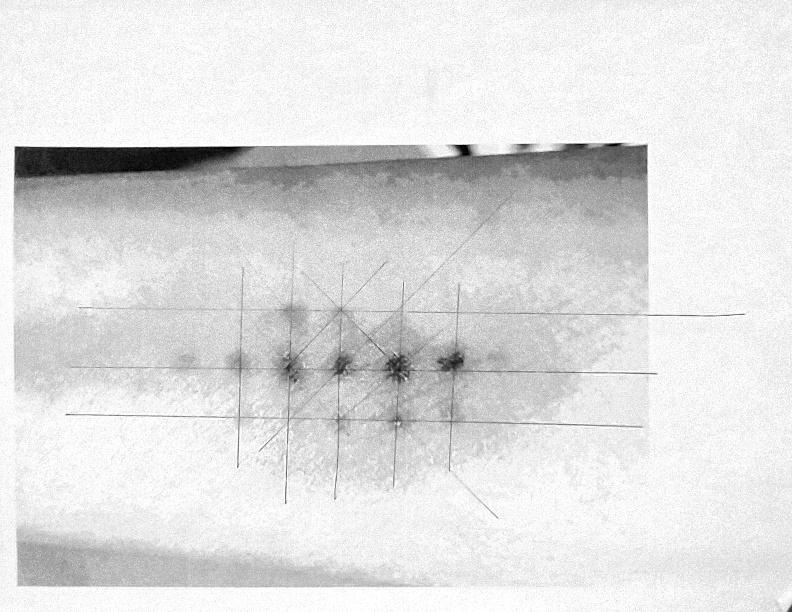
Note: Printed image of Marina’s RGMP. Dots appeared like typical RGMP dots, although slightly more purple and bruise-like in their appearance.
Figure 3
Analysis of Marina’s RGMP
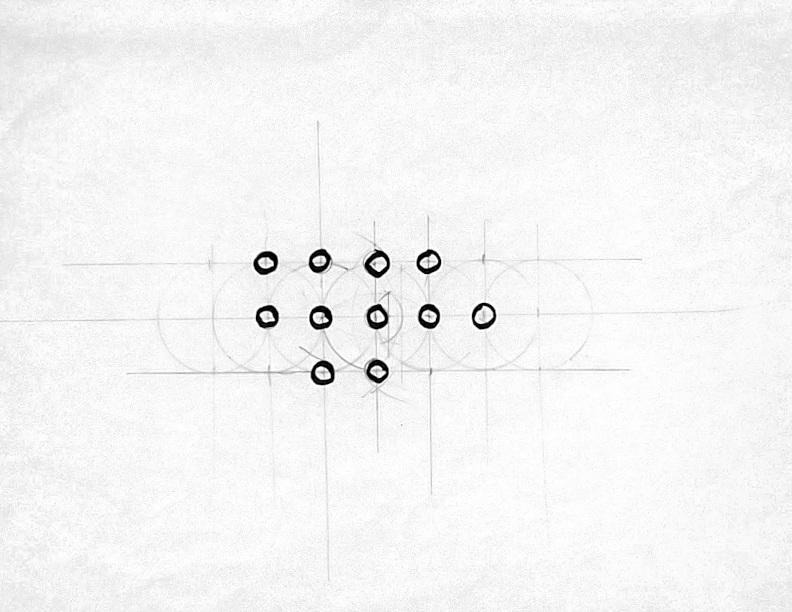
Note: The mark is composed of a square grid of dots, the radius of which appears to be 1/4th the radius of the circle that defines the square grid.
Figure 4
Arrow RGMP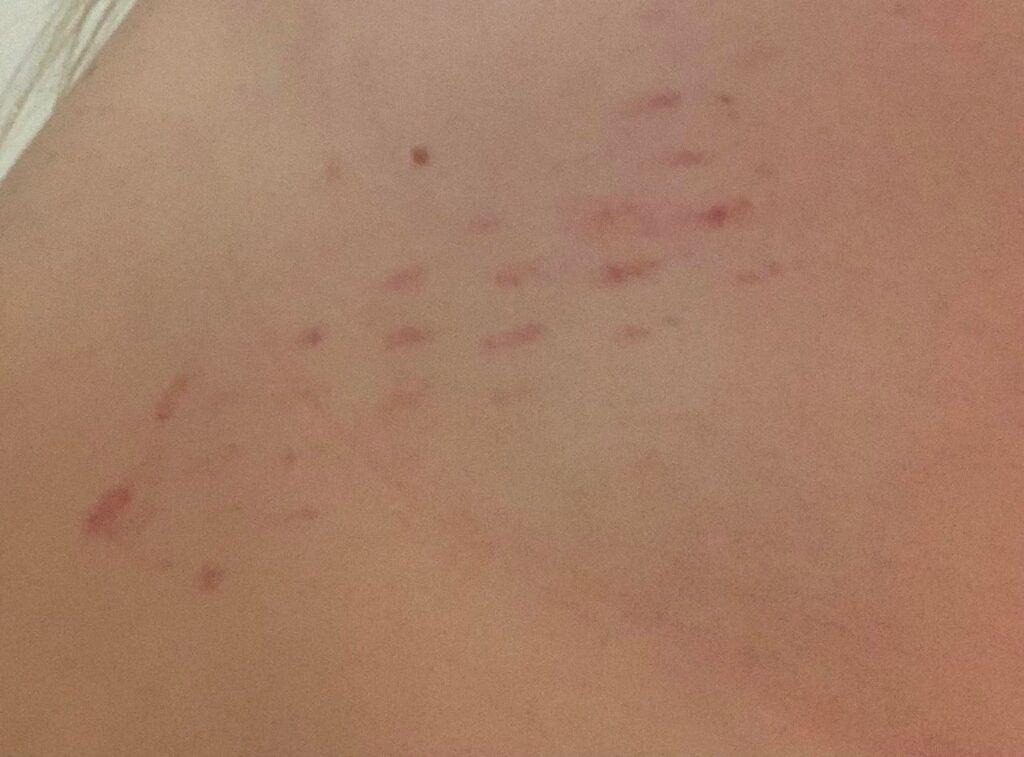
Note: Typical RGMP features include red burn like appearance of dots, hexagonal grid, and proportion between size of dots and grid. Atypical features include dots along multiple coordinate systems, as in the bottom left.
Figure 5
First analysis of Arrow RGMP
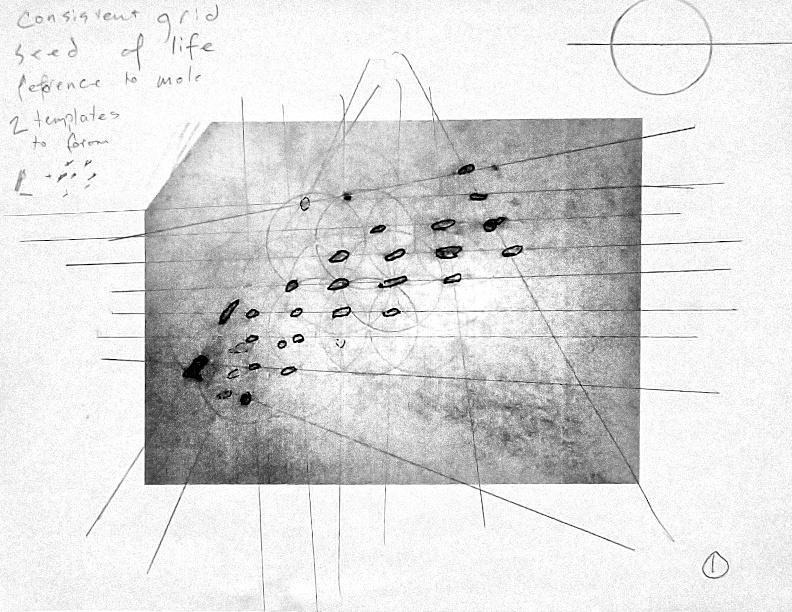
Note: This analysis explores the relevance of the flower of life pattern, which is used to construct a hexagonal grid.
Figure 6
Second analysis of Arrow RGMP
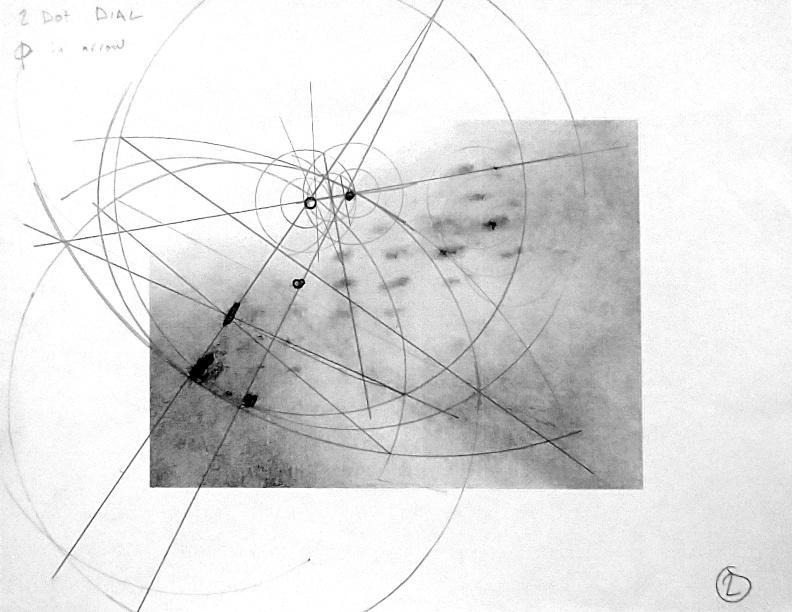
Note: This analysis explored the similarity of the two dots in the top with the 2-dot DIAL body mark shown in Figures 18-19. The additional circles explore the proportions of the 2-dot formation to the arrow head, which exhibits the golden ratio.
Figure 7
Third analysis of Arrow RGMP
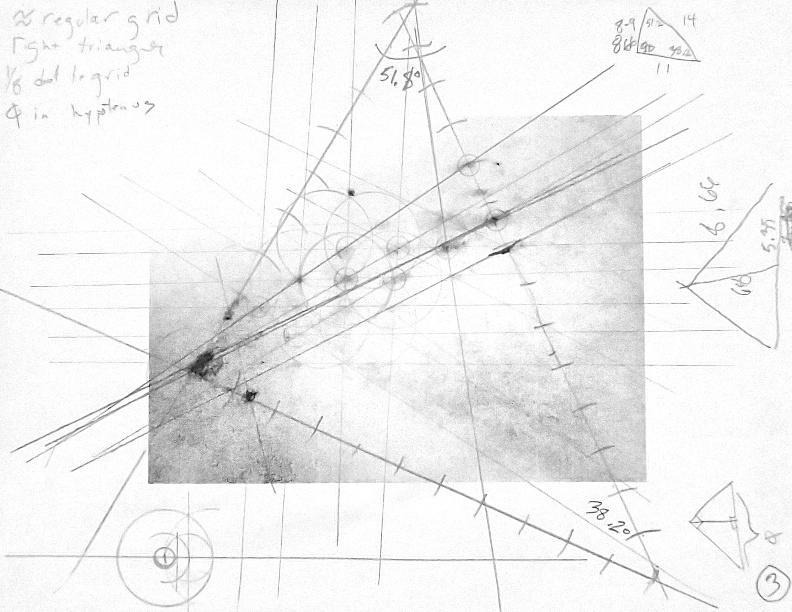
Note: This analysis explored the triangle made by the arrowhead and arrow. It appears to be a special triangle that involves the golden ratio.
Figure 8
My first DIAL body mark

Note: Photographed the day of discovery on my right calf.
Figure 9
My second DIAL body mark
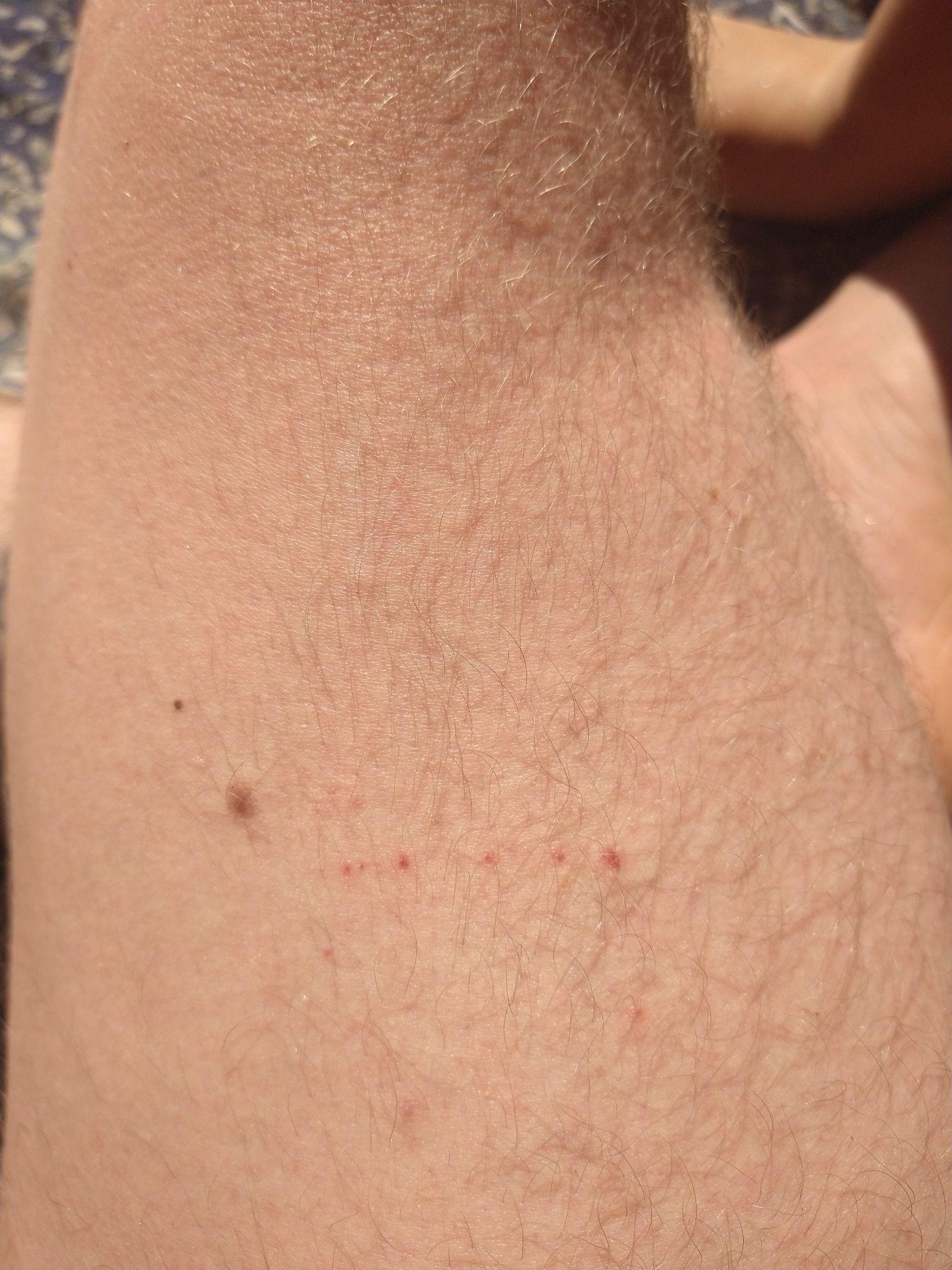
Note: Photographed the day of discovery on the top of my right thigh.
Figure 10
My second DIAL body mark analysis
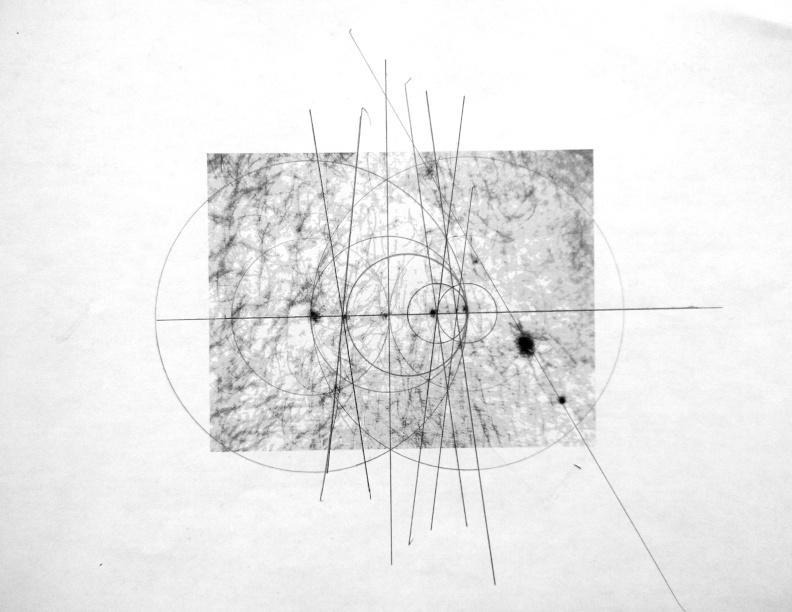
Note: The 6-dot DIAL mark exhibits typical interval proportions based on bisection and the golden section of the line drawn through most dots. The four dots, composed of two moles and two dots, on the right form another line, which appear to exhibit the golden ratio as well.
Figure 11
First DIAL body mark healing
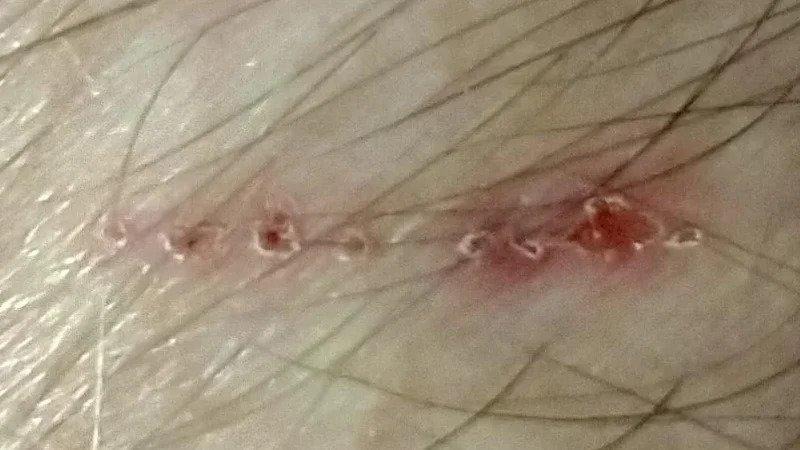
Note: A similar healing pattern, which reveals the mark to involve something like a puncture through the top layer of skin, was observed and photographed in my second mark. This image, when compared with the image on the day of discovery, allowed me to discern the geometry of my mark.
Figure 12
First geometry analysis of first DIAL body mark
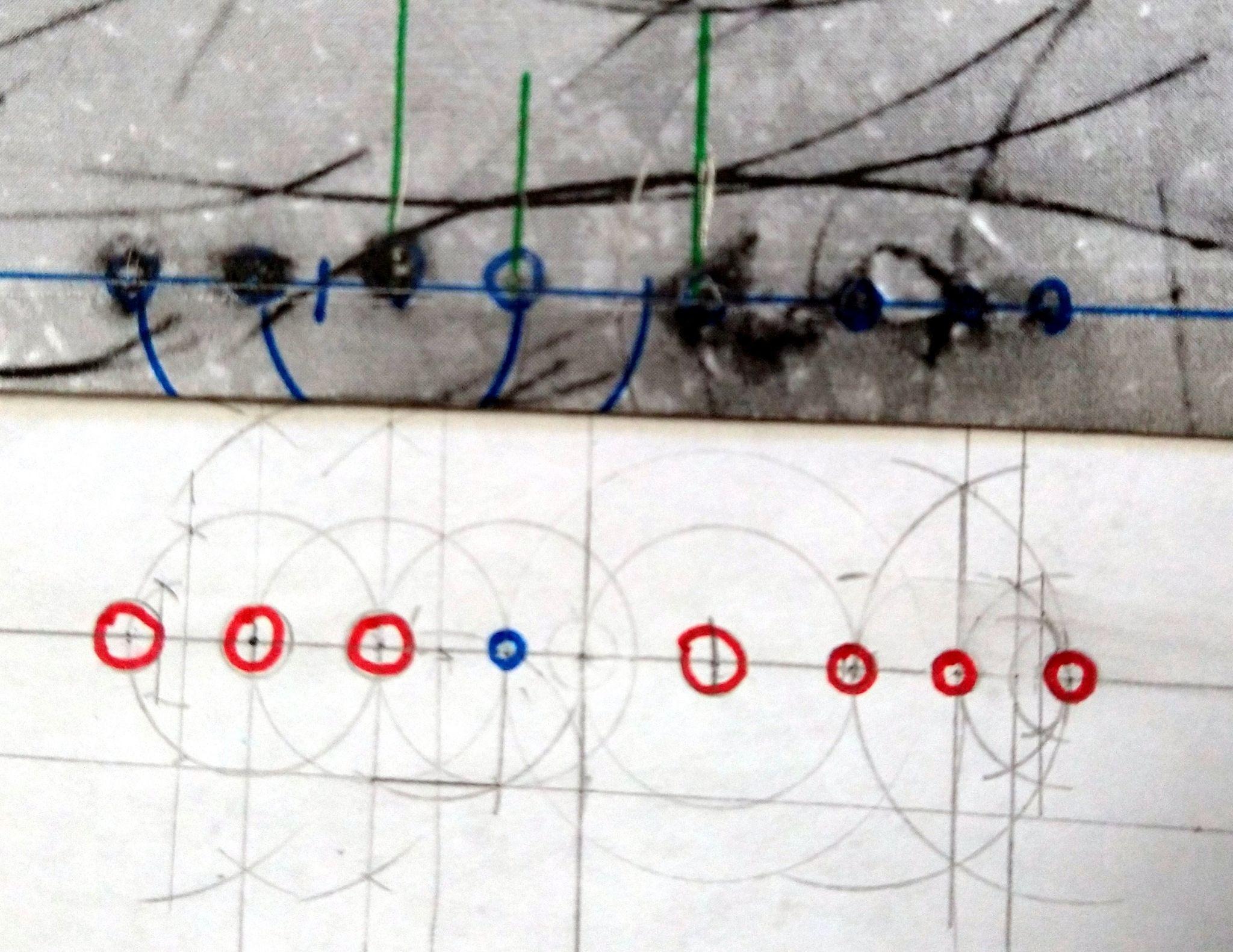
Note: This image compares an initial geometric construction with the image of the marks, suggesting that the mark is geometric communication rather than evidence of alien abduction.
Figure 13
Geometric construction of first DIAL using vesica pisces
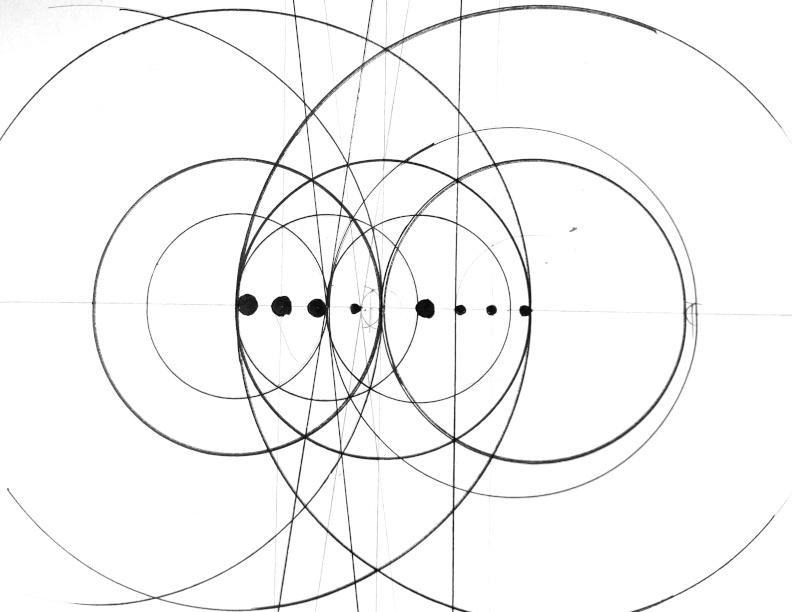
Note: This image presents a geometric construction of my first DIAL mark. I sought to produce an elegant drawing as well as accurate.
Figure 14
Paul’s DIAL body mark
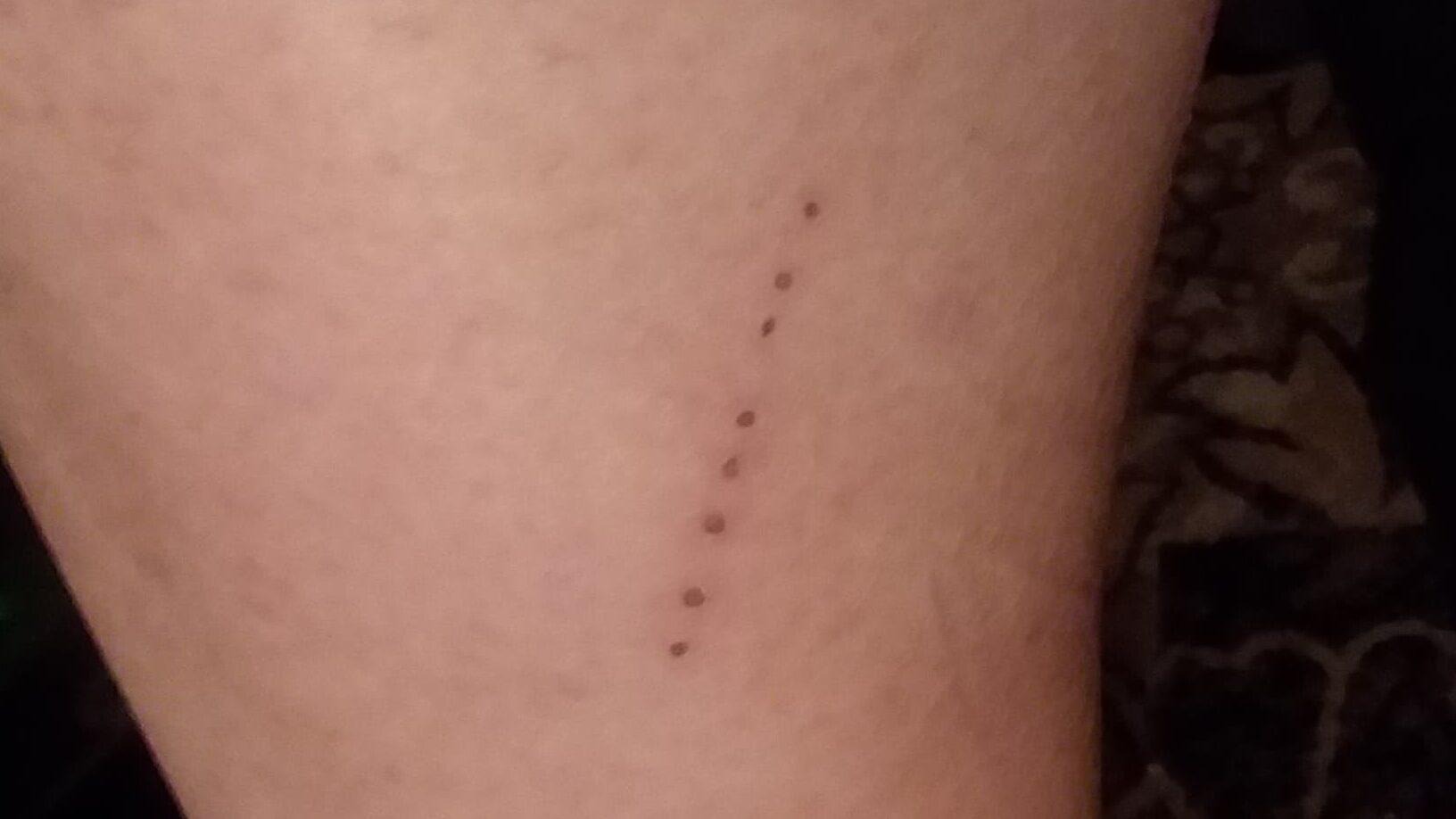
Note: Photograph of Paul’s leg. Like most body mark photos in this book, this image has been contrast-enhanced so that it may be printed in black and white and then drawn upon in pencil.
Figure 15
Analysis of Paul’s DIAL body mark
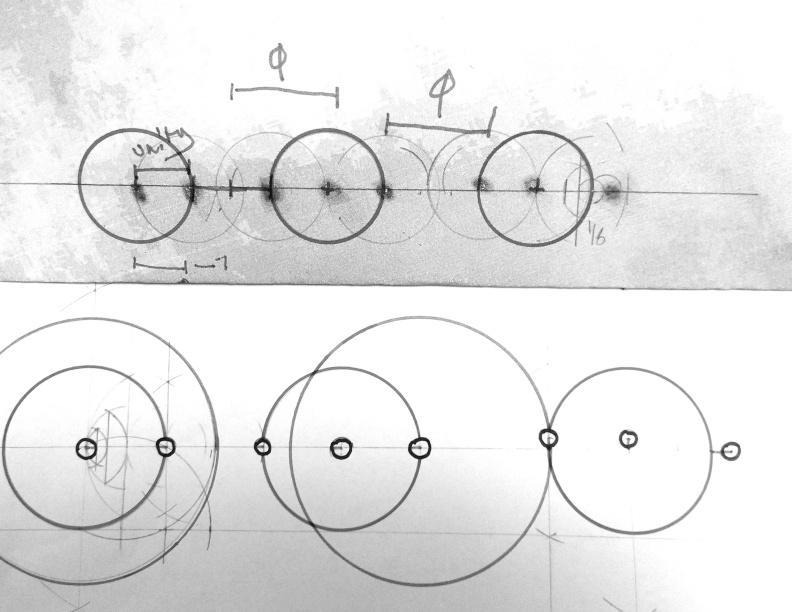
Note: Top image is a drawing upon the printed photograph. Bottom image is the geometric construction.
Figure 16
Congruence of Paul’s DIAL body mark with geometric construction
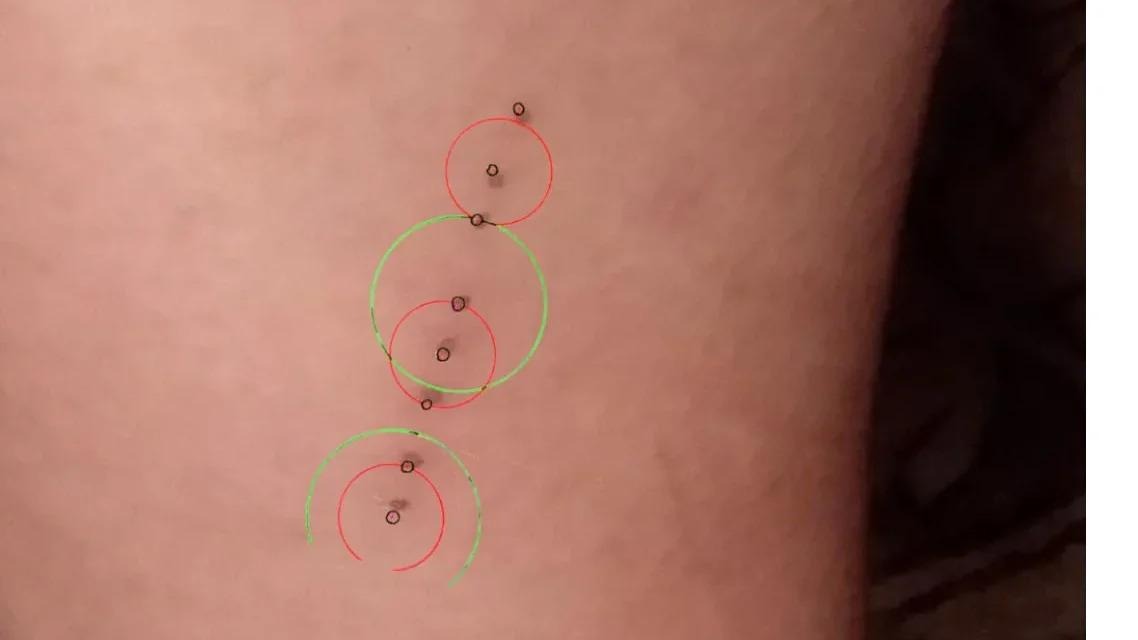
Note: This image combines Figures 13 and 14 to demonstrate the congruence of the construction with the mark, demonstrating that the mark is geometric communication.
Figure 17
Analysis of Paul’s DIAL body mark using the vesica pisces
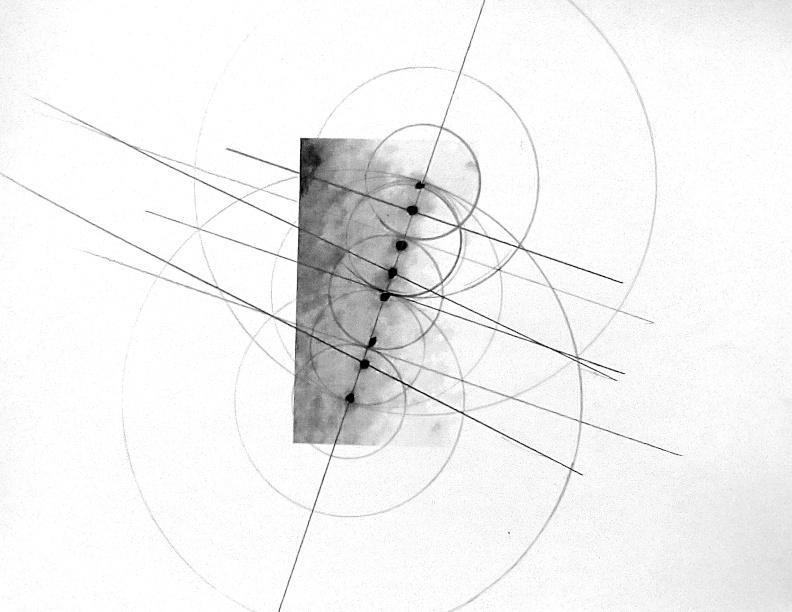
Note: The construction uses the vesica pisces to bisect and find the golden section of the line. Each dot is placed on or next to significant intersection points. Notice the bottom dot in included in the vesica pisces, which stands in contrast to the strange it’s strange placement in the more naive construction presented in Figure 14.
Figure 18
Analysis of Stan Romanek’s DIAL body mark
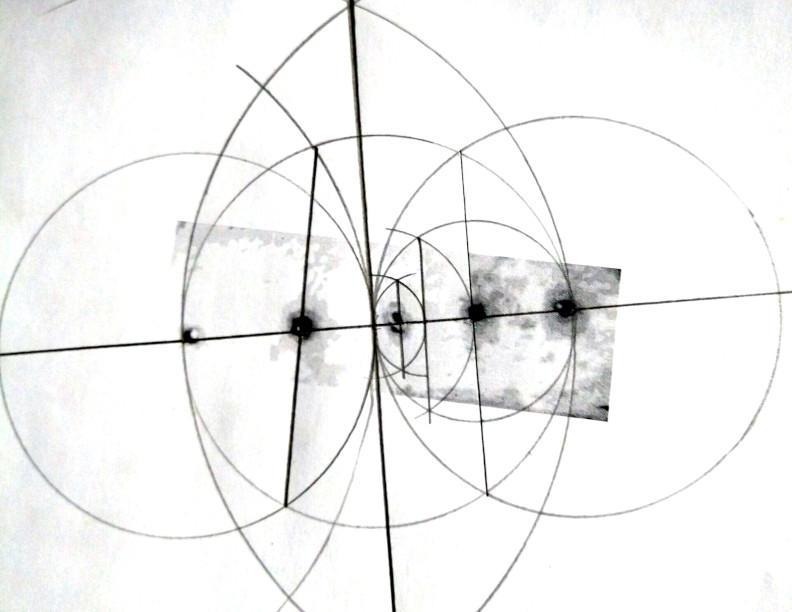
Note: This construction involves both bisection and the golden section of the line. The mark appears to be stereotypical of DIAL and the UAP geometric pattern as expressed in Figure 28. The printed photograph was cropped from a video frame of the Extraordinary documentary about Stan.
Figure 19
2-Dot DIAL body mark
Note: Printed photograph of the 2-dot DIAL body mark used for geometric analysis.
Figure 20
2-dot DIAL body mark analysis
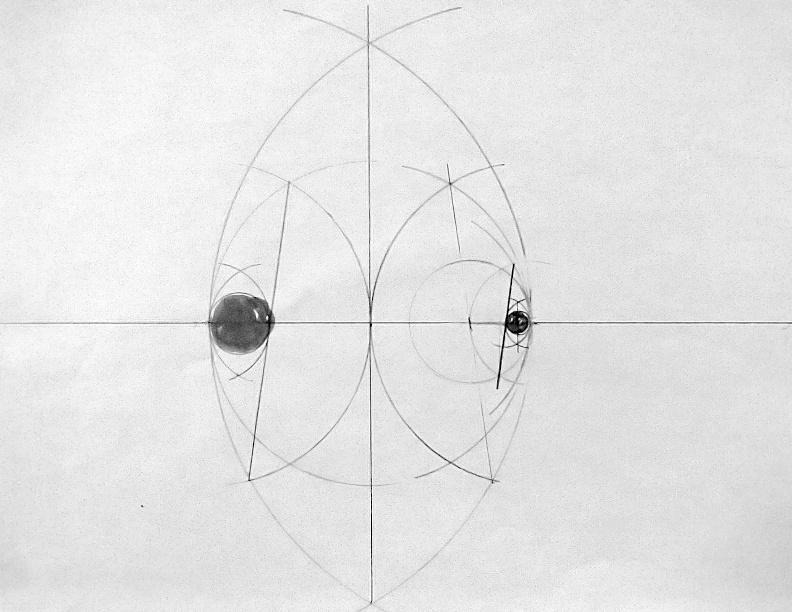
Note: Geometric construction involves bisection of the line, then golden section on both radii, then another on the right.
Figure 21
6-dot DIAL body mark
Note: Printed photograph of the 6-dot DIAL mark used for geometric analysis.
Figure 22
6-dot DIAL body mark analysis
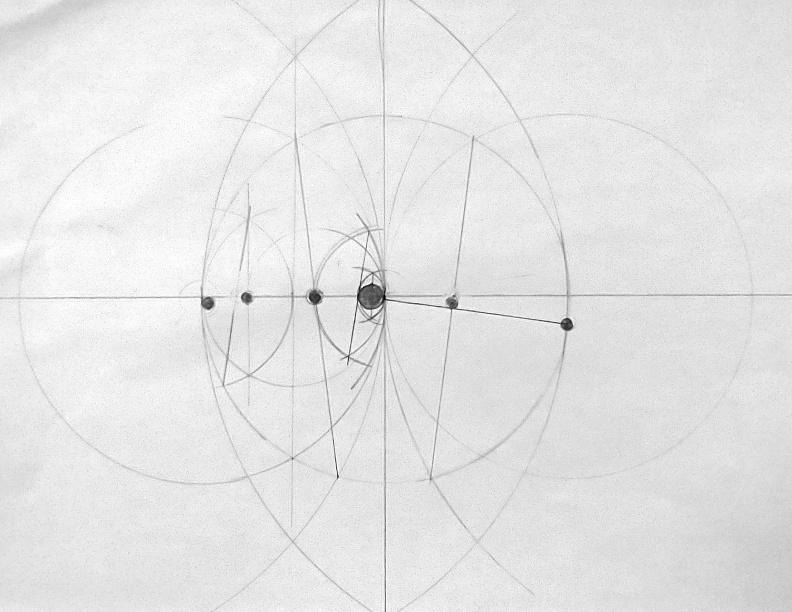
Note: Construction is based on bisection and the golden section of the line. The displacement of the dots from the central line may be described in reference the dots on the line.
Figure 23
Screenshot of ETolemy data visualization of the Monroe UAP
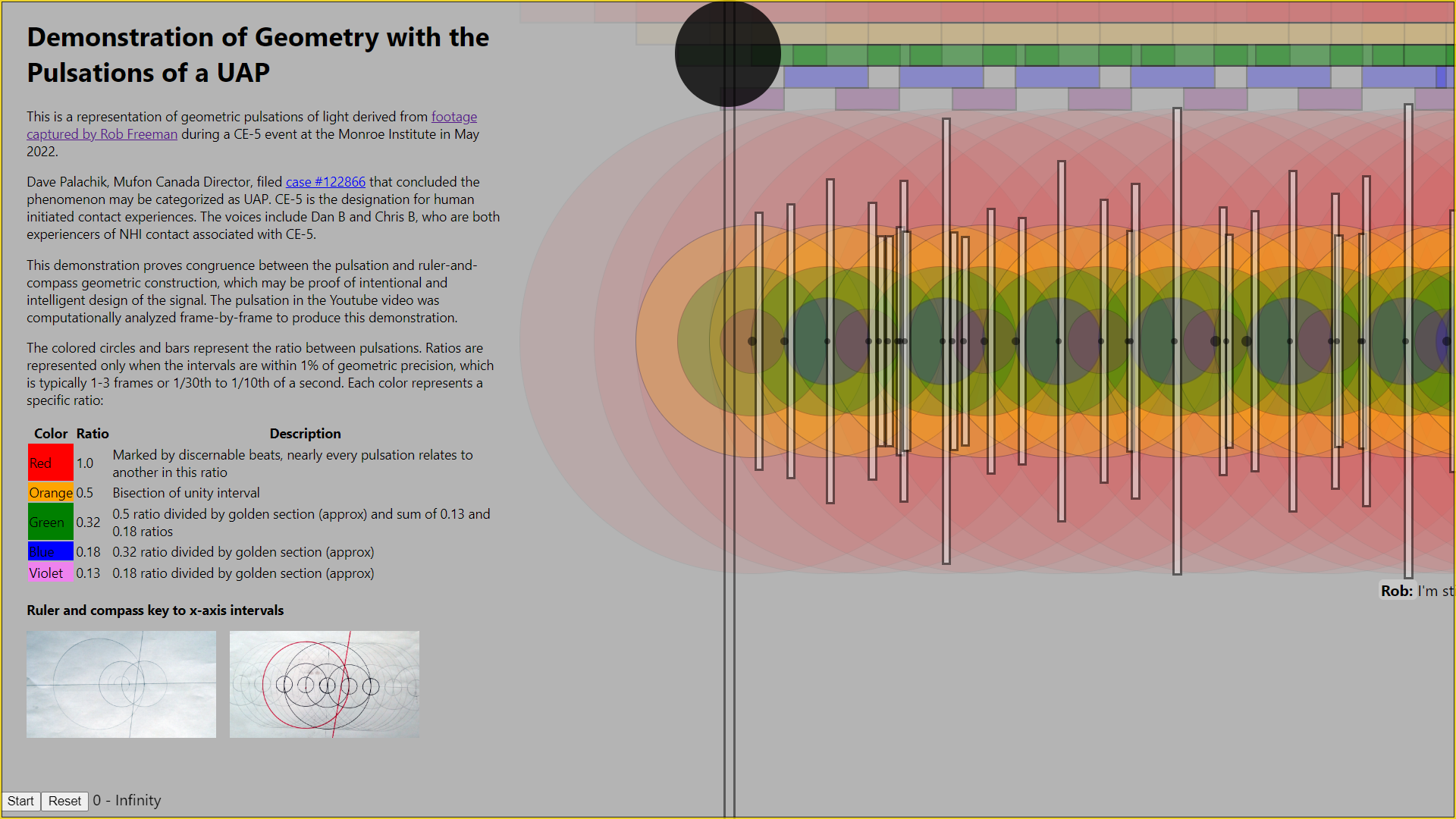
Note: This screenshot and data visualization code are available at the open source code repository ETolemy. The geometric drawing on the right represent various meaningful proportions between the pulsations of the UAP, therefore demonstrating the geometric properties of the UAP.
Published at: https://github.com/danielrekshan/etolemy
Figure 24
Graph of the Monroe UAP pulsation pattern
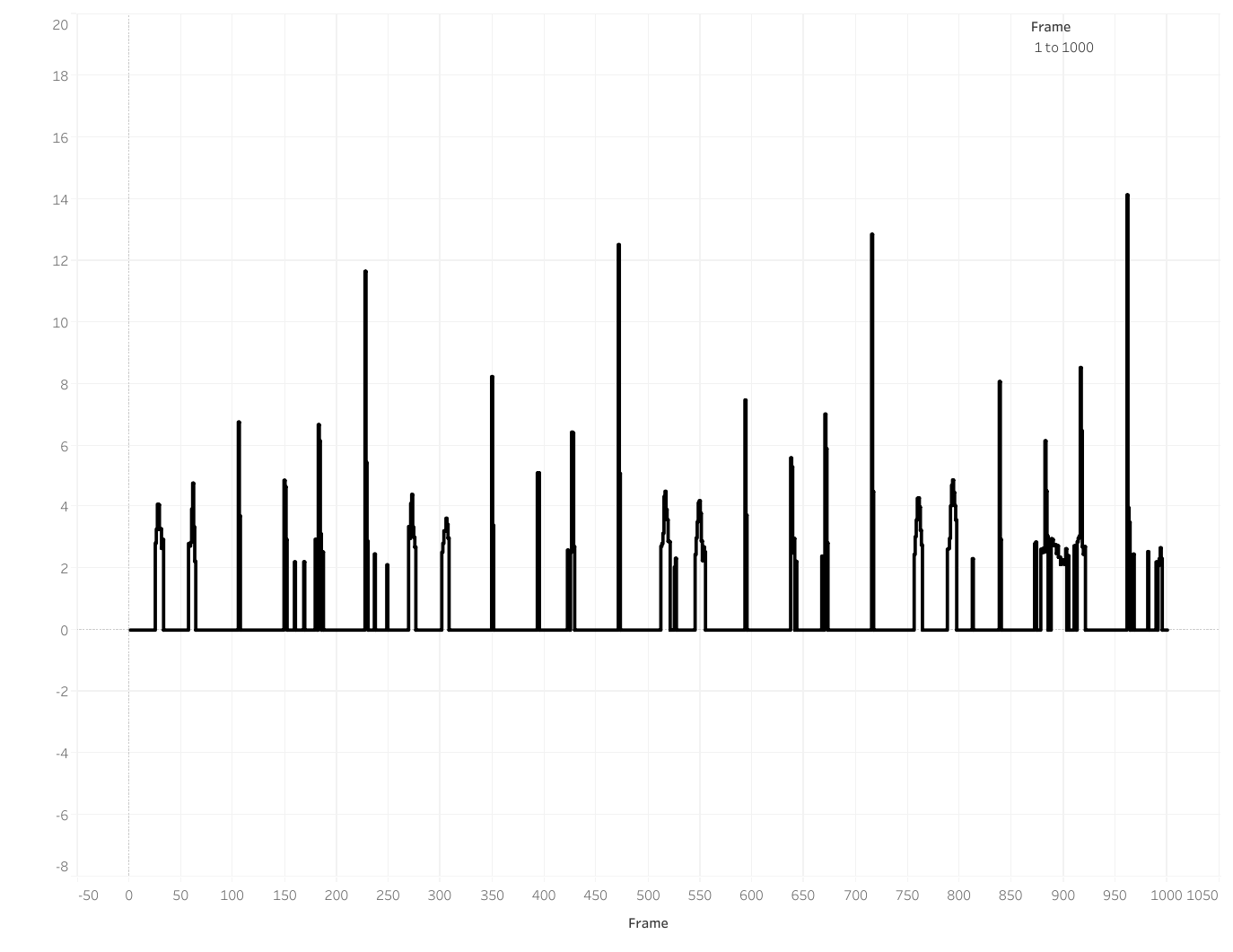
Note: X-axis is the frame number, at 30 frames per second. Y-axis is the relative brightness of UAP pulsation. Please note that this pattern is characteristic of geosynchronous satellites and is likely Intelsat 29E.
Figure 25
Analysis of the Monroe UAP pulsation pattern
Note: Construction demonstrates that intervals of pulsation are described by bisection and golden section the magnitude defined by one repetition of the bright-dim-dim-bright-dim-dim-bright pattern.
Figure 26
Graph of the Atacama UAP pulsation pattern
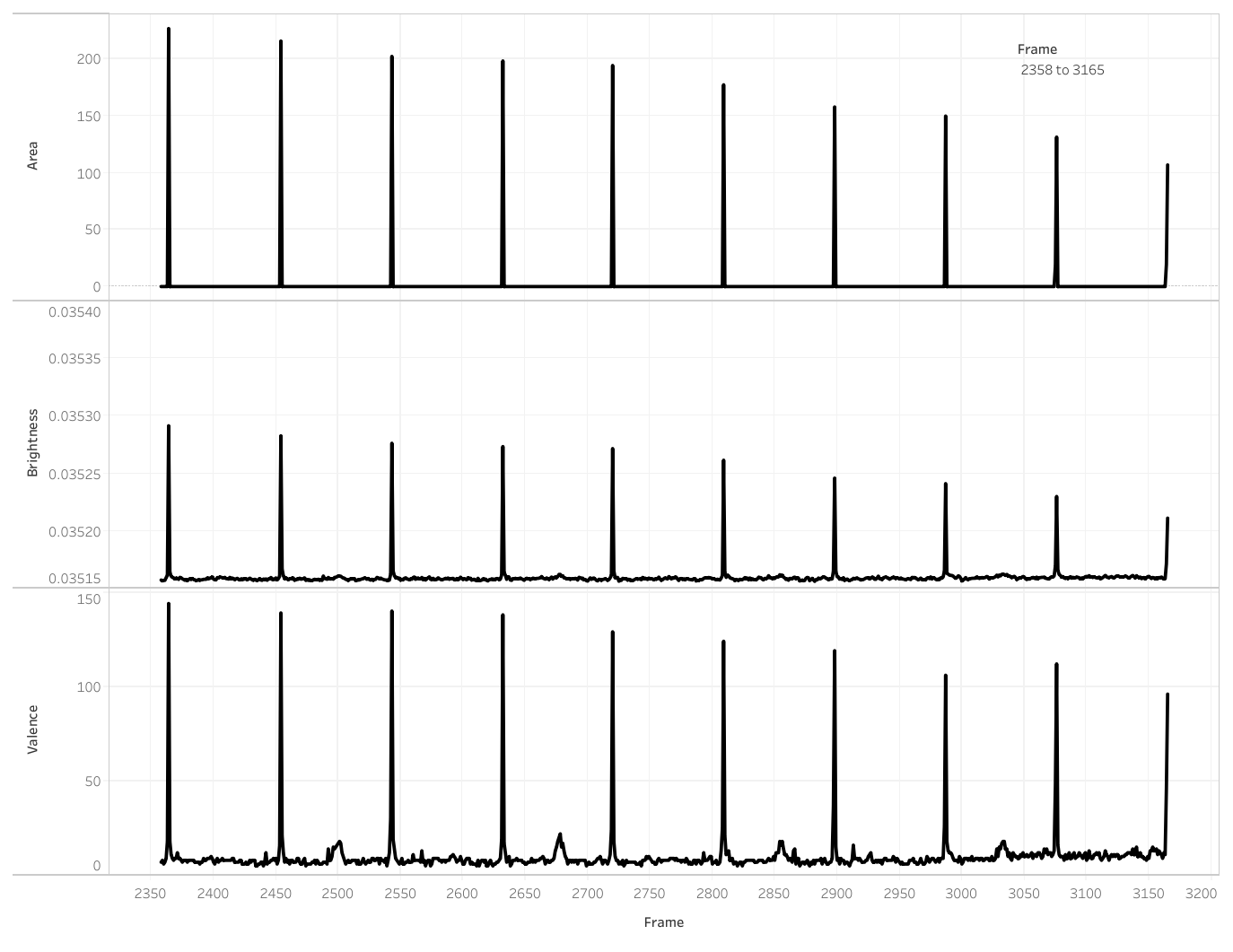
Note: Top line graph represents the area of UAP in terms of relative number of pixels. The middle graph represents the brightness of the UAP. The bottom graph represents the distance in brightness between the brightest and dimmest pixels in the frame. The pattern may be described as bright-dim-bright-gap-bright and so on.
Figure 27
Analysis of the Atacama UAP pulsation pattern
Note: The construction demonstrates that the pulsation pattern may be determined by the bisection and golden section of one iteration of the bright-dim-bright-gap-bright pattern.
Figure 28
Geometry framework for bit-like encoding of messages
Note: This geometric drawing represents an abstract framework or template that may be applied to UAPs or DIAL body marks. A line drawn through the body mark dots or the UAPs would be analogous to the diameter of the central circle. The bisection of its left radius and the golden section of its right radius represent the strange symmetry of rationality and irrationality presented in the anomalous geometry.
Figure 29
Analysis of Dr. Lynne Kitei’s 1995 missing time photos
Note: Geometric drawing upon printed photograph from https://thephoenixlights.net/. Top row: analysis of the two missing time photos from 1995 demonstrating proportions between foreground and horizon orbs. Bottom row: petroglyph from Kitei’s book expresses congruent geometric themes.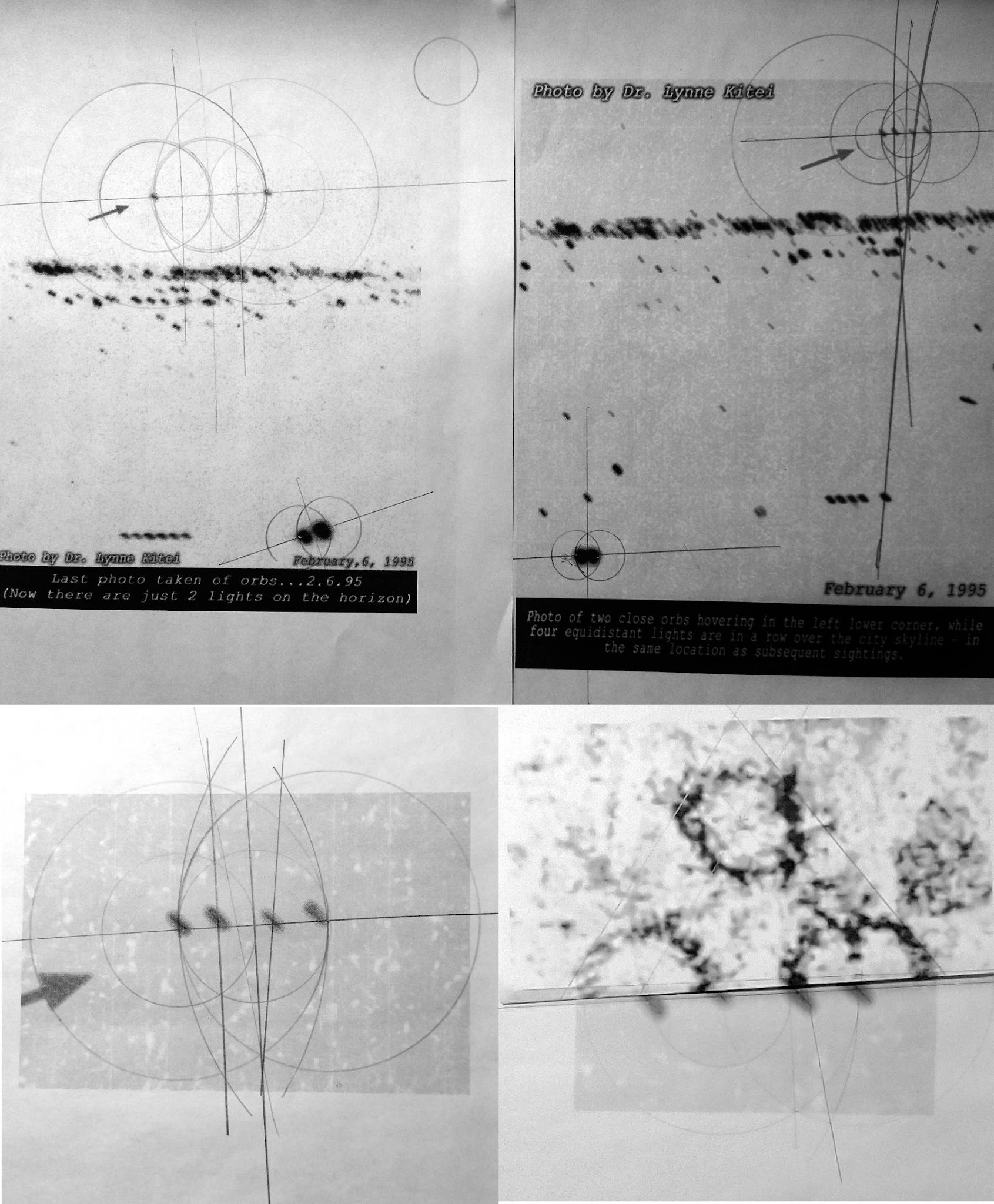
Figure 30
Analysis of Dr. Lynne Kitei’s orb photos
Note: Geometric drawing upon printed photograph from https://thephoenixlights.net/. 1st row: Geometric framework and 3/13 and 10/11 orbs. 2nd row: 3/13 still and 10/11 photos. Last row: 3/13 and 10/11 photos.
Figure 31
Analysis of Tom King’s March 13th, 1997 footage
Note: Frame from Tom King’s footage of the March 13th events. Main formation of 4 UAPs may be described using bisection and golden section of the line drawn through them, while the other lights may be placed using simple techniques like drawing perpendicular lines.
Figure 32
Analysis of recreation of Bledsoe’s 2007 orb sighting
Note: Initial image printed from screen shot of https://youtu.be/D1z7l4gNkCY, which is an embedded frame from original TV show featuring Bledsoe’s story. Placement and size of UAPs may be described using bisection and the golden section of the line drawn through them.
Figure 33
Analysis of Bossier City UAP
Note: Analysis of UAP formation similar to Phoenix Lights, demonstrating similarity of construction methods based on bisection and the golden section of a line drawn through UAPs. Tom King discovered its similarity.
https://ufovideo.com/site/news.php?extend.69
Figure 34
Analysis of Chelyabinsk Oblast UAP
Note: Analysis of UAP formation similar to Phoenix Lights, demonstrating similarity of construction methods based on bisection and the golden section of a line drawn through UAPs. Tom King discovered its similarity
https://ufovideo.com/site/news.php?extend.69.
Figure 35
Analysis of Kolomna UAP
Note: Analysis of UAP formation similar to Phoenix Lights, demonstrating similarity of construction methods based on bisection and the golden section of a line drawn through UAPs. Tom King discovered its similarity. This UAP formation involves movement of the orbs around the intersection places of the geometric framework expressed in Figure 27.
https://ufovideo.com/site/news.php?extend.69.
Figure 36
Graph of the Cosmic Highway UAP pulsation pattern
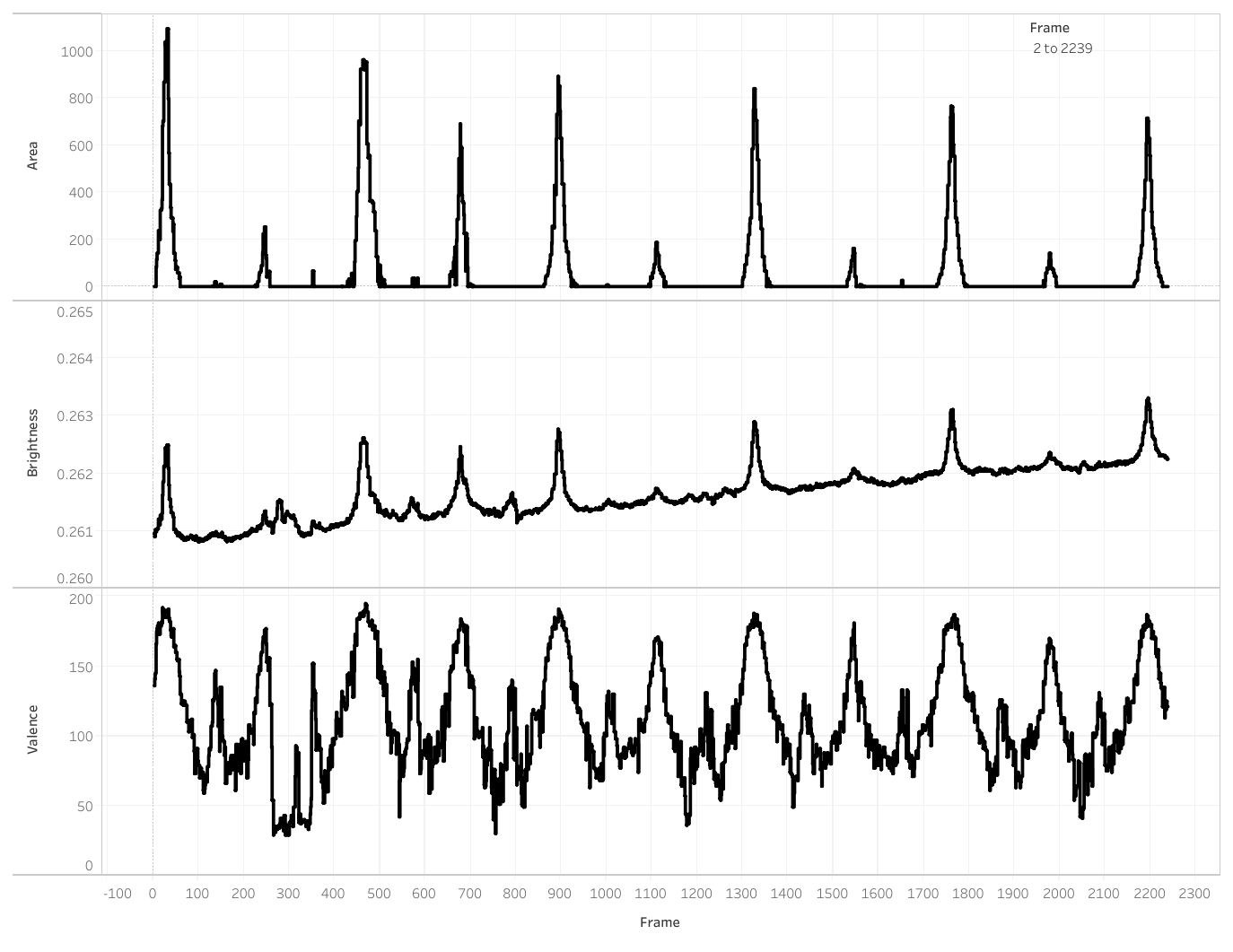
Note: Top line graph represents the area of UAP in terms of relative number of pixels. The middle graph represents the brightness of the UAP. The bottom graph represents the distance in brightness between the brightest and dimmest pixels in the frame. The pattern may be described as bright-dim-bright-dim-bright and so on.
Figure 37
Analysis of the Cosmic Highway UAP pulsation pattern
Note: This construction demonstrates that the interval between pulses may be described by the golden section of a segment of the line defined by one iteration of the pattern. The placement of the pulses is obviously based on the bisection of one interaction of the pattern. This construction shows that the duration of pulses may be geometrically meaningful.
Figure 38
Golden Triangle UAP construction
Note: Jimmy Blanchette demonstrated that the triangle was geometrically meaningful in his description of its mathematical properties. This construction relates the UAP to the vesica pisces and was used in the SETI message presented in Figure 39.
Figure 39
Geometric SETI message sent by Blanchette and Rekshan
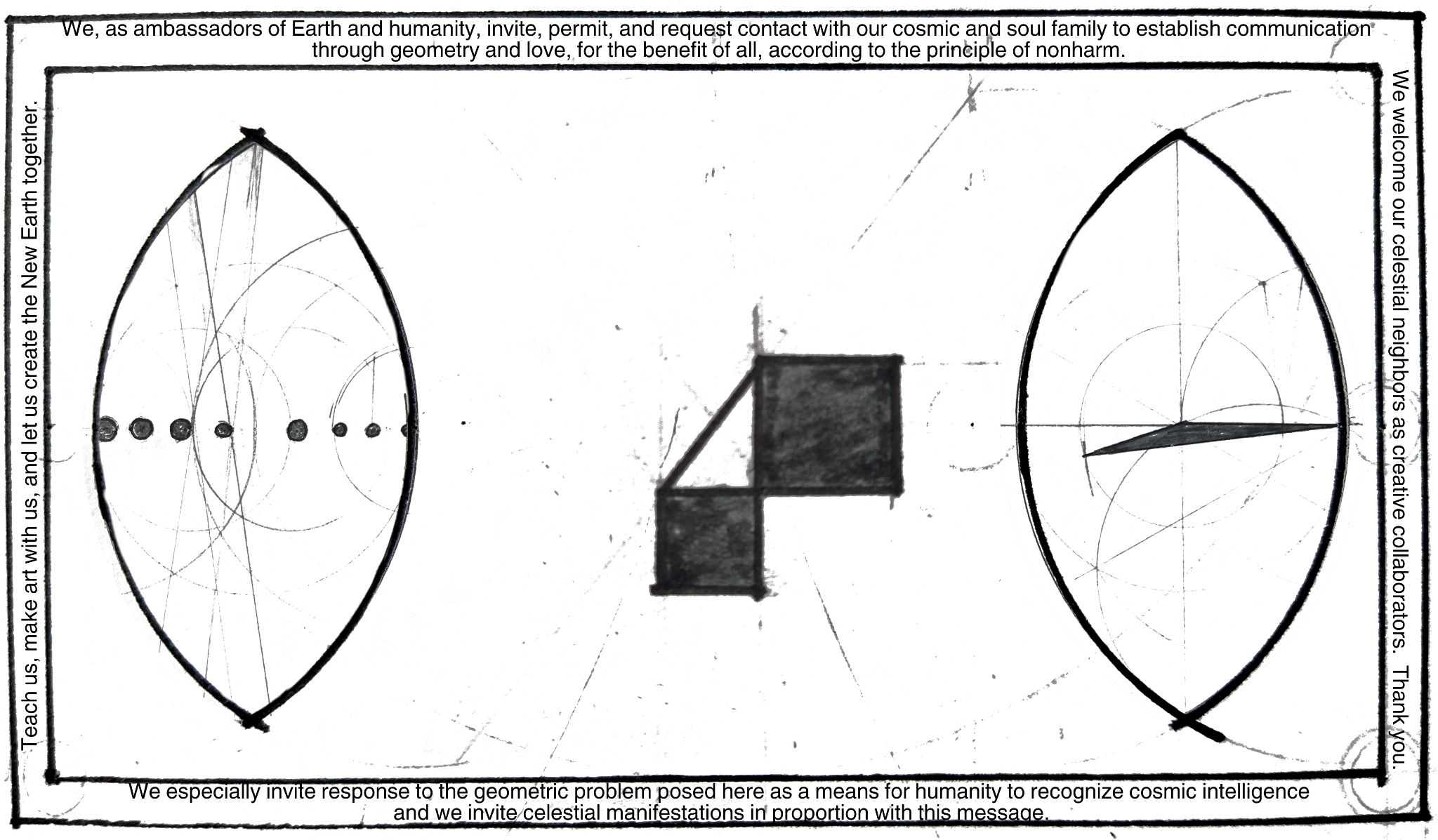
Note: This image is based on Figures 40, 38, and 13.
Figure 40
Geometric construction of SETI message
Note: This image presents my sketch for the composition of Figure 39.
Table 1
Estimate number of alien abduction cases informing literature
| Author | Text | Cases | Year |
|---|---|---|---|
| Benjamin Simon | Interrupted Journey | 2 | 1966 |
| Lorenzon and Lorenzon | Abducted! Confrontations with beings from outer space | 7 | 1977 |
| Budd Hopkins | Missing Time | 19 | 1981 |
| Steiger | UFO abductors | 30 | 1988 |
| Fiore | Encounters: a psychologist reveals case studies of abductions by extraterrestrials | 16 | 1989 |
| David Jacobs | Secret LIfe | 60 | 1992 |
| John Mack | Abduction | 14 | 1994 |
| David Jacobs | The Threat | 30 | 1997 |
| Dolores Cannon | Custodians | 12 | 1998 |
| John Mack | Passport to the cosmos | 32 | 1999 |
| Barbara Lamb | Alien Experiences | 25 | 2008 |
| French | Psychological aspects of the alien contact experience | 19 | 2008 |
| Total | 266 | ||
Acknowledgments
This book would not be possible without the direct participation of several types of contributors.
First and foremost, I must acknowledge my clients as co-researchers because hypnosis and dreamwork is nondual. While this book presents only a handful of case studies, it is informed by dozens of sessions and many deep conversations. Thank you for trusting me with your dreams and experiences.
Second, I acknowledge my dream characters and our imaginal relationships as the primary experience upon which I have drawn. I must testify that I was first given the intuition of this book through dreams involving ET/NHIs. Thank you for showing the way.
Finally, I must acknowledge my family for their belief in my and their support. Thank you for all you do and for the ten thousand things. I would be unable to do my work without their support, love and inspiration.
If the shamanic dreaming hypothesis, especially regarding the implication that the qualities of self and other or past and future are illusory, then I must say thank you for your contribution to this work. Thank you for working with your dreams and dreamlike experiences.
Edition Notes
This is an early edition of Missing Time Found. Like many dreams, the vision of the work far exceeded my capacity to accomplish it. For instance, I intended to include at least a dozen or so case studies in order to match the quantity of Hopkins, Mack, or Cannon. Even though I recorded enough sessions and interviews, I choose to limit the number of case studies to the bare minimum to demonstrate the shamanic dreaming hypothesis so that I could publish this edition at this time. Similarly, I set aside more content in order to publish this book sooner, such as interviews with experts in the field and recorded conversations with other content creators. I would also like to publish a version of my curriculum for dreamwork-based HICE, which I developed in collaboration with a small group of dedicated dreamers. Perhaps a future edition of Missing Time Found will include these topics or else they will become projects of their own. Regardless, I feel it is important to honor those who contributed their voice and thoughts to my inquiry even though I have not named them in this book.
I choose to publish this book as soon as possible for several reasons. First, much of the work is inspired directly from my dreams, which determined the timing of my work. Second, the US and related countries are actively considering the topics of UAPs and NHIs. While this book was inspired and researched in 2020-2023, I wrote the manuscript in a 6-week period immediately after the US Congressional hearing with David Grusch, who is known as the UFO whistle-blower. Mainstream society is now considering UFO narratives to be potentially true and historic, which means that the strange stories of abduction and ET contact may be seriously considered as an appropriate subject of conversation and inquiry.
Should the government disclose that UAPs are real, then next question will be, what about human encounters with aliens or NHIs? If UFOs are real, then why not aliens and alien abduction? There may be a huge shift of attitudes regarding ET/NHI contact. The premise of this book suggests that ET/NHI contact is dreamlike. If the shamanic dreaming hypothesis is accurate, then we may expect ET/NHI contact to behave in dreamlike ways. Therefore, I expect that a huge shift in attitudes towards ET?NHI contact will shift the experience of ET/NHI contact, just as attitudes towards dreams impacts their content and recall. I also expect that the content and emotional quality of ET/NHI contact to respond to conscious intention and subconscious conditions just as dreams do.
It is possible that the attitudes and biases of a few hypnotists working with missing time may have defined ET/NHI contact for a generation. People often worry that hypnosis is creating false memories because hypnotic testimony of alien abduction seems like imagination and directly responds to suggestion. However, if ET/NHI phenomena rely upon the mechanism of dream apports to enter this reality, then the hypnotist may be creating real memories because the hypnotic session retro-caused real events that were forgotten until the hypnosis session. It may also be the case that there are infinite possibilities for what happened during the missing time event, but that the attitudes, intention, and biases of the hypnotist and hypnotee select one possible reality from a quantum multiverse.
It is clear to me that society is at a turning point and that the attitudes and intentions of a few individuals (including you and me) may determine how our society enters interstellar culture. We may choose to alienate and fear others or else we may choose to see that we are more than just our human bodies on Earth and that, in some mystical way, we are all beings. ET/NHI contact may be nightmarish like abductees report, but we may not be powerless victims after all. I want each of us to dream a society of love and mutual respect between humans and all sentient creatures. I want a society built on the best of what dreams offer. I believe that the message of Missing Time Found will help society navigate the rite of passage into interstellar consciousness. I believe that this season of 2023 represents a turning point in our collective consciousness regarding UAPs and NHIs.
Another reason I have chosen to publish now rather than wait until all my research is completed is because I believe the anomalous geometry I present in this book represents a potential SETI message. The fact that UAPs blink and move in geometric ways suggests that they are communicating with us. It will require significant research to validate the claim that geometry in body marks and UAPs may be an ET/NHI message akin to the radio message in Sagan’s Contact. I hope the early publication of this manuscript will bring support and collaboration for research into anomalous geometry and SETI.
All these various reasons came together to produce a feeling of urgency in the writing and publication of this book. I have tried my best to be rigorous with my references and writing, although I must admit that some errors will be in this manuscript, such as in the formatting of the reference list. I intend to continue to edit the book, update the figures, elaborate several case studies, and add several chapters. If you found an error or have feedback, please get in touch with me at daniel@dseti.org. Please check the D-SETI website (https://dseti.org) for information about editions of this book.
Thank you again for going on this journey with me. May you dream well.